[music] there.
In November 2026, archaeologists in Sudan announced a discovery that had waited underground for centuries.
[music] The announcement came from the Polish Center of Mediterranean Archaeology at the University of Warsaw, working with Sudan’s National Corporation for Antiquities and Museums.
The team is directed by Professor Arur Obli.
Their site is old Dongola on the east bank of the Nile in northern Sudan and the fortified citadel at the heart of the old city.
And at its heart, they say, stands the grandest church of Christian Nubia, a building remembered in old chronicles and lost to the sand for 700 years.
Old Dongola was once a capital.
In the old Nubian language, it was called Tungul.
[music] For roughly eight centuries, from the 6th century to the 14th, it was the capital of Mccuria, a Christian kingdom of the Nile Valley.
Mccoria was one of three Christian kingdoms that grew up in Nubia, the land between Egypt and the deeper south, alongside Nobia to the north and Elodia to the south.
Its kings ruled from Dongola.
Its bishops prayed in his [music] churches, and its wealth came from the river, from trade and gold and ivory and grain flowing up and down the Nile.
The city itself was a place of churches and monasteries and excavators have found many of them across its ruins.
[music] When Mccoria fell in the 14th century, its capital faded with it and the sand moved in.
The building at the center of the announcement is called the great church of Jesus.
[music] Archaeologists first identified it in 2021 inside the old citadel of Dongola.
But only in the winter field season of 2025 to 2026 did they reach deep enough to see it clearly.
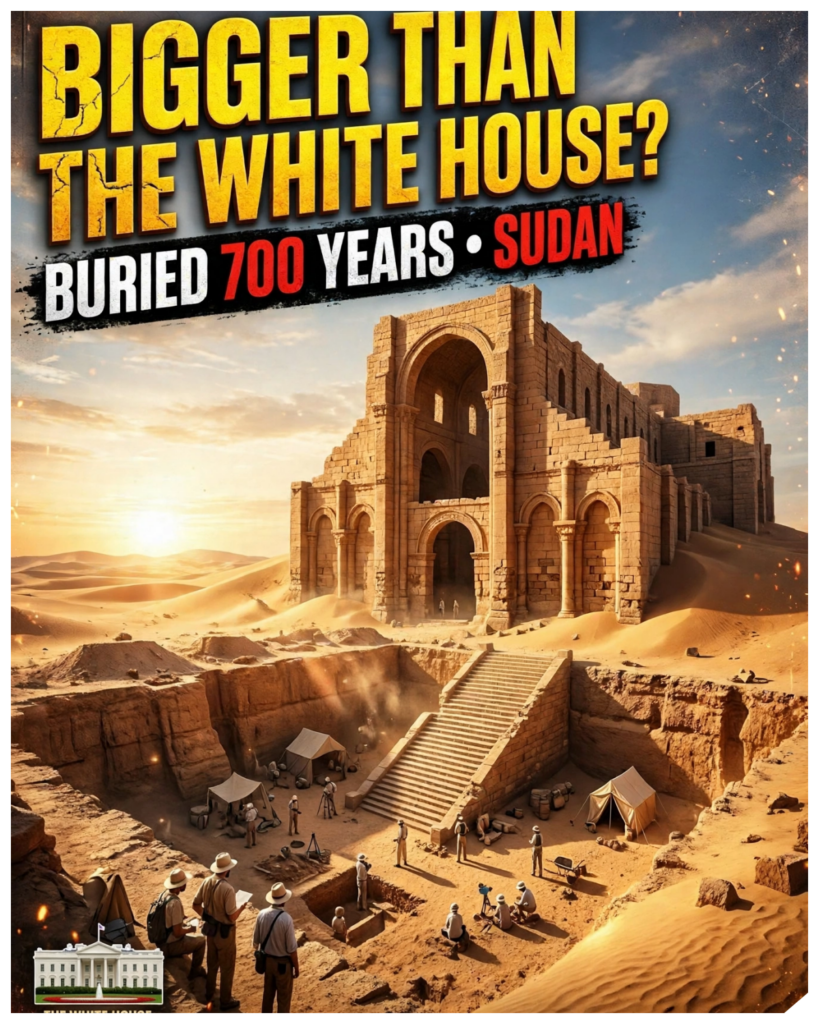
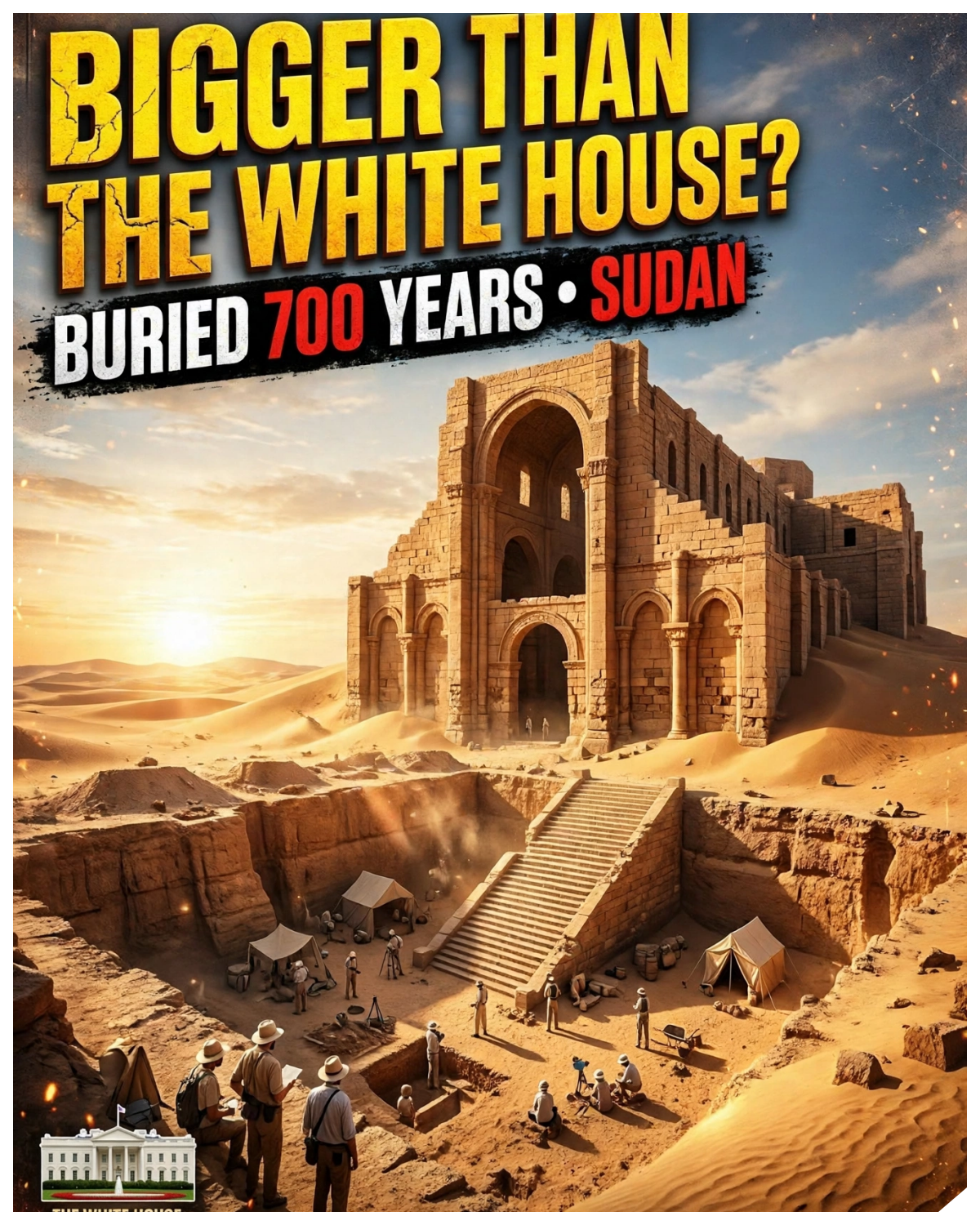
They cleared a monumental staircase [music] flanked by mud brick and masonry walls still standing about 11 m high.
[music] That is roughly 36 ft about three modern stories of wall still upright after centuries underground.
[music] A staircase like this was the ceremonial approach.
The way a congregation climbed toward the doors of the church.
[music] And at the base of that staircase, the excavators reached something no one had touched for hundreds of years.
The building’s original medieval floor.
The church is enormous.
According to the team’s surface mapping and test trenches, [music] its footprint measures about 47 m wide by 57 m long.
That is roughly 154 ft [music] by 187 ft.
Its original height is estimated at about 21 m about six modern stories.
Professor Oblooski compared its scale with the White House in Washington [music] DC and he said the great church of Jesus could be a trends setter for Nubia the way he sophia in Constantinople was for the Byzantine world.
Hegia Sophia built in the sixth century [music] became the model every Byzantine church was measured against.
Oblooski is saying this church could be Nubia’s equivalent.
The Arabic chroniclers of the Middle Ages remembered it as the wealthiest and grandest cathedral [music] in Christian Nubia.
The staircase was not the only find.
The team also exposed massive buttresses, the great stone supports that held up the eastern apps, [music] the rounded sanctuary at the head of the church.
And in an adjoining complex, they [music] found a second smaller church built on an upper story.
One church standing above another in the same [music] complex.
Inside that sanctuary, the walls still carry painted plaster and inscriptions.
Color and writing surviving where the roof once stood.
Nubia is famous for painted churches.
[music] The murals of Ferris, another Nubian cathedral, now hang in museums in cartoon in Warsaw.
[music] Saints and bishops in bright color on plaster.
If Dongola’s paintings survive in the same tradition, they could be extraordinary piece by piece.
The team says, a building that existed only in old chronicles is taking shape [music] again in stone.
But here is what the announcement does not mean.
The floor has been reached only at the base of the staircase.
Most of the nave, the great hall where the congregation stood, is still buried under more than 11 m of collapsed vaultting [music] and windb blown fill.
The 47x 57 m footprint and the 21 m height are estimates drawn from surface [music] mapping and test trenches, not from a fully cleared building.
The church is [music] coming back into view.
It is not yet uncovered, nor has the precise construction date [music] been established.
The team has not yet fixed the year the church was built, [music] and some Sudin specialists have questioned whether the name Great Church of Jesus and the [music] claim that this was a cathedral are proven by the evidence found so far.
That dispute is part of the story and it is still open.
Sudan’s antiquities authority also clarified on the 11th of November that the findings now being reported came [music] from the 2025 field season announced in November 2026.
This is an active excavation not an open visitor site and the [music] work continues under Sudin authorization.
To understand why this building matters you have to understand Mccuria itself.
In the sixth century, [music] Nubia turned Christian and three Christian kingdoms rose along the Nile.
Mccuria with its capital at Dongola became the strongest of them.
In the 7th century, Mccuria signed the Bach, [music] a treaty with Muslim Egypt that kept the peace along the Nile for centuries.
[music] Its kings kept that peace with Egypt to the north.
Its merchants traded up and down the river, [music] and its churches and monasteries filled the valley with painted walls and written [music] prayers in the old Nubian language, the kingdom’s own written tongue, in which documents and church books survive to this day.
Mccuria was not a footnote to Egypt or [music] to Byzantium.
It was a Christian civilization in its own right on African ground [music] lasting nearly 800 years.
The Poles have been digging at Old Dongola since 1964.
More than 60 years of work at [music] one site, a mission begun under Professor Kazmir’s Molowski.
Their excavations have uncovered houses, monasteries, and palaces.
And one of the most famous monuments of the city still stands above [music] ground.
The Throne Hall, a great audience hall of the Mccuran Kings, was converted into a mosque in 1317 as Mccur’s Christian centuries drew to a close, [music] and it still rises over the ruins today.
The kingdom faded in the 14th century.
Its capital emptied and the great church sank under the sand.
Its roof falling in, its walls buried, [music] its name surviving only in the chronicles.
The great church is not the only news from Denola this year.
In March 2026, the same Polish team published a short Arabic order issued in the name of King Cash Cash.
Until then, [music] Cash Cash was a king known only from legend, a name in old stories with no proof he had ever lived.
[music] Now the researchers say a single document shows he was real.
A forgotten king [music] brought back by a few lines of writing.
It is the same pattern as the church itself.
[music] Then keeps names that history had written off and hands them back.
What happens next is digging.
The team must clear the nave meter by meter under more than 11 m of rubble [music] before the full plan of the church can be drawn.
The painted plaster must be conserved before it crumbles in the open air.
The inscriptions must be read letter by [music] letter in old Nubian and in Arabic.
And the question of the date and of the cathedral’s true name [music] must be settled by what the ground gives up season by season.
If the estimates hold, the great church of Jesus will stand as the [music] grandest church of Christian Nubia.
A building the Arabic chronicers called the wealthiest of its [music] world.
Found again after 700 years under the sand.
The sand gave it back.
The digging will tell us what it really was.
If you want the next lost world the moment it is found, follow World Decoded.