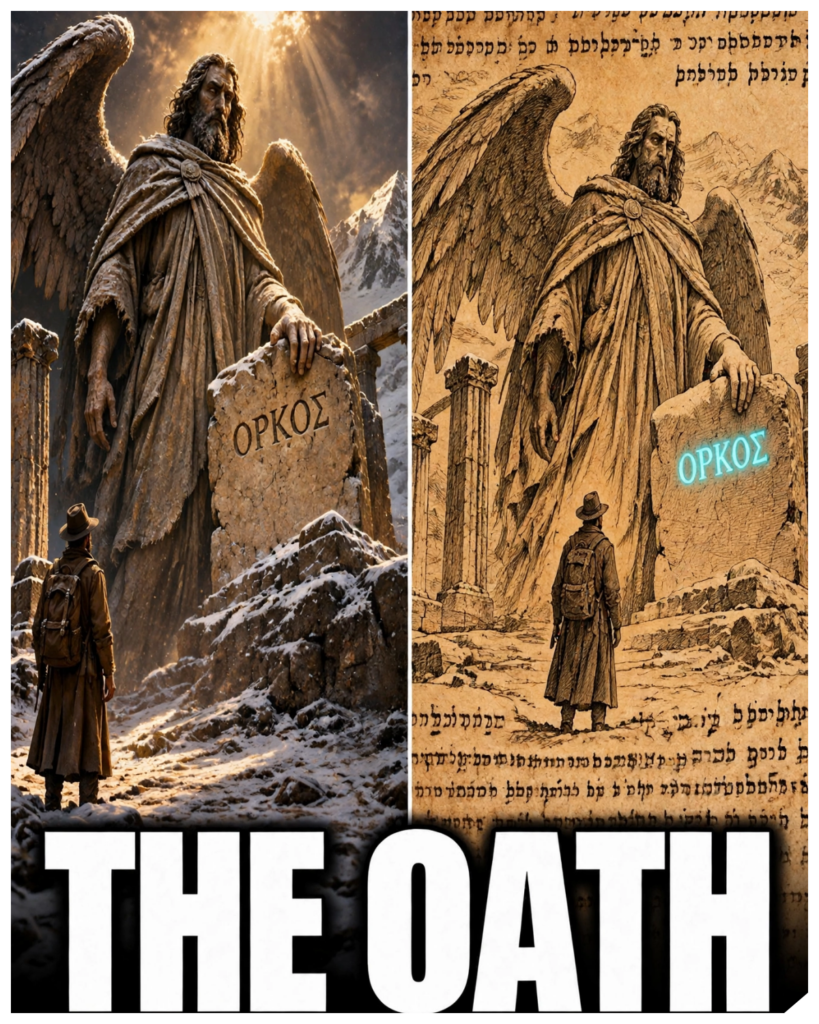
On the 14th of December in the year 1869, a British officer named Charles Warren stood in the snow on the summit of Mount Herman, inside the broken walls of a roofless temple and copied a sentence carved into a block of pale stone.
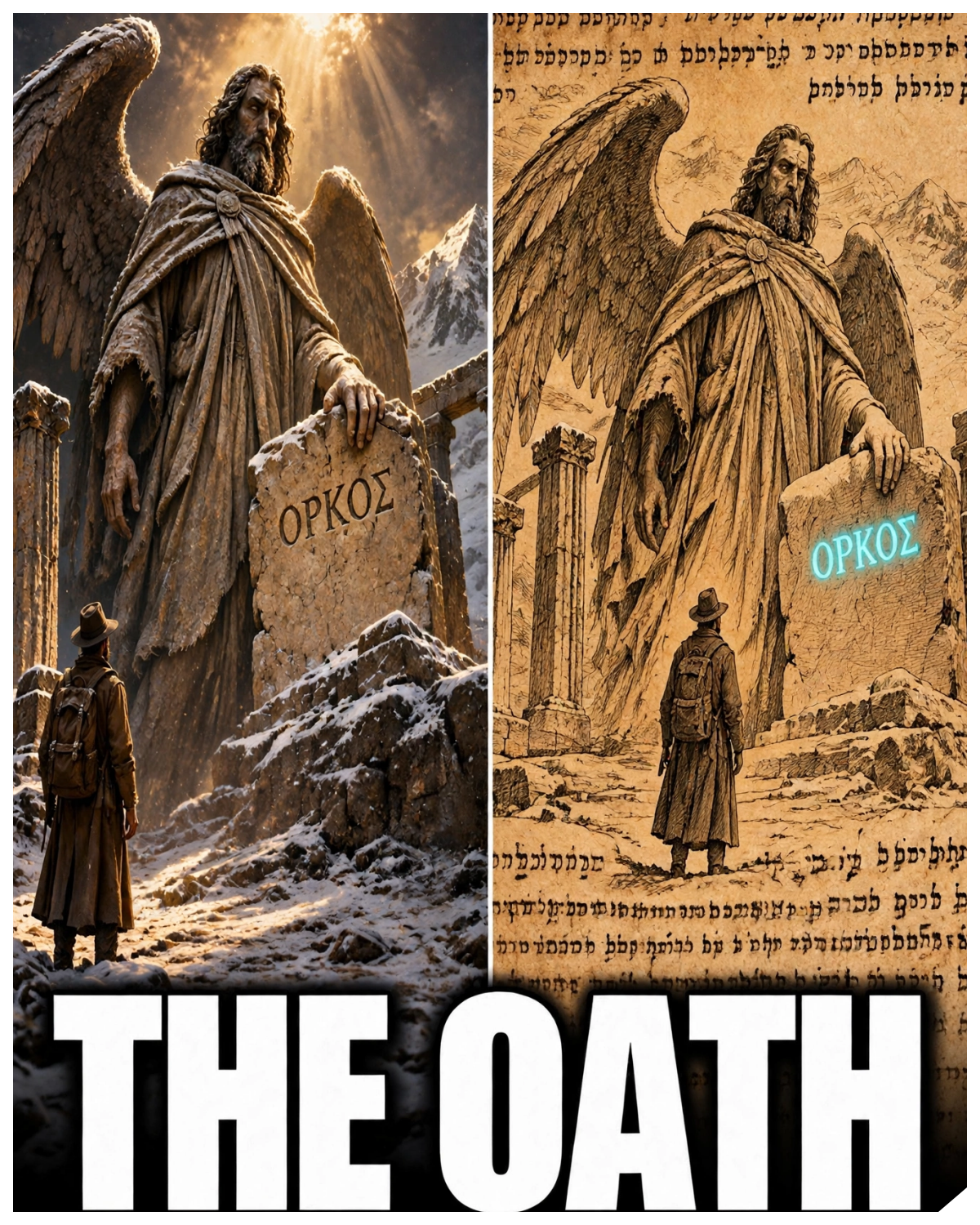
The sentence was in Greek, and it said as nearly as it can be read that by the command of the greatest and holy God, those who take an oath go out from here, an oath on the summit of Hermon.
And there is a book far older than that stone which says that 200 beings came down on that same summit, swore an oath together and bound themselves with a curse.
Officially, the stone belongs to a Roman shrine and the book belongs to no Bible at all.
Unofficially, that book was read, copied, and quoted for centuries and then quietly set aside until it survived whole in only one church in the highlands of Ethiopia.
The Book of Enoch names nine places you can still stand on today.
From Mount Hermon to the waters of Dan.
They are not myths drawn on clouds.
They are a map of where the ancients believed evil entered the world, where it will be judged and where forgiveness was asked for and refused.
If you have ever stood somewhere and felt without knowing why that something happened there long before you arrived, then you already know the feeling this book was written to explain.
By the end of tonight, you will know all nine places, what was written about each one, and why the last of them is the place where a man fell asleep while reading.
If you would like more readings like this, you can subscribe, and the archive will be here tomorrow night.
The lamp is lit.
The archive is open.
Tonight, we read the map hidden inside the book of Enoch.
One place at a time.
Settle in.
Let the room grow dark around you, and come with me.
Let me begin with the man in the snow because he is the reason this reading starts on a mountain and not in a library.
Charles Warren was a young officer of the Royal Engineers sent to the Holy Land by a society in London called the Palestine Exploration Fund.
The fund had been founded only a few years earlier in 1865 with a simple and ambitious purpose to measure, map, and describe the lands of the Bible with the same care that surveyors gave to any other country.
Not to prove anything, its founders said, and not to disprove anything, only to look and to write down what was there.
Warren is remembered today mostly for what he did underneath Jerusalem.
Between 1867 and 1870, he dug shafts and tunnels down along the ancient walls of the Temple Mount, crawling through rubble and mud in the dark, measuring stones that had not seen daylight for nearly 2,000 years.
Years later, the same man would become the head of the London police during the autumn of 1888, the season of the White Chapel murders, and his name would be tied forever to a mystery he never solved.
But in the winter of 1869, he was still young, and he went north.
He traveled through the Lebanon and the valley the Romans called Coil Syria, the hollow between the mountain ranges, looking at the ruins of small temples scattered across the slopes.
There are many of them.
Around Mount Herman alone, there are something like 30 ancient shrines and temples.
Most of them from the Roman period.
Some built on even older sacred ground.
All of them facing or climbing toward the same great mountain.
And then he climbed the mountain itself.
Herman is not a single peak.
It is a great swelling of limestone at the southern end of the anti- Lebanon range with three summits close together at the top rising to about 9,200 ft above the sea.
For much of the year, it is white.
Its snow is visible from the Sea of Galilee and from Damascus.
And the water that melts from it runs down through the rock and bursts out at its feet as springs.
And those springs become the Jordan River.
On the highest summit, Warren found what was left of a building.
It was a rectangle of cut stone without a roof, standing on an oval platform of rock.
Today, it is called Casser Antar, and it holds a strange record.
It is the highest temple known from the entire ancient world.
Whoever built it carried stone and water and offerings to a place where the wind does not stop and the snow can stay into summer.
Among the stones, Warren found a block with letters cut into it.
He copied the inscription on the 14th of December, and on the 30th of December, he drew a careful sketch of the summit and its three peaks.
His drawings still exist, kept in the archive of the society that sent him.
The inscription is short and worn, and scholars have argued about its exact wording ever since, but its sense is clear enough.
By the command of the greatest and holy God, those who take an oath go out from here.
I do not know whether Charles Warren, standing in that cold, thought of the book of Enoch.
His drawings do not tell me, and I will not pretend to know what was in his mind.
But I know that more than a century later, one of the scholars who has spent his life on that book read the inscription and noticed what you noticed a moment ago, an oath taken on the summit of Herman in the name of a great and holy god.
He was careful.
He did not say the stone proves the book.
He said only that the stone might reflect worship that was somehow informed by the traditions the book preserves.
That is how a careful person speaks when something lines up a little too well.
So before we walk to the first place, you should know the book.
What we call the book of Enoch or first Enoch is not one book.
It is a collection, five works gathered under one name, written by different hands over perhaps three centuries before the time of Jesus.
The oldest part and the part that will guide most of tonight is called the Book of the Watchers.
It fills the first 36 chapters.
The scholars place it in the 3rd century before Christ, which makes it older than most of the Dead Sea Scrolls, older than the book of Daniel in its final form.
And one of the oldest Jewish writings we have outside of the Hebrew Bible itself.
After the book of the Watchers come the book of parables, sometimes called the similitudes, then the astronomical book, which calculates the courses of the sun and moon.
Then the book of dreams, and finally the epistle of Enoch, a long letter of warning and comfort.
They all speak in the voice of one man.
That man appears in the Bible in only a few lines in the fifth chapter of Genesis in the long list of generations between Adam and Noah.
Every name ends the same way.
He lived, he had children, and he died.
Every name except one.
Enoch the seventh from Adam walked with God and he was not for God took him.
That is all.
Four or five sentences and then silence.
The book of Enoch is what happens when someone refuses to accept that silence.
It tells us where Enoch went when he walked with God.
It says he was taken up and shown the secrets of heaven and earth, the storehouses of the winds, the gates of the stars, the places of punishment, and the places of rest.
And it says that he was sent as a messenger to a group of beings who had fallen.
The book calls them the watchers.
You need to understand how seriously this book was once taken.
Copies of it in its original Aramaic, were found among the Dead Sea Scrolls in the caves near Kuman.
Fragments of perhaps a dozen copies, more than of many books that did make it into the Bible.
It shaped the way people of that time thought about angels, about demons, about the end of the world.
And in the New Testament, in the short letter of Jude near the end of the Bible, there is a passage that quotes it almost word for word.
Enoch the seventh from Adam prophesied.
Jude writes and then he gives the words and they are the words of the first chapter of the book of Enoch.
Early Christian writers read it.
Some of them treated it as scripture.
Others were uneasy and then slowly it disappeared.
I want to be honest here because this is the kind of story that is easily made more dramatic than it was.
There is no evidence of a single council where bishops met and voted to burn the book of Enoch.
That is not how it happened.
What happened was quieter and in some ways more final.
The rabbis who shaped Judaism after the destruction of the temple did not include it among their sacred books.
And over time they told the story of the sons of God in Genesis in other ways as men of high rank rather than as fallen angels.
In the west the great church teachers grew cautious.
St.
Dogugustine writing in the early fifth century said that writings under the name of Enoch were set aside because their great age made them uncertain and because no one could be sure they were genuine.
Copies stopped being made.
When copies stopped being made, a book does not need to be burned.
It simply ends except in one place.
In the highlands of Ethiopia, the church that had received the book in a Greek translation many centuries before rendered it into its own ancient language called gaze and kept it.
It kept it not as a curiosity but as part of the Bible beside Genesis and Isaiah.
Monks copied it by hand generation after generation in monasteries on mountaintops and on islands in lakes while the rest of the world forgot that it had ever existed except as a name.
In the year 1773 a Scottish traveler named James Bruce came home from Ethiopia carrying three manuscripts of the book.
One of them went to the Bodlian Library in Oxford and in 1821 a scholar named Richard Lawrence published the first English translation.
The effect people said afterward was something like the effect of the Dead Sea Scrolls in the 20th century.
A voice that had been silent for more than a thousand years was speaking again.
Then in the winter of 1886, French excavators working in a Christian cemetery at Akmim in upper Egypt opened a grave and found a small book of parchment inside it along with other writings were the first 32 chapters of Enoch in Greek.
Someone perhaps 14 or 15 centuries ago had wanted that text buried with them.
And in the 1950s, in the fourth cave at Kumran came the Aramaic fragments, the oldest of all, which a scholar named Yseph Milik spent two decades piecing together before he published them in 1976.
Some of those fragments preserve the very chapter about the oath on Herman.
One of them still holds the words, “They swore and bound one another by a curse on it.”
So the book was lost and then found three times in three different ways.
Carried home by a traveler, lifted out of a grave, pieced together from fragments in a cave.
Hold on to that pattern.
It will come back before the night is over.
Now, here is the thing that made me want to read this book to you in this particular way.
Most visions of the end of the world happen nowhere.
They happen in heaven or in some symbolic landscape of beasts and seas and horns.
They have no address.
You cannot go there.
The book of Enoch is different.
It has addresses.
When the watchers come down, the book does not say they came down on a mountain.
It says which mountain.
When Enoch goes to read their petition, the book does not say he went to a river.
It says which river and in which direction from the mountain, south and west.
When the watchers sit weeping, the book names the place and gives its boundaries between Lebanon and Senir.
When Enoch is carried to the middle of the earth, the book describes the hills and the ravines so precisely that anyone who has stood in Jerusalem recognizes them.
When it describes the place where the wicked are gathered, it describes a valley you can walk through on an afternoon.
And when it describes the waters where the angels of judgment are punished, the scholars who know the region point to a stretch of shore along the Dead Sea where hot springs still steam out of the rock.
One of the great commentators on this book noticed many years ago that the whole first drama of the watchers, the descent, the oath, the petition, the dream, and the weeping unfolds in a very small region.
You could walk across it in a day.
It sits at the feet of Mount Hermon at the headarters of the Jordan, in a corner of the land that the Bible itself remembers as the far edge of Israel.
Why would an author do that?
Why would someone writing about angels and giants and the judgment of the world anchor his story to real hills, real springs, real valleys, places his readers could visit?
There are few answers, and we will hear them as we go.
Some scholars think the author lived near these places or new pilgrims who went there.
Some think these places were already sacred, already full of shrines and old stories, and the book was claiming them, giving them a new meaning.
The way a new tenant moves into an old house and hangs his own pictures on the walls.
Some think the author wanted his readers to feel the story under their feet so that when they walked past a certain spring or looked up at a certain mountain they would remember.
I think all three may be true and I think the third one is the reason it still works because these places are still there.
That is what we are going to do tonight.
We are going to visit them one by one in the order I have chosen.
For each one, I will tell you three things.
First, what the record actually says, the words of the book itself, as close as I can bring them to you with the chapter where you can find them.
Second, what the scholars say.
The people who have spent their lives reading these texts in their original languages, who have argued about every word, including the ones who doubt the most.
Where they agree, I will tell you.
Where something does not close, where a question is still open after all their work.
I will tell you that too.
And third, the margin.
Every old book has margins.
And in the margins, over the centuries, readers have written their own ideas, some wise, some strange, some disproven.
I will read you those as well.
But I will always tell you when we have left the record and stepped into the margin, so that you never have to wonder which is which.
There are nine places.
Why nine and why in this order?
I have arranged them as a kind of descent.
We begin with the most fundamental place.
The one where everything in this story starts.
The place without which none of the others would mean anything.
From there we move to places that are more familiar, then more central, then places of waiting, of fear, of deception, of danger.
And then at the end, the places become quieter and more personal.
The last two are not places of judgment at all.
There are places where someone wept and where someone fell asleep.
You may notice that the order is not the order of a map.
We will not walk in a straight line from north to south.
We will go up to a mountain at the northern edge of the land, then down into the desert in the south, then to the city in the middle, then down to the lowest shore on earth, and then back north again to where we began.
That is deliberate.
The book itself moves this way.
Enoch is carried here and there by the angels who guide him, shown one thing and then another, and the meaning only becomes clear when he returns to where it started.
So the journey tonight is a circle.
It begins at the foot of Herman, and it ends at the foot of Herman, beside running water, with a man asleep and a scroll in his hands.
Before we set out, let me say a word about the people who first read this book.
They were not scholars in an archive.
Most of them could not read at all.
They heard it read aloud at night, perhaps by lamplight, in small rooms, the way you are hearing it now.
And when they heard the names of these places, they knew them.
Some of them had walked there.
Some of them had seen the snow on Herman from their fields.
Some of them had drawn water from the springs at Dan, or walked down into the valley south of Jerusalem, where no one liked to linger after dark.
For them, the book of Enoch was not a story about somewhere else.
It was a story about where they lived.
It told them that the ground under their feet remembered something.
That the mountain on the horizon had a name for a reason.
That the valley outside the city was waiting for something.
I would like you to listen tonight the way they listened.
Not as someone studying a strange old text, but as someone being told about the places around them, places you could visit, places you could touch, places that are standing tonight under the same stars, in the same darkness.
While you lie here and listen, there is one more thing I should tell you before we begin.
And it is a confession.
When I first started following the places in this book on a map, I expected the trail to go cold.
I expected that most of the names would turn out to be lost or symbolic or impossible to identify.
That is what usually happens with ancient visions.
And some of the names in Enoch are lost.
There are places in this book, mountains of precious stones, trees of fragrance at the end of the world that no one has ever found and no one ever will because they were never meant to be found.
But these nine are different.
These nine are still on the map.
You can stand on them.
Some of them you can drive to.
Some of them have parking lots and ticket booths and signs in three languages.
One of them is a nature reserve where families walk on weekends.
One of them is a summit inside a military zone that almost no one is allowed to climb.
One of them is a green park beneath the walls of an old city.
And one of them, if the scholars are right, is a bare hill in the desert whose Arabic name means the watchman.
I will be honest.
Standing on a place does not make a story true.
A real mountain can carry an invented tale.
People have told stories about real mountains for as long as there have been people.
But there is something about this book, about the way it insists on these particular places that I have never been able to shake off.
It feels less like a fantasy and more like a guide book written by someone who wanted you to go and see for yourself.
So that is what we will do.
We will go and see.
The night is long and there is no hurry.
If you fall asleep along the way, that is all right.
The places will still be there.
They have been there for a very long time.
We begin as the book itself begins its story of the watchers, high up in the snow on the mountain where the oath was sworn.
It is the first place you can still stand on, and it is the most fundamental of them all.
The first place you can still stand on is Mount Hermon.
It is the mountain where, according to the book of Enoch, the trouble of the whole world began with a promise.
Of all the places we will visit tonight, this is the most fundamental because every other place on the map exists only because of what was sworn on this summit.
Let me tell you how I first met it.
Not on a map and not in a photograph, but in a single line of an old translation late at night with the lamp low and the rest of the archive asleep around me.
The line said that a group of beings came down onto a mountain and that they gave the mountain its name because of what they did there.
I read it twice.
Then I set the book down and simply sat for a while because I realized that this was a place I could find on any atlas.
It was not a cloud kingdom.
It was not a symbol.
It was a mountain with snow on it and people live in its shadow today.
In the record, the story begins in the sixth chapter of what scholars call first Enoch inside the section known as the book of the watchers.
The scene is quiet at first.
The children of men have multiplied on the earth and in those days beautiful daughters are born to them.
Then the text turns its eyes upward.
The angels whom the Ethiopic text calls the children of the heaven see these daughters and desire them.
In the older Aramaic fragments, these beings have a different name.
They are called the watchers, the ones who do not sleep.
Their leader is named Seamjaza or in the Aramaic form, Shemihaza.
And here the text does something I did not expect the first time I read it.
It lets the leader be afraid.
Samjaza says to the others in effect that he fears they will not truly go through with this and that he alone will have to pay the penalty of a great sin.
It is a strangely human moment.
A being from the heavens about to cross the line worries that his companions will abandon him at the last step.
So they answer him.
They all swear an oath together.
In the words of the translation by R H Charles made in 1912.
They bind themselves by mutual impreations, which is an old way of saying they called curses down upon one another should any of them turn back.
They were 200 in number and they descended, the text says, in the days of Jared, upon the summit of Mount Herman.
Then comes the line that stopped me.
And they called it Mount Hermon because they had sworn and bound themselves by mutual impreations upon it.
The name of the mountain in this telling is not older than the sin.
The name is the scar the sin left behind.
There is a small puzzle hidden in that sentence and I want to show it to you because it tells us how fragile these texts are.
In the Ethiopic manuscripts, the phrase in the days of Jared appears as a strange word aris as if it were a place.
Charles explained it as a misreading.
In Hebrew, the name Jared is related to the word for descent for going down.
So the descent happened in the days of the one whose very name means descent.
A copist somewhere along the long road of copying seems to have lost the thread and left us a word that is almost a riddle.
The record does not stop at the oath.
In the seventh and eighth chapters, the watchers take wives and they begin to teach.
They teach charms and enchantments, the cutting of roots, the knowledge of plants.
One of them named Aazil teaches the making of swords and shields and breastplates, the working of metals, bracelets and ornaments, and the use of antimony, the dark powder used to paint the eyes.
Others teach the signs of the stars and the movements of the moon.
And from these unions, the text says, giants are born and the earth begins to groan under them.
But all of that, every terrible thing that follows, flows downhill from one moment on one summit.
The scholars who have spent their lives on this have looked very closely at that word play, the name and the curse.
RH Charles himself noticed it.
The name Herman sounds very close to a Hebrew word herm which means a ban, a curse or a thing devoted to destruction, something set apart that must never be touched again.
So the story is at least in part an explanation of a name.
Why is this mountain called Hermon?
Because something was put under a herum there because a curse was sworn on it.
And this is not only a feature of the later Ethiopic version among the Dead Sea Scrolls in the fourth cave at Kamran.
Archaeologists found the oldest Aramaic copy of this part of Enoch, a manuscript known by the catalog name 4Q 2011.
It preserves words that say they swore and bound one another by a curse on it.
The fragment is damaged.
And I will be honest with you, the edge of the leather breaks away right near the place where the mountain’s name should be.
But the oath and the curse are there in a copy far older than any of the Ethiopic manuscripts.
The mountain itself has more than one name in the Bible.
In the third chapter of Deuteronomy, we are told that the Sidonians call Herman Syrian and the Amorites call it Senir.
Hold on to that second name, Senir.
It will come back to us much later tonight near the end of our journey and it will matter more than you think.
Physically, Herman is a giant.
It rises to about 9,200 ft at the southern end of the anti-Lban range and its summit sits on the border between Lebanon and Syria.
Snow lies on it for much of the year.
When that snow melts and when its hidden springs push water out at its feet, that water feeds the Jordan River in a dry land.
This is the mountain that gives water.
The Psalms remember it for exactly that.
Psalm 133 speaks of the Jew of Herman coming down like a blessing.
And this is where it gets strange.
Around the slopes of Herman, archaeologists have counted something like 30 temples and shrines from the Roman era.
30 a ring of sacred buildings around one mountain.
And at the very top on an oval stone plateau near the summit, there is a ruin called Kazar Antar.
It is a roofless rectangular temple and it is considered the highest temple of the ancient world.
In December of 1869, a British officer named Charles Warren working for the Palestine Exploration Fund climbed up there in winter to document it.
On the 14th of December, he copied an inscription carved into a stone at the summit.
Later that month, on the 30th, he sketched the summit’s three peaks.
Imagine him up there in the cold, his fingers stiff, copying letters by hand on a mountain the book of Enoch says was named for a curse.
The inscription was in Greek.
Roughly translated, it says, “By the command of the greatest and holy God, those who take an oath go from here.
Those who take an oath on Herman.”
The American scholar George Nichollsburg in his large commentary on First Enoch looked at this inscription and at the sixth chapter side by side.
He was careful as good scholars are.
He said only that the similarities might reflect cultic activity that was somehow informed by traditions from one Enoch.
Might somehow those are the words of someone who sees a door half open and does not want to claim he has walked through it.
The strongest skeptic would say this.
The inscription is from the Roman period many centuries after the Enoch story was written down.
The greatest and holy god may simply be the local god of the mountain, a bal or a hadad of Herman, worshiped by people who had never heard of Samjaza.
Mountains are natural places for oaths in many cultures because they are high and permanent and seem to watch.
And the oldest Aramaic fragment of the Enoch story is broken exactly where we would most like it to be clear.
Many scholars also see chapters 6- 11 of Enoch as a retelling of a very short and very strange passage in Genesis in its sixth chapter where the sons of God see that the daughters of men are fair and the Nephilim are on the earth in those days.
Genesis gives us four verses and no mountain.
Enoch gives us names, numbers, an oath, and a summit you can point to.
I want to pause here because I think the difference matters more than it first appears.
A short mysterious story invites wonder.
A detailed story with a location invites pilgrims.
Once you give a sin an address, people can travel to it.
They can stand where it happened, look up at the same snow, and feel the old fear in their own bodies.
That is a powerful thing to do with a story.
And whoever first tied the watchers to Herman must have known it.
There is also the matter of the water.
Remember that Herman feeds the Jordan, the river of so many beginnings in the Bible.
There is something unsettling in the thought that the mountain of the curse is also the mountain that gives life to the land below.
The story never resolves that tension and perhaps it was never meant to.
We will come back to these northern waters at the very end of the night.
So what does not close this?
A story about beings who swore a binding oath on Herman.
And centuries later on that same summit a carved instruction for people who come to take oaths.
Coincidence is possible.
Shared custom is possible.
Influence is possible.
Nobody has proven which.
The point stays open like a gate nobody has bothered to lock.
And this is where the record ends and the margin begins.
In the margin, some writers have built far larger houses on this foundation.
In the line of Zechariah Sitchin and then of many television and internet authors after him, Herman and the great stone platform at nearby Balbeck are treated as landing places, sites where beings from the sky literally came down, perhaps in craft, perhaps with technology.
The watchers become visitors.
The descent becomes a landing.
Others fix their attention on a number.
Herman lies near the 33rd parallel of latitude, a little north of it, and some writers give that number an occult meaning as though the mountain were chosen by coordinates.
I want to be gentle here because I understand the hunger behind these ideas.
People want the old stories to be solid, to be physical, to be provable, but latitude lines are a modern grid laid over an ancient earth.
And the text of Enoch itself says nothing of craft or coordinates.
It speaks of an oath and of shame.
These readings belong in the margin, and that is where I will leave them, with a lamp beside them, but not on the main table.
There is a reason this story was pushed so far to the edges.
And it is worth asking who was relieved when it faded.
The idea that angels came down and taught humanity forbidden knowledge and fathered children with human women embarrassed many of the later teachers who inherited it.
It raised hard questions.
Can heavenly beings sin in that way?
Is human knowledge, metal work and medicine and astronomy a gift from rebels.
Later Jewish tradition began to reread the sons of God in Genesis as human nobles, powerful men, not angels at all.
Among Christian writers too, the angelic reading grew uncomfortable over time.
And the book of Enoch, once read and copied with care, fell out of most cannons.
Only in Ethiopia did the church keep it whole.
The mountain stayed where it was.
The story about it was quietly carried out of the room.
If you stood there today, what would you see?
A massive limestone mountain, pale and broad, with snow lying in its folds well into spring.
On its lower southern flank, there are ski slopes, and in winter people glide down, where, in the old story, 200 watchers came down.
Higher up, the summit is a militarized border area, and most visitors do not go there.
But from far below, from the valleys of the north, you can see its white crown on clear days, and it looks exactly like what it is.
The highest thing for a very long way.
The place everything else looks up to.
Now, let me bring this closer to you.
When you were younger, perhaps there was a night when you said something you could never take back.
Maybe you were standing somewhere high on a rooftop or a hill or a balcony with the air cold and the lights of a town spread out below you.
Maybe there was someone beside you and the dark made you brave.
You said the words slowly, and as you said them, you felt them leave you and settle into the world like stones dropped into deep water.
A promise, a vow, or perhaps something sharper.
A thing said in anger that you have carried ever since.
You remember the exact feeling of the air on your face, the sound of the wind, the way your heart beat after the words were out.
You remember thinking in that silence, there is no way back from this now.
Whatever comes next, it comes from here.
That is the feeling of Herman.
Not monsters, not giants, but the quiet, enormous weight of a sentence that cannot be unsaid.
Let yourself remember it gently now without judging it.
Every life has a summit like that.
Every life has one place where a word became a road.
This is the first place you can still stand on, Mount Herman.
And here is the question of the night, the one I would like you to carry down with you into sleep.
What did you once promise from a high place that is still shaping the ground you walk on?
You do not need to answer it.
Just let it rest beside you.
From this cold, high summit, where a promise was made in secret by beings who should have known better, we turn now to another mountain.
It is far to the south in a desert of red stone, and it is the opposite of Herman in almost every way.
Hermon is the mountain of a forbidden oath.
The next is the mountain of a holy one.
You already know its name.
You have heard it all your life, but the book of Enoch begins there on the very first page, and the next place changes how you read everything before it.
The second place you can still stand on is Mount Si.
It is the mountain where, according to the very first chapter of the book of Enoch, God himself will one day set his feet upon the earth to judge it.
Of all the places tonight, this is the most familiar, the one whose name you have known since childhood.
And that is exactly why it is so easy to walk past what Enoch does with it.
I remember the night I noticed it.
I had read the opening of Enoch many times.
The way you read the first page of a book you already think you know.
And then one evening, a single phrase lifted itself off the page, even on Mount Si.
I stopped.
Why would a book about Enoch, a man who lived long before Moses, long before the law, long before Israel was even a people, begin on the mountain of Moses?
It felt like opening a very old letter and finding in the first line the name of someone who would not be born for generations.
In the record, the book of Enoch opens with a blessing.
In the first chapter, the narrator introduces Enoch as a righteous man whose eyes were opened by God and who saw a vision of the holy one in the heavens.
The angels showed him things and he understood them and he says that what he saw was not for his own generation but for a distant one, a generation still to come.
Then the vision begins to move.
In the words of the translation by RH Charles, the holy great one will come forth from his dwelling and the eternal God will tread upon the earth even on Mount Si and appear from his camp.
I want you to hear how physical that is.
Not a voice from a cloud, not a distant glory, feet on stone, a God who walks, and the earth cannot bear it.
The text says, “The high mountains will be shaken, and the high hills will be made low, and they will melt like wax before a flame.
The earth will be split.
Everything on it will be judged.
And then in a line that I find both terrible and quietly moving, the text says that the watchers will quake.
The same watchers we met on Herman, the ones who swore their oath on a mountain in the north, will tremble when God steps down onto a mountain in the south.
Notice the shape of that.
The book has not yet told us the story of the watchers.
That comes later in the sixth chapter.
But here on the very first page, before we even know who they are, we already see them shaking.
It is as though the author shows us the ending before the beginning.
One mountain where the oath was sworn, another mountain where the oath will be answered.
Between them lies the whole land, and the whole story stretched like a cord from north to south.
Then comes the ninth verse, and this is where it gets strange.
And behold, he cometh with 10 thousands of his holy ones to execute judgment upon all and to destroy all the ungodly.
I have read that sentence in two places, once in Enoch, and once in the New Testament.
In the short letter of Jude near the very end of the Bible, verses 14 and 15 say this.
Enoch also, the seventh from Adam, prophesied of these, saying, “Behold, the Lord cometh with 10, thousands of his saints to execute judgment upon all.”
It is almost word for word.
A book that most Christians today have never read and that most churches do not count as scripture is quoted by name inside the Bible.
They do read.
Jude calls it prophecy.
I will be honest.
The first time I put the two passages side by side, I felt the floor of the archive move a little under my chair.
Think about what that means for a moment.
Jude is writing a short urgent letter to a community he loves, warning them about people who have crept in among them.
And when he reaches for the strongest words he can find, he does not reach for Isaiah or for the Psalms.
He reaches for Enoch.
He names him carefully, the seventh from Adam, the way you would name a source you expect your readers to recognize.
That small detail tells us that for at least some early followers of Jesus, the opening of Enoch was not obscure at all.
It was something they knew, something they could hear and nod at.
And yet over the following centuries that familiarity drained away.
The letter of Jude stayed in the Bible.
The book it quoted did not, except in Ethiopia, where the church kept Enoch and copied it faithfully.
So most readers today meet the quotation without ever meeting its source, like hearing a single line of a song and never learning the rest of the melody.
So the opening of Enoch is not a forgotten fringe.
It sits right at the doorway of the New Testament.
And the doorway it opens onto issa.
The scholars who have spent their lives on this agree on something important.
The first chapter of Enoch is a kind of reworking what Jewish tradition would call a midrash of older biblical passages.
Above all, it echoes the blessing of Moses in Deuteronomy 33:2.
The Lord came from Si and rose up from Seir unto them.
He shined forth from Mount Paron, and he came with 10,000s of saints.
Can you hear it?
The coming from Si, the 10,000s.
The author of Enoch is standing on Moses’s words, the way you stand on an old stone step.
Worn smooth by other feet.
There are other echoes too.
The prophet Micah in his first chapter says the Lord will come forth out of his place and tread upon the high places of the earth and the mountains shall be molten under him.
In Exodus chapter 19, the mountain smokes and quakes when God descends upon it.
In Habachok, God comes from the south from Teeman, the holy one from Mount Paron.
In the song of Deborah in the fifth chapter of Judges, the earth trembles and the mountains melt before the Lord.
Even that Sinai Enoch’s first chapter gathers all of these old thunderstorms into one.
And here is the part that I think is most interesting.
A book about a man who lived before Moses opens on Moses’ mountain.
The author ties Enoch’s authority to Sinai, to the most authoritative place in the whole of Israel’s memory.
But he moves the great event into the future.
At Sinai in Exodus, God came down to give the law.
In Enoch, God will come down to Sinai again, this time to judge.
It is as though the author is saying the mountain you remember is also the mountain you are waiting for.
There is a reason this matters so much and we will get to it.
But first let me tell you where Sinai actually is and the honest answer is we do not know.
The traditional site is Jebel Musa which means the mountain of Moses in the south of the Sinai Peninsula.
It rises to about 7 12,000 ft.
At its foot stands the monastery of St.
Catherine built in the sixth century under the Byzantine emperor Justinian.
The tradition of this mountain as Sinai goes back to Byzantine times to the fourth, fifth and sixth centuries when monks and pilgrims came to live and pray in its granite valleys.
That monastery has its own unexpected detail.
It was there in the middle of the 19th century that a German scholar named Constantin Fonticondorf found the Codeex Senaticus, one of the oldest complete Christian Bibles in existence.
He visited in 1844 and again in 1859.
Think of it.
One of the oldest surviving Bibles was kept for centuries at the foot of the mountain where tradition says the law was first given.
But the skeptic will remind us that tradition is not the same as proof.
Scholars have proposed many candidates for the real Sinai in the Sinai Peninsula in the Negv in the lands east of the Gulf of Akoba.
The Bible itself does not give coordinates.
It gives a journey, a wilderness, a mountain that smokes.
And so the most familiar mountain in the world is also strangely one of the hardest to find.
I find a kind of comfort in that if I am honest.
We tend to assume that the most important places must be the best known, carefully measured, fenced, labeled.
But Sinai, the mountain of the law, slipped out of precise memory.
People kept the words spoken there and lost the ground they were spoken on.
Perhaps that is what happens to a place when its meaning grows larger than its geography.
The mountain becomes a word and the word travels everywhere and the stone stays behind in the desert waiting for someone to remember which one it was.
What does not close is this.
The author of Enoch did not need to know where Sinai was.
For him, Sai was not mainly a point on a map.
It was a source of authority.
And by beginning his book there, he placed his entire vision, the watchers, the judgment, the journeys under the shadow of that one mountain.
Whether he meant to borrow its authority or simply could not imagine a holy God coming down anywhere else, we cannot say.
And this is where the record ends and the margin begins.
In the margin, there is a different mountain entirely.
It is called Jebel Alos and it stands in the northwest of Saudi Arabia rising to about 8 12,000 ft.
For some writers and adventurers, this is the real Sinai.
The story of that claim runs through a few colorful people.
Ron Wyatt was a nurse anist who became a kind of treasure hunter searching for biblical places and objects.
In 1986, he and David Fold traveled to the region and visited the mountain.
Later Larry Williams and Bob Cornuk made their own journey there and their adventure was told in a book by Howard Blum called the gold of Exodus.
These men pointed to the summit of Jebel Alos which is dark almost blackened and they said here is the mountain that burned when God came down upon it.
It is a striking image and I understand why it captures people.
A black topped mountain in a forbidden desert.
The real Senai hidden in plain sight.
But archaeologists reject the identification.
The features these men pointed to have not convinced the people who study these landscapes for a living.
And a dark summit on its own is not a signature of God.
So I leave Jebel a lows in the margin gently, the way you leave a child’s drawing pinned beside a real map.
It tells you something true about longing.
Even if it does not tell you where the mountain is.
Now let us return to the question I set aside earlier.
Why does it matter so much that Enoch begins at Si?
Because whoever owns Sinai owns the authority of the law.
Sinai is where in the memory of Israel, God spoke and the covenant was made.
Every priest, every teacher, every interpreter of the law drew their authority in the end from that mountain.
And the author of Enoch reached out and borrowed it.
He took a figure from before Moses, a man from the earliest generations of the world, and placed him on the threshold of Moses’ mountain.
That borrowing is part of why later gatekeepers came to distrust the book.
If Enoch received revelation before Moses, then revelation did not begin at Si.
There was an older voice, an earlier channel, a man who walked with God, as Genesis says, and was not, for God took him.
For a tradition built on Sinai, that is a dangerous thought.
It suggests that the law, as precious as it is, was not the first word.
So the book that opens on the holy mountain became for many a book to set aside.
If you stood there today at Jebel Musa, you would most likely arrive in the dark.
Pilgrims begin the climb in the middle of the night.
Some take the long path that camels also walk.
Others take the steps of repentance, about 3,750 stone steps cut by monks rising steeply through the granite.
You climb with a flashlight or with no light at all but the stars which in that desert are almost unbearably bright.
At the top it is cold and quiet and people sit wrapped in blankets on the rocks.
There is a small chapel and a small mosque at the summit and everyone waits facing east for the sun.
Now let me bring this closer to you.
When you have climbed something in the dark, you know the feeling.
Your legs ache.
Your breath is loud in your own ears.
You cannot see the top only the next step and the next lit by a small circle of light.
And then you arrive and you sit down on cold stone and you wait.
Slowly the sky behind the mountains turns from black to deep blue to a pale gray.
Than a line of gold and suddenly the light reaches you.
All of you, your face, your hands, your tired shoulders.
You are completely visible.
Nothing is hidden anymore.
And there is a strange double feeling in that moment.
A little dread because you are seen entirely.
Every part of you, nothing held back.
And then underneath the dread, a deep relief because the light is not cruel.
It is simply true.
To be seen fully and judged fairly is a kind of rest.
Let that light find you now gently wherever you are lying.
This is the second place you can still stand on Mount Si.
And here is the question of the night.
If someone saw all of you, every hidden thing, and judged you with perfect fairness, would you feel afraid or would you feel at last at rest?
You do not need to decide.
Just let the question sit beside you like the first warmth of the sun from Sinai, the mountain at the edge of the desert, the mountain of the past and of the future.
We travel now toward the center.
Si stands alone, far away in the wilderness.
The next place is the opposite.
It is not at the edge of anything.
Enoch calls it the middle of the earth.
There is a holy mountain there.
And beneath it, something runs in the dark.
And the next place changes how you read everything before it.
The third place you can still stand on is Jerusalem, which the book of Enoch calls the middle of the earth.
It is a holy mountain with a living stream running beneath it.
And in Enoch’s journeys, it is the still point around which the whole world turns.
Of all the places tonight, this is the most central, and I mean that in every sense of the word.
I came to it slowly.
For a long time, I read the journeys of Enoch as pure vision, a dream geography of fire and mountains and strange trees, the kind of landscape you cannot visit because it exists only on the page.
And then one night reading the 26th chapter, I found myself reaching for a map of a real city, not an imaginary one.
A city with streets and walls and buses and a spring that still runs today.
I will be honest, this chapter changed the way I read the whole book.
In the record, we are deep inside the book of the watchers.
In the long section of journeys that runs from the 17th chapter to the 36th, Enoch is taken across the world by angels.
Uriel, one of the holy angels, is often beside him, showing him things and answering his questions.
He sees the ends of the earth, the storehouses of the winds, the places where the stars are kept, mountains of fire, the prison of the fallen ones.
It is vast and it is dizzying.
And for many chapters, you feel as though you are flying over a world that is not quite ours.
And then at the opening of the 26th chapter, the tone changes.
In the translation of RH Charles, Enoch says, “And I went from thence to the middle of the earth, and I saw a blessed place in which there were trees with branches abiding and blooming.”
There is a little phrase in brackets in the old translation of a dismembered tree, as if the text remembers a tree that was cut down and yet still puts out living branches.
Then, and there I saw a holy mountain, and underneath the mountain to the east there was a stream, and it flowed towards the south.
Read it again slowly, the way the scribe may have written it.
A blessed place, trees still blooming, a holy mountain, and underneath it, on the east side, a stream flowing south.
I want to linger on that bracketed phrase for a moment, because it stopped me the first time, and it still does.
A dismembered tree, a tree cut apart, and yet its branches abide and bloom.
The old translators were not certain of the words here, and I will not pretend to be more certain than they were.
But the image stays with me, something broken at the center of the world and still alive.
There is a reason that image may belong here in this particular city, and we will get to it.
But first, let us stay with the mountain and the water.
After all the fire and the darkness of the earlier chapters, this feels like coming home.
The language becomes quieter, more concrete.
It sounds less like a vision and more like a description.
And that is exactly the clue.
The scholars who have spent their lives on this have noticed that phrase, the middle of the earth, and they have recognized it at once.
It is not invented by Enoch.
In the book of Ezekiel in the fifth chapter, God says, “This is Jerusalem.
I have set it in the midst of the nations and countries that are round about her.”
Later in the 38th chapter, Ezekiel speaks of the people who dwell at the navl of the earth, the navl, the center of the body, the place where life first entered.
The book of Jubilees, another ancient Jewish text closely related to Enoch in spirit, says it even more plainly.
In its eth chapter, it describes Mount Zion as being at the center of the naval of the earth.
The scholar Richard Borham argued that this belief, Jerusalem as the middle of the world, was common among Jews in that period.
It was not a strange private idea.
It was the way many people pictured the map in their minds.
And so the holy mountain in Enoch is in all likelihood the Temple Mount or Mount Zion, the hill on which the temple stood.
Philip Esler and other scholars have noted that the topography in this chapter is recognizable as Jerusalem.
The mountains, the ravines, the direction of the water, all of it fits the real ground of the city.
Now, this is where it gets strange because there really is a stream beneath that mountain on the east side flowing south.
It is called the Guihon spring.
It lies in the Kiddran Valley on the eastern side of the oldest part of Jerusalem below the ridge that rises toward the Temple Mount.
And it was the only true spring of ancient Jerusalem.
Everything depended on it.
A city on a dry ridge in the hills with one spring in a valley outside its natural line of defense.
Imagine the anxiety of that.
Every siege, every war, every enemy army arriving in the hills, and the city’s only living water bubbling up just outside the place where its people could most easily protect it.
So, the kings of Judah did something remarkable.
Around the year 700 before the common era, King Hezekiah had a tunnel cut through solid rock to carry the water of the Guihon south under the hill to a pool inside the city, the pool of Sylum.
The Bible remembers it.
The second book of Kings in its 20th chapter mentions how he made a pool and a conduit and brought water into the city.
The second book of Chronicles in its 32nd chapter says that Hezekiah stopped the upper water course of Guehon and brought it straight down to the west side of the city of David.
And here is an unexpected detail, one I love.
In 1880, a boy was wading in that tunnel in the dark in the water and on the wall he noticed letters.
It was an inscription carved by the ancient workers themselves.
It describes the moment when two teams of diggers who had started from opposite ends cutting toward each other through the rock finally heard each other’s voices and met pick against pick.
The water then flowed from the spring to the pool.
That inscription was later cut from the wall and today it is kept in the Istanbul Archaeology Museum far from the tunnel it once spoke from.
Think of those workers for a moment.
Two groups of men in the dark with lamps and hand tools deep inside the hill, guessing their way through the stone.
They could not see each other.
They could only listen.
And at the end, after all that blind labor, they broke through and found each other in the middle.
It is one of the oldest written records of ordinary people doing something extraordinary.
And it was found by a child playing in the water.
So when Enoch says there was a stream under the holy mountain flowing south, he is describing something real, something a pilgrim could have touched, something you can still touch.
But the scholars notice another layer too.
The prophets had visions of water flowing from the temple.
In the 47th chapter of Ezekiel, the prophet sees water coming out from under the threshold of the house, flowing east, rising first to the ankles, then to the knees, then to the waist, until it becomes a river that cannot be crossed.
And wherever it flows things live.
In the 14th chapter of Zechariah, living waters go out from Jerusalem, half toward the eastern sea and half toward the western sea in summer and in winter.
The stream under the holy mountain is not only a spring.
It is a promise.
And some scholars go further.
They think an editor may have laid a description of Jerusalem over an older description of paradise.
That would explain the blessed place, the trees with branches that abide and bloom, the strange feeling of a garden at the center of the world, paradise and the holy city folded into one another, like two maps traced on the same thin sheet.
The skeptic will say, “We cannot be sure which came first, or whether the author meant one place or both.”
And that is the point that does not close.
Is Enoch standing in a real city, looking at a real spring, or is he standing in the garden at the beginning of the world?
The text seems to want us to feel that these are the same place, that the center of the earth and the garden of life are not far apart, and this is where the record ends and the margin begins.
In the margin, the idea of Jerusalem as the middle of the world did not stay inside ancient texts.
It spread across centuries of maps.
In the medieval world, mapmakers drew what are called T and O maps, a circle of land divided by waters into three parts, with Jerusalem placed at or near the center.
In 1581, a German writer named Hinrich Bonting published a famous map in the shape of a clover leaf.
Three leaves for three continents, Europe, Asia, and Africa.
And at the very heart of the clover, Jerusalem, it is a beautiful image.
It is also, of course, not geography in our sense.
It is devotion drawn with a pen.
In the church of the holy sepulcha, in Jerusalem itself, there is a marker known as theos, which is the Greek word for navl.
It marks for those who honor it the center of the world.
Pilgrims stop beside it and some touch it and for a moment they feel they are standing at the middle of everything.
And in our own time some writers have gone looking for a hidden geometry, earth energy lines or a precise mathematical center that would prove Jerusalem’s position was chosen by something beyond human hands.
I place these gently in the margin.
The maps and the omalos are real traditions, real expressions of faith, and they tell us how people felt.
The search for secret lines and measured centers is something else, a modern hope wearing ancient clothes.
The text of Enoch does not measure anything.
It simply says, I went to the middle of the earth and I saw a stream.
There is a reason the center matters so much and it has little to do with maps.
The claim of being the center is a claim of power.
If a city is the navl of the earth, then whoever holds that city holds the world’s heart.
And so through the long centuries, every empire that ruled Jerusalem wanted the center.
Babylonians and Persians, Greeks and Romans, Byzantines, the early Califfs, the Crusaders, the Ottomans and the British.
Each of them in their own way wanted to stand on the holy mountain and say, “Here is the middle and it is ours.
The center is never neutral.”
That may be part of why the quieter meaning of this chapter, a stream of living water hidden underneath, was so easily forgotten.
People fought over the mountain.
Few stopped to listen to the water.
And now I can return to that broken tree.
Jerusalem is a city that has been cut down again and again.
Its walls have fallen.
Its temple has been destroyed.
Its people have been carried away and have returned more than once.
If you were writing about this city and you wanted one image to hold all of that, could you find a better one than a dismembered tree whose branches still bloom?
I cannot prove the author meant it that way.
The text is uncertain, and the scholars are careful, but when I read the chapter late at night, that is what I see.
A center that has been wounded many times and has never quite stopped living.
A spring that keeps rising no matter who holds the mountain above it.
If you stood there today, you could do something wonderful.
You could walk through Hezekiah’s tunnel.
You enter near the spring in the old city of David below the walls, and you step down into the water.
It is cold, and it comes up to your knees, sometimes higher, and the tunnel is narrow and winding, carved by hand.
You carry a flashlight, and its small beam moves across the chisel marks on the rock.
The tunnel runs for about half a kilometer, and for most of it, there is no light but yours.
You hear the water moving around your legs and your own breathing and perhaps the soft voices of others ahead of you.
And then at last a glow and you come out at the southern end near the pool, the Gihon spring still flows.
After more than 2 and a half thousand years, the water still comes.
Now let me bring this closer to you.
When you are lying in a quiet house at night, the lights off, everyone else asleep.
You may have heard it, a soft sound under the floor or inside the walls.
Water moving somewhere in the pipes, a faint rushing, then a pause, then a gentle trickle.
You do not see it.
You only hear it carried up through the bones of the house.
And for a moment, you become aware of something you usually forget.
That beneath the place where you lie, beneath the floor and the foundations, something is moving.
Something is running in the dark, carrying life from one place to another, quietly without asking anything of you.
It was running before you lay down.
It will still be running when you wake.
Let yourself listen to it now in your imagination.
The steady, patient sound of water under the floor.
The feeling that the ground beneath you is not dead, not empty, but alive and flowing south toward somewhere you cannot yet see.
This is the third place you can still stand on.
Jerusalem, the middle of the earth.
And here is the question of the night.
What is running quietly beneath the center of your own life, keeping you alive?
Even when you never hear it, let it flow beside you as you rest from the holy mountain with its hidden spring.
We will not travel far this time, only a few steps east.
Jerusalem is the center, the place everyone wants to stand.
But just beside it, Enoch looks down into a deep and narrow ravine and up toward another mountain higher than this one.
It is a place of graves and of patience.
It is the place of waiting.
And the next one changes how you read everything before it.
The fourth place you can still stand on is a deep ravine with a mountain rising on its eastern side.
And I have come to think of it as the place of waiting.
If Mount Herman was the most fundamental place in this book, and Jerusalem the most central, then this one is the place where people have sat down for thousands of years to wait for something that has not yet come.
Enoch saw it from the middle of the earth.
He turned his face east and he looked down and he stopped.
In the record, this passage follows directly from the last one.
Enoch has just been shown the holy mountain at the center of the world with a stream running beneath it toward the south.
Then in the 26th chapter of first Enoch, he lifts his eyes.
In the translation of RH Charles, he says, “And I saw towards the east another mountain higher than this, and between them a deep and narrow ravine.
In it also ran a stream underneath the mountain.
So there are two mountains now, and a cut in the earth between them, and water hidden in the bottom of that cut.
He keeps looking, and to the west thereof there was another mountain, lower than the former, and of small elevation, and a ravine deep and dry between them, and another deep and dry ravine was at the extremities of the three mountains.
Three mountains then, one holy mountain in the middle, a higher one to the east, a smaller one to the west, and around and between them ravines, some with water and some without.
It reads almost like a surveyor’s notebook, which is not what you expect from a vision.
Then the text says something that I find very quiet and very strange, and all the ravines were deep and narrow, being formed of hard rock, and trees were not planted upon them.
No trees, just stone and depth.
And then Enoch says this.
And I marveled at the rocks, and I marveled at the ravine.
Yay, I marveled very much.
That is the whole passage.
A man who has seen the fiery places at the edges of the world, who has been guided by angels past mountains of precious stone, stands over a bare ravine, and is astonished.
I will be honest, this line stopped me the first time I read it.
Why marvel at rock?
Why repeat it three times?
The rocks, the ravine very much.
There is a reason for this, I think, and we will get to it.
But first, let us hear what the people who study these lines for a living make of the map.
The scholars who have spent their lives on this have largely agreed on the geography, and that agreement is itself remarkable.
If the holy mountain in the middle is the Temple Mount, as most of them read it, then the higher mountain to the east is the Mount of Olives, and it does stand higher.
Anyone who has walked from the old temple area across to the eastern ridge knows the climb.
The deep and narrow ravine between them with a stream running underneath is the Kiddran Valley, the long trench that runs along the eastern side of the old city.
The lower mountain to the west is less certain.
Many identify it with the western hill, the one that today carries the name Mount Zion, though some have suggested the rise sometimes called the Mount of Evil Council south of the city.
The dry ravines would then be the Tyropion, the central valley that once divided the city, and the valley of Hinnim, which curls around the south and west.
Notice that word hinnam.
We will meet it again very soon, and it will not be gentle.
So what Enoch describes is not an imaginary landscape.
It is Jerusalem, seen from inside, as if someone stood at the heart of the city and turned slowly in a circle.
The skeptics are right to point out that we cannot pin every line to a single hill.
The lower western mountain could be one rise or another.
And the text never says the word Jerusalem at all.
But the shape is too close to be an accident.
And few serious readers now doubt that the author knew this ground with his own feet.
And this is where it gets strange.
The kiddron was not just any ravine in the imagination of ancient Israel.
In the book of the prophet Joel in the third chapter, God says he will gather all the nations and bring them down into the valley of Jehoshaphat.
The name means the Lord judges.
Joel never says where that valley is, but tradition old and persistent placed it here in the Kiddran right under the eastern wall.
Then there is the prophet Zechariah in the 14th chapter of his book.
He says that on a certain day the feet of the Lord will stand upon the Mount of Olives which is before Jerusalem on the east and that the mountain will split in two.
Half will move north, half will move south, and a great valley will open between.
So the very mountain that Enoch saw rising higher than the holy one is the mountain where according to the prophets the final day begins.
Put those two passages beside Enoch’s quiet astonishment and the marveling starts to make sense.
He is looking at the stage before the play.
He is looking at the ravine of judgment and the mountain of arrival empty treeless waiting.
The point that does not close for me is this.
The text never tells us why he marveled.
It simply leaves him there looking.
And perhaps that silence is the most honest thing about it.
There is one more thread the scholars point to and it comes from the gospels.
In the gospel of John in the 18th chapter, Jesus goes out with his disciples on the last night across the brook Kiddran to a garden.
Tradition calls that garden Gethsemane on the lower slope of the Mount of Olives.
So the ravine Enoch saw with its hidden stream is the same ravine crossed on the night of waiting in the garden.
Whatever you believe about that night, the geography is the same.
Let me offer a modern rereading, and you may take it or leave it.
We tend to imagine visions as bright and crowded, full of thrones and wings and fire, but this one is almost empty.
It is a description of a place before anything happens in it.
If you read the passage as a man looking at the ground where judgment will one day take place, then the absence of trees, the hardness of the rock, the dryness of the ravines, all of it becomes a kind of held breath.
The land is ready.
It is simply not time yet.
And that I think is the reason I promised you earlier.
Enoch marvels at the rocks because they will outlast everything.
Kings will come and go in this valley.
Walls will rise and fall above it.
Armies will camp on that eastern ridge.
And the rock will still be there, deep and narrow and bare, waiting for the day the prophet spoke of.
To marvel at it is to marvel at patience itself.
And this is where the record ends and the margin begins.
Look across the Kiddran from the Mount of Olives and the eastern wall of the old city faces you.
In that wall there is a gate and it is closed.
It is called the golden gate or in other traditions the gate of mercy.
It was sealed during the Ottoman period and tradition ties the ceiling to Sulaman the Magnificent who rebuilt the walls of Jerusalem in the 1500s.
That much is the stuff of guide books.
The legends go further.
Some say the gate was sealed on purpose to stop the Messiah from entering since the old expectation held that he would come from the Mount of Olives, cross the Kidron, and pass through the eastern gate.
Others add a second layer.
Before the gate lies a Muslim cemetery, and the story goes that it was placed there to keep out Elijah, who in Jewish tradition announces the Messiah, because Elijah was a priest, and a priest could not pass through a place of graves without becoming impure.
I want to be careful here.
These are legends told and retold, and no document I know of shows a sultan sealing a gate for that reason.
Walls are rebuilt, gates are closed, cemeteries grow near walls for many ordinary reasons.
But notice what the legend is really about.
It is about waiting.
It imagines someone on the far side of the ravine about to come and someone else on this side trying to keep the door shut.
The story only exists because so many people believed the arrival was close.
Which brings us to the graves.
The western slope of the Mount of Olives, facing the old city, is covered with a Jewish cemetery that has been in use for about 3,000 years.
Tens of thousands of people are buried there.
Some lie in plain graves, some under heavy stone slabs, layer upon layer, generation after generation.
Why there?
Because of Zechariah.
Because of the hope that when the mountain splits and the dead rise, those who sleep on that slope will be the first to stand.
Below in the Kidron itself, there are older tombs still, great monuments carved from the living rock in the second temple period with names the people later gave them.
The so-called tomb of Abselon with its strange cone-shaped roof.
The so-called tomb of Zechariah cut square from the cliff.
Their real occupants are uncertain.
The names came later from people who wanted these stones to belong to someone they knew from scripture.
So, who gained from the silence around this place?
Think about it for a moment.
A valley of graves is in the end a valley of hope.
Everyone buried on that slope was buried facing a promise.
And whoever controls the graves controls who waits closest to the gate.
Kings, priests, dynasties, and empires have all in their turn decided who could be buried where, which gate stayed open and which was sealed, whose dead were close to the arrival and whose were kept at a distance.
And Enoch’s little passage with its bare rocks and its unexplained wonder does not take any side in that.
It does not name a king or a people.
It does not tell you who will be first.
It only shows you the ravine and the mountain and says, “I marveled.”
Perhaps that is one reason a text like this was easier to set aside.
It gives the landscape of the end without telling anyone how to own it.
A book that refuses to hand out the best seats is not a book that powerful people rush to copy.
If you stand there today at the top of the Mount of Olives early before the buses come, you see the whole old city laid out below you across the Kiddran.
At dawn, the stone of Jerusalem turns gold, then pale, then white.
The slope below your feet is covered in white stone graves, row on row, falling away toward the valley.
On many of them, you will see small stones placed by visitors according to an old Jewish custom.
A sign that someone came, someone remembered, someone is still waiting.
The valley floor is in shadow long after the walls are lit.
You hear birds and traffic beginning somewhere, and bells and a call to prayer, all mixed in the morning air.
And across the ravine, the sealed gate sits in the wall, exactly where it has been for centuries.
Nothing about the view is dramatic in the way the prophets were dramatic.
It is simply patient.
It has been waiting longer than any of us have been alive.
And if you walk down the steep path toward the valley, past the graves, past the old olive trees near the garden, you feel the air cool as you descend, as if the ravine kept its own night a little longer than the rest of the city.
Now, let me bring it closer to you.
You know this kind of waiting.
Maybe you have sat beside a bed in a hospital at night, in a chair that was never meant for sleeping, listening to someone breathe.
The machines hum.
The corridor light comes under the door in a thin line.
You do not read, you just stay.
Every so often you lean forward and the breathing goes on and you lean back again.
Or maybe you have stood at a grave on a cold morning with your hands in your pockets, not saying anything aloud.
You set down a small stone or a flower and you stay a little longer than you planned.
You are not waiting for anything you could name.
You are only being faithful to someone who is not there.
And then at some point the window turns gray, then pale.
A bird starts somewhere outside.
The long night has not answered you, but it has ended and the light is coming whether you were ready or not.
You feel how tired you are.
You feel under the tiredness something like peace.
You waited.
You were there.
That was the whole of what you could do and you did it.
That is the feeling of the Mount of Olives at dawn.
Thousands of people lying in rows facing the gate, keeping faith in the dark.
And one old visionary on the ridge above them, looking at the rocks, marveling, saying nothing more.
This is the fourth place you can still stand on, the Kiddran ravine and the Mount of Olives.
And here is the question I will leave with you tonight.
Who or what are you still waiting for?
Not the thing you say you want, the thing you would get up from your chair for in the middle of the night if you heard it at the door.
Hold that question softly.
You do not have to answer it before you sleep.
But before you drift, look once more at the map Enoch drew.
Remember the dry ravine to the south and west, the one that curls around the edge of the city.
On the Mount of Olives, people chose to be buried because they hoped.
In that other valley, people were remembered with fear.
One slope faces the dawn.
The other was made into a word for darkness itself.
Enoch is about to turn and ask his angel a question about it, and the answer he receives became one of the most feared words in the history of the world.
The next place is close enough to walk to from here, and it changes how you read everything before it.
The fifth place you can still stand on is a valley on the southern edge of Jerusalem.
And of all the places in this book, it is the most feared.
Its name passed from Hebrew into Aramaic, then into Greek, then into the languages of half the world, became a word for hell itself.
And yet, as we will see tonight, the oldest words of the Bible ever found written down were hidden in a cave on its rim.
Hold those two things together.
We will need both before the night is over.
In the record, we are still standing exactly where we stood in the last place.
Enoch is at the middle of the earth in the 26th chapter of First Enoch, looking at the holy mountain, the higher mountain to the east, the lower hill to the west, and the deep dry ravines between them.
He has just said that he marveled very much.
And now in the 27th chapter, he does something he rarely does.
He asks a direct question.
In the translation of RH Charles, it goes like this.
Then said I, for what object is this blessed land which is entirely filled with trees and this oursed valley between.
Notice the contrast he draws.
On one side a blessed land full of trees.
On the other, an oursed valley.
He does not describe the valley in detail.
He does not need to.
He only wants to know what it is for.
And the angel answers.
Then Uriel, one of the holy angels who was with me, answered and said, “This oursed valley is for those who are accursed forever.
Here shall all the accursed be gathered together who utter with their lips against the Lord unsemly words and of his glory speak hard things.
Here shall they be gathered together, and here shall be their place of judgment.”
So this valley, a real valley, one you could walk across in a few minutes, is named as the gathering place of the accursed.
The ones who spoke hard things against the glory of God will be brought here.
And then the angel adds a final line that is easy to miss.
In the last times, in the days of the true judgment in the presence of the righteous forever, here shall the merciful bless the Lord of glory, the eternal king.
Read that again slowly.
The merciful will bless the Lord here in this same place.
Even in the passage that names the valley as a cursed, there is a blessing spoken inside it.
I will be honest.
I read this chapter many times before I noticed that last sentence.
Most people who quote it stop before the end.
There is a reason that small line matters more than it seems and we will get to it.
But first, let us see what the valley actually was.
The scholars who have spent their lives on this begin with a single word.
In the Greek version of this passage, these valley is called gay catartos.
That Greek word gay means land or earth.
But many scholars think it is playing on the Hebrew word gay which means valley.
And there was one valley above all others that a Jerusalem reader would hear in that word jihinum.
The valley of hinnham.
In Aramaic it became gehenn in Greek gehenna.
The valley of hinnam is real and it is not hard to find.
It wraps around the south and southwest slope of Jerusalem below the old walls.
The book of Joshua uses it as a boundary line in the 15th and 18th chapters.
Marking the border between the tribes of Judah and Benjamin.
In those passages, it is simply geography, a line on a map.
Sometimes it is called the valley of Hinnam, and sometimes the valley of the son of Hinnam, as if it once belonged to a family or a landowner whose name has outlived every other memory of him.
Who was Hinnam?
Nobody knows.
A man whose only legacy is a valley and whose valley became a word that would frighten children for 2,000 years.
But in other books of the Hebrew Bible, the valley carries a much darker memory.
It was the place called Tobath.
And this is where it gets hard to say aloud.
According to the books of Kings, Chronicles and Jeremiah, some of the kings of Judah made their children passed through the fire there.
2 Chronicles names King Ahaz and later King Manasseh, the prophet Jeremiah in his seventh chapter condemns the people for building the high places of Toph in the valley of the son of Hinnam to burn their sons and daughters in the fire.
In the 19th chapter, Jeremiah goes further.
He is told to take a clay jar out to the valley and break it there and to say that the place will no longer be called Toph or the valley of the son of Hinnam but the valley of slaughter.
And in 2 Kings in the 23rd chapter, King Josiah the great reformer defiles Tophth so that no one could make a son or daughter pass through the fire there ever again.
So by the time the author of Enoch was writing, this valley was already a place of shame in the memory of Jerusalem.
What the 27th chapter of first Enoch does is take that real shameful valley and turn it into something more.
It becomes the place of final judgment.
It is one of the earliest texts we have that makes that move.
And from that move, a straight path runs to the gospels where Jesus speaks of gehenna in the fifth chapter of Matthew as the place where the whole body may be cast.
The English Bible is often translated as hell.
Let me pause on that because it is easy to pass over.
When most people today hear the word hell, they imagine a place beneath the earth, far away, with no address.
But the word Jesus used, the word the gospel writers kept, was the name of a valley you could see from the temple courts.
His listeners knew it.
Some of them had walked through it that week.
And the bridge between that ordinary valley and the place of final judgment runs, at least in part, through this short chapter of Enoch, where an angel points down into a ravine and says, “Here shall they be gathered.”
Here is a modern rereading that I find helpful.
Enoch does not invent a new place of punishment out in the void.
He takes the place his people already remembered with shame.
The place where the worst thing had been done and he says, “This is where it will be answered.”
Judgment does not come from nowhere.
It comes back to the scene of the wound.
There is something almost just about that and something very human.
Now, the skeptics have a fair point to make, and I want to give it its full weight.
Despite the terrible accusations in the prophets, archaeologists have not found mass graves of children in the valley of Hinnham.
Some scholars suggest that the valley’s long and heavy occupation in later centuries, building and quarrying and burial, may have erased whatever was there.
Others wonder how much of the prophetic language was palemic.
The truth is that we do not know.
[snorts] The record speaks loudly.
The ground stays quiet.
And I will admit something to you.
I would almost rather the ground stayed quiet.
Some silences are a mercy, but an archive is not kept for comfort, and the prophets did not write so that we would look away.
And then comes the twist, the thing that turned this place over in my mind entirely.
In 1979, an archaeologist named Gabriel Bark was excavating on the escarment above the valley at a place called Ketfh Hinnam, which means the shoulder of Hinnham.
It was a volunteer dig, and among the helpers was a boy of about 13.
In a burial cave there, the team found two tiny rolledup scrolls of silver.
Each was smaller than a matchstick.
When those silver amulets were finally unrolled and read, they were found to carry the priestly blessing from the sixth chapter of the book of Numbers.
The Lord bless you and keep you.
They are dated to around 600 years before the common era, shortly before the Babylonians destroyed Jerusalem.
They are [snorts] the oldest known texts of the Hebrew Bible ever found.
Today, they rest in the Israel Museum.
Sit with that for a moment.
The valley that became the very name of hell.
And [snorts] on its shoulder, in the dark of a family tomb, someone laid a blessing rolled tight in silver, so small it could be worn around the neck.
The words did not say, “You are cursed.”
They said, “The Lord bless you and keep you.”
That is the point that does not close for me.
The same ground holds both.
And this is where the record ends and the margin begins.
If you have ever heard a sermon or read a book about Gehenna, you have probably heard this.
Gehenna, they say, was the city garbage dump of Jerusalem, a place where refues and the bodies of criminals were thrown and where fires burned day and night and never went out.
That is why, the story goes, Jesus spoke of it as a place of unquenchable fire.
It is a vivid picture and it has been repeated so many times that many people assume it is simply history.
But when scholars went looking for the source of that picture, they found something surprising.
The earliest clear form of the idea seems to come from a medieval rabbi David Kimhi in his commentary on the 27th Psalm written around the year 1200.
That is more than a thousand years after the gospels.
One scholar Lloyd Bailey writing in 1986 pointed out that there is no ancient literary or archaeological support for a constantly burning dump in the Hinnam Valley.
So the burning dump is, as far as anyone can show, a legend, a useful legend, perhaps one that made an ancient word feel concrete to modern listeners.
I do not say this to mock anyone who repeated it.
I repeated it myself once years ago before I knew better, but in this archive, we try to keep the record and the margin separate, and this one belongs in the margin.
Why then was the real story so easily replaced?
Think about it.
The real story of the valley is not a story about trash.
It is a story about what people did to their own children and about prophets who refused to let it be forgotten.
That is a much harder thing to remember.
A place of shame is easier to forget than to remember.
And once you turn it into hell, into a fire somewhere else, under the earth for other people, you can keep it at a comfortable distance.
The same thing may help explain why the end of Uriel’s answer is so rarely quoted.
Here shall the merciful bless the Lord of glory.
If the valley is only a place of fire, it stays simple.
Accursed people go there and the rest of us stay away.
But if mercy is spoken there too, then the valley becomes something you cannot simply avoid.
It becomes a place where judgment and blessing stand side by side.
And that is much harder to preach and much harder to own.
This is the reason I promised you about that small line at the end.
It quietly undoes the simple picture.
It says that the last word spoken in the most feared valley will not be a curse but a blessing.
If you stand there today, you will not see a pit of fire.
The valley of Hinnham is green.
Below the walls of the old city, there is a park with grass and trees and paths and a place where concerts are held on summer nights.
Along the slopes, if you look closely, you will see old tombs cut into the rock, dark doorways in pale stone.
Families walk there.
People sit on the grass in the evening.
The light falls softly into the valley and the walls above turn amber.
Nothing about it looks like the end of the world.
That is what is so strange.
The most feared word in the language came from a place where children now play and where on the rim a silver blessing lay hidden for more than 2 and a half thousand years.
Now let me bring it closer to you.
You have a valley like this.
Everyone does.
It is the room in your memory that you do not go into.
Maybe it is a year of your life.
Maybe it is something you did or something that was done to you or words that were said at a table and never taken back.
You know where the door is.
You walk past it every day without looking.
Some nights lying in the dark, you feel yourself drift toward it and you turn away and you think about something else.
That is all right.
That is what people do.
But imagine just for tonight that you open that door a little.
Not all the way, just enough to let in a thin line of light.
And imagine that in the corner of that room on the floor, you see something small and bright.
You bend down.
It is a tiny roll of silver, cool against your fingers, no bigger than a matchstick.
Someone left it there for you long ago.
Before you even knew you would need it.
You do not have to unroll it tonight.
You only need to know that it is there.
In your darkest place, someone hid a blessing.
It has been waiting the whole time.
This is the fifth place you can still stand on.
The oursed valley of Hinnam, the valley called Gehenna.
And here is the question I will leave with you tonight.
What would change if your darkest valley also held a blessing meant for you?
Not instead of the darkness inside it.
Let that question rest on your chest like something small and warm.
You do not have to answer it.
But the next place will ask you to be careful.
The valley of Hinnham looks terrible in the books and is gentle on the ground.
The next place is the opposite.
It is warm.
It is soothing.
It smells of minerals and rest, and kings traveled there for comfort.
In Enoch, it is a valley of burning waters, far below the level of the sea, where something is hidden under the healing.
It is the most deceptive place in this book, and it changes how you read everything before it.
The sixth place you can still stand on is a shore of warm springs at the lowest point of the earth’s dry land.
And it is the most deceptive place in this whole book.
It looks like rest.
It feels like healing.
Kings traveled there in their last days to soak their aching bodies.
And yet in the book of Enoch, it is a valley of burning waters where the punishment of fallen angels is hidden just beneath the comfort.
Tonight we go down below the level of the sea to the eastern shore of the Dead Sea.
In the record, we leave the book of the watchers behind for a while.
This passage comes from a later part of first Enoch, the section scholars call the book of parables or the similitudes which runs from chapter 37 to chapter 71.
And inside the parables there is a strange fragment that speaks not in Enoch’s voice but in the voice of his great grandson Noah.
It is in the 67th chapter and it is set just before the flood.
God speaks to Noah about the angels who sinned.
He says in the translation of R H Charles that he will imprison them in that burning valley which my grandfather Enoch had formerly shown to me in the west among the mountains of gold and silver and iron and soft metal and tin.
So Noah is told this is a place his ancestor already knew.
A valley among mountains of metal a valley of fire.
A small detail before we go on.
In Genesis Enoch is not Noah’s grandfather but his greatgrandfather.
Enoch fathered Methuselah.
Methuselah fathered Lamech.
And Lamech fathered Noah.
The text here simply uses the looser word, the way people sometimes still say grandfather for any ancestor a few generations back.
Scholars think these Noah passages may once have belonged to a separate book about Noah, later woven into Enoch.
Whatever their origin, they give us a rare thing, a second voice in this archive, looking back at what the first voice saw.
Then Noah sees it.
He describes that valley in which there was a great convulsion and a convulsion of the waters.
There is a smell of sulfur.
There are streams of fire.
The water heaves and boils.
So far it sounds like any vision of a place of punishment.
And this is where it gets strange because the text goes on to say that these same waters will serve a different purpose in later days.
Those waters shall in those days serve for the kings and the mighty and the exalted.
It says for the healing of the body but for the punishment of the spirit.
Read that slowly.
The the same water healing for the body, punishment for the spirit.
And then a detail that sounds almost like a natural observation.
When those angels are punished in these waters, these water springs shall change their temperature.
And when the angels ascend, this water of the springs shall change and become cold.
Hot springs that change temperature, explained as the torment of angels beneath the earth, rising and sinking.
Here is a modern rereading, and I offer it gently.
Anyone who has lived near hot springs knows that their warmth is not always steady.
Some days the water seems hotter, some days cooler.
Today we would talk about pressure and rock and depth.
An ancient writer standing in the steam needed a different explanation, and he found one that turned a simple observation into a moral lesson.
The warmth you enjoy is not neutral.
Something beneath it is moving.
The chapter closes with a warning I find hard to forget.
These waters of judgment minister to the healing of the body of the kings and the lust of their body.
Therefore, they will not see and will not believe that those waters will change and become a fire which burns forever.
The kings are comforted and because they are comforted, they do not see.
That is the deception at the heart of this place.
I will be honest.
The first time I read the 67th chapter, I thought it was simply a fever dream.
Then I learned what the scholars had found, and I could not read it the same way again.
There is a real place behind it, and quite possibly a real king, but we will come to the king in a moment.
First, the water.
The scholars who have spent their lives on this, beginning with Charles himself, have connected this passage with the hot springs near the Dead Sea.
And among those springs, one name keeps coming back.
Caliro.
The name is Greek and means something like beautiful flowing.
It lay on the eastern shore of the Dead Sea in what is today Jordan at a place now called Anesara.
Not far inland are other hot springs, the springs of Hammock Mine, where hot water falls from the rocks.
The Dead Sea itself is the lowest place on the land surface of the Earth, roughly 430 m below sea level, which is about 1,400 ft.
The air is thick and heavy there.
The water is so full of salt and minerals that a person floats on it without effort.
Around its shores, warm springs rise out of the ground, some smelling strongly of sulfur.
It is not hard to see how an ancient writer might picture fire beneath such a place.
Now, for the king, the Jewish historian Josephus, writing in the first century, tells the story twice.
Once in his antiquities and once in his Jewish war.
Herod the Great, the king who rebuilt the temple in Jerusalem, fell gravely ill near the end of his life.
His body was failing.
And so, Josephus says he crossed the Jordan and went to the hot waters of Caliro, which run down into the asphaltite lake, the old name for the Dead Sea.
He went seeking relief.
He did not find it.
He died not long afterward in what most scholars date to 4 years before the common era.
Read the 67th chapter of Enoch again with that story in mind.
The waters serve for the kings and the mighty and the exalted for the healing of the body.
Many scholars believe this is an illusion to Herod’s last days.
A king seeking comfort in the hot springs while the judgment was already near.
If that is right, it helps date the book of parables to around the turn of the era, roughly the time of Herod, and the generation after him.
It also fits the mood of the parables as a whole.
Again and again in those chapters, the same group appears under judgment.
The kings, the mighty, the exalted, the ones who possess the earth.
The phrase returns like a refrain.
Whoever wrote these chapters had watched powerful people closely and did not trust their comfort.
A king going down to the warm springs to ease his body would have been exactly the kind of image such a writer could not stop thinking about.
Why heal the body, he seems to ask, when it is the spirit that is sick.
The skeptics are cautious here and fairly so.
The text does not name Herod.
Kings and the mighty visited springs all over the ancient world.
The illusion could be general and the passage says the burning valley is in the west while the dead sea lies east of Jerusalem.
That is the point that does not close for me.
Perhaps the direction comes from an older layer of the tradition.
Perhaps it does not matter, but I would rather tell you the gap is there than pretend it away.
There is more.
Caliro appears on a famous mosaic map laid in the floor of a church in Madaba in Jordan in the sixth century.
On it, if you know where to look, you can see a spring house, basins of water, and palm trees by the shore.
Caliro also served as a harbor for Herod’s fortress of Macaris up in the hills, the fortress where, according to Josephus, John the Baptist was put to death.
The healing waters lay just below a place of execution.
And there is an early Christian echo, too.
Origin.
The great teacher of Alexandria in the 3rd century in his work against the philosopher Kelsus records a tradition that linked warm springs to an underground punishment of fallen angels.
So the idea in Enoch did not vanish.
It traveled quietly into the minds of later readers who looked at steaming water and wondered what lay beneath.
And this is where the record ends and the margin begins.
North and east of the Dead Sea, there is an ancient ruin called Tall El Ham, a large city of the Bronze Age.
In September of 2021, a scientific paper was published in the journal Scientific Reports, claiming that this city had been destroyed by a cosmic air burst, an exploding body from space and suggesting that the memory of that catastrophe might lie behind the biblical story of Sodom.
The paper drew enormous attention.
Headlines spread around the world.
It also drew heavy criticism from other researchers.
The paper was corrected in 2022, and in April of 2025, the journal formally retracted it, saying that the editors no longer had confidence in its conclusions.
The authors disagreed with the retraction.
I tell you this not to mock anyone, but because an archive must be honest.
The theory had its moment.
The journal that published it withdrew it.
There is an older margin, too, much older.
For centuries, readers have imagined the valley of fire and sulfur and Enoch as the very place where Sodom and Gomorrah burned somewhere near the Dead Sea.
It is an understandable association.
The Bible places those cities in this region, and the smell of sulfur hangs in the air, but Enoch does not say so.
The connection belongs to the readers, not to the text, and it belongs here in the margin.
So, who gained from the silence around this place?
Think about the warning again.
Waters that heal the body while the spirit is being judged.
A passage like that is not comfortable for anyone with power.
Kings wanted the cure, not the warning.
They wanted the warm water, the rest, the relief.
They did not want to hear that their comfort was the very thing keeping them from seeing.
And perhaps that is part of why a book like this was easier to set aside.
It does not only accuse monsters and fallen angels.
It accuses the comfortable.
It says that you can be soothed and doomed at the same time and not notice the difference.
Few rulers would pay a scribe to copy that.
Think too about the people who did not go to the springs, the ones who could never afford the journey.
The rest, the attendants, to them a passage like this might have read very differently.
It told them that the comfort of the mighty was not the same as their safety, that a king floating in warm water could still be under judgment, that the scales were not finished being weighed.
For some that would have been a frightening thought.
For others perhaps a quiet consolation.
And notice where the deception lives.
Not in a lie someone tells, in a feeling.
The warmth itself says, “All is well.”
That is what makes this the most deceptive place in the book.
Nobody has to trick you.
You trick yourself gladly because it feels so good.
If you stand there today, the first thing you feel is the heat.
Even in the cooler months, the air is warm and heavy.
And in summer, it presses down on you.
A haze lies over the water so that the mountains on the far shore look pale and unreal.
Travelers wade into the Dead Sea and lie back, and the water holds them up like a hand.
Along the shores, there are hot springs and spars, and the faint smell of sulfur drifts in the air.
The water feels oily on your skin from all the salt and minerals.
If a drop touches your eyes, it stings.
The shoreline is crusted white with salt.
Everything is still.
It is beautiful and a little uncanny, as if the whole place were holding something back.
In the evening, the light over the water turns soft and rosecoled, and the hills of the eastern shore glow for a moment before they darken.
Somewhere along that shore, near the place the Madaba map marked with its palm trees, the warm water still finds its way out of the rock and down into the sea, as it did when a dying king came looking for relief.
Now, let me bring it closer to you.
You have had a terrible day.
Maybe it was the kind of day when everything went wrong at once, or the kind where nothing happened at all, but the weight of it sat on your chest from morning to night.
You come home, you run the bath as hot as you can stand.
Steam rises and fogs the mirror.
You lower yourself in slowly.
The heat climbs your legs, your back, your shoulders.
You let out a breath you did not know you were holding.
Your muscles loosen.
The noise of the day goes quiet.
For a few minutes, it feels as if nothing is wrong at all.
As if the problem you carried home has dissolved in the water.
And it is good that relief.
It is real.
You needed it.
But somewhere very far back in your mind, there is a small voice.
It says, “The thing is still there.
When the water cools, it will still be there.
You do not have to get up yet.
You can rest.
Only remember the difference between rest and forgetting.
This is the sixth place you can still stand on.
The valley of burning waters, the warm springs of Caliro by the Dead Sea.
And here is the question I will leave with you tonight.
What comfort in your life might be keeping you from seeing something you need to see?
Not to take it away, only to look at it gently with clear eyes.
Let the question float the way a body floats on that heavy water.
But the next place offers no comfort at all.
No warm springs, no palm trees, no kings coming to rest.
It is a bare place in the desert under rough and jagged rocks where one of the watchers was bound hand and foot and left in the dark.
The angel who bound him was told to cover his face so that he would never see light.
It is the most dangerous place in this book and it changes how you read everything before it.
The seventh place you can still stand on is a bare hill in the desert.
A place the book of Enoch calls Dudale.
It is the place where, in the old story, a fallen angel was buried alive under jagged stones and told to wait in the dark until the end of the world.
Of all the places we have visited tonight, this one is the most dangerous.
Not because of what you would find there now, which is mostly wind and chalk and silence, but because of what the idea of this place has done to people for more than 2,000 years.
We are leaving the hot springs of the Dead Sea behind and climbing west into the wilderness between that sea and the hills of Jerusalem.
It is a hard country, folded and pale, and it has always been a place where people sent the things they did not want to keep.
In the record, the story begins in the 10th chapter of First Enoch.
The watchers have come down, the giants have been born, and the earth is crying out.
The great angels look down from heaven and see blood poured out upon the earth.
And they bring the complaint before the most high.
And the answer comes one command at a time to each of the archangels in turn.
And one, the angel Raphael, whose name means something like God heals, is given the hardest task of all.
I will read you the lines as RH Charles translated them in 1912 because the rhythm matters.
And again the Lord said to Raphael, “Bind Aazel hand and foot, and cast him into the darkness, and make an opening in the desert, which is in Dudo, and cast him therein, and place upon him rough and jagged rocks, and cover him with darkness, and let him abide there forever, and cover his face that he may not see light.
And on the day of the great judgment, he shall be cast into the fire.”
Listen to how physical that is.
Hand and foot, an opening in the desert, rough and jagged rocks.
This is not an abstract punishment in some invisible realm.
It is a hole in the ground in a named place with stones piled on top.
And then the passage turns and the turn is almost tender and heal the earth which the angels have corrupted.
Raphael is told not only to bury the guilty one, but to heal what was broken.
And then comes the line that stopped me the first time I read it and still stops me.
The whole earth has been corrupted through the works that were taught by Aazelle.
To him ascribe all sin.
To him ascribe all sin.
Hold that sentence for a moment.
We will come back to it because it is the reason this place is dangerous.
Who is Aazil?
In the Aramaic fragments found among the Dead Sea Scrolls.
His name appears in a slightly different form.
Azel.
In the 8th chapter of First Enoch, he is the watcher who taught human beings to make swords and knives and shields and breastplates.
He showed them the metals of the earth and how to work them.
He taught them to make bracelets and ornaments, the use of antimony to paint the eyes, the beautifying of the eyelids, and all kinds of costly stones and coloring, weapons and adornment, the tools of war and the tools of desire, handed over together as if they were two sides of the same gift.
So it is the teacher of war and vanity who is buried in dudale.
And the text does not say he is destroyed.
It says he waits in the dark under the stones until the day of judgment, a prisoner in a desert cell with no end to the sentence except a worse one.
There is a reason the writer chose the desert for this and we will get to it.
But first, the scholars, the scholars who have spent their lives on this have noticed something that once you hear it, you cannot unhear.
The name Azel appears in one other ancient text and it is not an obscure one.
It is in the Bible itself in the 16th chapter of Leviticus in the instructions for the day of atonement, the holiest day of the Israelite year.
On that day, the high priest took two goats.
He cast lots over them.
One lot was for the Lord and that goat was sacrificed.
The other lot was for Aazil.
The priest laid both his hands on the head of the living goat and confessed over it all the sins and wrongdoings of the people, putting them upon the goat’s head.
And then the goat was sent away alive into the wilderness carrying those sins with it into a solitary land.
This is where our English word scapegoat comes from.
Now set the two texts side by side.
In Leviticus, the sins of the people are confessed over a goat and sent to Aazil in the wilderness.
In first Enoch, Aazil himself is bound and cast into a hole in the desert and the instruction is given to him ascribe all sin.
A number of scholars, beginning in earnest with a study published in the late 1970s, have argued that this is no accident.
The writer of this part of Enoch seems to be deliberately echoing the Day of Atonement ritual.
The confession over the goat has become a verdict over an angel.
The wilderness where the goat was sent has become a prison with a name, and the name itself is where it gets strange.
For a long time, Dudal was simply a mysterious word, a place that appeared on no map.
The manuscripts of First Enoch do not even agree on how to spell it.
Some copies read Dudall, others something like Dudal, others dadd.
When copiists spell a place three different ways, it is often a sign that they did not know where it was.
The name had come down to them, but the place had slipped away.
Then the Dead Sea Scrolls scholar J T Milik along with others drew attention to a place name in the old rabbitic writings.
In the Mishna, the great collection of Jewish oral law written down around the year 200, there is a trackctate called Yoma, which describes the day of atonement in careful detail.
And in it, a rabbi named Judah says that from Jerusalem to a place called Bate Hudo, at the edge of the wilderness, was a distance of 3 mil, the old measure of distance.
He describes how people waved signals along the way so that those in Jerusalem would know the moment the goat had reached the wilderness.
There is more.
An ancient Aramaic translation and paraphrase of the Torah known as Tarum Pseudo Jonathan explains the verse in Leviticus about the goat for ail and gives the place a name.
It calls it Beth Hadaduri in the rocky desert of a place called Suk Hudo Haduri Dado.
You can hear the family resemblance.
The Mishna gives us even more of the scene and it is one of the most haunting passages in all of rabbitic literature.
It says there were 10 booths set up along the road from Jerusalem to the cliff.
The souk, a distance of 12 mil.
People waited at each booth and walked with the man leading the goat from one to the next.
But the last stretch he walked alone.
No one went with him to the edge.
And when he reached the cliff, the mission says, he took a thread of crimson wool.
He divided it.
He tied half of it to a rock and the other half between the goat’s horns.
And then he pushed the goat backward off the cliff.
Modern scholars often identify that cliff, the tsuk, with a summit in the Judeian desert called Jebel Mantar, a name that means something like the mountain of the watchman.
It rises east of Bethlehem and Jerusalem, and from its top, the land falls away toward the Dead Sea in long pale ridges.
Now, I need to be honest with you because this is exactly the kind of moment where it would be easy to say too much.
The connection between Dudale and Bate Hadudo is a proposal.
It rests on similar sounding names and on the shared world of the scapegoat ritual.
It is an elegant proposal and many scholars find it persuasive, but it is not proven.
No inscription has been found that says Dudale here.
The strongest skeptic would remind us that place names drift, that sounds can resemble one another by chance, and that the writer of Enoch may have had a purely imaginary desert in mind.
And yet, the point that does not close is this.
Even if we cannot prove the exact hill, the shape of the idea is unmistakable.
A goat carries sin into the wilderness.
An angel is buried in the wilderness and made to carry all sin.
And somewhere east of Jerusalem on the edge of the desert, a man walked the last mile alone and pushed something off a cliff so that a whole city could breathe again.
And this is where the record ends and the margin begins.
In the margin, Aazil never stopped being real.
For many readers through the centuries, he became a desert demon, a figure who lived in the wastelands, and some popular writers today still speak of him as if he were literally there bound under the rocks somewhere in the Judeian wilderness, waiting for the day of his release.
I mention it not to endorse it, but because it shows how powerful the image in chapter 10 really is.
A buried thing does not stay buried in the imagination.
There is a gentler tradition in the margin as well and it comes from the rabbis themselves.
In the tractate yoma alongside the description of the ritual, there is a memory of the crimson thread.
It was said that a piece of crimson wool would turn white when the sins of the people had been forgiven.
An echo of the words of Isaiah, “Though your sins be as scarlet, they shall be as white as snow.”
It is a tradition, and I present it as one.
But I find it beautiful that the people who preserved this harsh ritual also preserved a hope inside it.
A small sign that the guilt had truly been carried away.
And in medieval art, the two stories sometimes blur together with the scapegoat driven toward an abyss where a demon waits below.
The one who carries the sin and the one who receives it folded into a single dark picture.
So why was this place forgotten?
Why did Dudale fall off the map so completely that the copists could not even agree on its spelling?
Part of the answer is simple history.
When the temple in Jerusalem was destroyed in the year 70, the ritual of the scapegoat ended, no more goats were led into the desert.
Within a few generations, the path was only a memory written down by rabbis who had never walked it.
But I think there is a deeper answer, and it is the reason I called this the most dangerous place.
Every society needs somewhere to send its guilt.
We need a desert, a cliff, a dark hole with stones on top, and there is real relief in it.
When the priest confessed over the goat, the people did not have to carry their wrongs alone anymore.
That is a mercy.
But listen again to the line from Enoch.
To him ascribe all sin.
All of it.
Not some.
Not the part he taught.
All.
There is comfort in that sentence because it places the source of evil outside of us in a single fallen figure far away in the desert.
And there is danger in it for the very same reason.
Once you have a being who is responsible for everything, you no longer have to look at what you yourself have done.
And it is a very short step from blaming a buried angel to blaming a neighbor, a stranger, a whole people.
History is full of human scapegoats.
Perhaps it was wiser in the end to let the name of that place grow faint.
If you went there today, if you stood on Jebel Manta, the hill that many scholars think may be the old cliff of the scapegoat, you would find no pit, no jagged pile of stones, no sign.
You would find a bare, chalky summit, pale under the sun.
You would feel the wind, which seems to come from everywhere at once.
You would see the Judeian desert in rounded ridges the color of bone, falling away toward the Dead Sea, hidden in its haze.
A few Bedawin paths crossed the slopes.
Somewhere in the folds of that same wilderness, the ancient monastery of Mars Saba clings to the wall of a ravine as it has for many centuries.
And above everything, there is silence.
The kind of silence that makes you aware of your own breathing.
When you lie awake at night, sometimes a memory rises that you would rather not see.
Something you said, something you did or failed to do.
And almost without thinking, you do what people have always done.
You find someone else to carry it.
It was their fault really.
They pushed you to it.
If they had only been kinder or quicker or less difficult, it would never have happened.
And for a moment, the weight lifts.
You feel lighter, the way a city must have felt when the signals came back from the edge of the wilderness.
Or perhaps you do the other thing.
You take the memory and you put a stone on top of it.
Then another stone.
You cover its face so that you will never have to look at it in the light.
You tell yourself it is buried and that it will stay buried forever.
But you know where it is.
You always know exactly where it is.
The way the copists knew there was a place called Dudeel, even when they could not spell it.
And tonight, here in the dark, you do not have to lift the stones.
You do not have to push anything off a cliff.
You only have to notice that the stones are there and breathe and let the wind move over them.
That is enough for now.
This is the seventh place you can still stand on.
Dude, the pit of Aazale.
And here is the question of the night, the one I would like you to carry down with you into sleep.
What have you been sending into the desert so that you would never have to see its face?
You do not need to answer it.
Just let it rest beside you quietly like a thread of crimson wool that might by morning have turned a little paler.
Dudeale is a place of stones and silence, a place where the guilty are buried and the door is shut.
But the next place we visit is not dry and it is not silent.
It is green and full of running water.
And in the old story, it is filled with the sound of weeping.
The same watchers who taught forbidden things come there to beg for forgiveness with their faces covered in their hands.
It lies in a valley between two mountain ranges in the far north of the land.
It is, I think, the saddest place in the entire book.
And the next one changes how you read everything before it.
The eighth place you can still stand on is a green mound in a valley in the far north.
A place the book of Enoch calls by a strange and broken name, and which scholars now believe was the ancient town of Abel, Maine.
It is the place where the Watchers, the same fallen angels who taught forbidden things and fathered giants, sat together on the ground and wept with their faces covered.
Of all the places in this long night, this one is the saddest, and I will be honest with you, it is the one I return to most often when I cannot sleep.
We have come a long way from the desert of Duddale.
The air is cooler here.
The ground is soft and wet, and there is water in every direction, running in channels and rising from springs.
To the east stands the great white shoulder of Mount Herman, where this whole story began.
To the west, another range of mountains, the Lebanon, and between them, in a shallow green valley, a hill that has been waiting a very long time to be heard.
In the record, we are in the 12th and 13th chapters of First Enoch.
And the story has taken a turn that most people never expect.
The judgment has already been announced.
Aazil is bound.
The giants will destroy one another.
And the watchers, the ones who swore their oath on Herman, are now condemned.
They have lost something they did not know they could lose.
They can no longer speak with God.
They can no longer even lift their eyes toward heaven.
The text says, because of their shame, so they do something extraordinary.
They go to a human being.
They go to Enoch, whom the book calls the scribe of righteousness, and they ask him to write a petition for them, a request for forgiveness.
Think about the strangeness of that.
Beings from heaven, who once looked down on humankind and took what they wanted, now need a man to hold the pen for them because they no longer have the right to speak for themselves.
Enoch agrees.
He writes down their petition and every one of their requests for each of them and for their deeds.
And he takes it away with him north to the waters of Dan near the foot of Herman.
He sits down there and reads it aloud until he falls asleep.
We will go to those waters in the next place and I will save that moment for then.
But for now, I want you to see what happens when he wakes up.
I will read it to you in the words of RH Charles from 1912.
And when I awake, I came unto them, and they were all sitting gathered together, weeping in Abel’s shale, which is between Lebanon and Senia, with their faces covered.
They were all sitting gathered together, weeping with their faces covered.
That single sentence holds so much.
These are not the monsters of the earlier chapters.
They are not standing on a mountaintop swearing oaths.
They are sitting on the ground together, waiting for an answer, unable to look up, and the answer when it comes is no.
In the chapters that follow, Enoch tells them what he has seen and heard in his vision.
Their petition will not be granted.
They will have no peace.
The request they asked a human being to write for them in their own words has been read in heaven and it has been refused.
I find it very hard to read that passage without stopping.
There is something unbearable about it and I think a modern reader feels it even more sharply than an ancient one did.
We live in an age that talks a great deal about apology and forgiveness, about asking and being heard, not the punishment itself, but the waiting before it, the gathering, the covered faces, the hope that had to come before the refusal.
The scholars who have spent their lives on this have tried for a long time to understand that strange word ables shale.
In the Ethiopic manuscripts, it appears as something like ubel, and for many years, it was simply one more puzzle in a book full of puzzles.
A name that pointed nowhere.
Then George Nichollsburg, one of the great Enoch commentators, made a proposal that changed the way the whole passage is read.
In an article published in 1981, and later in his commentary, he suggested that Abel’s shale was a garbled form of Abel Maine, also called Abel Mim, which means meadow of waters.
This is a real town that appears in the Bible.
In the second book of Chronicles, it is called Abel Mim, and elsewhere it is called Abel Beth.
It lay about 7 km a little over 4 mi west of Dan near the modern town of Metula at the northern edge of the Hoola basin.
And this is where it gets strange in the best way.
Look again at the phrase in Enoch between Lebanon and Senir.
We already met the name Sir on the first night of this journey at Mount Hermon.
In the third chapter of Deuteronomy, we are told that the Amorites called Herman by the name Senir.
So Senir is Herman and Lebanon is the range of mountains to the west.
Put them together and the watchers are sitting in exactly the valley where Abel Main stands between those two mountain ranges within sight of the mountain where they first came down.
He put it beautifully.
He observed that the whole of this primordial drama unfolds in a narrowly circumscribed geographical region.
The descent on Herman, Enoch reading at Dan, the Watchers weeping at Abel.
These places all lie within a day’s journey of one another.
A story about the beginning of evil in the world, about angels and giants and the coming flood turns out to be set in a small corner of northern Galilee that you could cross in a single day.
The town itself has a long history in the Bible.
In the second book of Samuel chapter 20, a rebel named Sheba flees from King David and takes refuge in Abel.
David’s commander, Joab, besieges the town and begins to batter its wall.
And a woman of the town whom the Bible calls simply a wise woman calls down to Joab from the wall.
She says to him in the old words of the King James version.
They will want to speak in old time saying they shall surely ask counsel at Abel.
In other words, Abel was famous as a place where people went to ask for answers, to seek counsel, to have their questions settled.
She persuades the town to give up the rebel and Abel is saved.
Hold that detail beside the passage in Enoch, a town known since old times as the place where people go to ask for counsel.
And in Enoch, it is the place where the watchers sit and wait for an answer to their petition.
I cannot prove that the writer of Enoch had that verse in mind, but I cannot quite forget it either.
Abel’s later history was harder.
In the first book of Kings, it was conquered by Benhad, the king of Aram.
And later in the second book of Kings, it was taken by the Assyrian king Tiglath Peliza III.
In the late 700s, before the common era, when he swept through the north and carried its people away, Abel stood with John and with Dan as one of the guardian cities of Israel’s northern frontier.
All of them in the shadow of Hermon, and all of them among the first to fall when armies came down from the north.
For a long time, the mound where Abel Mine once stood was known, but left alone.
It was identified in the 19th century, but no one dug there.
One of Israel’s most famous archaeologists considered excavating it in the 1950s, but in the end he chose Hazor instead, and so the hill waited.
It was not until 2013 that a team from the Hebrew University of Jerusalem and Isusa Pacific University in California began to excavate.
Among the things they found was a small horde of silver, earrings, and pieces of silver buried about 3,200 years ago.
Someone hid their treasure in that ground and never came back for it.
Now the strongest skeptic would say that we should be careful.
Abel shale is a damaged word passed from Aramaic to Greek to Ethiopic and any reconstruction of it is a guess.
The identification with Abel Main is a good guess, a very good one, and it fits the geography of between Lebanon and Sen remarkably well, but it remains a reading, not a certainty.
And the point that does not close is the most human one of all.
We know where they wept.
We do not know what they wrote.
The petition itself, the actual words the watchers asked Enoch to carry to heaven is not given to us in the book.
We hear only that it was read and that it was refused.
And this is where the record ends and the margin begins.
Some readers have listened to the name Abel and heard something else in it.
In Hebrew, the word Abel can mean a meadow, which fits a place called the meadow of waters.
But there is also a Hebrew word for mourning, evil, or ebel, which sounds very close.
And so some have suggested that the writer of Enoch chose this place on purpose so that the watchers would weep in a town whose very name sounds like grief.
It is a lovely idea.
I want to be clear that it is only a suggested word play and it is not proven.
The meadow may only ever have been a meadow, but sometimes when I read that line late at night, I let myself hear both, and there is a further margin, a lighter one.
A few writers have imagined that the watchers petition was a real document, a scroll or tablet still buried somewhere in the hills of northern Galilee, waiting to be found.
There is no evidence of any such thing.
And I mention it only because it shows how much the missing words haunt people.
We want to read what the angels wrote.
We want to know what they said when they finally asked to be forgiven.
So why is this the part of the story so few people remember?
Everyone has heard of fallen angels.
Many people have heard of giants, of the flood, of the oath on Herman, but almost no one has heard of the angels who sat in a meadow and cried.
I think the reason is simple and a little uncomfortable.
A story in which heavenly beings beg for mercy and are refused is hard to live with.
It raises questions that are easier to leave alone.
Can anyone be beyond forgiveness?
What does it mean to ask and ask sincerely and be told no?
It was easier for later readers to tell the version where the watchers are only monsters, only villains, only darkness.
Monsters do not weep.
Monsters do not cover their faces.
Monsters do not ask a man to write a letter for them because they can no longer speak to God.
The weeping makes them too close to us.
If you went there today, you would find a large green mound rising out of farmland very close to the Lebanese border.
There would be fields around you and the sound of water because springs and streams still run through that valley as they did when it was called the meadow of waters.
To the east you would see the long massive shape of Herman, often with snow along its upper ridges.
To the west the Lebanon range, and you would be standing quite literally between Lebanon and Senir, exactly where the old text says they sat.
It is not a dramatic place.
There are no ruined columns here, no great gate, no temple on the summit.
It is a hill of earth and grass, the kind of hill you might drive past without a second glance.
Birds move over the fields.
In the evening, the light turns gold on the slopes of Herman long after the valley has fallen into shadow.
And I think that is fitting.
The saddest scene in the whole book of Enoch does not happen on a mountaintop or in a palace of fire.
It happens in an ordinary meadow near running water, in a place where farmers have worked the land for thousands of years.
Grief, after all, rarely chooses grand settings.
It finds us in kitchens and hallways and parked cars.
It found the watchers in a field.
When you were a child, perhaps, or maybe not so long ago, there was a moment when you did something you could not undo, and you went to someone to say you were sorry.
Do you remember the walk?
The way your feet slowed down as you got closer, the words you rehearsed in your head again and again, and then you said them, and you waited.
And in that waiting, you may have done what the watchers did.
You covered your face with your hands, not to hide exactly, just because you could not bear to look up yet.
Your palms were warm against your eyes.
Your breath came back to you, damp and close.
The world outside your hands went quiet, and all you could hear was your own heartbeat and the silence of the other person deciding.
That silence is one of the longest things a person can feel.
A few seconds can stretch like hours.
And whatever the answer was, yes or no, you have never quite forgotten what it was like to sit inside that silence with your face in your hands.
Tonight you can let your hands rest.
You are not waiting for any answer now.
You are only listening.
This is the eighth place you can still stand on.
Able Maine between Lebanon and Sineir.
And here is the question of the night.
The one to carry with you down into sleep.
If you could write one petition, one letter asking to be forgiven, to whom would you send it?
You do not need to write it tonight.
Just let the name of that person rest quietly in your mind.
Ablem is the place of the answer.
The place where the watchers heard the word no, but the answer had to come from somewhere a few miles away beside a spring of cold rushing water.
A man sat down with a petition in his hands and read it until his eyes closed.
The next place is not about the watchers at all.
It is about the one who carried their words and what happened to him when he fell asleep.
It is the most personal place in the whole book.
And the next one changes how you read everything before it.
The ninth place you can still stand on is a spring of cold water at the foot of Mount Hermon.
A place the book of Enoch calls simply the waters of Dan.
It is the place where Enoch sat down with the watchers petition in his hands.
Rid it aloud until his eyes grew heavy and fell asleep.
Of all the places we have visited tonight, this one is the most personal.
Not because it is the grandest or the most mysterious, but because of what Enoch was doing there.
He was doing exactly what you are doing now.
We have walked only a few miles from the meadow of Abel Mine.
The watchers are still sitting there behind us with their faces covered, waiting.
And here, a little to the east, the ground opens, and water pours out of it, clear and cold, as if the mountain itself could not hold it in any longer.
Let us sit down beside it for a while.
This is the last place, and there is no need to hurry.
In the record, we are back in the 13th chapter of First Enoch, just before the moment we heard about it, Abel.
The watchers have asked Enoch to write their petition.
He has written it, every request for each of them, and for their deeds.
And then he goes somewhere quiet to read it.
I will give you the words as RH.
Charles translated them in 1912 slowly because they deserve it.
And I went off and sat down at the waters of Dan, in the land of Dan, to the south of the west of Hermon.
I read their petition till I fell asleep.
And behold, a dream came to me, and visions fell down upon me, and I saw visions of chastisement.
Read it again in your mind, if you like.
I went off and sat down.
I read their petition till I fell asleep.
There is something so simple about this, so ordinary.
In the middle of a book full of angels and giants and fire, a man walks away from a crowd.
He finds running water.
He sits down.
He reads and keeps reading until sleep takes him.
And it is in that sleep, not before it, that heaven answers.
And I will be honest, this line stopped me the first time I truly paid attention to it.
Enoch is not reading his own words.
He is reading the words of the guilty.
He is the one human being in the story who has agreed to carry the watcher’s voice, to sit with their shame, and to speak it aloud on their behalf.
He does not judge them first.
He reads.
He stays with their words until his own strength gives out.
There is a kind of mercy in that, even if the answer that comes back is not merciful at all.
Notice how carefully the writer places him.
In the land of Dan, to the south of the west of Herman, it is almost like a surveyor’s note, as if the writer wanted us to be able to find the spot.
And it does fit.
Dan lies at the southwestern foot of the great mountain, just where its waters come rushing out into the valley.
And there is a small detail in the older Aramaic text preserved in fragments from the Dead Sea Scrolls that I find very moving where the later versions say that visions fell upon him.
The Aramaic seems to have a phrase something like, “I raised my eyelids to the gates of heaven.”
I want to be careful here because the fragments are broken and the reading is reconstructed.
But imagine it.
A man asleep beside a spring and in his sleep he lifts his eyelids not to the trees above him but to the gates of heaven.
What he saw there begins in the next chapter and I am going to leave it there for now.
There is a reason and we will come to it at the very end.
The scholars who have spent their lives on this have asked a simple question that turns out to have a surprising answer.
Why Dan?
Of all the places in the land, why would a writer send Enoch to this particular spring to receive his vision?
In 1981, George Nichollsberg published an article with a title that sounds almost like a riddle.
Enoch, Levi, and Peter, recipients of revelation in upper Galilee.
His argument was that this small region around Dan and the foot of Hermon was remembered for a very long time as a place where heaven speaks.
Enoch receives his vision at Dan.
In another ancient book outside the Bible, the testament of Levi, the patriarch Levi has his own vision near Abel and Hermon.
And in the gospels centuries later, it is at Cesaria Philippi, a town at the foot of Herman, not far from Dan, that Peter tells Jesus, “Thou art the Christ, the son of the living God.”
Soon after that, the gospels say Jesus was transfigured on a high mountain, and many readers have linked that mountain with Hermon.
Three revelations, three different eras, one small corner of the north.
It is a striking pattern and once you see it, it is hard not to wonder whether there was a memory of holiness clinging to this landscape passed from one generation to the next.
But the strongest response came from two Israeli scholars, a husband and wife team who published a reply in 2003.
They argued that the tradition about Levi should be kept separate from the tradition about Enoch and that the pattern might be less solid than it first appears.
That is the honest state of things.
The idea is beautiful and it has real evidence behind it, but it remains debated.
And the point that does not close is this.
Whatever the reason, the writer of Enoch chose to put his hero not on a mountaintop, not in the temple, but beside a spring, at a place with a very complicated past.
Because Dan has a past, its waters are the largest of the three sources of the Jordan River.
Two other streams come down from the Herman region, one from Banias and one called the Senir, and they join the waters of Dan to form the Jordan.
But the springs of Dan are the greatest of them.
Water gushes out of the ground there all year round, making a lush green pocket in a land that is mostly dry for much of the year.
Think about where that water goes.
It runs south through the Hula Valley into the Sea of Galilee and out again as the Jordan.
It winds down the long rift with the hills of Jerusalem far off to the west until at last it pours into the Dead Sea.
The lowest place on the land surface of the earth, not far from the hot springs we visited earlier tonight.
In a sense, the water that rose beside Enoch as he slept, has been running through this whole journey from the foot of Hermon to the shores of the burning valley.
It is the same river.
Long before it was called Dan, the city there was a Canaanite town called Lash or Lasham.
The book of Judges tells how the tribe of Dan looking for land came north and took it and renamed it after their ancestor.
And from then on, Dan marked the northern edge of Israel.
When the Bible wants to say the whole land, it says from Dan to Beersa, from the northernmost city to the southern desert.
And then the story darkens.
In the first book of Kings, after the kingdom split in two, King Jeroboam of the north set up two golden calves.
One at Bethl in the south of his kingdom and one at Dan.
He did not want his people going down to Jerusalem to worship, so he gave them shrines of their own.
The biblical writers never forgave him for it.
For them, Dan became a byword for false worship.
Archaeologists have been digging at Teldan since 1966, and they found a large stone platform, a high place, which many believe was part of the sanctuary connected with Jerobom’s shrine.
They also found an ancient mudbrick gate from the Canaanite period with an arch which visitors sometimes call Abraham’s gate.
And then in July of 1993, something happened that sounds almost too neat to be true.
A surveyor on the team, a woman named Giller Cook, was working near the outer gate of the city when she noticed a piece of dark basalt built into a wall.
There was writing on it.
When it was cleaned and read, the Aramaic inscription turned out to mention the House of David.
It is a victory monument from the 9th century before the common era, probably set up by Hazel, a king of Damascus.
Two more fragments were found the following year.
Today, the Teldan Stellle sits in the Israel Museum in Jerusalem, and it is one of the earliest known references outside the Bible to the dynasty of David, a piece of history reused as building stone noticed by someone who simply looked twice.
And this is where the record ends and the margin begins.
In the margin, Dan has never quite escaped its reputation.
In the second century, the church father Aronyaeus writing in his great work against the heresies said that the antichrist would come from the tribe of Dan.
He pointed out that when the book of revelation lists the tribes of Israel in its seventh chapter, Dan is missing from the list.
Why would a tribe be left out unless something was wrong with it?
That was his reasoning.
It is an early tradition and it shaped how Christians thought about Dan for a long time.
But it is a reading, not a fact.
And just a short way east at Banas, there is a great cave in the cliff, once dedicated to the Greek god Pan.
In popular writing today, that cave is often linked to the words of Jesus in Matthew, spoken in that same region, the gates of hell shall not prevail against it, or in other translations, the gates of Hades.
Some writers say Jesus was standing in front of the cave when he said it, pointing at it.
The gospel does not say that.
It is a margin idea, a picture people have drawn around the text.
But you can understand why.
The whole area feels like a threshold, a place where something opens.
So why was this place and this moment so easy to forget?
It is a fair question.
Because Enoch’s sleep at Dan is the hinge of the whole first part of his book.
Everything before it is the crime.
Everything after it is the answer.
I think it is because it is the opposite of everything an official revelation is supposed to be.
Moses received the law on a mountain in fire and thunder in front of the whole people.
Isaiah saw the Lord in the temple, but Enoch received his vision lying down asleep by running water in a town that the official histories called idolatrous holding a letter written on behalf of the guilty.
There is no crowd, no priest, no altar, only a tired man, a spring and a dream.
That kind of revelation is hard to control.
It cannot be scheduled or authorized.
It simply comes to whoever is listening in the dark.
If you went there today, you would walk into the Teldan Nature Reserve along shaded paths under tall trees.
Everywhere around you, you would hear water, cold, clear water rushing over stones, splitting into channels, pouring under little foot bridges, so loud in places that you would have to lean close to hear the person beside you.
The air is cool even on hot days.
Further along, the paths lead up to the ancient city, to the old gate, and to the high place.
And everywhere there is the sound of the spring, never stopping, the way it never stopped when Enoch sat beside it.
Before I let you go, look back with me for a moment over the road we have traveled.
We began on the summit of Herman, where an oath was sworn that could not be taken back.
We climbed Si in the dark.
We stood at the middle of the earth and heard water moving under Jerusalem.
We waited in the kind among the graves and walked the edge of the oursed valley.
We floated in the deceptive waters of the burning valley, stood on the bare hill of Dudale, and sat in the meadow of Abel with the weeping watchers.
And now we are here at the very end beside a spring in the place where a man let go and fell asleep.
And now I want to say something to you directly.
You have been listening to me read for a long time tonight old words about mountains and valleys and springs.
And somewhere along the way, perhaps a little while ago, perhaps only now, your eyes have started to feel heavy.
Your breathing has slowed.
The words are beginning to blur together.
The way the sound of water blurs into one long soft note.
That is all right.
That is exactly what Enoch did.
He sat down by the water with something important in his hands.
And he read it, and he kept reading until he could not keep his eyes open any longer, and he let himself go.
You may have done this before, fallen asleep with a book open on your chest or a page still in your hand.
And sometimes when you woke, something had shifted.
A question you had carried for days had quietly settled.
An answer was simply there as if it had been waiting for you to stop trying so hard.
So let the reading go on without you if it wants to.
You do not need to hold on to every word.
The water keeps running, the voice keeps reading, and you can rest.
This is the ninth place.
You can still stand on the waters of Dan.
And here is the question of the night, the last one.
If an answer came to you tonight in your sleep, would you let yourself believe it in the morning?
Let that question drift down with you.
You do not have to answer it now.
There is one thing I have not told you.
When Enoch fell asleep by the waters of Dan, he did not simply dream.
He was carried.
He saw a house built of something like crystal and surrounded by fire.
Walls that shone and a door he could not look at for very long.
And beyond that door, something else, something the book struggles to put into words.
I will not read it to you tonight.
You are almost asleep, and it deserves your full attention, and that is a reading for another night.
And so we come back to where we began, at the foot of the mountain, beside the water in the dark.
If you have ever made a promise you could not take back.
If you have ever felt that someone saw you completely.
If you have ever heard water moving beneath a quiet house.
If you have ever waited beside someone for a morning that seemed slow to come.
If you have ever carried a memory you could not bear to look at and found a small blessing hidden inside it.
If you have ever sunk into warmth that eased the body and left the heart exactly as it was.
If you have ever pushed your own fault onto someone else and covered it with stone.
If you have ever covered your face with your hands and waited for an answer.
And if you have ever fallen asleep in the middle of reading something that mattered, then you have already stood in your own way in every one of the nine places on Herman where the oath was sworn on Si where the judgment begins in the middle of the earth above the hidden stream.
In the ravine below the eastern mountain, in the oursed valley beside the burning waters, at the edge of Dudeale, in the meadow between Lebanon and Senia, and by the waters of Dan.
Think for a moment about what had to happen for you to hear this tonight.
A book was written in Aramaic in a small land more than 2,000 years ago.
It was read and loved and quoted even inside the pages of the New Testament.
And then slowly, without any single fire, it was set aside.
The people who decided what would be copied decided that it would not be.
In most of the world, its words fell silent for more than a thousand years.
But a church in the mountains of Ethiopia kept copying it.
A traveler carried it home.
Someone in Egypt wanted it in their grave.
Bedwin shepherds and then archaeologists climbed into a cave above the Dead Sea, and the fragments were waiting there, still holding the words about the oath on Herman.
Things that are left out have a way of coming back.
Not always in the way we expect, not always complete, but they come back and when they do, they point to places.
They say, “Here, it happened here.
Go and stand on it.”
Remember the man in the snow, Charles Warren, in the winter of 1869, copying a worn sentence from a block of stone on the highest temple of the ancient world.
By the command of the greatest and holy God, those who take an oath go out from here.
He came down from the mountain and he went back to his work and his drawing went into an archive in London where it is still kept.
For a long time almost no one connected that sentence with the book of Enoch.
The stone was on one shelf and the book was on another, and the two had never been read together.
That is what an archive is for in the end, not to keep things apart, but to let them find each other.
A stone on a mountain and a chapter in a forgotten book.
A spring in the north and a dream.
A valley outside a city and a word for the place of judgment.
Sometimes the meaning is not in any one of them.
It is in the space between them, waiting for someone to read them side by side at night with the lamp lit.
I have told you what the record says.
I have told you what the scholars say and where they doubt.
I have told you what has been written in the margins and which of those things have fallen apart under examination.
What you do with all of this is yours.
I will not tell you what to believe about watchers or oaths or valleys of judgment.
I have only tried to give you the map and to show you that the map is real, that the mountains and springs and ravines it names are still standing tonight under the same sky.
If you are still awake, still with me at the end of this long reading, then thank you.
Truly, not many people listen this far.
Not many people want to sit with an old forgotten book for hours in the dark, letting it speak at its own pace.
You did.
That tells me something about you.
It tells me you are the kind of person who wonders what was left out and why, and who is not satisfied with the short version of anything.
There are others like you.
You might not know them yet.
They are out there lying awake at this same hour asking the same quiet questions.
If you know someone who would want to walk these nine places, someone of your kind, you might share this reading with them, not to convince them of anything, only so that they too can stand at the foot of the mountain and listen.
And if you would like to come back to the archive, there is a reading waiting for you.
Because the story at the waters of Dan did not end when Enoch fell asleep.
It began in his dream.
He was lifted up, and he came to a wall and then to a house built of something the book can barely describe.
Something like crystal and something like fire.
And inside that house there was a second house greater than the first and a door he could not look through for long.
What he saw there and what he heard is one of the strangest and most beautiful passages ever written.
And it was left out of almost every Bible in the world.
The next reading in the archive is called the house of fire and crystal.
What Enoch saw when he fell asleep by the waters of Dan.
When you are ready, it will be here.
But not tonight.
Tonight you have walked far enough.
Let the mountain stand where it stands, white and silent in the dark.
Let the springs at Dan keep running, as they have run every night for thousands of years, cold and clear over the stones.
Let the valleys below Jerusalem be quiet.
Let the desert be still.
Let the water at the shore of the lowest sea grow cool.
You do not have to remember all nine places.
You do not have to remember any of them.
They will remember themselves.
That is what places do.
Just let your breathing slow.
Let your hands rest.
Let the last sound you hear be the sound of water moving somewhere far away at the foot of a mountain where a man once sat with a scroll in his lap and closed his eyes.
The lamp is low now.
The archive is closing for the night.
Close the book.
Keep the question and sleep.