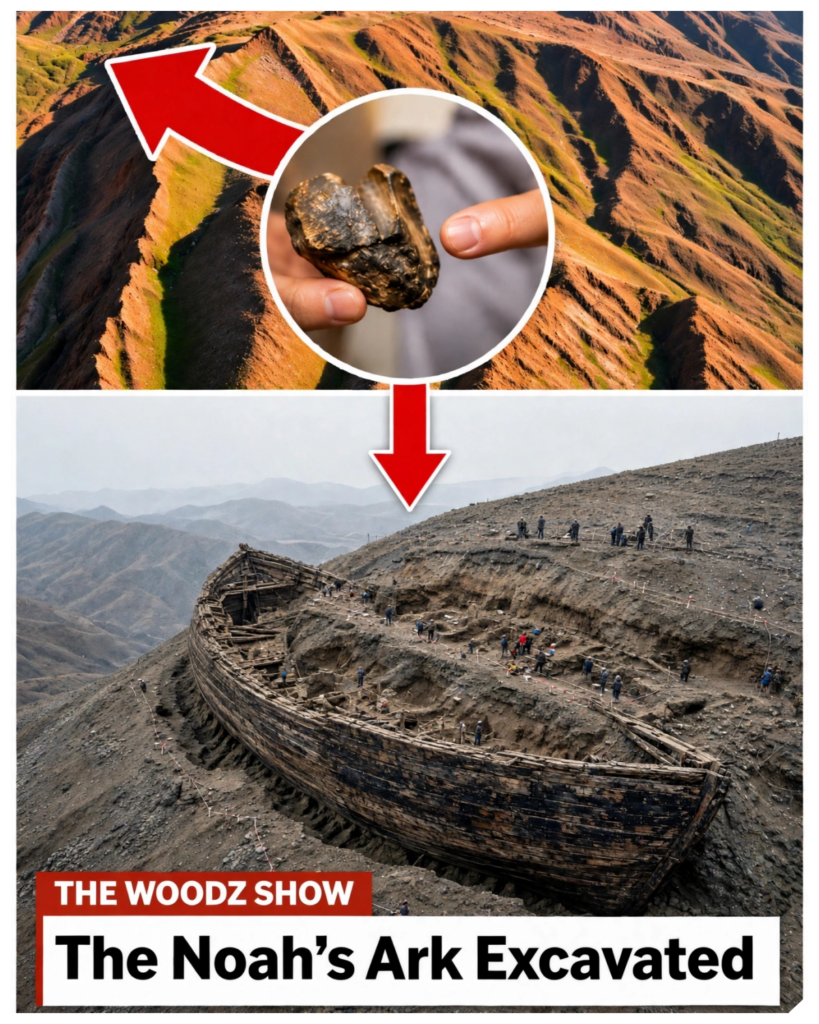
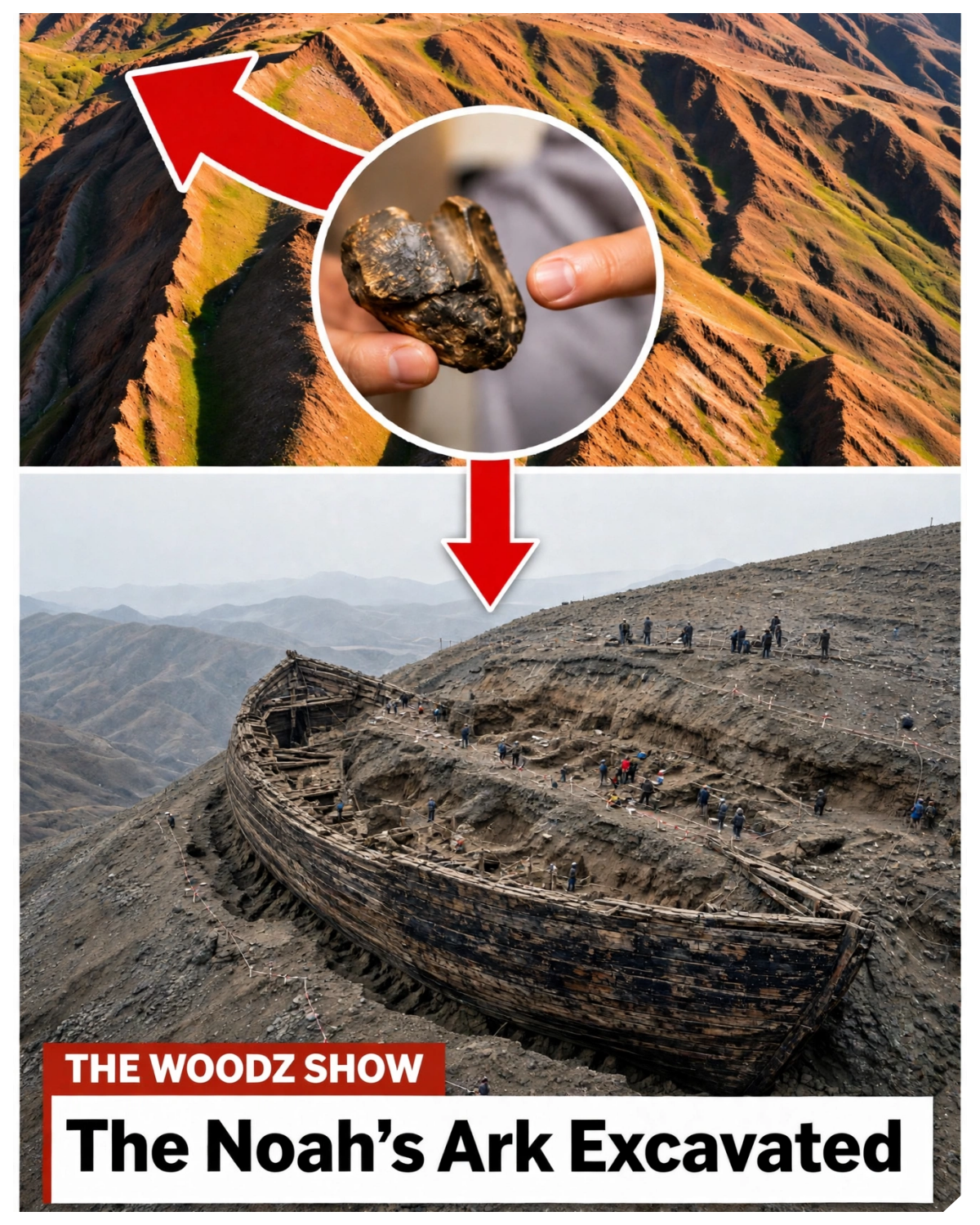
Never before seen lab results from a piece of wood that just might bring us one step closer to confirming the location of Noah.
[music] Disclaimer.
This video explores religious texts and historical theories.
All visuals are illustrative only and should not be taken as factual reporting [music] or verified depictions of current events.
As it was in the days of Noah, so it will be at the coming of the Son of Man.
Matthew 24:37.
Ladies and gentlemen, something extraordinary is unfolding near Mount Ararat in Turkey, where the search for Noah’s ark is taking an unexpected turn.
As researchers investigate a massive ship-shaped formation, a remarkable rainbow has appeared near the site, reminding believers of God’s ancient covenant with humanity.
The mystery deepens as researchers report uncovering unusual woodlike fragments buried 30 ft underground [music] alongside separate claims of prehistoric fossils.
Could these discoveries bring us closer to understanding the world before the Great Flood?
Before uncovering these mysteries, leave a prayer in the comments asking God to guide us with wisdom and discernment.
The first remarkable moment came not from beneath the earth, but from the heavens above near the Durupanar formation in eastern Turkey.
A beautiful rainbow appeared across the sky, overlooking the mountainous landscape believed by some researchers to hold the [music] remains of Noah’s ark.
Footage reportedly captured by an eyewitness showed the brilliant colors stretching across this historic region, creating a breathtaking scene that carried special meaning for many [music] Christians.
Ladies and gentlemen, what makes this moment remarkable [music] is not simply the appearance of a rainbow, but the biblical history associated with its location.
Scientifically, rainbows occur when sunlight is refracted [music] and reflected through water droplets in the atmosphere.
It is a perfectly natural phenomenon.
Yet, its significance in scripture takes us back thousands of years to one of the most extraordinary moments in biblical history.
When the waters of the great flood finally receded, Noah [music] and his family stepped onto dry land, leaving behind a world forever changed.
In that moment of uncertainty, God gave humanity a promise.
In Genesis 9:13, God declared, “I have set my rainbow in the clouds, and it will be the sign of the covenant between me and the earth.”
The rainbow became a lasting symbol of God’s promise, never again to destroy all life through a flood.
Where destruction had brought sorrow, God’s covenant offered hope.
Where humanity had witnessed judgment, it now encountered mercy.
Seeing a rainbow near the suspected resting place of Noah’s ark does not necessarily prove that a supernatural event has occurred.
Nevertheless, its appearance offers a powerful opportunity to reflect on God’s faithfulness.
Thousands of years may have passed since the days of Noah.
Yet, the message remains deeply meaningful.
Even after the darkest storms, God’s promises endure.
Yet, the mystery extends far beyond what appeared in the sky.
[music] Deep beneath the Durupanar Formation in Turkey, researchers have reportedly uncovered something that could open a fascinating new chapter in the search for Noah’s Ark.
According to a November 10th report by Fox News Digital, unusual fragments resembling charred wood [music] were recovered from approximately 30 ft beneath the surface of the ship-shaped formation.
Photographs released by the research team reveal darkened pieces with cracked surfaces, rough textures, and distinctive markings that appear to resemble natural wood grain.
What makes these fragments particularly intriguing is the depth at which they were discovered, [music] raising questions about their origin and how long they have remained buried.
Ladies and gentlemen, consider for a moment what this discovery could mean [music] if laboratory testing confirms that these fragments are indeed ancient wood.
Could they represent the remains of a man-made structure that has been concealed beneath layers of sediment for [music] thousands of years?
For decades, much of the debate surrounding Durupanar has focused on its remarkable shape.
The recovery of these physical samples, however, offers researchers material that can be examined directly.
Scientists still need to determine whether the fragments are genuine wood or geological material with a similar appearance.
If they are organic, further analysis could help establish their age, species, [music] and origin.
These details will be essential in understanding whether the material has any connection [music] to an ancient vessel.
Although the fragments have not been conclusively identified as remains of Noah’s ark, the discovery offers another compelling reason to continue investigating this extraordinary [music] location.
For believers who have followed the search for decades, the possibility of uncovering something historically significant is deeply exciting.
The greatest mystery, however, may not be these small fragments themselves, but what else could be waiting beneath the surrounding layers of Earth.
More than 300 soil samples have reportedly been collected from the Durupanar Formation, marking an important step in the continuing investigation of this mysterious site.
Rather than relying solely on its unusual appearance, researchers are now using advanced technology to examine what has remained concealed beneath the landscape.
One of their primary tools is [music] ground penetrating radar, a technology that sends electromagnetic pulses into the Earth.
When these signals encounter different materials or underground features, they reflect toward the surface, allowing researchers to identify variations without disturbing the entire site.
Alongside radar surveys, the team has conducted deep core drilling, extracting samples from various depths to examine the composition of the buried layers.
Interestingly, researchers have collected material from both inside and outside the formation.
Why is this comparison so important?
If the soil inside the boatshaped structure contains significantly different materials from the surrounding terrain, those differences could provide valuable clues about how the formation originated.
Researchers can also examine the samples for [music] organic matter, mineral concentrations, and evidence of past environmental conditions.
The challenge, however, lies in interpreting these findings.
An unusual radar signal could indicate a buried object, an underground cavity, or simply a natural variation in geological layers.
Laboratory analysis and independent scientific evaluation are therefore essential before drawing any definitive conclusions.
For those who have followed the search for Noah’s Ark over the years, these investigations represent [music] an exciting opportunity to move beyond speculation and toward measurable evidence.
If you want to follow the latest discoveries surrounding Noah’s Ark, subscribe to our channel and turn on notifications so you never miss an important update.
Every sample recovered brings researchers another opportunity to understand this remarkable formation.
Whether the investigation reveals an ancient human-made structure or an extraordinary geological phenomenon, the findings could deepen our understanding of this region’s mysterious past.
For now, the earth beneath Durupanar still holds many unanswered questions.
The search for Noah’s ark took an even more intriguing turn when reports emerged of an unusual fossil discovered near the Durupanar Formation [music] in eastern Turkey.
According to the original account, researchers examining sediment surrounding the suspected remains of the ark reportedly uncovered a fossilized bone believed to belong to a dinosaur.
Unlike the wood-like fragments recovered beneath the formation, this discovery raised questions about the ancient creatures that may once have inhabited the region.
Excavating fossilized remains is a delicate process.
Researchers must carefully remove surrounding sediment while preserving the specimen and documenting its original position.
The geological layers surrounding a fossil can provide valuable information about its [music] age, environmental conditions, and how it became buried.
Even a small fragment of bone can potentially reveal important details about a prehistoric animal.
What makes the reported discovery particularly fascinating is its proximity to the enormous ship-shaped formation?
Was the fossil simply part of a much older geological layer, or had natural forces transported it to this location over time?
Determining its origin would require careful examination of both the bone and [music] the surrounding sediment.
Ladies and gentlemen, the original account does not provide the fossils exact dimensions, [music] species, or excavation depth.
Nevertheless, the claim has revived a fascinating discussion about the mysterious creatures [music] described in scripture.
In Job 40:15 to 24, behemoth is portrayed as an immensely powerful creature with bones like tubes of bronze and [music] a tail resembling a cedar tree.
Job 41 introduces Leviathan, a fearsome creature protected by armor-like scales.
Some biblical interpreters associate these descriptions with prehistoric reptiles.
Others suggest that they describe known animals through poetic language.
Genesis 6:19-20 also records God’s instructions to Noah to preserve living creatures aboard the ark.
This has led some believers to speculate that younger prehistoric animals might have been among its inhabitants.
Ancient carvings and legends depicting enormous reptilian creatures have further fueled such discussions.
Modern paleontology, however, establishes that non-avian dinosaurs became extinct approximately 66 million years ago, long before humans appeared.
The reported fossil discovery near Durupunar has not been independently verified and its connection to Noah’s ark remains speculative.
Further excavation, geological analysis, and fossil identification would be necessary to establish what was actually recovered and whether additional prehistoric remains lie beneath the surrounding landscape.
Yet, mysterious animals were not the only extraordinary beings mentioned in the biblical account of the ancient world.
Before the waters of the great flood rose, scripture speaks of another mysterious group whose identity continues to provoke debate.
The Nephilim.
Before the first raindrop fell, a far greater danger had already spread across the ancient world.
It was not a natural disaster, but the corruption of humanity itself.
Genesis 6 introduces a mysterious group of beings known as the Nephilim.
Described as mighty men of old and men of renown, their presence has remained one of the most debated mysteries in scripture.
According to one ancient interpretation, they were the offspring of rebellious heavenly beings who abandoned their rightful place and formed forbidden unions with human women.
Other biblical scholars interpret the passage differently.
Regardless of their precise identity, scripture paints a disturbing picture of the generation in which they lived.
Violence had become widespread.
Wickedness dominated human thoughts [music] and the world had fallen into profound moral corruption.
In the midst of this darkness, one man stood apart.
His name was Noah.
God instructed Noah to construct an enormous vessel that would preserve his family and living creatures through the coming flood.
Interestingly, although scripture does not explicitly record a separate prohibition against the [music] Nephilim entering the ark, they were not among those identified as its passengers.
The most powerful moment came when Noah and his family [music] finally entered the vessel.
Genesis 7:16 records a remarkable detail.
Then the Lord shut him in.
It was God himself who closed the door, separating those sheltered within from the judgment approaching outside.
Ladies and gentlemen, how powerful [music] is that moment?
Noah’s protection rested not merely in the strength of the vessel, but in his obedience to God.
If you believe that God’s protection is greater than any storm, write God is my refuge in the comments.
Curiously, the name Nephilim appears again centuries later in Numbers 13:33.
When Israelite spies returned from exploring Canaan, [music] they reported encountering enormous people who made them feel as small as grasshoppers.
Their account terrified the Israelites.
Yet Joshua and Caleb refused to surrender to fear.
They trusted that God’s power was greater than any obstacle standing before them.
[music] Whether the spies encountered actual descendants of the Nephilim or used the name to express their overwhelming fear remains a matter of theological debate.
The enduring lesson of these accounts, however, reaches far beyond the mystery of ancient giants.
Human strength, influence, [music] and earthly power could not provide the security that Noah found through faithfulness to God.
The flood eventually receded, and humanity began a new chapter.
Yet, what happened to the enormous vessel that carried Noah’s family [music] to safety remains a mystery that researchers continue to explore?
What if the reason researchers have never recovered Noah’s ark in its entirety [music] is that parts of the vessel were deliberately removed thousands of years ago.
During the 1990s, researcher and author David Allen Deal explored the mountainous region around Mount Mata near Ararat in eastern Turkey.
Unlike explorers who concentrated their efforts on finding an enormous wooden structure, deal approached the mystery from a different perspective.
He examined local settlements, geographical landmarks, and ancient traditions that might reveal what happened after Noah [music] and his family stepped onto dry land.
During his investigations, Deal identified villages and landmarks whose names he believed were connected to the biblical account of Noah.
These observations encouraged him to develop an intriguing theory about the ultimate fate of the ark.
According to his hypothesis, Noah and his descendants may have gradually dismantled portions of the enormous vessel, using its timber to construct shelters and establish settlements as they began rebuilding their lives.
From a practical perspective, this possibility raises some interesting considerations.
After spending months aboard the ark, Noah’s family would have needed permanent shelter, agricultural tools, [music] storage facilities, and protection from harsh weather.
An enormous wooden vessel could have provided valuable construction materials for those purposes.
If portions of the ark were indeed reused, its original structure might have gradually disappeared, leaving scattered fragments rather than a recognizable ship.
This theory also offers a different direction for archaeological investigations.
Instead of searching [music] exclusively for a complete vessel, researchers could examine ancient settlements, buried foundations, and construction materials that might preserve evidence of early human occupation.
Local traditions, however, present a considerable challenge.
Place names can change over centuries, and stories passed down through generations can acquire new details.
Establishing a direct connection between these settlements and Noah’s family would require archaeological evidence, reliable dating methods, and historical documentation.
Deal also drew comparisons with ancient Mesopotamian literature, including the Epic of Gilgamesh, which contains an account of a catastrophic flood and a vessel that preserved life.
Although these similarities are fascinating, [music] they do not conclusively establish where Noah settled or what became of the ark.
[music] For now, the mountains of eastern Turkey continue to hold questions that remain unanswered.
Perhaps the most significant clues are not confined to a single ship-shaped formation, but scattered across a much wider landscape.
That possibility has encouraged researchers to look beyond Mount Ararat itself, turning their attention toward other ancient mountains that may hold clues to this enduring mystery.
The search, therefore, [music] extends far beyond the familiar slopes of Mount Ararat.
For generations, [music] explorers have focused their attention on the snow-covered summit of eastern Turkeykey’s [music] most famous mountain, believing that somewhere beneath its glaciers or volcanic rocks lie the remains of Noah’s ark.
However, a closer examination of scripture has encouraged researchers to consider a much broader geographical area.
Genesis 8:4 states, [music] “And on the 17th day of the 7th month, the ark came to rest on the mountains of Ararat.”
Notice something particularly important about this passage.
Scripture refers to the mountains of Ararat rather than identifying a single mountain [music] or providing its precise location.
This distinction has opened several possibilities concerning where the vessel may have [music] finally come to rest.
One of the most intriguing locations is Mount Judy, situated in southeastern Turkey near the borders of Iraq and Syria.
Although it receives considerably less international attention than Mount Ararat, this mountain has a long history of association with ancient [music] flood traditions.
For centuries, communities living throughout the surrounding region have preserved accounts connecting Mount Judy with Noah and his family.
Its significance extends across different religious traditions, including early Christian writings and Islamic [music] accounts.
The Quran specifically identifies Aljudi as the resting place of Noah’s vessel.
Historical traditions also describe religious gatherings near the mountain where generations of believers commemorated Noah’s deliverance from the flood.
These traditions have encouraged some researchers to question whether modern expeditions have concentrated too heavily on Mount Ararat while overlooking other historically significant locations.
Unlike the towering, permanently snow-covered summit of Mount Ararat, Mount Judy offers a more accessible mountainous environment.
Researchers who favor this location argue that its proximity to ancient Mesopotamia makes it geographically interesting, particularly when considering the early civilizations described in biblical history.
Nevertheless, religious traditions and geographical similarities cannot establish the presence of an ancient vessel.
No conclusively authenticated remains of Noah’s [music] arc have been recovered from Mount Judy.
Another region attracting attention is the vast Zagros mountain range extending across western Iran and parts of Iraq and southeastern Turkey.
Its rugged peaks, deep valleys, and isolated terrain have inspired alternative theories about the ark’s final destination.
The Zagros Mountains occupy an important geographical position near Mesopotamia, a region widely recognized as one of the earliest centers of human civilization.
Archaeological discoveries throughout this broader area have revealed ancient settlements, agricultural communities, and remarkable evidence of humanity’s early development.
Some researchers have argued that this geographical relationship deserves closer examination.
If the biblical account describes humanity gradually establishing new communities [music] after the flood, mountainous regions near the fertile lands of Mesopotamia could offer [music] an interesting setting for further historical investigation.
The difficulty is identifying a specific location within such an enormous mountain system.
Countless valleys and remote peaks remain difficult to explore, while thousands of years of erosion and geological activity have transformed the landscape.
Even if researchers discovered ancient timber or unusual structural remains, determining their original purpose would present another challenge.
Wood could have belonged to [music] settlements, religious structures, agricultural buildings, or other human activities unrelated to the ark.
Establishing a meaningful connection would require evidence far more substantial than an isolated artifact.
Perhaps the most unexpected alternative takes the investigation thousands of kilometers eastward into the Premier Mountains of Central Asia.
Often referred to as the roof of the world, the Pomeier contain some of the most remote and elevated landscapes on Earth.
Their immense mountain peaks rise above deep valleys where glaciers, extreme temperatures, and difficult terrain have limited human access to many areas.
Certain explorers and biblical researchers have proposed that the ark may have reached this region, drawing attention to ancient flood traditions and the extraordinary geographical characteristics of Central Asia.
Supporters of this hypothesis have examined stories passed down through different communities, searching for possible connections between regional traditions and [music] accounts of ancient catastrophic flooding.
Yet the considerable distance between the Pomeier and the historical region associated with Ararat presents a major obstacle.
Without archaeological discoveries or reliable historical documentation connecting the two, the premier theory remains highly speculative.
Ladies and gentlemen, one important question emerges from these competing locations.
How would researchers actually recognize Noah’s Ark if they encountered its remains?
After thousands of years, [music] an ancient wooden vessel exposed to changing temperatures, moisture, microorganisms, and geological disturbances would not necessarily retain its original appearance.
Under ordinary conditions, organic materials gradually deteriorate, making their preservation over such an immense period exceptionally challenging.
Certain environments, however, can slow this process.
Extremely cold temperatures, oxygen depleted sediment, or unusually dry conditions may preserve organic materials that would otherwise disappear.
This is why archaeological investigations [music] must consider the environmental history of each proposed location.
Researchers would need to understand whether the surrounding conditions could have preserved ancient construction materials and whether any recovered objects genuinely originated from the same historical period.
Modern technologies, including satellite imagery, aerial mapping, [music] and geological surveys, could help identify promising areas for further investigation.
These methods allow researchers to examine remote landscapes and recognize features that might escape detection during traditional ground expeditions.
Still, [music] identifying an unusual formation is only the beginning.
Establishing its origin requires physical evidence, careful documentation, reliable dating, and independent examination by qualified specialists.
A genuine archaeological breakthrough would need to withstand intense scrutiny, regardless of whether its implications supported or challenged existing interpretations.
The competing theories surrounding Mount Judy, the Zagros Mountains, and the Pameir demonstrate how many questions remain unanswered.
Each location presents a different historical or geographical argument.
Yet none has produced definitive evidence establishing the ark’s final resting place.
For Christians, this continuing uncertainty does not diminish the spiritual significance of Noah’s story.
The biblical account preserves a message that has endured through generations, [music] cultures, and centuries of human history.
Perhaps the most meaningful question is not simply where Noah’s ark rests today, but why Jesus himself directed humanity’s attention back to the days of Noah when speaking about the future.
Of all the ancient events recorded in scripture, Christ specifically chose this account to illustrate the spiritual condition of humanity before his return.
His words invite believers to look beyond the mountains, ancient artifacts, and archaeological mysteries towards something infinitely more important, [music] the condition of the human heart before God.
The greatest warning in the story of Noah was not the rising water, but the spiritual blindness of those who failed to recognize their need [music] for God.
In Matthew 24:37-39, Jesus declared, “As it was in the days of Noah, so it will be at the coming of the Son of Man.”
[music] He described people eating, drinking, marrying, and carrying on with their ordinary lives until the flood came.
Notice that Jesus did not condemn these ordinary activities.
The danger was that people had become so consumed by earthly concerns [music] that they neglected their spiritual condition.
They continued making plans for tomorrow without considering their relationship with the one who held their future.
How relevant is that message to our generation.
Humanity has achieved extraordinary technological progress.
Information travels across the world within seconds.
Medical discoveries save countless lives and scientific advancements reveal [music] mysteries that previous generations could scarcely comprehend.
Yet technological progress does not necessarily produce spiritual wisdom.
A person can possess everything the world considers valuable and still experience profound emptiness.
A society can celebrate its achievements while becoming increasingly indifferent to suffering, injustice, and the needs of others.
The story of Noah challenges believers to examine their own hearts [music] rather than merely condemn the world around them.
Hebrews 11:7 tells us that Noah, [music] when warned about things not yet seen, built an ark through faith.
His obedience was not dependent upon visible evidence of the approaching flood.
He trusted God’s word even before witnessing [music] its fulfillment.
That is the kind of faith Christians are called to demonstrate today.
Remaining faithful is not always easy.
There are seasons when prayers seem unanswered, when circumstances become overwhelming, [music] and when the future appears uncertain.
Sometimes believers may even wonder whether God has forgotten them.
Yet scripture consistently reminds us that God’s silence does not mean his absence.
Consider the words of second Peter 3:9.
The Lord is not slow in keeping his promise as some understand slowness.
Instead, he is patient with you, not wanting anyone to perish, but everyone to come to repentance.
What humanity sometimes interprets as delay may actually be an expression of divine mercy.
Every passing day represents another opportunity for someone to turn away from sin, restore a broken relationship, [music] seek forgiveness, and discover the transforming love of Jesus Christ.
Ladies and gentlemen, the purpose of biblical prophecy is not to fill our hearts with terror.
It is to awaken our spiritual awareness and remind us that our earthly lives carry eternal significance.
Jesus never instructed his followers to abandon their responsibilities or spend their lives calculating the date of his return.
Matthew 24:36 clearly declares that no one knows the day or the hour.
Neither archaeological discoveries nor extraordinary natural phenomena [music] can establish that appointed moment.
Instead, Christ calls believers to remain ready through faith, obedience, compassion, and love.
Spiritual readiness can be demonstrated through [music] something as simple as forgiving someone who has caused us pain, helping a struggling neighbor, comforting a grieving family, or choosing honesty when dishonesty would be easier.
These quiet [music] acts of faithfulness may receive little recognition from the world, yet they reflect the character [music] of Christ.
The ark carried Noah and his family through the waters of judgment.
Today, the Christian message points toward a greater refuge found in Jesus Christ.
In John 14:6, Jesus declared, “I am the way and the truth and the life.
No one comes to the father except through me.”
Our hope rests not in an ancient wooden vessel, but in the living savior who gave his life for humanity.
Whatever challenges tomorrow may bring, believers can face them with confidence that God’s love remains unchanged.
The same Lord who demonstrated mercy in the days of Noah continues to invite people into a relationship with him.
Do not allow uncertainty about the future to steal the peace God offers [music] today.
Strengthen your faith.
Cherish your family.
Extend kindness to others.
[music] And remember that no earthly treasure is more precious than a heart surrendered to Christ.
May God grant us wisdom to recognize the truth, courage to remain faithful, [music] and compassion to share his love with those who need it most.
Thank you for watching.
May the Lord bless you and your family, protect you through every storm, and guide your steps until the glorious day when faith becomes sight.
Amen.