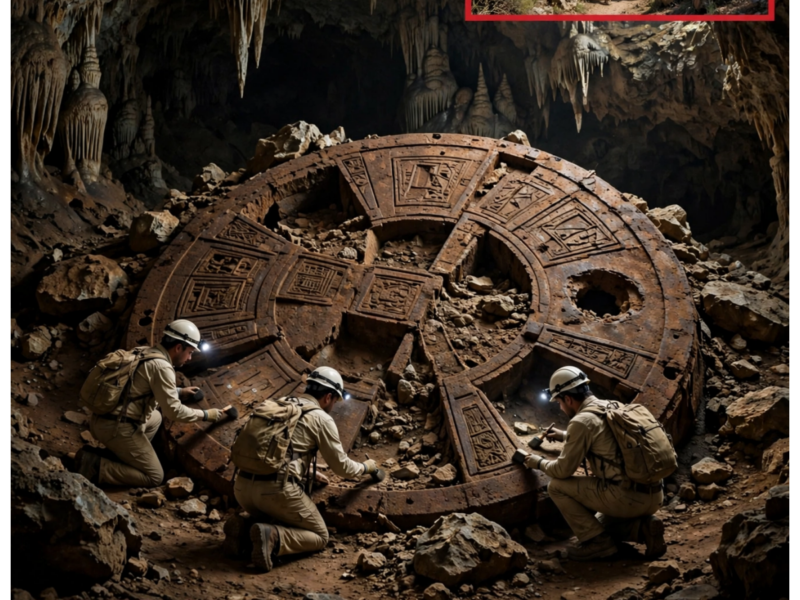
Well, they started with the renderings of the ship based on the book of Genesis in which God gave Noah.
He has fresh evidence working with a local professor to look beneath the surface after [music] they could have moved in later, which would explain the bones.
The only proof I have of this theory is that the ground in in the Tenderek mountains near Ararat, a massive ship-shaped land mass is sparking debate worldwide.
[snorts] But its outward appearance isn’t the most striking feature.
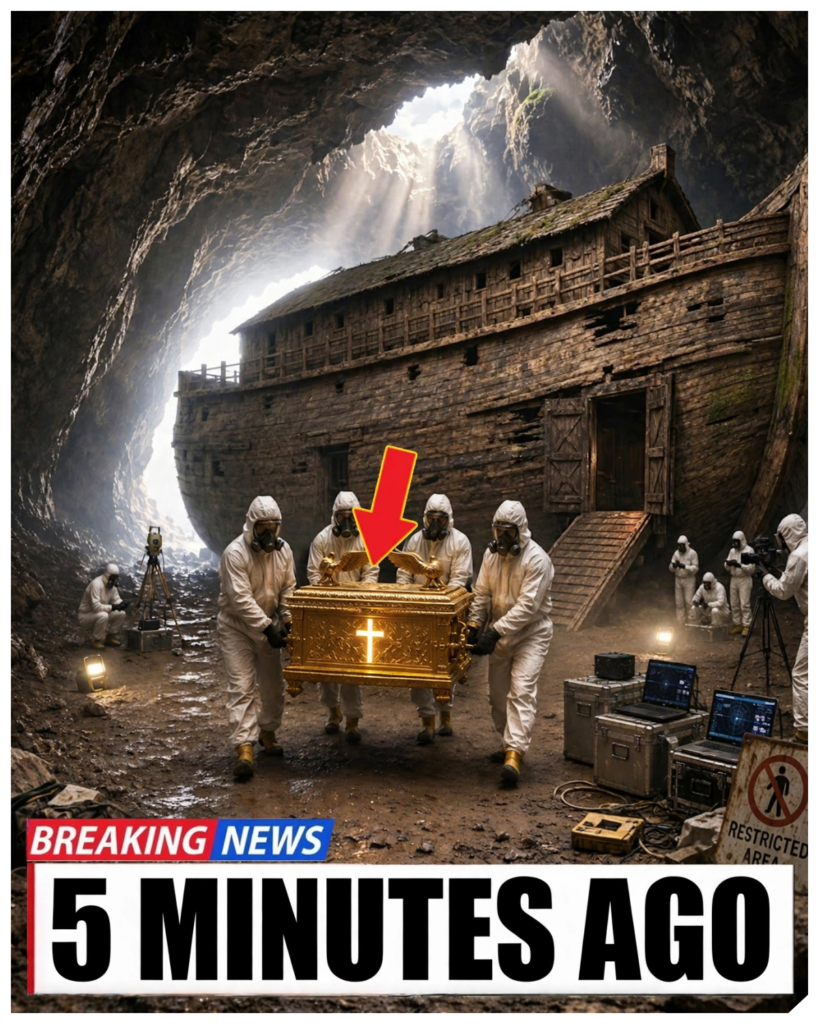
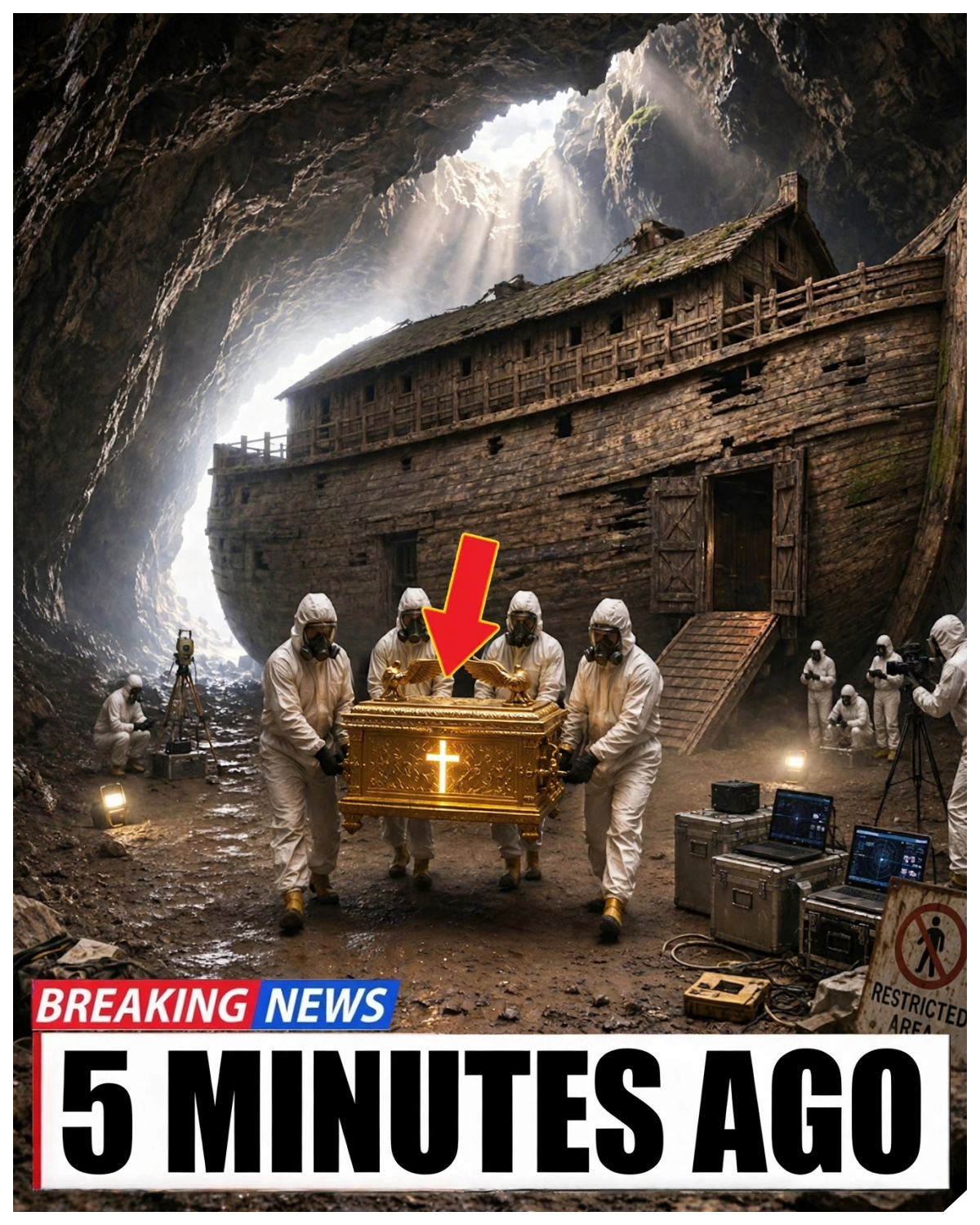
Scans beneath the surface are believed to have revealed a tunnel containing deliberately arranged skeletons, a sealed chamber resembling a prison cell, and a gilded chest with two cherubim on its lid.
Genesis 8:4 states that Noah’s ark landed on the Ararat mountains.
So, is this just a strange geological formation [music] or a relic of a story recorded in the Bible thousands of years ago?
Before continuing, please like, subscribe, and share this video so more Bible enthusiasts can learn about it.
Do you believe this is Noah’s ark or just a natural phenomenon?
Let us know in the comments below.
It began with a massive ship-shaped formation rising from the rugged landscape of the Tendurk Mountains in eastern Turkey.
Viewed from above, the outline resembles the hull of an ancient vessel with one end narrow and pointed while the other appears broader.
Stretching more than 500 ft or about 150 m, the formation is far too large to ignore.
Its size is what first led many people to compare it with Noah’s ark.
Genesis describes the ark as being 300 cubits long.
And depending on the ancient cubit measurement used, that length comes remarkably close to the dimensions of the tendere formation.
The resemblance is striking, but shape and size alone cannot prove that a wooden vessel lies beneath the mountain.
Erosion, volcanic activity, and shifting layers of rock can also produce formations that appear almost deliberately designed.
Even so, the location makes the mystery difficult to dismiss.
Genesis 8:4 states that the ark came to rest on the mountains of Ararat.
The verse refers not necessarily to one specific summit, but possibly to the wider mountainous region surrounding Ararat, an area that includes the tender site.
So, could this be nothing more than an extraordinary work of nature?
Or might something ancient still remain buried beneath the surface.
The ship-like outline first drew the world’s attention, but it was what later scans reportedly detected underground that would deepen the mystery.
According to the reported radar scans, a narrow passage appeared deeper beneath the formation.
At first, researchers believed it might be a simple structural corridor.
[music] However, the objects detected inside raised far more disturbing questions.
The tunnel was said to contain numerous bone fragments and partial skeletons.
They did not appear to be scattered randomly as would normally happen through erosion, flooding, or the natural movement of soil.
Instead, the remains were described as being separated into groups and placed along specific sections of the passage.
Their positions seemed deliberate, almost as though someone had carefully arranged them before the tunnel was sealed.
This unusual pattern led the research team to consider another possibility.
Perhaps the passage was not designed for storage or movement, but served as an isolation area, a place where certain individuals or creatures were kept apart from the rest of the structure.
Yet, without a complete excavation and independent laboratory testing, the identity and age of the remains cannot be confirmed.
The discovery also drew attention to Genesis 6:4, which mentions [music] the Nephilim living on the earth before the great flood.
Because of this verse, the article raises the possibility that the arranged skeletons were connected to these mysterious beings.
Still, this remains an interpretation rather than established evidence.
And the tunnel was not the end of the passage.
Beyond it, [music] scans reportedly revealed a sealed narrow chamber that looked less like an ordinary room and more like a place built to confine something.
Its [snorts] shape immediately raised questions.
The chamber did not resemble a stable, a storage room, or any normal space designed for daily use.
Instead, it appeared large enough to contain only one unusually large individual.
With thick walls and no obvious secondary entrance, the room looked less like a place of shelter and more like something built to prevent escape.
Some researchers compared its shape to an ancient coffin.
Others believed it may have served as a special confinement chamber created to separate one dangerous or mysterious occupant from everything else inside the structure.
However, without excavation, physical samples or independent verification, its original purpose remains unknown.
The description has also been connected symbolically to Jude 1:6, which speaks of angels who abandoned their proper place and were kept in darkness, bound while awaiting judgment.
The verse does not identify this chamber or prove that anything supernatural was held there.
But it adds a disturbing biblical parallel to the discovery.
If this room truly was designed for confinement, the question becomes unavoidable.
What was considered so dangerous that it had to be sealed away from every other compartment.
Yet the mystery did not end inside that narrow chamber.
Deeper within the structure, another object was reportedly detected, one whose shape closely resembled a sacred artifact described in the book of Exodus.
Beyond the sealed chamber, the investigation reportedly uncovered an object unlike anything else inside the structure.
A rectangular chest resting near the center of a deeper room.
At first, it appeared to be buried beneath layers of dust and sediment, but when researchers examined its outline more closely, traces of a metallic surface were said to remain visible beneath the debris.
[music] The chest was described as having once been covered with gold.
Even more striking were the two winged figures positioned on its lid.
They appeared to face one another with their wings extended inward over the center of the chest.
This arrangement immediately reminded some observers of one of the most sacred objects described in the Bible, the Ark of the Covenant.
[music] Exodus 25-1022 gives detailed instructions for constructing the ark.
It was to be made of wood covered [music] with pure gold and topped with two cherubim facing each other with their wings spread above the mercy seat.
Because the reported object appears to share these features.
Some have suggested that it could be the ark itself.
Others propose a different possibility.
If the object truly predates Moses, it may have been an earlier sacred chest or a prototype connected to an older form of worship.
However, no independent examination has confirmed its age, material, or identity.
[music] Still, the resemblance raises a powerful question.
Why would an object matching the biblical description of the Ark of the Covenant be hidden inside a structure associated with Noah?
And if the chest was placed there intentionally, what did it mean to protect or preserve?
Another unusual detail was reportedly found along the corridor leading deeper into the structure.
The walls were described as being covered with a thick, hardened black substance [music] that resembled ancient tar or asphalt.
In several areas, the coating appeared to fill cracks and join sections of the passage together, suggesting that it may have been applied deliberately rather than formed naturally.
In the ancient world, tar-like materials were commonly used to waterproof wooden structures.
A heavy coating could protect the surface from moisture, prevent water from entering through small gaps, and help preserve the interior over long periods of time.
If this passage was once part of a wooden vessel, the black material may have served as a protective seal against the floodwaters outside.
However, the placement of the coating raised another possibility.
The substance was reportedly especially thick around the narrow corridor and the sealed chamber.
This led some observers to wonder whether it had another purpose beyond keeping water out.
Perhaps it was also intended to strengthen the walls, close every opening, and prevent something inside from breaking free.
This detail closely echoes Genesis 6:14, where God instructs Noah to build the ark [music] and cover it with pitch both inside and outside.
The similarity does not prove that this corridor belonged to Noah’s ark, but it strengthens the connection drawn by those studying the site.
Was the black coating simply an ancient method of waterproofing?
Or was the passage sealed so carefully because its builders feared what might be contained behind it?
Inside the gilded chest, researchers reportedly found several stone slabs covered with an unfamiliar system of writing.
The characters were described as simple angular marks resembling early protosemitic script, although some observers suggested they could be even older than the earliest known Hebrew inscriptions.
If that description is accurate, the tablets may have come from a period long before Moses received the Ten Commandments [music] at Mount Si.
According to the reported translation, the inscriptions contain rules about worship, warnings against moral corruption and repeated [music] commands to remain obedient to God.
Rather than recording ordinary trade or daily events, the words appear to focus on how people should live and what happens when they reject divine authority.
This has led to a striking theory.
Perhaps basic moral laws were already known in the generations before the great flood.
The Bible describes Noah as a righteous man living among a deeply corrupt society, suggesting that people could still recognize the difference between right and wrong even before the law of Moses was written.
Romans 2:14:15 offers a possible connection.
It says that the requirements of the law can be written on the human heart while conscience bears witness to a person’s [music] actions.
In that sense, written commandments may not have been the beginning of moral knowledge, but a later confirmation of principles humanity had already received.
Still, the age, translation, and origin of these slabs remain unverified.
Yet, if they truly predate Moses, they could suggest that humanity once possessed a much older record of God’s commands, one preserved through the flood and later forgotten.
Near the inner chamber, investigators reportedly discovered another object that deepened the mystery.
A fossilized bone fragment partly buried beneath layers of sediment.
At first, its size and unusual shape made it difficult to identify.
However, the curved structure and dense fossilized surface led some observers to believe that it may have come from a very large reptile.
Further examination reportedly suggested that the fragment could belong to a dinosaur or another extinct creature of similar size.
If that interpretation is correct, the discovery would raise a difficult question.
How could the remains of such an ancient animal appear inside or so close to a structure believed by some to be connected with Noah’s ark?
One theory is that large prehistoric creatures may still have existed during the time described in the flood account.
Others argue that the bone could have been carried into the area by natural forces, mixed into the surrounding sediment, or misidentified entirely.
Without laboratory testing and independent verification, its true species and age remain uncertain.
The discovery has also been connected to the description of behemoth in Job 40-15:24.
The passage speaks of an immensely powerful creature with great strength in its body and bones.
Because of this paragraph, some readers believe Behemoth may have referred to a dinosaur or another enormous ancient animal, while others interpret it as a known creature described poetically.
Whatever the fragment may be, its presence adds another layer to the mystery.
Was it simply a fossil trapped in the surrounding rock or evidence that creatures remembered in scripture once lived much closer to humanity than modern history suggests?
Beneath all [music] the mystery, the story carries a warning that is much larger than the question of whether Noah’s ark has truly been found.
The world before the flood was described [music] as deeply corrupted.
Violence had spread, moral boundaries had collapsed, and humanity had turned away from God.
Noah’s task was therefore not only to preserve life, but also to carry forward what was still meant to survive.
In that [music] sense, the ark was more than a place of rescue.
It was also a boundary between what could continue and what had to remain behind.
That idea gives the sealed tunnels and hidden chambers a darker meaning.
[music] If something was deliberately isolated, covered, and locked away, perhaps it was not meant to be recovered.
Some things may have been sealed because their return would bring danger rather than knowledge.
This is where the ancient warning becomes relevant today.
Modern people are often driven by curiosity, [music] ambition, and the desire to uncover every secret.
Yet discovery does not always mean understanding and opening something is not the same as being prepared for what lies inside.
The central question then is not simply has Noah’s ark been discovered.
This is what happens when humanity opens a door that was intentionally sealed in ancient times.
Perhaps the greatest danger is not what may be hidden behind that door, but the belief that human curiosity alone gives us [music] the right to open it.
The unusual signs surrounding the ship-shaped formation near Ararat create more than a mysterious archaeological story.
When viewed alongside human life and the Bible, they also suggest a deeper message about [music] curiosity, corruption, and the boundaries humanity should not cross without understanding the consequences.
The ship-like landform reminds us that time may cover ancient traces, but it does not necessarily erase their meaning.
[music] The reported tunnels, sealed chambers, and objects believed to lie beneath the surface all raise the same question.
Why were they separated and closed off?
Although these claims have not been independently verified, the image carries powerful symbolic meaning.
A locked door may not only protect what is inside, it may also protect those living outside.
This warning connects directly to modern life.
Humanity now possesses the technology to excavate, analyze, and reach places that earlier generations could never access.
[music] Yet knowledge does not always come with wisdom.
Deuteronomy 29-29 says, “The secret things belong to the Lord our God.”
This reminds us that some mysteries may remain beyond human understanding and authority.
[music] The reportedly arranged bones, the prison-like chamber, and the black substance sealing the corridor all suggest separation.
Some things may have been preserved so they could continue, while others may have been isolated because they were never meant to be released.
The same lesson applies to spiritual life.
People must recognize what should be protected, what must be left behind, and what should never be awakened again.
Proverbs 14:12 warns that a way may appear right to a person, yet its end can lead to destruction.
An action may begin with harmless curiosity, but without wisdom and restraint, [music] its consequences can move far beyond anyone’s control.
Jesus also referred to the days of Noah in Matthew 24-37:39.
[music] People continued eating, drinking, marrying, and living ordinary lives until the flood came unexpectedly.
The problem was not their daily activities, but their failure to recognize the warning signs around them.
Therefore, the greatest question is not simply whether Noah’s ark has finally been discovered.
The real question is whether humanity today possesses enough wisdom to recognize its own limits.
Ancient discoveries may expand our knowledge, but they also remind us that not every door we find must be opened.
Sometimes wisdom is not found in uncovering every secret, but in knowing when to stop before something we do not yet understand.
Jesus Christ is beautiful in ways that challenge ordinary expectations.
In him, qualities that seem opposite do not compete.
They belong together perfectly.
He is majestic yet gentle.
He is almighty yet willing to draw near.
He rules as king yet gives himself as a sacrifice.
He is the lion who conquers and the lamb who was slain.
These truths do not weaken one another.
Each one makes the other more glorious.
Human beings often imagine greatness as distance.
We expect powerful rulers to remain above ordinary people protected from weakness, pain, and service.
We also tend to imagine gentleness as a lack of strength.
Jesus overturns both ideas.
His authority does not make him cold and his humility does not make him powerless.
He possesses infinite greatness while showing perfect compassion.
He is strong enough to rule all creation and loving enough to enter human suffering.
Christians confess that Jesus is Lord.
This means far more than calling him a wise teacher or inspiring leader.
He is fully divine.
Through him all things were made and by his power creation continues to exist.
Nothing lies beyond his knowledge, authority or wisdom.
History is not moving outside his control.
[music] Every nation, ruler, generation and hidden purpose remains beneath his sovereign rule.
His lordship does not depend on human approval.
He is king whether the world recognizes him or not.
Yet this eternal lord also became our savior.
The son of god did not cease to be divine when he came into the world.
He took a complete human nature and entered real history [music] with a human body, mind, emotions, and will.
He experienced hunger, tiredness, sorrow, rejection, friendship, and pain.
He did not rescue humanity from a safe distance.
He came near and lived among the people he came to save.
Because he is fully human, he can represent us.
Because he is fully divine, [music] his saving work has unlimited worth and power.
He is not merely a strong God who remains far away, nor merely a compassionate man who lacks the power to rescue.
In one person, Jesus brings divine authority and human nearness together.
He is able to save and he is willing to save.
[music] Revelation 5 presents this beauty through a dramatic vision.
John sees God seated on the throne with a scroll in his right hand.
[music] The scroll is written on both sides and sealed with seven seals.
It represents God’s hidden purposes for history, judgment against evil, salvation for his people, and the final fulfillment of his kingdom.
A mighty angel asks, “Who is worthy to open the scroll and break its seals?
The question is not who is intelligent, powerful or curious enough.
It is a question of worthiness.
Who possesses the moral perfection and authority required to carry out the purposes of God?
The answer initially appears devastating.
No one in heaven, on earth, or under the earth is found [music] worthy.
No angel, ruler, prophet, warrior, scholar or saint can open the scroll.
Human achievement reaches its limit.
Intelligence cannot unlock it.
Military strength cannot seize it.
Religious effort cannot earn the right to reveal it.
Jon begins to weep because the resolution of history remains beyond human reach.
His sorrow expresses a longing shared by all people.
We want evil to be answered, injustice to end, and suffering to have meaning.
We want history to move toward restoration rather than endless confusion.
Yet no ordinary human being can guarantee that ending.
Then one of the elders tells John not to weep.
The lion from the tribe of Judah, the root of David, has conquered.
He is worthy to open the scroll.
These titles identify Jesus as the promised king.
The lion represents royal authority, courage, strength, and victory.
The root of David shows that Jesus fulfills the ancient promise of a righteous ruler whose kingdom will endure.
Yet when John turns to see the announced lion, he sees a lamb standing as though it had been slain.
This is the surprising center of the vision.
John hears about a lion but sees a lamb.
Jesus conquered not by avoiding suffering but by giving himself through it.
His victory [music] came through sacrifice.
The Lamb bears the marks of death, yet he is standing.
He was slain, yet he lives.
His wounds are not signs of defeat, but evidence of the way he conquered.
At the cross, Jesus faced sin, judgment, and death.
In the resurrection, he rose victorious.
The lamb who gave himself is also the king who cannot be overcome.
This reveals a form of power.
Unlike the power celebrated by the world, human power often seeks to preserve itself at the expense of others.
Jesus used his power to give himself for others.
Human rulers may sacrifice their people to protect their thrones.
Jesus left glory, entered suffering, [music] and gave his life to rescue his people.
His gentleness does not reduce his majesty.
It reveals what his majesty is like.
The greatest king is not selfish.
The strongest ruler is not cruel.
The one with all authority is also the one who serves.
His humility is not weakness.
It is strength under perfect control, directed by perfect love.
We need both the lion and the lamb.
If Jesus were only mighty, we might admire him from a distance while fearing that sinners could never approach him.
If he were only gentle without divine authority, we might appreciate his kindness while wondering whether he could truly defeat evil, forgive sin, or overcome death.
But Jesus is both.
Because he is the lamb, we know that he has drawn near and given himself for us.
Because he is the lion, we know that his sacrifice is powerful enough to save completely.
[music] His tenderness gives us confidence to approach him, and his authority gives us confidence [music] that he can keep every promise.
Throughout Revelation, the Lamb continues to act with lionlike power.
He opens the seals, gathers a people from every tribe and nation, defeats the accuser, receives honor from heaven, and reigns from the throne.
The title lamb remains central because his sacrificial love is not a temporary stage that he leaves behind.
It forever reveals who he is.
This combination of greatness and nearness answers two deep human longings.
We want to admire someone greater than ourselves, but we also want to be known and loved personally.
We long for a king who can rule the universe.
And we long for a friend who understands our weakness.
In Jesus, these desires meet.
Jesus is therefore more than Lord and more than Savior.
He is also our treasure.
Salvation is not merely receiving benefits from him while remaining uninterested in him.
Eternal life is knowing God through Jesus Christ.
The greatest gift of the gospel is Christ himself.
People often try to fill the deepest hunger of the soul with success, comfort, relationships, possessions, knowledge, entertainment or recognition.
These things may be good gifts, but they cannot become our ultimate purpose.
Jesus satisfies because he is both infinitely glorious and personally near.
His greatness gives the soul someone worthy of endless admiration and his love gives the heart a secure home.
This changes how believers face suffering.
The lamb understands pain because he endured it.
The lion rules over suffering because he has conquered.
Christians do not trust someone unfamiliar with grief, nor do they depend on someone unable to redeem it.
Jesus is present in sorrow and sovereign over its final outcome.
It also changes obedience and worship.
We do not obey merely because a distant ruler demands submission.
We obey the king who loved us and gave himself for us.
We worship Jesus not only for what he gives but for who he is.
His justice makes his mercy meaningful.
His holiness makes his nearness astonishing.
His power makes his gentleness safe.
His sacrifice makes his kingship beautiful.
The message of Revelation 5 is ultimately a message of hope.
History is not trapped behind seals forever.
Evil will not remain unanswered.
Human failure does not have the final word.
Someone worthy has been found.
Jesus has conquered.
The lion has the strength to open the scroll.
And the lamb has the worthiness to carry out God’s purposes.
The one who rules history is the same one who gave himself to save sinners.
Believers may still grieve suffering, [music] injustice, and loss, but they do not grieve as though no answer exists.
The throne is occupied.
The scroll is in God’s hand.
The lamb [music] is standing.
Jesus is our Lord, possessing all authority.
He is our savior, giving himself for our rescue.
And he is our treasure worthy of our deepest love and lasting joy.
We were made not only to receive help from Jesus but to know him, admire him, trust him, and enjoy him.
In him majesty and meekness meet, might and mercy embrace.
Grandeur and gentleness shine together.
The lion is the lamb.
The sacrificed savior is the reigning king.
And in this one glorious person, the deepest longings of the human soul finally find their answer.
Eyewitnesses through history have [music] added fuel to the mystery.
In the 13th century, Marco Polo wrote of a great vessel resting on the mountain.
Centuries later, British explorer [music] James Bryce claimed to have found wood fragments high upon Ararat’s slopes.
While critics argue these accounts are mere legends or geological coincidences, [music] believers see them as confirmations that the ark’s legacy endures, yet the debate rages on.
Scientists [music] remain divided, many dismissing the formation as a quirk of nature.
But for those of faith, the duropanar site is [music] not just stone and soil.
It is testimony.
It speaks of judgment, mercy, and God’s covenant with humankind.
[music] It stands as a reminder that the Bible’s most dramatic stories may not be myth, but history [music] etched into the earth itself.
Stay with us.
What was found inside the ark’s remains will shock you even [music] more.
When news first broke that a fossilized mammoth had been discovered within the remains of a structure [music] long believed to be Noah’s ark, the world reeled in disbelief.
For generations, [music] the ark had been portrayed as a vessel carrying pairs of familiar creatures, sheep, goats, [music] lions, and doves.
But the idea that colossal ice age beasts once walked up its wooden ramp, shakes both science [music] and faith.
Mammoths, long thought to have vanished thousands of years before recorded history, [music] suddenly emerge as part of the biblical flood narrative.
Their remains, uncovered deep within the ark’s [music] suspected resting place, invite profound questions.
Were these magnificent giants [music] part of the two of every kind that God commanded Noah to save in Genesis [music] 6:1 19:20?
Or were they swept into the ark’s remains after the flood, intombed by rushing waters and layers of sediment?
[music] Some researchers suggest that mammoths, like other ice age animals, lived alongside early humans longer than modern textbooks admit.
If so, Noah could indeed have taken young [music] or smaller specimens aboard, ensuring their survival during the flood.
Others propose a different explanation that the [music] waters of judgment preserve these creatures in fossilized form, locking them forever into the ark’s legacy.
[music] The presence of a mammoth fossil in this sacred context ties directly to scriptures descriptions of mighty creatures that puzzled theologians for centuries.
The book of Job speaks [music] of behemoth, a beast of immense strength, whose tail moved like a cedar and whose bones [music] were like bars of iron.
Job 40:15.
While interpretations vary, many have connected this creature [music] to large, now extinct animals.
Similarly, Job 41 describes Leviathan, a terrifying sea monster, [music] suggesting that the ancient world knew beasts beyond our present experience.
Finding a mammoth within the ark’s ruins blurs [music] the line between myth and memory.
It forces us to confront the possibility that prehistoric [music] creatures were part of God’s original creation, coexisting with humanity until judgment fell.
This discovery also highlights the [music] cataclysmic power of the flood itself.
The waters were not merely rainstorms.
They were earthshattering upheavalss, reshaping continents, [music] burying forests, and intombing living beings in rock and mud.
[music] In this context, the fossil is more than bone.
It is a monument to the violence and finality [music] of divine judgment.
Scientists remain cautious as always.
Some argue the fossil may [music] have washed into the ark’s outline long after the flood.
Others contend that it proves nothing about Noah, only about Turkeykey’s complex geology.
But to believers, the discovery resonates with God’s [music] faithfulness.
It proves that his command to save life extended beyond what we might expect, and that his judgment was both thorough and unforgettable.
If the discovery of a mammoth fossil within the ark’s supposed resting place stunned the world, [music] what came next shattered expectations entirely.
Near the Duropanar site, scientists unearthed what appeared to be a fossilized [music] dinosaur bone.
For many, this raised an impossible question.
How could evidence of dinosaurs [music] said to have gone extinct 65 million years before humans existed be found in the same place [music] tied to Noah’s ark?
The implications are staggering.
Traditional evolutionary science [music] insists that dinosaurs died out long before mankind walked the earth.
Yet, the Bible hints at monstrous creatures living alongside [music] humanity.
In Job 40:158, the behemoth is described as a land beast of unparalleled strength [music] with bones like iron and a tail compared to a cedar tree.
Job 41 speaks of Leviathan, a terrifying sea monster whose fiery breath and armored [music] scales defy any ordinary explanation.
Could these vivid accounts describe [music] dinosaurs or creatures like them that survived until the flood?
Ancient cultures worldwide also preserve memories of giant reptilian [music] beasts.
Mesopotamian carvings depict serpent-like creatures.
Medievalities recognizing its cultural and religious significance declared the area a national park in 1,987, a decision that both protected the site and ignited worldwide curiosity.
Since then, Ararat has become a [music] magnet, drawing scientists, journalists, believers, and skeptics alike.
Each hoping to uncover truth beneath legend.
Why does this mountain [music] captivate so many?
Aerial photographs reveal a striking outline, 538 ft long, etched into [music] the earth, resembling the skeleton of a colossal ship.
Soil samples inside the formation [music] hold three times more organic matter than the surrounding terrain, as if something once alive had decayed [music] there.
Radar scans suggest symmetrical chambers and deck-like layers.
Features too precise [music] to be explained easily by natural geology.
These anomalies may point to the possibility that the ark was not swallowed by [music] time.
Yet with every discovery comes controversy.
Some geologists insist the Durupanar formation is merely a quirk of mud flows and erosion.
Others argue the evidence is too compelling to dismiss.
Believers see an Ararat the hand of God preserving testimony for the final days.
Skeptics see only coincidence shaped by nature.
And so the debate rages science [music] against faith.
Jesus himself warned of such days in Matthew 24:37.
He declared, “Just as the people of Noah’s generation mocked until the flood came suddenly, so too our world may be blind until the final judgment descends.
[music] The mountain still whispers a question.
Are we listening?”
When the first explorers cut deeper into the frozen [music] flank of Mount Ararat, what they uncovered silenced even the most hardened skeptics.
Beneath layers of ice and volcanic stone lay massive wooden beams, preserved against the centuries.
These were not fragments or splinters, but colossal timbers longer [music] than a city bus aligned with uncanny precision.
Their size alone defied explanation.
No tree native to this region could have produced such beams.
Yet here [music] they were, fused into the mountain as though hidden deliberately.
Closer examination revealed something even stranger.
The fibers of this ancient wood were coated in a dark resin.
[music] Tests showed the resin resisted decay, shielding the timber from rot for thousands of years.
Believers immediately drew the parallel with Genesis 6:14, where God instructed Noah to cover the [music] ark inside and out with pitch.
That pitch was more than waterproofing.
It symbolized atonement, a covering against judgment.
The very substance that preserved Noah’s ark now seemed to echo through the preserved resin in [music] Ararat’s beams.
As excavation widened, a floor section collapsed, revealing fossilized impressions pressed deep into the planks.
They were not random marks of nature, but distinct [music] outlines.
Hoof prints, claw marks, scratches hardened by time.
Scientists argued over their origin, but to many they looked like the footprints of creatures [music] sealed inside a silent testimony that this was more than geology, that living beings had once crowded into its [music] chambers.
Feathers, fragments of woven reeds, and even bones were recovered bones belonging not to species native to Turkey, but to creatures from distant continents.
[music] A jawbone resembled that of an African analopee.
Pigmented feathers matched birds of Asia.
How could such remains appear here thousands of miles from their homelands?
[music] Unless, of course, a vessel carried them.
Clay jars, cracked and blackened [music] by age, lay scattered in the hollow spaces.
Some still bore residues of bumen, the very material described in ancient accounts [music] of a flood.
It was as though the ark had been frozen midvoyage, intombed before its memory could vanish.
The vessel described in scripture was not [music] just allegory etched into holy text.
Its marks, its cargo, its design seemed to surface here in stone [music] and resin.
Yet the discoveries carried a chilling reminder.
While the ark preserved Noah and his family, [music] it also stood as a dividing line between life and death.
For those inside, safety.
For those outside, destruction.
Jesus compared the coming of the Son of Man [music] to the days of Noah.
People eating, drinking, marrying, unaware until the flood swept them away.
These beams, these fossilized marks were more than artifacts.
They were warnings carved into history.
They remind us that divine judgment comes swiftly [music] and salvation must be entered before the door closes.
Skeptics claim these patterns are mere illusions of geology.
Coincidences [music] shaped by erosion.
But how many coincidences must gather before doubt itself [music] begins to tremble.
The beams, the resin, the claw marks, the foreign bones all tell a story of 30 cubits.
Converted to modern metrics [music] that is about 515 ft long, 85 ft wide, and 51 ft high.
The Durupanar site fell within these remarkable limits.
Was this coincidence, [music] or was this the silent testimony of a vessel built millennia ago, one that carried eight souls [music] in every kind of living creature through the waters of divine judgment?
Geologists soon examined the [music] site.
Beneath the soil, they found not merely rock, but a mixture of clay and marine sediments.
Even more startling, embedded within the surrounding layers were traces of fossilized sea life shells, corals, and organisms that should have belonged to the ocean floor, [music] not the heights of eastern Turkey.
The evidence whispered a haunting question.
What ancient waters once surged [music] high enough to leave behind these remnants of the sea?
Skeptics argued that the shape was a natural formation, the work of landslides and erosion.
[music] Yet others pointed out symmetrical patterns, sharp angles, and layers that hinted at design rather than chance.
If this was mere geology, why did it align so precisely [music] with the biblical account?
Why here, in the shadow of Ararat, the very mountain where the scriptures declare the ark came to rest?
This discovery sparked decades of debate.
Expeditions returned, bringing ground penetrating radar, soil [music] samples, and even stories of petrified wooden beams lying hidden beneath.
Each investigation only deepened [music] the mystery.
Could the world’s most ridiculed tale dismissed as myth, fable, or allegory [music] have left behind a physical scar upon the earth that even now refuses to be erased?
But this is only the beginning.
What lies inside the formation may shock [music] the world even more.
Stay with us for what comes next will not only challenge history, [music] it may confront your very soul.
When explorers pressed deeper into the durup in our sight, the mystery grew heavier.
Beneath layers of hardened soil and volcanic ash, strange patterns [music] began to emerge, lines too straight, angles too deliberate.
Geoysical scans hinted [music] at a structure hidden within chambers, decks, and compartments buried in stone.
If the outline above ground looked like a ship, [music] what lay within, whispered of its ancient construction.
The first astonishing find was wood, yet not ordinary wood.
Samples revealed organic fibers turned to stone through a process [music] known as petrification.
When studied, the fragments displayed the cellular patterns of timber, locked forever in mineral.
[music] Some beams seemed aligned in parallel, as if forming a deck or bulkhead.
How could wood survive millennia unless it had been sealed by divine design and geological [music] force?
The Genesis account spoke of gopher wood, a material no longer identified in today’s [music] taxonomy.
Was this the lost remnant of that sacred lumber?
But the story did not end with stone [music] turned timber embedded within the hardened earth.
Investigators found metallic anomalies, objects that resonated differently [music] under scanning equipment.
Excavation revealed what appeared to be rivets or fasteners [music] fashioned from an alloy containing magnesium, titanium, and aluminum.
[music] These metals combined in such a way defied explanation for the supposed era of Noah.
Ancient people were not believed to possess [music] knowledge of advanced metallurgy.
Yet here were artifacts that challenged the narrative of human history.
[music] Were they evidence of forgotten knowledge or assistance granted from heaven itself for the task of building a vessel meant to endure [music] global catastrophe?
Then came another discovery, quiet yet profound.
Ceramic jars buried within the site.
Some were shattered, their fragments scattered [music] among the soil.
Others remained remarkably intact.
Their curved bodies sealed by earth for thousands of years.
These jars were simple in shape but powerful in meaning.
Could they have once stored grain, dried fruits, [music] or perhaps fresh water gathered from rain to sustain not only Noah’s family, but also the multitude of animals aboard?
Vast reserves of food and drink would have been [music] required.
These jars seem to testify that the ark was more than myth.
It was a vessel of survival prepared with care and foresight.
The symbolism of the jars cannot be [music] ignored.
In the scriptures, vessels often represent preservation, readiness, and divine provision.
In Matthew 25, the wise virgins carried oil in [music] jars prepared for the bridegroom’s arrival, while the foolish were left in darkness.
Noah’s jars, if these indeed were his, were vessels of life in a world drowning [music] in death.
Each fragment unearthed in the dust was a silent witness that judgment had once fallen and that salvation was offered through obedience and preparation.
Archaeologists who doubted the [music] biblical record wrestled with the implications.
Were these truly artifacts of a lost epic or coincidental remnants from later civilizations?
Critics pointed to trade routes and settlements [music] that existed in the highlands of Turkey.
Yet, the placement of these jars deep within a formation shaped like a massive vessel compelled even scale European [music] folklore speaks of dragons.
Even Asian legends tell of massive scaled beasts that breathe fire.
Are these scattered echoes of mankind’s encounters [music] with dinosaurs or remnants of a shared cultural memory of creatures destroyed in the flood?
The discovery of a dinosaur [music] fossil near Noah’s ark forces us to reconsider our assumptions about history.
If humans and dinosaurs [music] truly coexisted, the flood narrative may be the missing link explaining [music] their sudden disappearance.
The cataclysmic changes unleashed by 150 days of water, earthquakes, [music] and volcanic eruptions could have devastated delicate species, altering the climate so severely that many could no longer survive.
This perspective brings new meaning [music] to Genesis 6, 19:20, where God commanded Noah to bring two of every kind of living creature into the ark.
Perhaps smaller or younger dinosaurs were among [music] those kinds.
Perhaps the fossilized remains we find today are not random geological accidents, but testimonies of a creation [music] swept away in judgment.
For believers, this discovery underscores the literal truth of the biblical record.
[music] It affirms that the ark was not just a metaphor, but a real vessel that carried God’s chosen people [music] and animals through the fiercest storm in history.
It affirms that the creatures we know only through fossils once walked [music] the same earth as Noah.
And it warns us, just as God’s judgment swept away an ancient world, another judgment is coming upon [music] this one.
Friends, this is more than history.
It is prophecy unfolding before our eyes.
[music] The fossil record echoes Jesus’s warning.
As it was in the days of Noah, so it will be at [music] the coming of the Son of Man.
Matthew 24:37.
If this revelation stirs you, don’t keep it [music] to yourself.
Like, comment, and subscribe so we can share these urgent truths together.
And stay with us.
What comes next will [music] uncover even darker secrets hidden within the ark’s legacy.
The discoveries of mammoth and dinosaur [music] fossils have stirred amazement.
But the Bible reveals an even darker truth about the story of [music] Noah’s ark.
The ark was not only a vessel of rescue.
It was also a vessel of exclusion.
A forbidden bloodline was deliberately [music] left behind to perish.
The Nephilim, giants born from the unnatural union between the sons of God [music] and the daughters of men.
Genesis 6:24 tells of this mystery.
The sons of God saw that the daughters of humans [music] were beautiful and took them as wives.
Their offspring were the Nephilim, beings of immense size [music] and strength, described as the heroes of old, men of renown.
Many scholars believe [music] these sons of God were fallen angels who abandoned their heavenly place to corrupt humanity.
Their children were not part of God’s [music] intended creation, but a distortion of it, blending the spiritual with the earthly in rebellion [music] against the creator.
Genesis 6:5 describes how far this corruption spread.
The Lord saw that the wickedness of mankind had [music] become great, that every thought of the human heart was continually evil.
Violence and immorality [music] filled the world.
God’s only solution was to cleanse the earth with a flood, [music] preserving only Noah, a man described as righteous and blameless in his generation.
Some understand this phrase to mean [music] that Noah’s lineage remained uncorrupted by the Nephilim.
Archaeology appears to echo this account.
Across [music] many regions of the world, reports of giant skeletons have been uncovered.
In the 19th century, [music] newspapers in America described skeletal remains more than 3 meters tall found in [music] burial mounds of the Midwest.
In the Middle East, particularly in lands once known as [music] Canaan, excavations revealed oversized bones that match the biblical accounts of giants.
In Sardinia, explorers reported massive [music] skeletons in ancient tombs, suggesting the existence of a race of beings larger than ordinary humans.
[music] These discoveries, often debated or concealed, align closely with the biblical [music] narrative.
Numbers 13 33 records the words of the Israelite spies who entered Canaan.
We saw the Nephilim there, and we [music] seemed like grasshoppers in our own eyes, and we looked the same to them.
Later accounts of Agab Bashan, whose bed was over 4 m long, and the warrior Goliath, [music] defeated by David, testify that traces of this bloodline of giants lingered after the flood.
The ark was more than a wooden [music] vessel.
It was God’s safeguard for the purity of creation.
By excluding the Nephilim, he ensured their corruption would not carry into the new world.
[music] Salvation was not open to all.
Just as God himself shut the door of the ark before the waters rose, [music] his judgment on sin was final and absolute.
This message reaches into our own time.
Humanity once again seeks to blur [music] boundaries through genetic manipulation, artificial intelligence, and experiments that echo the rebellion of the Nephilim.
The giant skeletons uncovered across the world stand [music] as silent witnesses that the warnings of scripture are not myth, but memory.
The story of the Nephilim is [music] both history and prophecy, reminding us that evil cannot be carried into God’s new beginning.
[music] Only those who walk with him in faith and obedience will find salvation as Noah did through the ark that foreshadowed Christ [music] himself.
The discoveries surrounding Noah’s ark take a more mysterious turn with claims that a sealed chamber within the Dupinar site [music] contained a remarkable artifact, an ornate golden chest.
According to reports, [music] when archaeologists and scientists first approached it, their instruments were disrupted by strange electromagnetic [music] pulses.
The chest, decorated with intricate carvings, bore striking similarities to the biblical description of the Ark [music] of the Covenant.
If true, this finding suggests Noah’s ark was more than a lifeboat.
It may have been a sacred repository [music] designed to preserve divine wisdom.
The ark of the covenant as described in Exodus was the holiest object of ancient [music] Israel.
It contained the stone tablets of the Ten Commandments, Aaron’s rod that budded and [music] a golden jar of mana.
Above it rested the mercy seat flanked by cherubim symbolizing the [music] very presence of God among his people.
To discover a chest resembling this artifact inside Noah’s [music] ark or even associated with it would shake both archaeology and theology to the core.
Inscriptions allegedly found on [music] the chest add another layer of intrigue.
These carvings depict scenes of the flood, divine judgment, and covenant promises.
[music] Some researchers claim the markings speak of knowledge meant only for God’s chosen, including insights about [music] creation, morality, and prophecies concerning humanity’s final destiny.
If Noah preserved not only animals and people, but also divine knowledge, the flood narrative becomes more [music] than a tale of survival.
It becomes a story of God resetting creation while safeguarding truth for future generations.
This interpretation [music] aligns with Daniel 12 4 where the prophet is told but you Daniel roll up and seal the words of [music] the scroll until the time of the end.
Many will go here and there to increase knowledge.
Could the hidden chest inside the ark be one of those [music] sealed repositories of knowledge destined to be revealed only when humanity nears its final chapter?
[music] The possibility cannot be dismissed lightly.
Critics argue that the golden chest is more likely a natural rock formation [music] or a later relic deposited in the mountain by ancient civilizations.
They caution against linking it [music] to the Ark of the Covenant, which biblical tradition places centuries after the flood.
Still, the symbolism remains powerful.
Even if the chest [music] is not the literal ark of the covenant, its presence in Noah’s story resonates with the same themes.
Covenant preservation and the transmission [music] of divine truth across generations.
Theologically, this discovery reinforces the idea that the ark was a vessel of [music] salvation, not only for life on earth, but also for God’s word.
Just as Noah carried pairs of living creatures to ensure the continuity of creation, perhaps he also carried knowledge to ensure the continuity [music] of faith.
The chest, whether real or symbolic, reminds us that God’s plan for humanity includes both physical survival and spiritual [music] preservation.
If indeed such an artifact lies within the arks remains, its unveiling in our time [music] may not be accidental.
It could be part of the divine timetable, a signal that hidden truths are now being brought [music] to light as the world approaches its final reckoning.
For believers, the chest is not merely an archaeological curiosity.
[music] It is a call to recognize that God’s word has been preserved through the ages and that his promises remain unbroken.
[music] Jesus himself drew a chilling connection between Noah’s generation and the days leading up to his return.
In Matthew 24:37 [music] 39, he declared marrying and giving [music] in marriage up to the day Noah entered the ark.
And they knew nothing about what would happen [music] until the flood came and took them all away.
The parallel is unmistakable.
[music] In Noah’s day, the world was saturated with corruption, violence, and disregard for God.
People lived as [music] if judgment would never come.
They mocked Noah as he built the ark.
Blind to the warnings until it was [music] too late.
Today, we see the same pattern repeating.
Global immorality rises as [music] traditional values collapse, lawlessness spreads, and deception becomes the norm.
Technology accelerates change at a pace humanity [music] cannot control, raising questions about identity, truth, and power.
Artificial intelligence manipulates [music] perception, blurring reality with digital illusions echoing Revelation 13, where false signs and wonders deceive the nations.
Meanwhile, [music] the prophetic clock ticks in 1,940 older than memory, a story that scripture has already preserved.
And now, as explorers press deeper into the sealed chambers of Ararat, the question grows sharper.
What else waits in the darkness, untouched for millennia, don’t look away, the next revelation could change [music] everything we thought we knew about Noah, the flood, and the days we live in now.
As explorers dug further into the mountain, they stumbled upon something far more complex than a hollow shell of timbers.
Ground penetrating radar revealed a labyrinth hidden deep [music] within the formation.
The scans lit up the monitors with symmetrical patterns, parallel lines, [music] sharp right angles, and voids arranged like decks within a ship.
It was not chaos carved by mud flows, but order.
Chambers built with deliberate [music] intention.
One chamber stood out above the rest.
Larger, shielded by dense layers of volcanic stone.
It resisted [music] every probe.
It was as though someone long ago had sealed it with purpose.
The instrument struggled to penetrate, returning only blurred outlines [music] and erratic spikes in the readings.
The message was clear.
This chamber was not simply forgotten by time.
It had been hidden.
When a smaller compartment was finally breached, the discoveries grew stranger.
The walls bore residues [music] of bumen, dark streaks clinging to the timber, the same waterproofing described in Genesis.
Within the dust lay fragments of woven reads and shards of hardened clay jars.
To the astonishment of the team, tucked between these relics were scraps of parchment so fragile [music] that they dissolved almost at the touch.
Yet highresolution scans captured fleeting glimpses before they vanished.
The inscriptions resembled [music] ancient Semitic writing, words etched in fading ink.
It was not myth.
It was [music] testimony.
The scrolls hinted that the ark was not merely a vessel of escape, but also a record, a witness left for future generations.
These fragments suggested the flood was remembered not only as catastrophe, but as covenant, God’s [music] promise etched into fragile script.
Never again would waters destroy [music] all flesh, though judgment would one day return by fire.
Even more unsettling were the copper line cylinders [music] embedded in the chamber’s floor.
At first assumed to be food containers, metallurgical analysis revealed alloys unfamiliar to ancient craftsmanship.
The copper was mixed with rare minerals, elements used today in high strength steel and advanced reactors.
How could such knowledge [music] exist thousands of years ago?
The presence of these materials defied conventional timelines, suggesting [music] either a lost technology or divine provision for the preservation of life.
Symbols appeared as the chambers were examined more closely.
[music] On one massive beam, faint geometric shapes came to life under ultraviolet light.
Spirals, intersecting circles, and [music] star-like patterns glowed with eerie clarity.
Some match constellations, but not as they appear in today’s sky.
Astronomers who reviewed the patterns [music] suggested they depicted alignments from an ancient epoch when Earth’s tilt and heavens differed from now.
It was as if the builders of the ark had inscribed a cosmic map, a record of the heavens before the flood.
The parallels with scripture are impossible to ignore.
Genesis 9 speaks of [music] God’s covenant with Noah, sealed by the rainbow in the clouds, a sign of mercy following judgment.
Yet here, deep inside the ark’s hidden [music] chambers, other signs appear.
Copper vessels resisting decay, scrolls whispering of survival, symbols etched into wood as warnings.
Were these markings the fingerprints of a forgotten civilization?
Or were they the hand of God preserving testimony against [music] unbelief?
For centuries, the ark has been seen as a story of deliverance.
But these sealed compartments suggest it was more [music] than that.
It was a vault storing knowledge, preserving life, and recording judgment.
The ark was not only about survival in the past, but about remembrance [music] for the future.
Each sealed chamber testifies that humanity was warned once, saved once, and [music] judged once.
And now, as the chambers yield their secrets, the question echoes louder.
Were these warnings meant [music] not just for Noah’s time, but for ours?
The deeper the excavations went, the clearer it became that the ark was not just a vessel of [music] survival.
It was a vault.
Within its sealed chambers, explorers uncovered containers wrapped in hardened resin.
When carefully opened, they revealed [music] something extraordinary.
Their genetic structure showed traits long erased by modern agriculture, preserved as [music] though planted yesterday.
They carried within them the promise of renewal.
This discovery shook the team.
The ark had not only carried Noah’s family and animals, it had preserved [music] the future of food itself.
It was a genetic library ensuring that when the waters receded, humanity could [music] begin again.
Just as God commanded Noah to take every kind of food to store for his family and the [music] animals.
Soil samples supported this reality.
Beneath the structure lay remnants of marine sediment, shell fragments, algae traces, clay deposits, all signs that the site had once been submerged by catastrophic flood waters.
Radiocarbon dating of organic [music] matter pointed to 3 55 years ago.
Aligning with the biblical flood narrative, the evidence suggested the ark [music] had come to rest exactly when and where scripture recorded.
For believers, these discoveries held a deeper meaning.
The ark was not simply about biology and survival.
It was about [music] salvation.
The seeds symbolize new life.
Just as Jesus Christ is called the bread of life.
John 6:35 Through him, humanity finds nourishment for the soul, [music] a renewal beyond the destruction of sin.
The ark preserved the physical future of mankind, [music] but Christ preserves the eternal future of every believer.
Yet alongside this hopeful imagery [music] was a chilling reminder.
The ark’s preservation of seeds and food existed because the rest of the world had been swept [music] away.
Renewal was possible only because judgment had already fallen.
What lay inside the ark was life.
To step into the ark in Noah’s day [music] was to step into safety.
To step into Christ today is to step into eternal life.
Skeptics may argue that seeds [music] could have been preserved through natural means.
But the sheer scale and purity of what was uncovered points beyond coincidence.
It whispers of design.
It points to the hand of God preparing not just for Noah but for generations yet unborn.
The ark stands as both vault and prophecy.
It shows us that God provides, God preserves, and God warns.
Its seeds [music] remind us that life can be planted again, but only if it is first protected within his plan.
If you believe this discovery carries meaning for our world today, don’t forget to like this [music] video, share your thoughts in the comments, and subscribe so more can hear the truth hidden in Noah’s Ark.
The deeper the team ventured into the wrecked corridors of the ark, the discoveries shifted from hopeful to unsettling.
What began with beams, seeds, and scrolls soon turned darker.
In one [music] chamber, beneath collapsed timbers, skeletal remains were uncovered.
The skulls were elongated, [music] the ribs slightly misshapen, the overall anatomy inconsistent with any known human population.
DNA sequencing revealed fragments that partially matched human genetics, but large [music] portions had no correlation with any species cataloged in modern science.
These were not [music] livestock nor ordinary men and women.
They were something else, partly human, partly unknown.
Some of the bones bore copper [music] alloys fused into them, as if their bodies had been altered or reinforced with strange materials.
This discovery rattled the scientific camp.
Were these passengers alongside Noah’s family?
Or were they experiments?
Beings carried into the ark, but [music] never recorded in the biblical account.
Nearby, the team uncovered fragments of tablets scorched by fire.
[music] The inscriptions did not match Mesopotamian uniform or Sumerian script.
Instead, they displayed pictograms and geometric designs unlike any known language.
Translations were fragmentaryary, but enough was deciphered to [music] suggest a chilling narrative.
Cycles of catastrophe.
The tablet spoke of destruction not [music] once but many times.
Eras of fire, ice, and water.
[music] Each followed by the construction of vessels designed to preserve life.
Noah’s ark, according to [music] these tablets, might have been one of several arcs across history.
Each rising in response to a worldending disaster.
Further into the wreckage, strange carvings appeared on the walls.
Spirals, interlocking circles, and motifs [music] resembling constellations glowed faintly under ultraviolet light.
These patterns bore no resemblance to random scratches.
They appeared to be star maps, but not of the skies we see today.
Astronomers who examined the images noted alignments consistent with the heavens, [music] as they might have appeared thousands of years before recorded astronomy.
Whoever inscribed them was marking the position of the heavens before the flood, a cosmic record carved into wood and sealed for millennia.
[music] The unsettling question remains, what was the true purpose of these inscriptions?
Were they [music] warnings left for future generations, or were they coded knowledge belonging to a civilization erased by the flood?
Scripture reminds us that the days before the flood were marked by corruption, violence, [music] and the mingling of what should not have been.
Genesis 6 speaks of the [music] sons of God and the Nephilim beings whose presence brought chaos to the world.
Could the bones discovered inside the ark hint at [music] this same corruption?
Could they represent a fragment of humanity’s rebellion, preserved unintentionally [music] or imprisoned deliberately within the very vessel meant to save.
The ark, once thought of only as a sanctuary, [music] now appeared to hold shadows as well as salvation.
Life and death, covenant and corruption, [music] side by side in its wooden chambers.
Each discovery deepened [music] the mystery, suggesting that the flood was not only about survival, but also about judgment on something far darker than human sin alone.
[music] Beyond the chambers of seeds, scrolls, and skeleptics to pause.
Why here at this elevation?
[music] Entwined with petrified wood and metallic rivets.
Together, these discoveries [music] painted a haunting picture.
A ship once anchored in a sea of chaos.
Wooden beams [music] reinforced with mysterious fasteners.
Food and water stored in earthn vessels.
Fossilized sea [music] creatures embedded in mountain clay.
Each piece connected to a narrative older than empires, [music] older than nations.
The ark was not merely a story told to children.
It was an engineering marvel preserved by God’s providence.
[music] And these fragments, wood, rivets, jars, were not just relics of survival, [music] but echoes of prophecy.
For as in the days of Noah, the earth was filled with violence [music] and corruption, and only those who heeded the warning found refuge in the vessel of salvation.
The ark became the dividing line between judgment [music] and mercy.
Now, thousands of years later, the stones are crying out once more.
Not far from the Duropanar Formation lies a curious monument, [music] a massive stone carved with eight distinct sides.
Locals have long called it a marker of ancient faith, a silent witness to the survivors of the great flood.
To believers, it represents [music] Noah, his wife, their three sons, and their wives, the eight souls spared when judgment drowned the rest of mankind.
In the Bible, numbers carry meaning.
8 signifies new beginnings, a fresh start after destruction.
Genesis 8 tells [music] us Noah stepped onto dry land and built an altar dedicating the new world to God.
This stone [music] weathered by centuries may stand as an altar of remembrance, a memorial of salvation.
Some archaeologists dismiss [music] it as coincidence, a simple boundary marker left by ancient villagers.
Yet, its placement near the supposed ark site, coupled with its unusual form, [music] presses us to look deeper.
Why 8?
Why here?
What story was carved [music] into stones so long ago that even time could not erase it?
Throughout history, survivors of divine encounters erected memorials?
[music] Abraham built altars.
Jacob raised stones.
Joshua stacked 12 rocks from the Jordan.
Each monument was a testimony for future generations.
A reminder that God intervenes in [music] the affairs of men.
Could the eight faces stone be such a reminder?
Whispering across millennia [music] that a flood once covered the earth and that God once judged but also preserved.
Imagine the fear and awe of Noah’s family.
Stepping out of the ark into silence.
[music] The mountains stretched wide, the valley scarred by retreating waters.
To mark their survival, perhaps they lifted this stone, [music] shaping it as a testimony for their children and their children’s children.
A marker not of man’s glory, but of God’s [music] mercy.
And today, that stone still speaks.
It speaks of warning [music] and of promise of judgment past and judgment yet to come.
As Jesus declared, just as it was in the days of Noah, so will it be at the coming of the son of man.
The stone stands not only as history, but as prophecy.
If the ark is a vessel of salvation, [music] then this stone is its monument of remembrance.
One preserved in the earth, the other rising as a witness to heaven’s truth.
The mysteries are far from [music] over.
A headline stories of flood legends around the world, tremors in the mountains, lights in the skies, and sounds like trumpets shaking the [music] valleys.
All of it pointing to the same conclusion.
History is not myth, and prophecy is unfolding.
Stay with us [music] because what comes next may challenge everything you thought you knew about our past and about our future.
If you’re moved by these discoveries, make sure to like this [music] video, share your thoughts in the comments, and subscribe so you won’t miss the revelations.
Still to come.
The ark in Turkey is not an isolated tale.
Across the earth, whispers of a great deluge echo from culture to culture, [music] like fragments of a memory too vast to be silenced.
More than 200 flood stories [music] exist in ancient traditions, each shaped by its own people, yet all carrying the same haunting refrain.
The world once drowned.
[music] In Mesopotamia, long before modern archaeologists traced the rivers of the Tigris and Euphrates, [music] scribes carved into clay the epic of Gilgamesh.
Within its lines, Utnapishtum, chosen by the gods, builds a massive vessel to withstand waters [music] that consume the land.
He fills it with his family, artisans, and animals of every kind.
[music] When the storm ceases, the boat rests upon a mountain, and a bird is sent out to search [music] for dry ground.
The parallels to Genesis are undeniable, so close that some scholars argue for borrowing, while others say both accounts [music] spring from a single worlds shattering event.
Another Mesopotamian text, the Atraasus epic, tells of divine wrath unleashed by a flood.
Again, a chosen man warned, a vessel built, [music] life preserved from Babylon to Assyria.
The theme repeats, humanity judged, a remnant spared.
Far away in the Pacific, Hawaiian legends speak of [music] Nu, a man who survived a global flood by building a large canoe.
When waters receded, his vessel [music] came to rest upon a mountain.
Believing he owed his life to the moon, Nu built an altar in thanks.
[music] Yet the story preserves the core flood vessel survival mountain altar.
From [music] China comes the tale of Fuhi who with his wife, three sons, and three daughters survived a great flood and repopulated the earth.
In India, the story of Manu recounts a warning from a divine fish, urging him to build a boat before [music] waters swallowed the land.
In Native American lore, from the Hopi to the Ojiway, floods cover the land, sparing only those who prepared vessels of refuge.
[music] What are we to make of this?
If these were mere myths, why do they repeat with such striking similarity across nations [music] separated by oceans and millennia?
Why does every story involve divine judgment, [music] a chosen man, a vessel, animals, and a mountain?
These are not the echoes of imagination, but the residue of memory memory of a catastrophe that reshaped the world [music] and etched itself into the soul of humanity.
Scripture speaks into this very question.
Jesus himself warned in Luke 17:26-27.
[music] As it was in the days of Noah, so it will be also in the days of the Son of Man.
People were eating, drinking, marrying, being given in marriage up to the day Noah entered the ark.
[music] Then the flood came and destroyed them all.
These legends scattered across the nations are more than cultural curiosities.
[music] They are prophetic echoes, reminders that the past holds a mirror to the future.
[music] Just as the flood once swept away a world lost in corruption, prophecy declares another judgment is coming.
This time not by water but by fire.
The mountain of memory stands before [music] us.
Will we dismiss it as coincidence or will we recognize in these converging stories [music] the warning God has never stopped speaking.
The mountains surrounding Ararat are restless.
Beneath their [music] snow-covered peaks and rugged cliffs lies one of the most volatile geological regions on Earth.
Volcanic activity, shifting plates, and violent [music] tremors constantly reshape the landscape.
Over centuries, these quakes have torn open the ground, [music] exposing hidden layers of rock and soil, revealing cracks that seem to whisper of something buried deeper.
Some researchers believe it was through [music] such violent shaking that the outline of the ark at Durupanar was first thrust into the light, [music] as though the earth itself was forced to give up its secret.
Local villagers tell of the ground trembling without warning, of sudden rumblings that send [music] stones tumbling down slopes.
Scientists attribute these events to fault lines and volcanic instability.
Yet, the timing of these tremors [music] raises unsettling questions.
Each quake tears at the formation, unveiling shapes and chambers that appear more like ship decks than geological accidents.
Could the hand of prophecy [music] be at work in the natural convulsions of the earth, guiding human eyes to rediscover the testimony of Noah’s ark at the appointed time?
Beyond the shaking [music] ground, stranger phenomena have been reported.
Eyewitnesses climbing near the site speak of lights that appear in the night sky, flickering above the valleys like torches [music] in the darkness.
Some describe luminous orbs hovering over the ridge where the ark rests, vanishing as suddenly as they came.
Others speak of sounds [music] deep resonant blasts like the call of a distant trumpet echoing through the canyons when no storm clouds gather when no human [music] instruments are near.
Scripture is clear in its warnings.
Jesus declared in Matthew 24:7, [music] “Nation will rise against nation and kingdom against kingdom.
There will be famines and earthquakes in various places.”
Earthquakes are not random in the prophetic narrative.
They are signs, signals that history is reaching its [music] climax.
Joel 2 speaks of trumpet sounds and wonders in the heavens.
Blow the trumpet in Zion.
Sound the alarm on my holy hill.
Let all who live in the land tremble, [music] for the day of the Lord is coming.
One of the most remarkable recent accounts came from shepherds in the region.
[music] As they guided their flocks at dawn, they saw what they described as a radiant halo resting at top the mountain.
Not a cloud, [music] not a storm, but a perfect circle of light shining against the morning sky.
To some, it was a meteorological phenomenon.
Sunlight refracted through ice crystals.
But to others, it was a sign, a vision of divine presence on the very peak, where the ark of salvation once came to rest.
Some whispered that it was Christ [music] himself, revealing glory where judgment and mercy had once met.
Geology and prophecy, two worlds often seen in conflict, seemed to converge on this mountain.
The shaking of the earth uncovers what men tried to bury as legend.
The lights and sounds call to mind the warnings of scripture.
The halo blazing at top the summit stirs memories of God’s [music] covenant boughs set in the clouds after the flood.
Is the earth crying out?
Is creation itself bearing witness [music] as Jesus said it would when men refuse to listen?
Skeptics will argue these are coincidences.
Earthquakes, lights, and sounds [music] explained by science.
Yet faith sees something deeper, a pattern too precise to ignore.
[music] A convergence of natural signs and eternal prophecy.
The stones of Ararat are not silent.
They tremble.
They blaze.
[music] They echo, testifying to the truth that judgment once came and will come again.
The mountain does not merely guard a relic of the past.
It proclaims [music] a warning for the future.
When Jesus warned his disciples about the last days, he chose an image as old as human memory.
As it was in the days of Noah, so it will be at the coming of the Son of Man.
[music] Matthew 24:37.
The generation of Noah