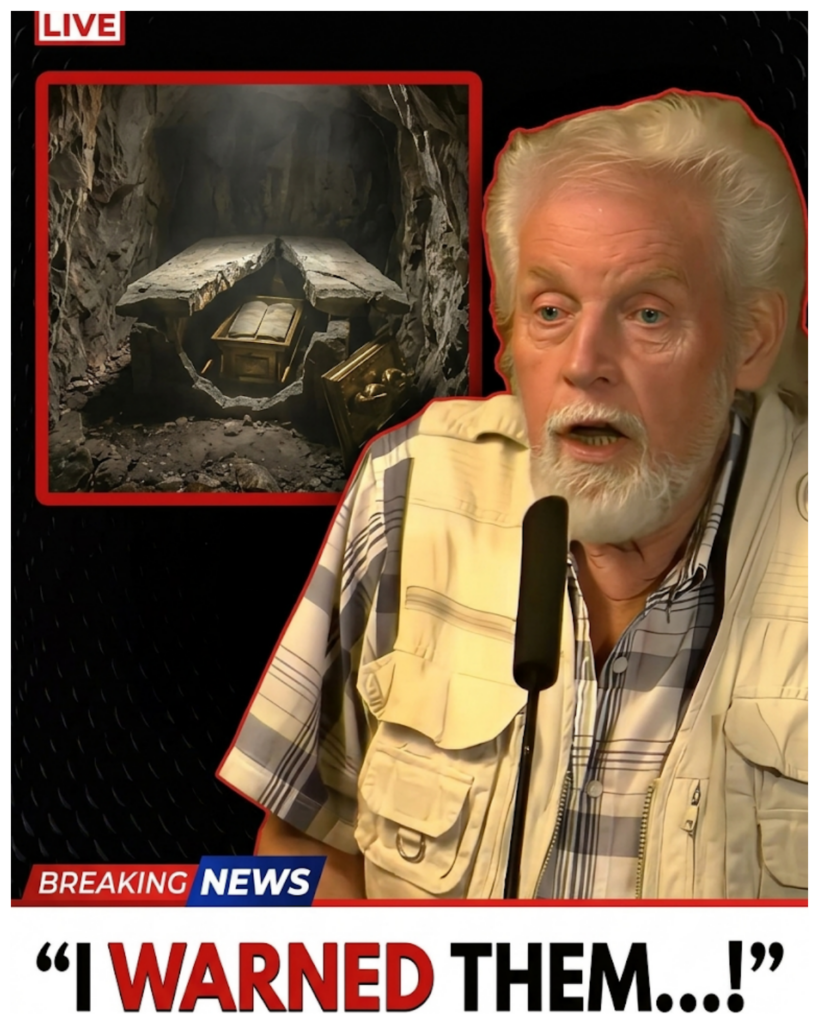
In the sanctuary represented the type when Jesus would die and his blood would take the place of all of those that it symbolized.
The ark of the covenant was only used one.
Few objects in human history have inspired as much fascination as the ark of the covenant.
According to the Bible, it was not simply a sacred chest covered in gold.
It represented the very presence of God among his people.
It stood inside the holy of holies where only the high priest could enter and only once each year.
It witnessed miracles, accompanied Israel through battles, and became one of the greatest symbols of God’s covenant with his people.
Then without warning, it disappeared.
For more than 2 and a half thousand years, kings, explorers, archaeologists, historians, and ordinary believers have searched for the ark.
Countless theories have emerged.
Some believe it rests beneath the Temple Mount.
Others think it was carried into Ethiopia.
Some insist it was destroyed long ago.
Yet, none of these ideas has ever been universally accepted.
Then during the late 20th century, one man made an astonishing announcement.
He claimed not only to have located the ark of the covenant beneath Jerusalem, but also to have witnessed events that defied ordinary explanation.
His story involved hidden tunnels, mysterious chambers, unusual scientific testing, [music] and encounters that he believed involved angels sent by God.
Before we uncover this remarkable story, please take a moment to subscribe to our channel and turn on notifications.
We explore fascinating discoveries, [music] biblical mysteries, ancient history, and archaeological evidence.
Now, let us examine one of the most mysterious claims ever connected [music] to the Ark of the Covenant.
The man at the center of this extraordinary story was Ron Wyatt.
Unlike many well-known archaeologists, Wyatt was not professionally trained in archaeology.
He worked as a nurse anesthetist in the United States.
Yet throughout much of his life, he devoted enormous amounts of time and personal resources to searching for locations described in the Bible.
Over several decades, Wyatt announced discoveries connected to Noah’s Ark, the crossing of the Red Sea, Mount Si, and many other biblical sites.
Some people celebrated him as a courageous explorer driven by faith.
Others criticized his methods and questioned his conclusions.
Among every claim he ever made, none attracted greater attention than his declaration that he had discovered the Ark of the Covenant beneath Jerusalem.
If true, it would represent one of the greatest archaeological discoveries in history.
Wyatt believed his search led him to a location near the ancient site of Golgatha, the place traditionally associated with the crucifixion of Jesus Christ.
According to his account, he entered a network of underground tunnels and eventually reached a sealed chamber hidden beneath layers of rock.
Inside that chamber, Wyatt claimed he encountered several remarkable objects connected with Israel’s worship during the first temple period.
Most astonishing of all, he believed the ark of the covenant rested there, exactly where it had remained hidden for centuries.
The Bible never explains where the ark disappeared after the Babylonian destruction of Jerusalem in 586 BC.
Although Jeremiah, 2 Chronicles, and other biblical passages describe the destruction of Solomon’s temple, they never reveal the ark’s final destination.
That silence has encouraged generations of researchers to continue searching.
Wyatt believed his discovery finally answered that ancient mystery.
Perhaps the most unusual part of Wyatt’s story had nothing to do with archaeology.
According to his own testimony, while exploring the underground chamber, he experienced something he never expected.
He said, “Angels of the Lord appeared before him.”
Wyatt explained that these heavenly messengers instructed him not to continue digging or disturbing the site.
According to his account, they warned that the timing was not yet [music] appropriate for the ark to be publicly revealed.
He claimed they instructed him to leave the chamber exactly as he had found it.
For many people, this became the most controversial element of his entire story.
Some believers accepted his testimony as a genuine supernatural encounter, similar to biblical moments when angels delivered God’s instructions.
Others remained cautious, pointing out that such experiences cannot be independently verified.
Hebrews 13:2 reminds believers, [music] “Do not forget to show hospitality to strangers.
For by so doing, some people have shown hospitality to angels without knowing it.”
Although the verse speaks generally about angels, it demonstrates that scripture acknowledges their active role in carrying out God’s purposes.
Whether Wyatt truly encountered angels remains a matter [music] of personal belief rather than historical evidence.
Among Wyatt’s most extraordinary [music] claims was one involving the crucifixion of Jesus.
He proposed that [music] a crack formed in the rocks during the earthquake described in Matthew 27:51.
When the earth shook, the rocks split.
According to Wyatt, this crack extended downward into the chamber where the ark rested.
He claimed that when the Roman soldier pierced Christ’s side, blood flowed down through that crack and landed directly upon the mercy seat of the Ark of the Covenant.
For Christians, this idea carries powerful symbolism.
In the Old Testament, the high priest sprinkled sacrificial blood upon the mercy seat on the day of atonement as described in Leviticus 16.
Wyatt believed Christ’s blood fulfilled that symbolism in [music] a literal and physical manner.
It was a breathtaking claim.
Yet, it became even more controversial because of what Wyatt said happened afterward.
Wyatt stated that he collected a tiny sample of what he believed was dried blood from the site.
He claimed laboratory testing revealed something highly unusual.
According to his testimony, the sample appeared to contain an unexpected chromosome pattern unlike ordinary human blood.
Wyatt interpreted this as supporting the miraculous conception of Jesus Christ.
However, these reported laboratory findings have never been published in peer-reviewed scientific literature, and independent researchers have not verified the results.
For this reason, historians, scientists, and biblical scholars generally do not regard the claim as established evidence.
Even many Christian archaeologists who firmly believe in the authority of scripture remain unconvinced by Wyatt’s interpretation because the evidence has not been independently examined.
A remarkable claim requires equally remarkable evidence.
The debate surrounding Ron Wyatt continues because it involves two different kinds of evidence.
On one side stand those who admire his dedication and believe God revealed hidden truths through an ordinary man.
On the other side are archaeologists who emphasize careful excavation, documented findings, independent verification, and transparent [music] scientific analysis.
Most professional archaeologists have concluded that Wyatt did not provide sufficient evidence to confirm the discovery of the Ark of the Covenant.
Several Christian organizations devoted to biblical archaeology have likewise stated that his conclusions remain unproven.
That does not necessarily prove [music] he was dishonest.
It simply means that extraordinary historical claims require documentation that can be examined and repeated by other researchers.
Until such evidence exists, the mystery remains unresolved.
Ron Wyatt’s story continues to captivate millions because it exists at the fascinating intersection of faith, archaeology, mystery, [music] and history.
He sincerely believed he found the Ark of the Covenant [music] beneath Jerusalem.
He described hidden chambers that few people have seen.
He spoke of angels who instructed him to stop excavating.
He claimed unusual laboratory discoveries that challenged conventional explanations.
Yet, despite decades of discussion, none of these extraordinary claims has been independently [music] confirmed in a way that satisfies the wider archaeological community.
The Ark of the Covenant, therefore, [music] remains one of history’s greatest unsolved mysteries.
Perhaps it [music] still rests exactly where Wyatt believed he found it.
Perhaps it lies hidden somewhere no one has yet explored.
Or perhaps God intends its ultimate significance to point beyond archaeology and toward the person of Jesus [music] Christ, whose sacrifice fulfilled everything the ark represented.
Until undeniable evidence finally emerges, [music] the mystery continues to invite curiosity, careful investigation, and thoughtful faith.
One thing remains certain.
The search for the Ark of the Covenant is far from over.
And every new discovery beneath the ancient stones of Jerusalem reminds us that history still holds secrets waiting to be revealed.


