February 1923, Valley of the Kings.
20 people are crammed into a hot, dusty room cut into the rock.
In front of them stands a wall of plaster stamped with the seals of the royal necropolis.
Two life-sized statues of the boy king guard it, one on each side, [music] staring straight ahead.
Nobody has passed through that wall in more than 3,000 years.
At least that’s what everyone in the room was told because the man holding the hammer, Howard Carter, already knew exactly what was on the other side.
He’d seen it months earlier in secret at night.
And a 100red years later, scientists pointed instruments at the hillside behind Tutin Common’s burial chamber.
Deep in the limestone, they found shapes nature doesn’t make.
Straight lines, right angles, something carved, sealed, and [music] waiting right behind the most famous wall in Egypt.
Here’s what we now know.
Carter didn’t discover the burial chamber in February 1923.
He broke into it in November 1922, through a hole at the bottom of the sealed wall, then hid that hole from the world.
The proof came out piece by piece in his own photographs, in an admission by one of his own team, and in a letter that stayed hidden for nearly 90 years.
And in September 2026, a team of researchers published the results of the most ambitious survey ever carried out around this tomb.
Their conclusion, Toutin Common’s tomb may only be the entrance to something much bigger.
So, in this video, we’re going through both walls.
The one Carter broke and the one nobody has been allowed to touch.
Oh, and I see that 85% of you watching aren’t subscribed yet.
If you want to be here the day that wall is finally opened, subscribe.
Watching on TV?
Press okay and the subscribe button is right there.
To understand why that first wall mattered so much, you have to understand how desperate Howard Carter was.
In 1922, [music] he’d been digging in the Valley of the Kings for years, paid by a wealthy British aristocrat, Lord Cararvin, and for [music] years, he’d found almost nothing.
Most experts were convinced the valley was empty.
[music] Every royal tomb had been found, and almost every royal tomb had been robbed, most of them already in ancient times.
[music] But Carter had a hunch.
A few small objects had turned up over the years, carrying the name of an obscure pharaoh, a boy who took the throne at about 9 years old and died around 19, more than 3,300 years ago.
A king so minor that his successors later left him off the official lists of rulers.
Tuten.
[music] No tomb had ever been found for him.
Carter believed it was still out there.
By the summer of 1922, Carnarvin was ready to stop paying.
Carter begged for one more season, one last winter of digging.
Carnaran agreed.
On the 4th of November 1922, [music] just days into that final season, a water boy, according to the story most often told, scraped the sand and hit something hard.
A step cut into the rock.
Then another, then 16 of them, leading down to a blocked doorway covered in seal impressions.
Carter covered everything back up and sent a telegram to England.
[music] Cararvin took the next boat.
On the 26th of November, Cararvin, his daughter, Lady Evelyn, and Carter stood in front of a second sealed doorway at the end of a sloping [music] corridor.
Carter made a small hole in the top corner.
He pushed a candle through.
Hot air rushed out and made the flame flicker.
And then, slowly, as his eyes adjusted, shapes came out of the darkness.
Gold everywhere, the glint of gold.
Kernarvin [music] asked if he could see anything.
Carter’s answer became one of the most famous lines in archaeology.
Wonderful things.
What they were looking at was the anti-chamber, a room packed from floor to ceiling, gilded couches shaped like animals, chariots taken apart and stacked against the wall, boxes, [music] vases, chairs, food, clothing.
Hundreds of objects in that one room alone.
But Carter’s eyes went straight to the far wall.
Two black and gold statues of the king stood facing each other like centuries.
And between them, another doorway, plastered, sealed, untouched.
Everyone understood what that [music] meant.
Behind that wall was the king.
Officially, the team [music] spent the next 3 months emptying the anti-chamber, photographing, cataloging, packing every object before they would allow themselves to go further.
Methodical, scientific, the model of how archaeology should be done.
That’s the version the world heard.
It’s not what happened.
Look closely at the photographs Carter’s team took of the anti-chamber in those first weeks.
At the bottom of the sealed wall between the guardian statues, there’s a reed basket lid and a pile of rushes leaning against the plaster.
It looks like part of the clutter.
It isn’t.
It’s covering a hole.
Tomb robbers had broken into Tuten Common’s tomb in ancient times, probably twice, not long after the burial.
Officials of the Necropolis had resealed the doorways behind them, and you can still see the patches of newer plaster carrying different seal impressions.
One of those patches was at the bottom of that wall, a low opening, just big enough for someone to crawl through.
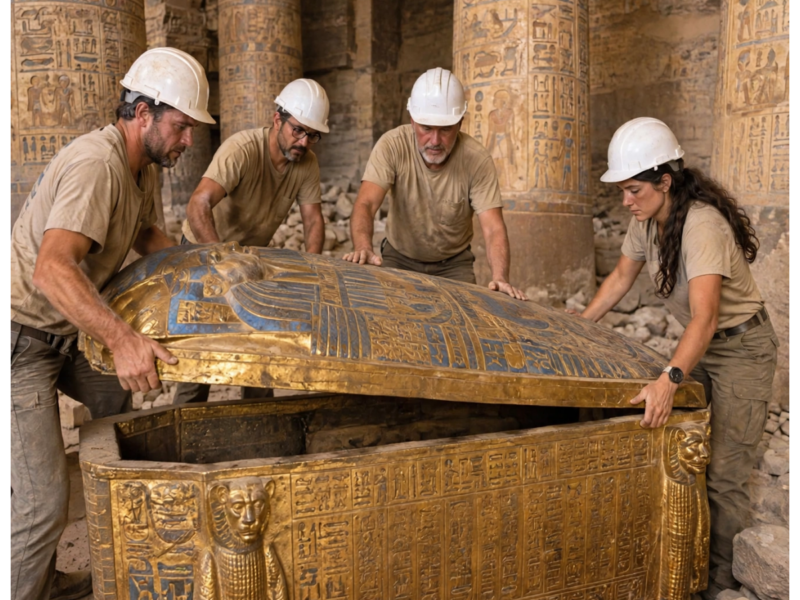
And according to the evidence, in those first nights after the anti-chamber was opened, Carter, Karvin, and Lady Evelyn reopened that robbers hole and crawled into the burial chamber alone without the Egyptian inspectors, without telling anyone.
On the other side, they would have found a room almost entirely filled by a gigantic gilded shrine.
Gold walls inlaid with blue fance so big there was barely room to squeeze along the sides and next to it an open doorway into another room the one Carter later called the treasury [music] guarded by a black statue of the jackal god Anubis then they crawled back out and filled the hole and Carter placed the basket lid and the reeds in front of the fresh plaster for decades this was just a rumor but the evidence slowly y piled up.
First, the photographs themselves, then Kernarven’s own words.
In a letter written on the 28th of November, 1922, 2 days after the candle, he let it slip.
Before I leave, he wrote, “We peep into the walled chamber.”
Then in 1947, years after Carter’s death, the chemist on his own team, Alfred Lucas, admitted in print that the hole had been there and that it had not been resealed by ancient officials.
It had been resealed by Carter himself.
He tried to frame it gently, but he confirmed the hole.
And then there’s the letter.
In 1934, one of the most respected Egyptologists of the time, Alan Garder, wrote to Carter, and the letter is anything but friendly.
Carter had given Gardner a small amulet, assuring him it did not come from the tomb.
Gardner showed it to Rex Angelbach, a curator at the Egyptian Museum in Cairo.
Angelbach compared it with objects from Tutin Common’s burial and concluded it had been taken from the tomb.
Gardner passed that verdict straight back to Carter and made it clear how deeply embarrassed he was.
That letter stayed in private hands for almost 90 years.
It was published in full only in 2022 for the 100th anniversary of the discovery.
To be fair, it’s one letter about one amulet.
There’s no proof Carter took anything during that secret night.
He might simply have been unable to wait.
Imagine spending your whole life looking for one tomb and then being told to sit in front of the door for 3 months.
But it changes the meaning of what happened on the 16th of February, 1923.
That afternoon, Carter stood on a wooden platform in front of the sealed wall in front of officials, scholars, and representatives of the Egyptian government.
He took the first stones out slowly, carefully, as if he had no idea what lay behind them, and the room watched him reveal a wall of solid gold.
He had already seen it.
The opening of Tutin Common’s burial chamber was a performance.
Still, what came out of that chamber over the following decade was staggering.
Four gilded shrines nested, one inside the other.
Inside the last, a stone sarcophagus.
Inside the sarcophagus, three coffins.
The innermost one made of solid gold.
More than 110 kilos of it.
Carter himself described the moment in a recording made for the BBC in 1936.
A gospel wonderment escaped our lips.
So gorgeous was the sight that met our eye.
And inside that, the king himself.
His face covered by the golden mask that became the most famous object of ancient Egypt.
In total, Carter’s team cataloged more than [music] 5,000 objects, including 130 walking sticks.
It looked like the perfect royal burial, the only intact one ever found.
But the closer you look, the less it fits.
The tomb is tiny, four small rooms.
His neighbor in the valley, Rammeses V 6th, has a tomb that runs more than 150 m into the hillside.
Tuten Commons is the smallest royal burial of its era in the entire valley.
The rooms were so cramped that Carter had to break away parts of the doorways just to get the panels of the golden shrines out.
And a lot of the treasure doesn’t seem to have been made for Tuten Common at all.
On the small golden coffins that held his organs.
Experts found that the king’s name had been carved over another name.
The original belonged to a mysterious ruler called Nefer Nefu at a pharaoh who reigned briefly just before Tuten and whom many Egyptologists believe was a woman.
The usual explanation is simple.
Tuten died young and unexpectedly.
His officials had to bury him fast in whatever tomb was ready with whatever equipment was available.
Which raises an obvious question.
If they used her objects, did they also use her tomb?
To understand who that woman might be, you have to go back [music] to the strangest family in Egyptian history.
Tuten wasn’t born Tuten.
He was born Tutenkot, [music] living image of the Atton because his father’s generation had done something no Pharaoh had ever dared to do.
The Pharaoh Akenatan had turned [music] his back on Egypt’s gods, on Ammon, on Osiris, [music] on the whole crowd of deities the country had worshiped for more than a thousand years.
In their place, he put one god only, the Aten, the dis of the sun.
[music] He closed temples.
He chiseled the name of Ammon off monuments [music] and he built a brand new capital in the middle of the desert, a city called Aket Aton, today known as Amarna.
[music] At his side in almost every image, was his great royal wife, Nefertiti, shown not behind him, but next to him, [music] riding with him in his chariot, even striking down Egypt’s enemies, a pose normally reserved for the king himself.
Then Akenatan died.
A short confused period followed with one or two rulers whose identity Egyptologists [music] still argue about.
One of them was Nefer Nefu at a child came to the throne.
The boy changed his name from Tutenkotton to Tuten.
The court abandoned Amarna.
The old gods came [music] back and the next generations of kings did everything they could to erase that whole family from history.
Their names were left off the official king lists.
Their monuments were dismantled and reused as building blocks.
In 2010, DNA tests on royal mummies filled in part of the puzzle.
They pointed to a mummy found in a tomb close to Tutin Commons KV55 as [music] his father.
Most researchers identify that mummy as Akenatan, though it’s still debated.
[music] And they showed that his mother was a woman known only as the younger lady, found decades earlier in another tomb, and that she [music] was also the sister of his father.
The two tiny mummified babies found in Tutin Common’s treasury [music] were most likely his own daughters, Stillborn.
Their mother was most likely his wife, Ank Essen Ammun, a daughter of Akenatan and Nefertiti.
So Nefertiti wasn’t some distant queen.
She was Toutin Common’s stepmother and his mother-in-law, and she’s the only major figure of that family whose body has never been securely identified.
Some researchers have argued that the younger lady herself could be Nefertiti.
Most experts reject that idea, which means Nefertiti is still missing.
And if anyone in Egypt would have been buried quietly in a hidden tomb [music] by a family that had to disappear, it was her.
In 2014, a Spanish workshop called Factum Artee made an exact copy of the burial chamber so tourists could visit a replica and spare the original.
To do that, they scanned every wall in extremely high resolution, every crack, every brush stroke, every bump in the plaster.
A British Egyptologist named Nicholas Reeves started studying those scans.
He wasn’t looking for hidden rooms, but on two walls, he saw something nobody had noticed in 90 years.
Straight lines, faint, but regular, running beneath the painted surface of the north wall and the west [music] wall.
Not the random cracks of old limestone.
Exactly the kind of lines you’d expect if two doorways had been blocked, plastered over, and painted to look like solid rock.
[music] In July 2015, Reeves published his theory, and it was explosive, even if he himself chose his words carefully.
I’m pretty cautious as a scholar.
I don’t stick my neck out too often, but I’m prepared to stick my neck out here because I think there is something to investigate.
If I’m right, well, fantastic.
But let’s cross that bridge, Roman, when we get to it.
Despite, [music] he argued that Toutin Common’s burial chamber wasn’t the end of the tomb.
It was only the outer part of a much larger one.
Behind the west wall, a storage [music] room.
And behind the north wall, a corridor leading to the real burial.
A burial that was there before Tutenaman.
And he had a name for its owner, Nefertiti, the great royal wife of the pharaoh Akenatan.
[music] The woman whose painted limestone bust, now in Berlin, made her the most recognizable face of ancient [music] Egypt.
Possibly the same person as Nefernu Atton, the ruler whose name was on Tuten Commons coffinets.
Her mummy has never been identified.
Her tomb has never been found.
Reeves even pointed at the painting on the north wall.
For 90 years, everyone had read it the [music] same way.
Tuten’s successor, I performing the opening of the mouth ritual on the dead king.
Reeves argued the scene had originally been painted for someone else and later reworked when the boy king was placed [music] inside.
If he’s right, the most famous tomb in the world is only the entrance hall.
Egypt took it very seriously.
In November 2015, a team from Egypt’s Antiquities Ministry, Cairo University, and a Paris Institute scanned the walls with infrared cameras.
They detected a zone on the north wall at a different temperature from the rest.
Then a Japanese radar specialist, Hiokatsu Watanabe, scanned the walls with ground penetrating radar, and Egypt’s antiquities minister at the time, Mambdu El Damati, stood before the cameras.
There is a 90% probability that there is something behind the north and the west walls.
Four months later, in March 2016, the ministry went further.
The radar, they said, suggested two hidden rooms, possibly containing metal, possibly organic material.
Front pages around the world, the most important discovery since 1922.
But Watanab’s raw data was never released for others to check.
[music] Then came the second scan.
In 2016, a team working with National Geographic brought in different radar equipment.
They found nothing.
Then the third.
In 2018, an Italian team led by Franchesco Porchelli of the Polytenic University of Turin carried out the most thorough survey yet with three separate radar systems.
In May, in front of an international conference in Cairo, Porchelli was blunt.
Our work shows in a conclusive manner that there are no hidden chambers, no corridors.
Uh adjacent to to Tankamon’s tomb.
Egypt’s ministry endorsed the verdict.
Case closed.
But listen to that word again.
Adjacent.
Every one of those radar surveys was done from inside the tomb.
Every one of them was asking the same question.
What is directly behind this painted wall?
And nobody had ever measured the pull of gravity in the hillside around it.
Nobody had looked further out and Mambdu El Damati, the minister who’d announced 90% in 2015, never let it go.
In 2023 and 2024, El Damati, now a professor in Cairo, came back to the Valley of the Kings with a new team, Nicholas Reeves, a British specialist named George Ballard, [music] and geoysicists from Egypt’s National Research Institute.
Egypt’s antiquities authorities gave them permission for two field seasons.
This time they didn’t just scan the walls.
They went outside on the hillside around the tomb.
They took more than 1200 microgravity measurements.
The idea is simple.
Solid rock is dense, so it pulls very slightly harder.
Empty space pulls less.
With sensitive enough instruments, a buried room shows up as a tiny weakness in gravity.
It had never been tried at this tomb.
What they found didn’t belong in solid limestone.
Several low density zones with straight edges and right angles.
[music] Natural rock cracks and curves.
It doesn’t make corners.
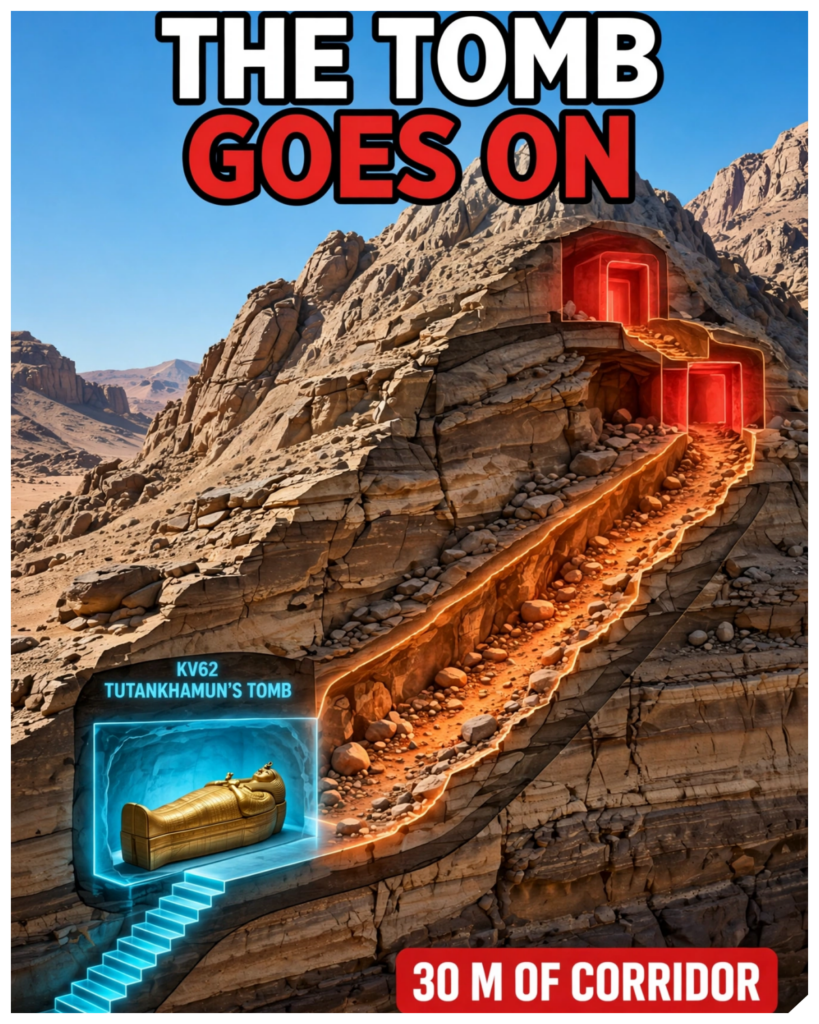
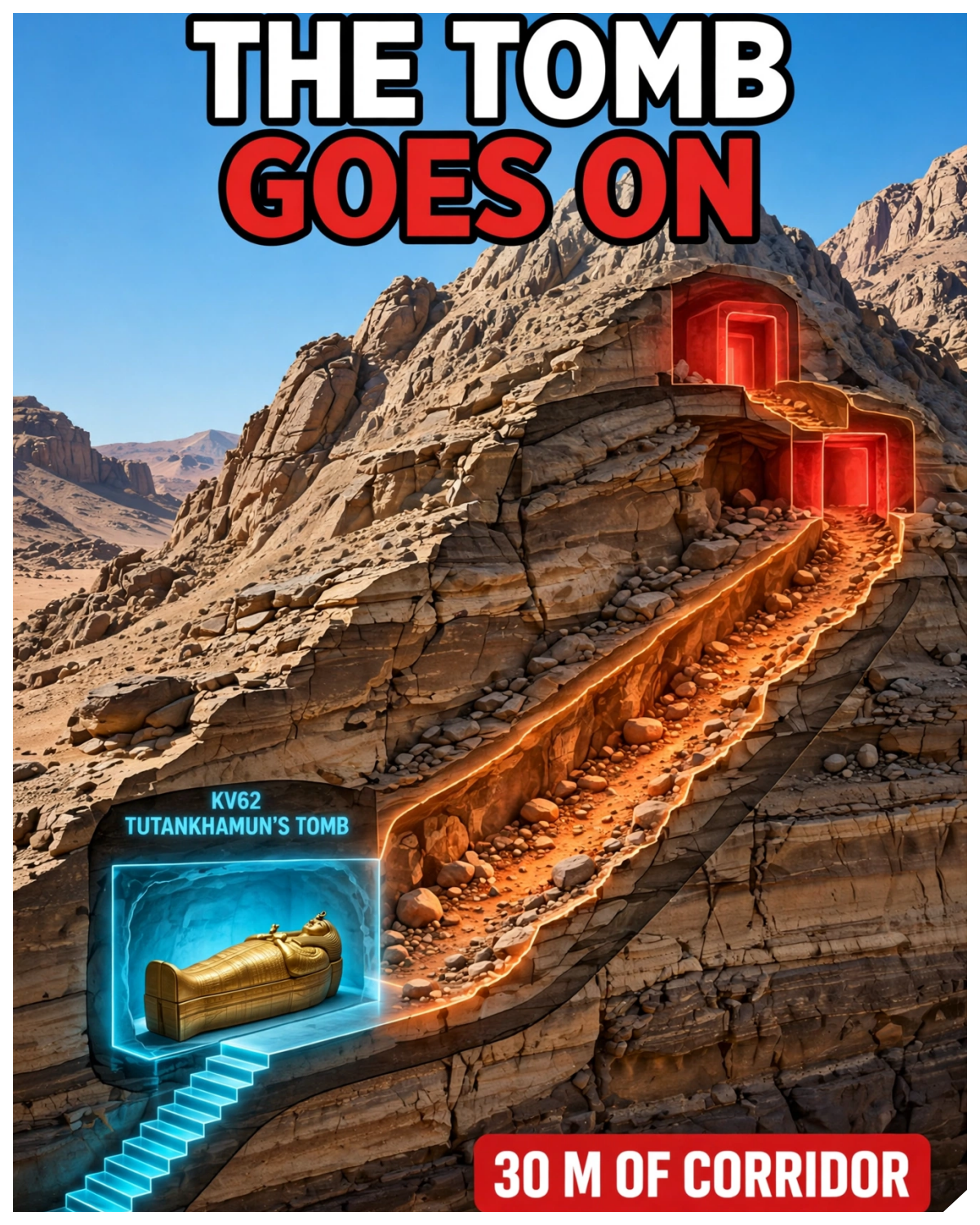
And some of those shapes run parallel to the north wall of the burial chamber, [music] exactly where Reeves had said the hidden corridor would be.
Inside the tomb, new radar readings near the north wall picked up material that behaves less like natural rock and more like built walling stone placed there by human hands.
And then there’s anomaly 7, a zone of low density with a denser, roughly square core inside it.
Ballard’s reading, an empty space with something in it.
Solid objects sitting inside a void.
[music] exactly what you’d expect from a sealed chamber still holding its contents.
The team was careful.
That signal sits close to the limit of what these methods can detect.
But the overall picture they published in September 2026 is striking.
A corridor heading north from the burial chamber, possibly packed with rubble, leading to a series of spaces that could extend 25 to 30 m beyond the known tomb.
At least one storage room beyond the west wall and a tomb that they argue existed before Toutin Common was ever buried in it.
[music] Porchelli’s 2018 survey wasn’t wrong.
It was accurate for what it measured.
It just didn’t measure this far.
So, is Nefertiti behind that wall?
Nobody can say that yet.
The team itself says the results don’t prove a Nefertiti burial.
It could be another member of her family.
It could be storage rooms.
It could be a rubble-filled cut in the rock or the effect of another tomb nearby.
Zahi Hawas, Egypt’s most famous archaeologist, still rejects the idea outright.
For him, no pharaoh would ever have been buried inside someone else’s tomb.
An independent geoysicist who reviewed the gravity data called hidden chambers plausible, but asked for more.
There’s only one way to find out.
The team wants to drill a narrow bore hole into the suspected corridor just wide enough for a camera without touching the paintings.
Ballard said the work could start as early as November 2026 if Egypt says yes.
Which leaves us in a strange position.
A 100 years ago, Howard Carter couldn’t wait.
He crawled through a sealed wall at night, saw the gold, and hid what he’d done.
Today it’s the exact reverse.
Scientists can measure every millimeter of that north wall and the gravity of the rock behind it.
And still nobody is allowed to look.
So what lies behind Toutin Common’s sealed wall [music] behind the first one, the one with the guardian statues?
We now know the answer.
And we know Carter saw it first.
A golden shrine, a [music] treasury, a boy king in three coffins, and a secret that lasted for decades.
Behind the second one, the painted wall of the burial chamber, the answer might be nothing but rubble and rock.
Or it might be the tomb of the most powerful woman of her age, untouched, unrobed, a few meters from the millions of visitors who walk past it without knowing.
In 2018, the verdict said there was nothing adjacent to that wall.
It never said anything about what was beyond.