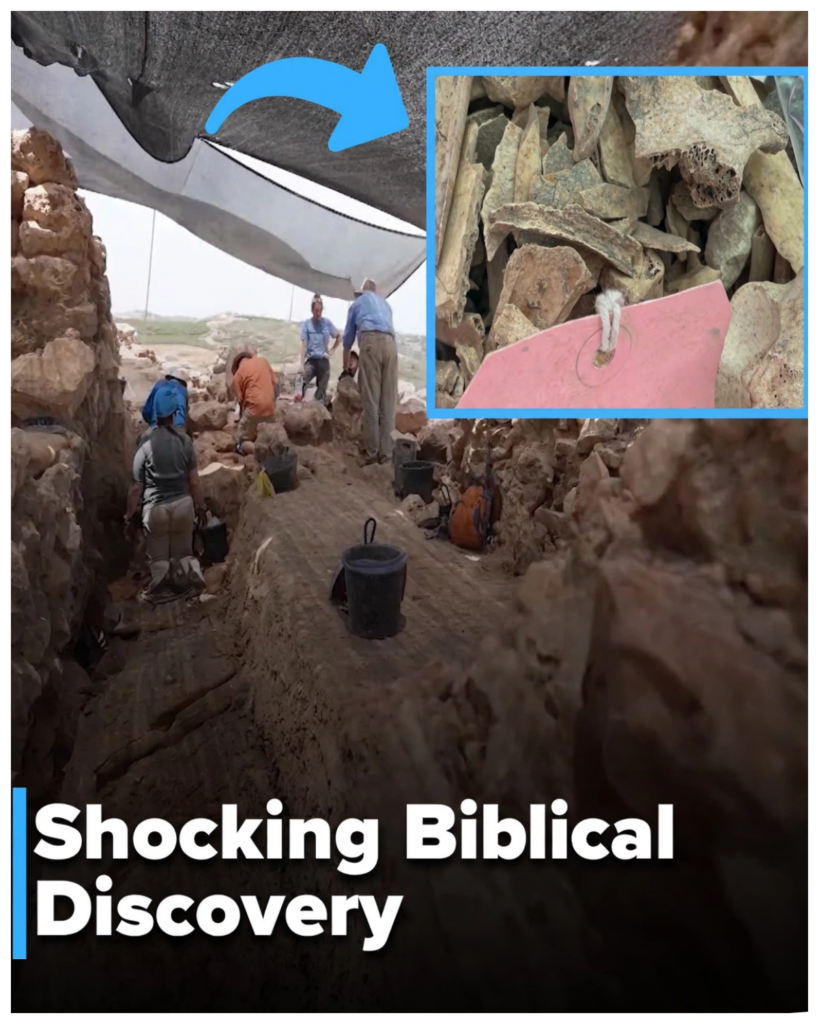
THE CITY THAT WAS NEVER SUPPOSED TO BE FOUND
The first clue was a wall.
Not a broken stone. Not an ancient coin. Not a fragment of pottery.
A wall.
It stood nearly twelve feet beneath the desert floor, perfectly preserved, stretching into the darkness like the remains of a world that had been deliberately erased.
Dr. Daniel Mercer stared at the exposed stonework, unable to speak.
For twenty-seven years, he had searched for evidence of ancient civilizations mentioned in biblical texts. He had studied forgotten kingdoms, translated damaged inscriptions, and excavated ruins across the Middle East.
But nothing had prepared him for what his team had uncovered in the desert.
Because the wall was not merely old.
It appeared to be nearly three thousand years old.
And its location matched a description Daniel had read hundreds of times in the Bible.
The discovery would soon challenge everything he thought he knew about the ancient world.
But first, he had to understand why an entire city had disappeared.
The expedition had begun six weeks earlier.
Daniel and his small archaeological team had traveled to a remote region of desert where shifting sands concealed the remains of settlements that had once flourished along ancient trade routes.
The team included Dr. Miriam Hale, an expert in ancient languages; Samuel Reed, a field archaeologist with years of excavation experience; and Elias, a young researcher whose enthusiasm often exceeded his experience.
Their original objective was modest.
They hoped to locate traces of an ancient settlement mentioned in several historical accounts.
Nobody expected to find an entire city.
On the third morning, Miriam noticed something unusual.
She was examining satellite images when she spotted a faint rectangular pattern beneath the sand.
At first, she assumed it was a geological formation.
But the lines were too straight.
They formed what appeared to be the outline of streets, walls, and several large structures.
“Daniel,” she called, turning her laptop toward him. “You need to look at this.”
He studied the image.
“How old is the satellite data?”
“Three years.”
“And this formation?”
“I don’t know. But look at the measurements.”
The rectangular structure was enormous.
It appeared to cover several acres, with smaller geometric shapes surrounding what might have been a central complex.
Daniel leaned closer.
“Could be an ancient settlement.”
“Or something else,” Miriam replied.
He looked at her.
“What are you thinking?”
She hesitated.
“I’ve seen a description of something remarkably similar.”
She opened an old translation of a biblical passage and pointed to a section describing a powerful ancient city, its gates, its walls, and its eventual destruction.
Daniel frowned.
“You think this is connected?”
“I’m saying we shouldn’t dismiss the possibility.”
The following morning, they began digging.
For days, their work produced little more than pottery fragments, scattered stones, and traces of ancient foundations.
Then, on the sixth day, Elias struck something solid.
“Dr. Mercer!”
Daniel hurried toward him.
Elias was kneeling beside a partially exposed stone surface.
It was not natural rock.
It was a carved block.
Miriam brushed away the dust with a soft archaeological brush.
Several symbols appeared.
She stopped moving.
“Daniel…”
He crouched beside her.
“What is it?”
“These markings are old.”
“How old?”
She examined the shapes again.
“Possibly from the early first millennium BCE.”
Samuel whistled quietly.
“That’s almost three thousand years.”
But it was the arrangement of the symbols that disturbed Miriam.
They resembled an inscription style associated with ancient kingdoms of the region.
And one particular symbol appeared repeatedly: a royal emblem.
The team expanded the excavation.
Within forty-eight hours, they had uncovered the remains of a massive stone gateway.
Beyond it lay a paved road.
The road disappeared beneath a thick layer of compacted sand, but its edges were unmistakable.
There had been a city here.
A city with organized streets, defensive walls, storage buildings, and what appeared to be a central administrative complex.
Daniel stood at the entrance, looking across the exposed ruins.
He felt something he had rarely experienced during an excavation.
Not excitement.
Unease.
The place seemed strangely untouched.
There were no obvious signs of gradual abandonment.
No scattered rebuilding materials.
No evidence of a settlement slowly declining over generations.
It looked as though something had happened suddenly.
Then Miriam discovered the inscription.
It was carved into a large stone beside the gateway.
The surface was damaged, and several lines had disappeared beneath the sand.
But enough remained for her to recognize the language.
She worked for hours, comparing the surviving characters with ancient inscriptions.
Finally, she translated a portion.
“The city of the king… the gates… the judgment…”
Daniel looked over her shoulder.
“Judgment?”
Miriam nodded.
“That’s the closest translation.”
“Could it refer to a military defeat?”
“Possibly. But there’s something else.”
She pointed toward the lower section.
There were several marks arranged in a pattern.
A name appeared to be written there.
Daniel read the transliteration slowly.
“Could that be the name of the city?”
Miriam did not answer immediately.
Instead, she opened her notebook and turned to a page filled with references.
“I found this name in an ancient text several years ago. I never knew where it belonged.”
Daniel stared at her.
“You’re telling me this inscription matches a name from a historical account?”
“Yes.”
The team worked through the night.
By sunrise, they had uncovered another section of the gateway.
Then came the discovery that changed everything.
Behind the stone entrance was a narrow chamber.
Its ceiling had partially collapsed, but the walls remained intact.
Inside were broken vessels, fragments of wooden furniture, and a collection of small clay tablets.
Samuel carefully lifted one of the tablets.
It contained several lines of ancient writing.
Miriam examined it.
Her expression changed.
“What?” Daniel asked.
She looked up slowly.
“This isn’t an ordinary inventory record.”
“What is it?”
“It’s a warning.”
The tablet described a city facing destruction. It mentioned a powerful ruler, a population that had ignored repeated warnings, and an approaching catastrophe.
Daniel felt his stomach tighten.
“Does it give a date?”
Miriam studied the final lines.
“Not precisely. But it refers to an event that may have taken place around the eighth century BCE.”
Samuel looked toward the buried streets.
“Then this place could be connected to the biblical world.”
Daniel nodded.
It was a possibility they could no longer ignore.
But the greatest surprise was still waiting beneath the central structure.
Three days later, the team uncovered a staircase descending below the ruins.
It led to a sealed underground room.
The entrance was blocked by enormous stones, carefully arranged to prevent access.
There was no obvious indication of what lay beyond.
Daniel examined the doorway.
“Could be a storage chamber.”
Samuel shook his head.
“Not with construction like this.”
Miriam noticed something carved into the upper stone.
A series of symbols surrounded a central image.
She recognized the pattern.
It appeared to represent a royal seal.
Daniel ordered the team to document everything before attempting to open the chamber.
After several hours of careful work, they moved the final stone.
Cold air escaped from the darkness.
The smell was unlike anything they had encountered during the excavation.
Dry earth.
Ancient dust.
And something faintly metallic.
Daniel switched on his flashlight.
The beam revealed a chamber containing several sealed containers, a damaged wooden chest, and a large stone object covered by a cloth that had survived against all expectations.
On the far wall was another inscription.
Miriam approached it.
Then she stopped.
“Daniel, don’t touch anything.”
He turned.
“What is it?”
She was staring at the inscription.
Her hands were trembling.
The writing contained a reference to a place, a king, and a warning that seemed to connect directly with the ancient biblical account they had been studying.
Daniel moved closer.
“Can you read it?”
Miriam swallowed.
“Not all of it.”
“Read what you can.”
She translated the surviving words.
“Here lies the record of the king who refused to listen… the city that was warned… and the judgment that came upon it.”
Nobody spoke.
Then Elias noticed something beneath the cloth.
A stone tablet.
He carefully lifted the edge.
An image emerged.
It showed a royal figure standing before a city gate.
Beside him was a second figure holding what appeared to be a scroll.
And beneath the image was a name.
Miriam stepped backward.
Daniel noticed her expression.
“What?”
She looked at him, pale.
“This is impossible.”
“What is?”
She pointed at the inscription.
“The name of the messenger.”
Daniel leaned closer.
Miriam whispered the name.
It was a name associated with a biblical prophet whose warnings had been recorded centuries before the city disappeared.
Daniel stared at the tablet.
If the identification was correct, the discovery could become one of the most important archaeological finds of their careers.
But there was a problem.
The tablet contained another line.
Miriam translated it slowly.
“One record was buried beneath the king’s house. The other was carried away by the witness.”
Daniel frowned.
“Another record?”
She nodded.
“And I think…”
She stopped.
“What?”
Miriam pointed toward the back of the chamber.
There, hidden behind a stone panel, was a narrow opening.
Something had been placed inside.
Daniel approached and carefully pulled out a small leather-wrapped object.
It was a second tablet.
But this one was not written in the same hand.
Its surface carried a message that appeared to have been added much later.
Miriam examined the markings.
Then she turned toward Daniel with an expression he would never forget.
“Daniel, this inscription says the city was not the only thing buried here.”
He looked at the tablet.
“What else was buried?”
Miriam’s voice dropped to a whisper.
“The truth about what happened to the people who survived.”
Daniel turned the tablet over.
On its reverse side was a symbol.
The same symbol appeared on the old Bible Daniel had carried throughout the expedition.
But there was something even more disturbing.
The symbol had been carved into the tablet from the inside of the chamber, facing outward.
As though someone had deliberately left it for the next person who would enter.
And beneath it were five words that made Daniel’s blood run cold:
“If you found this, he survived.”
Daniel looked at Miriam.
“Who survived?”
Before she could answer, a heavy sound echoed from somewhere beneath the chamber.
Three slow knocks.
Then silence.
The team stood frozen.
And when Daniel’s flashlight moved toward the staircase, he saw something that should not have been there.
A second set of footprints in the ancient dust.
They were fresh.
And they led deeper underground.
Was someone else searching for the same secret? Check the comments for Part 2. 👇