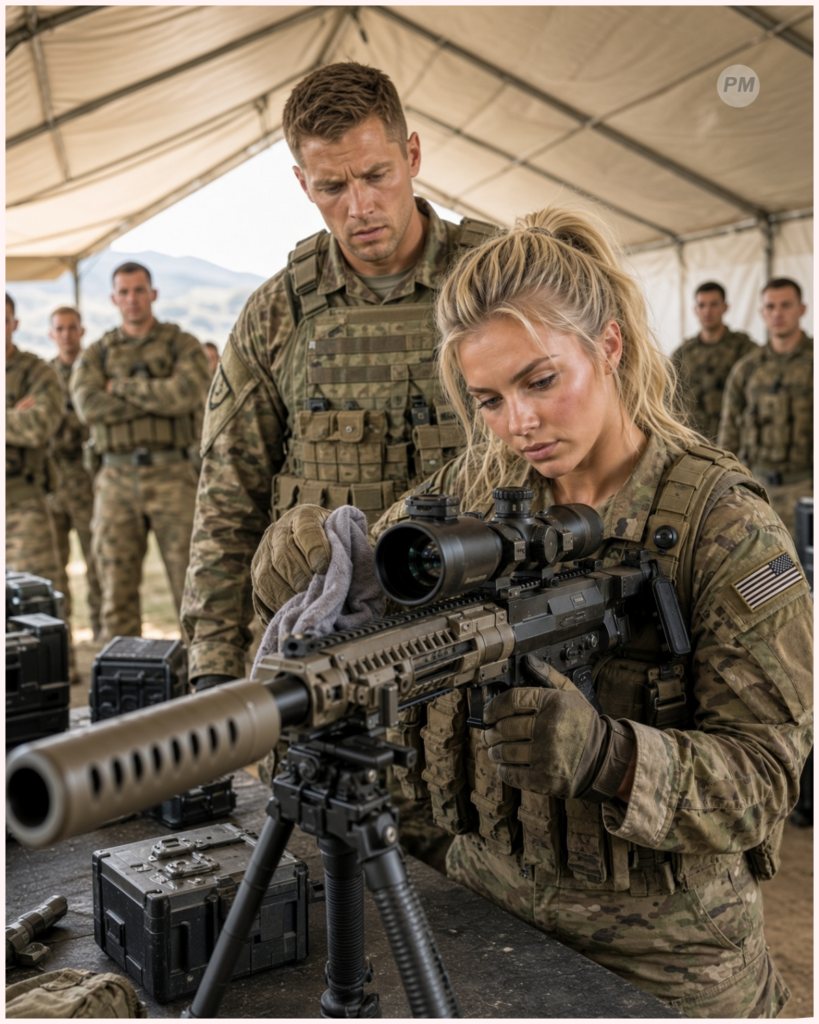
The Barrett M82’s recoil slammed into Maya Reeves’ shoulder like a sledgehammer, but she didn’t flinch.
The rifle’s report echoed across the Hindu Kush mountains, a sound that could wake the dead or create them.
Through her scope at an impossible 2,800 m, she watched the target, a rusted oil drum perched on a ridge, explode into fragments.
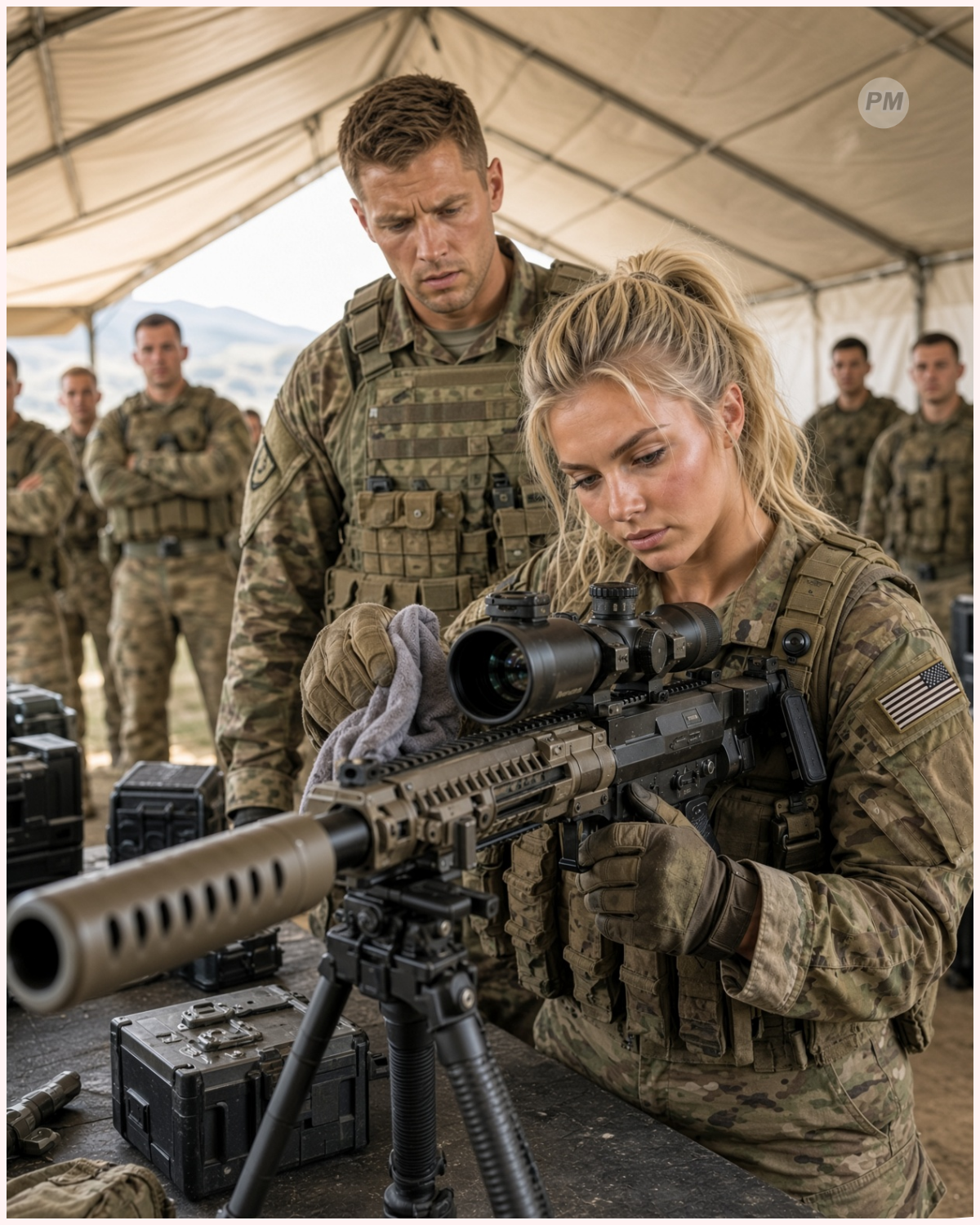
Commander Ryan Harrison lowered his binoculars slowly. His weathered face carved by four decades of combat showed something he hadn’t felt in years, surprise.
“Jesus Christ,” whispered Boone “Bull Thompson,” the team’s heavy weapons specialist. His Texas drawl carried across the firebase like wind through canyon walls.
>> [music] >> But that moment, that impossible shot in the thin mountain air, came later.
Three weeks later, after everything changed. Maya’s workshop smelled like gun oil and metal shavings.
She preferred it that way. Clean, honest, predictable. The scent reminded her of her father, though the memories came wrapped in pain she’d learned to ignore.
At 27, she’d perfected the art of being overlooked. Standing 5 ft 3 in her work boots, wearing oversized coveralls that hid her frame, she moved through the Marine Corps base like a ghost.
The Marines who brought their rifles for calibration saw a pretty face and dismissed the mind behind it.
They called her Barbie with a Barrett when they thought she couldn’t hear. She heard everything.
Maya ran her fingers along the barrel of an M40A3 sniper rifle, checking for imperfections with the precision of a surgeon examining a patient.
The morning sun cut through the workshop’s single window, illuminating dust particles that danced like stars in her private universe.
“Perfect bore,” she murmured to herself, peering through the barrel toward the light. “Zero throat erosion.
>> [clears throat] >> This rifle’s been babied.” The door burst open without warning. Maya’s hand instinctively moved toward the SIG Sauer P226 she kept hidden beneath her workbench, a habit from a life she pretended not to have.
But she recognized the silhouette immediately. Colonel Frank Ironside Mitchell filled the doorway like a monument to a war that never ended.
At 68, his shoulders still carried the weight of command, though he’d officially retired from the Marine Corps 5 years ago.
His silver hair was military short, his blue eyes sharp enough to cut glass. “Maya,” he said, not a greeting, a statement.
She straightened, wiping her hands on a rag that had seen cleaner days. “Colonel, you don’t usually visit my workshop.”
“This isn’t a social call.” Mitchell stepped inside, closing the door behind him with deliberate care.
The click of the latch sounded final like a coffin lid. “I need you.” Maya felt her stomach tighten.
She’d known this moment would come eventually, had dreaded it, had somehow longed for it in the darkest hours of sleepless nights.
“I’m an equipment tech,” she said carefully. “I fix rifles, I don’t use them.” “Stop.”
Mitchell’s voice cut like a blade through her deflection. “I’ve known you since you were 7 years old, since your father Don’t.”
The word came out sharper than she intended. Maya took a breath, forced her voice level.
“My father died 20 years ago. That doesn’t make me him.” Mitchell pulled a tablet from his jacket, tapped the screen twice, and turned it toward her.
The image froze her blood. The man on screen stood on a balcony carved into mountainside.
Afghan mountains by the terrain. He wore traditional robes, but his eyes held a predator’s calculation.
Late 50s, maybe 60, with a gray beard and a face that had watched too many people die.
“Khalid Nazari,” Mitchell said quietly. “They call him the wolf, Taliban commander. Responsible for 17 attacks on US forces in the last 3 years.
63 American soldiers dead, 38 wounded.” Maya stared at the screen, her throat dry. “Why are you showing me this?”
“Because 20 years ago, in November 2004, Nazari planned an ambush in Fallujah.” Mitchell’s voice dropped to barely above a whisper.
“An ambush specifically designed to kill one man. Your father.” The workshop seemed to tilt.
Maya gripped the edge of her workbench, knuckles white. “James Reeves,” Mitchell continued, “gunnery sergeant, scout sniper, the best I ever trained.
Nazari knew Ghost was the greatest threat to his network. So, he sacrificed 12 of his own men to set a trap.
And your father walked into it.” “He knew.” Maya’s voice cracked. “He knew and he went anyway because 40 Marines needed time to retreat.
He chose them over himself.” Mitchell paused. “He chose them over you.” Maya closed her eyes.
Her father’s face materialized in the darkness. His gentle smile, his patient hands showing her how to breathe, how to squeeze a trigger between heartbeats, how to read wind in the dance of grass and leaves.
“Why are you telling me this now?” “Because Khalid Nazari is still alive, still killing American soldiers, and we finally found him.”
Mitchell swiped the screen showing satellite imagery of a compound nestled in Afghan mountains. “He appears twice a week, 14 seconds on a balcony.
That’s our window. Send a drone strike.” “Too many civilians, wrong optics. We need precision.”
Mitchell looked at her with an intensity that made her want to run. “We need a sniper.
The shot’s over 3,000 m in mountains with unpredictable wind.” Maya laughed, but the sound held no humor.
“You have an entire Marine Corps full of snipers. Why Because our best is injured, because this mission deploys in 72 hours, and because the team lead is someone your father trained.”
Mitchell set the tablet on her workbench. “Commander Ryan Harrison, former SEAL, now a military contractor.
He was with your father in Fallujah. Ghost saved his life.” The name hit like a fist.
Maya had heard it before in her father’s letters, the ones she’d found after his death, written but never sent.
Letters where Ghost spoke of his best student, a young SEAL with instinct that transcended training.
“What’s my role?” Equipment specialist. Officially, backup sniper. Unofficially,” Mitchell’s eyes softened, the only crack in his armor.
“Maya, I’ve watched you practice at that private range 40 mi outside Alexandria. I’ve known for 5 years what you do every night, what you are.”
Heat rushed to her face, anger, shame, something else that she couldn’t name. “You’ve been following me.”
“Protecting you like I promised Ghost I would.” Mitchell leaned against the workbench. “You inherited your father’s gift, maybe exceeded it, but you’ve been hiding it, living small, pretending to be less than you are.
Why?” Maya’s hands trembled. She pressed them flat against the cold metal of the bench.
“Because everyone who knew Ghost expects me to be him, to fill his boots, to carry his legacy.”
Her voice broke. “I can’t be him. I’m just Maya.” “You’re wrong.” Mitchell straightened. “You’re not just Maya.
You’re the woman who shoots one MOA groups at 1,000 yd, who can read wind like your father read books, who has a gift that comes once in a generation.”
He picked up the tablet. “And you’re the only person who can kill the man who murdered Ghost.”
The workshop fell silent except for the distant sound of Marines training their cadence calls drifting through walls like ghosts of wars past and wars to come.
Maya looked at her hands, mechanic’s hands, scarred from metal edges and hot rifle barrels, but steady, always steady.
“When do we leave?” The conference room smelled like stale coffee and testosterone. Five men sat around a table covered with satellite imagery, weapon specs, and mission parameters typed in 12-point font that somehow made death seem bureaucratic.
Maya stood in the doorway, still wearing her coveralls, feeling every eye turn toward her like searchlights.
The man at the head of the table stood slowly. Commander Ryan Harrison looked exactly like his photographs, 6-ft-1, gray hair, cut military short, a scar tracing his left cheekbone like a lightning bolt frozen in flesh.
62 years old and built like he could still walk 20 miles with a full combat load.
His eyes pale blue and hard as winter ice assessed her in 3 seconds. “Frank Harrison said, not looking at Mitchell.
I asked for a sniper.” “This is Maya Reeves.” Harrison’s expression didn’t change, but something shifted behind his eyes.
Recognition, maybe pain. “James Reeves’ daughter.” “Yes.” “I respected Ghost more than any man I’ve served with.”
Harrison’s voice carried the flat authority of someone accustomed to being obeyed. “He saved my life twice.
I owe him everything.” He paused. “But respect doesn’t win firefights. Experience does. She’s a tech.
This is tier one work.” Maya felt the familiar burn of dismissal, that special kind of erasure reserved for women in men’s spaces.
She’d learned long ago that arguing only made it worse. So, she stayed silent, watching, cataloging weaknesses.
The other four men studied her with expressions ranging from skepticism to outright hostility. Gareth Doc Williams, the team medic, had the lean build and watchful eyes of a man who’d seen too many friends die.
British accent, former SAS, 58 years old according to the brief Mitchell had given her.
He sipped coffee and said nothing. Bull Thompson looked like his nickname, massive shoulders, barrel chest, hands that could crush walnuts.
The heavy weapon specialist wore a Texas Rangers cap and contempt like a second skin.
Wyatt Sullivan, the comm specialist at 47, had the calculating look of someone who trusted technology more than people.
Former Navy, pragmatic, dangerous in the quiet way that mattered. Dalton Preacher Hayes sat apart from the others, Bible open on the table beside mission docs.
The primary sniper. 52, gray-bearded with a thousand-yard stare of someone who’d look through a scope at another human being and pulled the trigger without hesitation.
“Gentlemen,” Harrison said, “mission brief, target Khalid Nazari, compound in Hindu Kush Mountains, eastern Afghanistan.
Distance from optimal shooting position 3,200 m. Target appears Tuesday and Friday morning 0600 local time, 14 seconds maximum exposure.
He tapped the satellite image. Preacher is primary shooter. Miss Reeves is Maya, she said quietly.
Harrison looked at her. Excuse me. My name is Maya, not Miss Reeves, and if I’m on this team use my name.
The room went silent. Bull snorted. Doc raised an eyebrow. Wyatt typed something on his laptop, possibly updating his insurance.
Harrison studied her for five long seconds. Maya will provide equipment support and function as backup if needed.
Backup? Preacher’s voice carried the soft drawl of Kentucky hills. Sir, with respect, 3,000 m shots aren’t something you learn in a workshop.
Agreed, Harrison said, which is why she’ll qualify before we deploy. He turned to Maya.
You want on my team, prove it. Tomorrow 0900 range 400. Thousand yard standard Marine qualification.
Pass is seven out of 10. Your requirement is 10 out of 10. Maya met his eyes.
Fair enough. Perfect score, Bull muttered. She’ll fold. Maya smiled then a small cold expression that made her look exactly like her father’s photographs.
We’ll see. Dawn came to Virginia like a reluctant promise. Cold, gray, the kind of morning that made you question decisions made in warm offices far from consequences.
Maya arrived 30 minutes early. She’d barely slept spending most of the night in her apartment disassembling and reassembling her father’s rifle, a ritual she’d performed a thousand times muscle memory and meditation combined.
The range stretched before her like judgment day. 1,000 yards of Virginia soil, autumn grass brown from early frost, the distant target barely visible without magnification.
Harrison’s team assembled like pallbearers at a funeral. They brought coffee and thermoses, skepticism in their postures.
Mitchell stood apart saying nothing. His faith in her either unshakable or cruelly misplaced. Eight Marine instructors gathered as well.
Word had spread. The daughter of Ghost Reeves was attempting qualification. They came to witness legacy or watch it crumble.
Harrison checked his watch. You’re early. Habit. Maya opened her rifle case slowly, deliberately. The Barrett M82A1 inside gleamed like a surgical instrument.
Standard issue. Not her father’s rifle, that stayed home, too sacred for this particular kind of profaning.
She assembled the rifle with economical movements. Stock, barrel, scope, magazine. Each click and snap precise, no wasted motion.
The weather briefed itself. 18 mph crosswind from 3:00. Temperature 42° Fahrenheit. Cold bore, the barrel hadn’t been warmed by previous shots, which meant her first round would fly different from the rest.
Bull lit a cigarette. Money says she doesn’t make it past shot three. I’ll take that action, Doc said quietly.
20 says she makes seven. 50 says she makes all 10, Mitchell announced. Everyone turned to stare at him.
That’s a sucker bet, Colonel, Preacher said. Then take it. Preacher didn’t. Maya settled into position, prone.
Bipod legs extended and firm against packed earth. Left hand supporting the stock. Right hand feather-light on the grip, finger outside the trigger guard until ready.
The rifle weighed 30 lb. The moment weighed more. She pressed her eye to the scope.
The world narrowed to crosshairs and target wind and mathematics, breathing and patience. Her father’s voice echoed in memory.
Patient as sunrise. Feel the wind, Maya. Don’t calculate it. Feel it. She closed her eyes, listened to the grass whisper secrets, felt the cold air kiss her cheek from the right, consistent, steady, no gusts yet.
18 mph meant she needed to adjust 4.2 minutes of angle right to compensate for wind drift at this distance.
Temperature correction -0.8 MOA for cold bore and ambient temp. Total adjustment 3.4 MOA MOA right.
Maya’s hands moved with the autonomy of long practice adjusting the scope’s windage knob. Click, click, click.
Each click a quarter MOA. 13 clicks right, three clicks down for cold bore. She opened her eyes, settled her breathing, four count inhale, four count exhale.
Heart rate dropping from 68 to 56 beats per minute. The rifle became an extension of her body, no separation between flesh and metal.
The target sat 1,000 yd down range. 10-in X-ring at the center. Hit that you were a shooter.
Hit it 10 times you were a sniper. Maya inhaled, half exhaled, squeezed the trigger between heartbeats.
The Barrett roared, .50 caliber fury. The recoil slammed into her shoulder like divine retribution, but she rode it, stayed on target through the scope watching.
3 seconds later, the time it took the bullet to fly 1,000 yd, the target shuddered.
Dead center X-ring. One of the Marine instructors called through binoculars. Bull dropped his cigarette.
Lucky shot. Maya didn’t respond. She chambered the next round, the bolt action smooth as silk, and settled back into position.
Same wind, same calculations, same cold mechanical process that transformed thought into death at distance.
Shot two X-ring, shot three X-ring, shot four X-ring. By shot seven, the Marines had stopped talking.
The only sounds were wind through grass, the Barrett’s periodic thunder, and the distant ting of bullets punching paper.
Maya fired shot eight, then nine. Each report identical. Each impact devastating. She chambered the 10th round settling into the rifle one last time.
Moving target. Harrison’s shout cracked across the range like a whip. Before Maya could react, the downrange target began tracking left to right pulled by cables she hadn’t known existed.
3 mph lateral movement. Not part of standard qualification. Not fair. Every instinct screamed protest.
This wasn’t the test. This was sabotage. But Maya’s hands didn’t listen to instinct. They listened to training.
To thousands of hours at that private range shooting in conditions her father had deliberately made impossible.
Moving targets, wind, rain, snow, darkness. “When conditions are perfect,” Ghost had written in one of his letters, “you’re not training.
You’re just confirming what you already know.” Maya tracked the target through her scope. Calculated time.
At 1,000 yd a target moving 3 mph needed 14 in of lead to compensate for both target movement and bullet flight time.
She shifted aim. Led the target. Breathing controlled. Heart rate steady. Squeezed. The Barrett spoke its final judgment.
4 seconds of flight time felt like years. The bullet intercepted the target mid-movement punching through the X ring like destiny had always known exactly where that piece of copper-jacketed lead would end up.
“Hit.” The Marine instructor’s voice carried something that might have been awe. “Dead center. Moving target.”
Maya safed the rifle and stood slowly. Her shoulder would bruise 10 .50 caliber rounds in rapid succession guaranteed that.
But the pain felt distant, unimportant. She turned to face Harrison and his team. No one spoke.
Harrison walked forward, boots crunching on gravel. He stopped 3 ft from her, close enough that she could see every line age and combat had carved into his face.
He looked at the Barrett in her hands. “That’s quite a toy for a technician.”
The words hung in cold morning air, dismissive and sharp. Maya felt something ignite in her chest.
Not anger. Something colder. More precise. She looked up at him, 6 in of height difference that suddenly meant nothing, and her voice came out level, hard, absolutely calm.
You think that’s a toy? That’s a Barrett 50 caliber. She didn’t blink, didn’t look away.
This rifle has more confirmed kills at extreme range than most snipers accumulate in entire careers.
It’s killed enemy combatants from distances you’ve never even attempted. And I’m not a technician, Commander.
She took one step closer, close enough to see his pupils dilate. I’m James Reeves’ daughter, sir.
The range fell into silence so complete that Maya could hear her own heartbeat still steady at 56 bpm.
Harrison stared at her. The calculation happening behind his eyes was almost visible. Reassessment, recognition, something that might have been respect fighting something that definitely was prejudice.
Mitchell’s voice broke the moment. Any other questions, Ryan? Harrison’s jaw tightened. He looked at Maya for 5 more seconds, then stepped back.
Gear up. Wheels up 600 tomorrow. Welcome to the team. He turned and walked away, his men following like iron filings pulled by a magnet.
Doc paused beside Maya. That was either the bravest or stupidest thing I’ve seen in 30 years.
He smiled slightly. I’m hoping for brave. Maya watched them go, adrenaline finally beginning to fade, leaving exhaustion in its wake.
Mitchell approached quietly. Your father would have been proud. Would he? Maya’s voice cracked. I don’t even know if this is what I want, or just what everyone expects.
Maybe both. Maybe neither. Mitchell looked toward the target a thousand yards away, where 10 bullets had written their verdict.
But you’re going. Not for Ghost, not for me. For you. Maya looked at the Barrett in her hands.
Her father had carried a rifle just like it, had killed men with it, had died because of it, in a way died because being a warrior meant walking into traps with eyes open.
I’m scared, she whispered. Good. Fear makes you careful. Arrogance gets you killed. Mitchell squeezed her shoulder gently.
Trust your training. Trust yourself. That night Maya packed in her small Alexandria apartment. The ritual felt ceremonial religious in its precision.
Clothing designed for mountain cold, medical supplies, protein bars that tasted like cardboard but kept you alive.
Extra socks her father had been fanatical about dry socks. And then from the back of her closet she pulled out the hard case.
The rifle inside wasn’t standard issue. Custom McMillan TAC-50, bolt action, .50 BMG, 42 pounds of precision engineering.
Her father’s rifle left to her in a will that she’d read once and never again because the words hurt too much.
The stock was worn where his cheek had pressed against it 10,000 times. The barrel showed micro scratches from desert sand and mountain grit.
An engraved along the receiver in letters her father had carved himself, Ghost’s Legacy. For Maya.
She ran her fingers over the words feeling their depth. I don’t know if I can do this, Dad.
She whispered to the empty apartment. I don’t know if I’m enough. The rifle of course said nothing.
But somewhere in her chest in the place where memory lives stronger than reason, Maya heard her father’s voice.
You’re more than enough, baby girl. You always have been. She closed the case gently like tucking a child into bed.
Tomorrow she would board a C-17 transport headed for war. Tomorrow she would face men who doubted her, a mission that might kill her, and a target who’d murdered the man who taught her everything that mattered.
Tomorrow Maya Reeves would stop hiding. Tonight she allowed herself one last moment of being small, of being scared, of being just a 27-year-old woman who missed her father and wished the world was different.
Then she locked that feeling away in the same place she kept her fear and her doubts stood up and started loading magazines.
The C-17 Globemaster’s engines screamed their metal prayer to physics and thrust. Maya sat in the cargo bay surrounded by Harrison’s team.
The rifle case between her knees heading toward mountains that had broken empires in men in equal measure.
Harrison sat across from her studying mission documents by red overhead light. After 20 minutes he looked up.
Your father, he said, not a question, just an opening. Maya waited. Ramadi 2003, insurgent ambush on convoy.
Ghost made a shot at 1400 m, four tangos, 6 seconds, saved 40 Marines. Harrison’s voice carried something Maya hadn’t heard before.
Reverence. I was one of those Marines. He never told me combat stories. Only training.
Because he wanted you to have a choice. Wanted you to choose this life, not inherit it.
Harrison folded the documents. Why workshop? Why hide what you are? Maya looked at the rifle case.
Because being Ghost’s daughter is like carrying a monument. Everyone expects greatness, excellence, legacy. And I’m just You shot 10 for 10 with a moving target at the end in cold bore conditions.
Harrison leaned forward. You’re not just anything, you’re exceptional. Or lucky. Luck’s what you call skill when you don’t want to take credit for it.
He paused. Out there in Afghanistan, there’s no room for hiding. People die when warriors pretend to be something less.
And if I’m not good enough, then you would have missed. You didn’t. Harrison’s eyes held hers.
Ghost trained you. I can see his methods in your shooting. But there’s something else, something yours.
That’s what makes you dangerous. The cargo bay shuddered through turbulence. Maya felt her stomach drop, then settle.
Tell me about Fallujah, she said quietly. Harrison went still. What do you want to know?
Everything. How he died, what he said, why he walked into that trap. Mitchell told you it was a trap.
Maya nodded. Harrison was silent for 30 seconds. We knew something was wrong. Intel was too perfect, set up too convenient.
Ghost said it was bait. He looked away. I wanted to abort, but 40 Marines were pinned down two clicks away.
They needed covering fire, needed time to retreat. So Dad volunteered. No, he ordered me to stay, said it had to be him because he was the best shot, most experienced, best chance of success.
Harrison’s voice dropped. His last words to me were “Tell Maya I’m sorry. Tell her to be better than me, not just like me.”
Maya felt tears threaten, but refused them. Not here. Not now. “I’ve carried that message for 20 years,” Harrison said.
“Didn’t know how to deliver it. Didn’t know if you knew what you were. But watching you shoot yesterday,” he shook his head, “you’re already better.
You just don’t know it yet.” The C-17 began its descent toward Bagram Airfield. Maya felt the pressure change in her ears, there’s the shift from journey to arrival.
“Commander Ryan,” he corrected, “on this team we use first names. Hierarchy matters less than trust.”
“Ryan, when we’re in position, if the shot comes to me instead of Preacher, will you trust me?”
Harrison looked at her for a long time. “Ask me again when we’re on target.”
Which wasn’t yes, but it wasn’t no either. The plane touched down, hard tires screaming against runway, and Maya Reeves arrived in Afghanistan carrying her father’s rifle and a legacy she’d spent 20 years running from.
But running, she was beginning to understand, only worked until the moment you turned around and faced what was chasing you.
And Maya was done running. Maya’s lungs burned. Each breath at 8,000 ft felt like swallowing razor blades.
She’d been climbing for 6 hours carrying 107 lb across terrain that killed the careless and broke the strong.
Bull set the pace ahead of her. Fast, aggressive, testing. She kept up. The The Kush mountains rose around them like the teeth of some ancient god, jagged and unforgiving.
Reading about these peaks in mission briefs hadn’t prepared her for the reality. The cold that bit through tactical gear, the air so thin each breath felt borrowed.
Firebase Phoenix clung to the mountainside like a barnacle to a ship’s hull, desperate, stubborn, refusing to be dislodged.
Sandbags and HESCOs and concertina wire transformed geology well into military geometry. Maya stepped off the Chinook’s ramp into cold that bit through her tactical gear and found her bones.
-5° C, wind at 12 mph gusting to 18. The kind of cold that made metal stick to skin, that turned breath to ice crystals, that killed careless soldiers in their sleep.
“Welcome to hell’s waiting room.” Bull said, shouldering his pack. “Temperature drops another 10° after sunset.
Frost gets in your weapon. Better check that fancy rifle.” Maya said nothing. She’d already done the calculations.
At this altitude and temperature, her bullet’s ballistic coefficient would change. Less air resistance meant flatter trajectory, but also more wind drift.
The cold would affect powder burn rate reducing muzzle velocity by approximately 30 ft per second.
These were the kinds of details that separated good snipers from dead ones. The firebase commander, a Marine captain who looked 12 years old and exhausted beyond his years, briefed them in a plywood hut that smelled like diesel fuel and desperation.
“Target compound is here.” He tapped a satellite image blown up to poster size. “8 km northwest, elevation 9,200 ft.
Intel confirms Nazari maintains residence. Appears on eastern balcony Tuesday and Friday mornings, 0600 local, approximately 14 seconds.”
“Approximately” Preacher leaned forward, his Kentucky drawl sharpening with professional interest. “12 to 16 seconds, variable.
He’s not setting a timer.” “What security?” Ryan asked. “30 to 40 fighters, patrols but predictable.
They sweep the perimeter every 4 hours. Your infiltration window is 2200 tonight. Next patrol is 0200 tomorrow.
Maya studied the compound through the grainy satellite resolution. Three buildings arranged in a U-shape.
The eastern balcony jutted from the main structure like an afterthought, maybe 6 ft wide, 30 ft above ground level.
No cover, no concealment. Anyone standing there for 14 seconds was either stupid or confident.
Nazari was not stupid. Optimal shooting position. Ryan’s finger traced the map. Here. Ridge designated Echo 7.
3,247 m from target balcony. 3.247 km. Maya’s mind converted instantly. 2 miles plus another 135 ft.
The kind of distance where bullets fell more than they flew, where wind became your enemy or ally depending on how well you read its intentions.
Wind conditions, preacher asked. Variable, 8 to 15 mph direction shifts with thermal currents. Morning shoot window gets the calmest conditions.
Which meant still nearly impossible. Ryan looked at his team. Questions? Just one, Maya said quietly.
[clears throat] Everyone turned. Has anyone actually confirmed Nazari appears exactly at 0600 or is that an average of observed appearances?
The captain blinked. Intel report says 0600. That’s not what I asked. Silence stretched. The captain shuffled papers, found a different document.
Observations over 6 months, appearances range from 0553 to 0607. So, we have a 14-minute window where he might appear for 14 seconds.
Maya looked at Ryan. That changes timing calculations for security avoidance. Ryan’s expression it didn’t change, but something behind his eyes shifted.
Recognition maybe, or reassessment. Good catch, he said. We adjust patrol timing based on 0550 window.
They departed Firebase Phoenix at 2200 hours under a moonless sky. The Hindu Kush swallowed them like Jonah into the whale dark absolute transformative.
Maya carried 107 lbs, 65 lb ruck, 42 lb McMillan TAC-50. Her own body weight was 118 lbs.
The math was simple and brutal. She was carrying 91% of her body weight across 18 km of mountain terrain climbing 600 m in elevation in temperatures that would kill exposed skin in minutes.
Bull set the pace, fast, aggressive, testing. Maya understood the game. Prove you can’t keep up, prove you don’t belong.
She’d seen this dance before in a hundred small ways throughout her life, doors held closed, opportunities withheld, respect conditioned on meeting standards no one else had to meet.
So, she kept pace, controlled her breathing, four counts in through the nose, six counts out through the mouth.
Oxygenation maximized. Heart rate steady at 122 bpm, high but sustainable. High but sustainable. The mountains unfolded in shades of darkness, rock and scree and patches of snow that glowed faintly in starlight.
The team moved in tactical column, 30 ft between each operator, weapons ready, eyes scanning.
Doc dropped back beside Maya after the first hour. You holding up? Yes. That pack is heavy.
I know, I’m fine. He studied her for a moment then nodded and moved forward again.
At 0315 they were 8 km from Firebase Phoenix and 8 km from target compound.
Halfway. In the valley between destinations where soldiers were most vulnerable. Wyatt walking point stopped suddenly.
His fist went up, the universal military signal for freeze. Everyone stopped. Maya’s hand moved to her M4 carbine selector switch from safe to semi with a click that sounded too loud in the mountain silence.
Wyatt knelt examining the trail. His hand moved slowly tracing something in the dirt. Then he looked back at Ryan and even in the darkness that Maya could see the fear in his eyes.
Wire, Wyatt whispered. The word hit like electricity. Maya’s training kicked in before thought. She froze completely, not even breathing every muscle locked.
IED, improvised explosive device. Hidden pressure plate or tripwire connected to artillery shells or homemade explosives.
The Hindu Kush was littered with them left over from Soviet occupation, from Taliban resistance, from decades of war layered on war.
Nobody move. Ryan’s voice carried absolute authority. Wyatt, can you trace it? Wyatt pulled out a red lens flashlight, the kind that preserved night vision.
He swept the beam slowly across the trail. The thin wire glinted like a spider’s web in the red light stretched across the path at ankle height.
Trace goes that way. Wyatt pointed right. Into rocks. I can’t see the device without The world exploded.
Maya never knew what triggered it. Maybe Wyatt’s light. Maybe a pressure plate they hadn’t seen.
Maybe the device was on a timer and their arrival was just catastrophically bad luck.
The blast picked her up and threw her backward like a child’s toy. She flew through air, no control, no orientation, just force and momentum and the certainty that this was how she would die.
She hit rock, hard. Her helmet cracked against stone and stars bloomed behind her eyes, constellations of pain.
The ringing in her ears drowned out everything. No sound, just a high pitched whine like the universe screaming.
Maya lay still checking for damage. Fingers moved. Toes moved. Legs responded. Arms functioned. She tasted copper blood from a split lip or bitten tongue.
She rolled onto her hands and knees shaking her head to clear it. The world swam then slowly stabilized.
The blast site was a crater, smoke and dust still rising. The team was scattered dark shapes on the ground, some moving, some terrifyingly still.
Report. Ryan’s voice cut through the ringing. Sound off. Doc operational. The medic was already moving checking bodies.
Bull good. The big Texan stood limping but mobile. Wyatt concussed but functional. Maya, she tried to speak, coughed, tried again.
Operational. Preacher, silence. Doc reached him first. Maya saw the medic’s body language change, the sudden urgency, the quick movements.
She struggled to her feet ignoring the protest from her ribs and moved toward them.
Preacher lay on his side, right arm bent at an unnatural angle, blood covering the right side of his face.
His breathing was shallow, rapid, the sound of lungs struggling. Shrapnel to shoulder and face.
Doc reported, hands already working pressure bandages appearing like magic. Right eye damaged, possible skull fracture.
He needs medevac now. Ryan was already on the radio. Phoenix actual, this is Hunter 7.
IED strike one, urgent surgical request, immediate dust-off. Static, then Hunter 7, Phoenix actual, negative on dust-off.
Weather system moving in. Bird can’t fly in these conditions. ETA for medevac 48 hours minimum.
48 hours, he’ll I’m aware, Hunter 7. I’m sorry, you’re on your own. Ryan stared at the radio like he could will it to give different answers.
Then he looked at his team, at Preacher bleeding and broken, at the target compound 8 km away, at the mission window that was closing with every second.
Sir, Doc said quietly, I can stabilize him, but he can’t shoot. Zero depth perception, shoulders destroyed.
Can he survive 48 hours? If we keep him warm and the wound doesn’t get infected and he doesn’t go into shock.
Doc’s tone made clear those were all very big ifs. But he’s combat ineffective. Ryan looked at the sky, at the stars that had watched empires rise and fall in these mountains.
We abort. Get Preacher back to Phoenix. Sir, Bull stepped forward. Nazari, if we abort, he goes to ground.
We lose him. I’m not sacrificing the mission for one man. Ryan’s voice was steel.
We always bring our people home. Always. With respect, Wyatt said, what if there’s another option?
Everyone looked at him. Maya. The name hung in the thin mountain air heavy with implications.
Ryan turned to her slowly. In the red glow of chemical light sticks Doc had cracked for medical work, his face looked carved from granite.
No. Sir, she qualified perfect. She’s got the skill. She’s got a thousand yard qual.
This is 3,000 m in mountains with variable wind. It’s not the same thing. Neither is letting Nazari walk away, Bull said.
Maya felt every eye on her, weighing, measuring, doubting. She thought of her father walking into an ambush in Fallujah, knowing it was a trap, going anyway because 40 Marines needed him.
Legacy wasn’t just skill, it was choice, the choice to stand when standing was hard, to shoot when the shot was impossible, to be more than just Ghost’s daughter, to be someone who made decisions that mattered.
I can make the shot, Maya said quietly. Ryan stared at her. You don’t know what you’re saying.
3,000 m is not 3,247 m, Maya interrupted. At 9,200 ft elevation, temperature approximately -2° C.
Wind 8 to 15 mph, variable direction. Bullet flight time approximately 4.2 seconds. Total drop approximately 341 minutes of angle.
She paused. I know exactly what I’m saying. Knowing the math isn’t the same as making the shot.
Then teach me. Maya stepped closer to Ryan. You have 12 hours before the shoot window.
You were Ghost’s best student. He trained you. Train me. In 12 hours, that’s enough time to remind me what I already know.
Maya’s voice didn’t waver. My father taught me first. You taught him. Circle completes. The decision played across Ryan’s face, duty versus pragmatism, protection versus mission.
Finally, he nodded. Get Preacher stabilized and bivouacked here. Doc stays with him. Bull and Wyatt provide security.
Maya and I continue to ridge position. He looked at Maya. 12 hours. I’ll teach you everything I know, but if you can’t make the shot when the time comes, we abort.
Clear? Clear. They moved through darkness like ghosts, leaving behind Preacher’s shallow breathing and Doc’s quiet prayers.
The 8 km to ridge position felt longer than the eight they’d already traveled. Each step waited with new purpose.
Ryan set a slower pace now, stopping frequently to test Maya’s knowledge. Wind check. Maya closed her eyes, felt the air on her face.
11 mph from 2:00. Steady, no gusts. How do you know no gusts? The sound.
Gusts whistle. This is smooth flow. Temperature effect on powder burn? Every 10° C change affects muzzle velocity by approximately 0.4%.
We’re at -2, rifle will be cold soaked. Estimate velocity loss of 30 to 35 ft per second from standard.
They climbed. Rock gave way to snow, then back to rock. The Hindu Kush tested every muscle, every joint, every cell that needed oxygen the thin air wouldn’t [clears throat] provide.
At 0500 hours, they reached Echo 7 Ridge. The position was perfect, a natural shelf of rock overlooking the valley with the target compound visible 3,247 m away.
Ryan unpacked his ranging equipment, confirmed the distance with laser. 3247, exactly as briefed. Maya set up her father’s rifle.
The McMillan TAC-50 settled onto its bipod like coming home. She checked the bore, the scope, the trigger pull.
Everything perfect. Everything ready. Except her. Talk to me, Ryan said. What are you feeling?
Scared. Good. Fear makes you careful. He settled beside her with his spotter scope. Now, tell me the shot.
Maya looked through her scope. The compound jumped into magnification. Three buildings, the eastern balcony, the door that would open and reveal her target.
Range 3247. Elevation angle -4.3°. Temperature -2° C. Wind she paused feeling. 10 mph variable direction 2 to 3:00.
Calculations. 341 MOA elevation. Wind call 7.2 MOA right for 10 mph, but if wind shifts to 3:00 you need 8.8.
Coriolis effect at this latitude adds 0.8 MOA right. Temperature effect -1.1 MOA elevation. She closed her eyes, the math flowing like music.
Total adjustments 340 MOA up. 8.0 MOA right adjustable if wind changes. You memorized all that?
My father taught me to see numbers like colors. This isn’t math, it’s just knowing.
Ryan was silent for a moment. He taught you well. Better than he taught me.
They waited as the sky shifted from black to gray, that liminal space before dawn when the world held its breath.
Maya thought about preacher 8 km away bleeding. About her father dead 20 years. About all the moments in life that came down to single decisions, single shots, single chances.
Tell me about Fallujah, she said quietly. What happened after my father died? Ryan adjusted his spotter scope checking the compound for movement.
We extracted. 40 Marines made it out. Three didn’t including Ghost. We carried his body 12 km through hostile territory because we don’t leave our people.
Did he suffer? It was fast. He made his shot, took out four tangos in 6 seconds.
They returned fire. He was hit in the chest, died in my arms. Ryan’s voice went rough.
His last words weren’t about the mission. They were about you. Tell Maya I love her.
Tell her to be better than me. Maya felt tears threaten. I don’t know how to be better than to legend.
You’re already better. You just haven’t proven it to yourself yet. At 05:30, Wyatt’s voice crackled over the radio.
Hunter 7 over watch, contact. 20 plus hostiles 400 m north of your position moving your direction.
Ryan grabbed binoculars, scanned. Confirmed. It’s a security sweep. They’re early. ETA to your position, Maya asked.
8 minutes. Target window is 05:50 to 06:07. I know, Ryan keyed his radio. Bulldog, be advised we have company inbound.
Maintain position and silence. Copy, Ryan looked at Maya. We have a problem. Security sweep arrives at our position in 8 minutes.
Target might appear in 20 minutes. We’ll be in a fire fight when the shot window opens.
Or we abort now, Maya said. Or we abort. She looked through her scope at the compound, at the balcony where a man who’d killed her father would stand for 14 seconds offering the only chance for justice she might ever get.
There’s a third option, Maya said slowly. I’m listening. Nazari’s running a security sweep. That means he knows something’s wrong.
Possibly knows we’re here. She turned to Ryan. If he’s paranoid enough for random sweeps, he’s paranoid enough to check the perimeter himself before his scheduled appearance.
That’s speculation. No, that’s psychology. You don’t send security unless you’re worried. And if you’re worried, you want visual confirmation before you expose yourself.
Maya checked her watch. I think he appears early, not 06:00, closer to 05:50, maybe even 05:45.
If you’re wrong, we’re blown and he escapes. If I’m right, we complete the mission before the sweep reaches us.
Ryan studied her for 10 long seconds. That’s a hell of a gamble. It’s not gambling, it’s reading the pattern.
Nazari survived 20 years by being careful. Careful people verify threats. Maya looked at him.
Trust me. Trust my father’s training. The mountains held their breath. Somewhere below 20 Taliban fighters moved toward their position minutes away.
Somewhere in the compound, a man who killed Ghost prepared for his day unaware that Legacy was about to come calling.
Ryan keyed his radio. Bulldog, stand by. We’re holding position for early target appearance. Say again, sir.
We have I know what we have. Trust Maya’s read. Hunter seven out. He looked at her.
If this goes wrong It won’t. You sound like your father. Good. At 05:43, a security force then closed to 600 m as the sky shifted from gray to pale blue, the compound door opened.
Maya’s heart rate steady at 62 dropped to 54. Khalid Nazari stepped onto the balcony.
He wore traditional Afghan robes, brown and weathered. His gray beard caught the early light.
He held binoculars scanning the mountains looking for threats he could sense but not see.
Target? Ryan whispered. Range 3247. Wind 10 mph 2:00 steady. You have the shot. Maya’s world narrowed.
The rifle became her body. The scope became her eye. The bullet waiting in the chamber became her will.
She felt the wind on her face. 10 mph steady. No gusts yet the morning calm before thermal currents started.
Her breathing slowed. Four count inhale. Hold. Six count exhale. Heart rate 52. Nazari turned slightly presenting his back.
Not ideal. Center mass was best but backs worked if the angle was right. Maya settled the crosshair between his shoulder blades.
Adjusted for wind, for distance, for the weight of 20 years of grief and 10,000 hours of training.
“Wind shift,” Ryan said, “12 mph now, 3:00.” Maya adjusted, 8.8 MOA right instead of 7.2.
Small changes at this distance meant life or death. “He’s turning,” Ryan said, “about to go back inside.
6 seconds. That’s all she had, maybe less.” Maya inhaled, full breath, let half out, held, found the space between heartbeats where the world went still, and eternal and perfect.
Her finger feather-light on the trigger began to squeeze, not a pull, a squeeze, gentle, inevitable.
The McMillan TAC-50 roared, recoil slammed into her shoulder, 36 foot-pounds of energy trying to break bones.
Maya absorbed it, rode it, stayed on target through the scope. The bullet left the barrel at 2,800 feet per second.
.50 caliber, 750 grains of copper-jacketed lead, angry and precise. Flight time, 4.2 seconds. Maya watched through her scope, not breathing as the bullet flew.
She could almost see it, a dark streak against pale sky, arcing arcing down from the ridge toward the valley, dropping, dropping, wind pushing it right, gravity pulling it down.
Nazari was halfway through the doorway when the bullet arrived. The impact was catastrophic. The .50 caliber round hit between his shoulder blades with 8,000 foot-pounds of energy.
His body jerked forward, then collapsed, disappearing into the doorway. “Hit,” Ryan said, voice tight with awe.
“Confirmed hit. Target down.” Maya chambered another round, automatically training overriding emotion. She kept the scope on the doorway, watching for movement.
Nothing. “Confirmed kill,” Ryan said. “Holy God, 3,247 m. Maya, that’s that’s impossible.” The compound exploded into activity.
Fighters poured from buildings. Alarms sounded. Chaos bloomed like blood in water. “Security sweeps breaking into run,” Wyatt reported over radio.
“They heard the shot. ETA your position 4 minutes.” “Time to leave,” Ryan said. He started packing gear with professional speed.
Maya stared through the scope at the doorway where Nazari had fallen. Where the man who’d killed her father had breathed his last breath, never knowing his death had been waiting 20 years.
She thought she’d feel satisfaction. Victory. Something clean and complete. Instead, she felt hollow. Empty.
Like she’d carried a weight for so long that without it she didn’t know how to stand.
“Maya.” Ryan’s hand on her shoulder. “We need to move. Now.” She nodded, packed the rifle with hands that shook slightly.
Not from fear, from adrenaline crash, from the enormity of what she’d just done, from the knowledge that she’d crossed a line her father had crossed, and there was no going back.
They ran. The Hindu Kush mountains, indifferent to human drama, watched as two figures sprinted across rock and scree, pursued by men with guns who didn’t [clears throat] know they were chasing ghosts.
Behind them, 2,300 m of ground between ridge and rendezvous point. A fighting retreat that would test everything they had.
The extraction became a blur of violence. Maya transitioned to her M4, covering sectors, while Ryan called in artillery support.
She dropped eight more Taliban fighters during the 47-minute retreat, controlled bursts at ranges between 200 and 400 m.
Faces she could see. Men who dropped and didn’t rise. Nine kills total. Nine men who’d woken up that morning not knowing it was their last.
A grazing round caught her left shoulder. The impact spun her sideways, but she kept moving.
Kept fighting. Kept living, because that’s what warriors did. By the time the Black Hawk extracted them, Maya had crossed into a place her father had been.
A place where you carried the weight of deaths you’d caused and learned to keep walking anyway.
She’d become what everyone said she would be. She just wasn’t sure she wanted to be it anymore.
The Black Hawk carved through Afghan sky like a bullet through flesh, fast, violent, purposeful.
Maya sat pressed against the vibrating hull, her shoulder throbbing where the rifle’s recoil had kissed bone and a Taliban bullet had kissed flesh.
Her hands still trembling with adrenaline that refused to fade. Nine men dead because Maya Reeves had pulled triggers.
Her hands wouldn’t stop shaking. Ryan sat beside her, his face streaked with dust and dried blood from a grazing wound across his cheek.
He’d barely spoken since they’d loaded onto the helicopter. Just checked his team, methodically counted heads, confirmed everyone was breathing.
Now he looked at Maya, really looked the way people looked at soldiers after their first combat, searching for cracks, for breaks, for the moment when the person you were disappeared and something else took residence in your skin.
“Talk to me,” he said, voice barely audible over the rotors. Maya stared at her hands.
They looked like her hands, same fingers, same scars from working on rifles. But they felt foreign, like they belonged to someone else.
“I killed nine people today,” she said. “You completed the mission. You saved your team.
You did what had to be done.” “Does it get easier?” She looked at him.
“Did it get easier for you?” Ryan was silent for a long time. “No. Anyone who says it gets easier is lying or broken.
You just get better at carrying it.” He paused. “Your father asked me the same question once, after his first kill in combat.”
“What did you tell him?” “I told him the day it stops bothering you is the day you need to stop pulling triggers.”
Ryan leaned back against the hull. “You’re not a killer, Maya. You’re a warrior. There’s a difference.
Warriors do hard things because someone has to. Killers do hard things because they want to.”
Maya closed her eyes. Behind her eyelids she saw Nazari’s body jerk from the bullet impact, saw the eight other men drop during the retreat, saw their faces frozen in that final moment between living and not.
I don’t feel like a warrior. I feel like I’m drowning. Then drown. Let it wash over you.
Don’t fight it. Ryan’s voice held hard-won wisdom. The ones who fight it, who try to pretend they’re fine, they’re the ones who break later.
Feel everything now, process it, then pack it away somewhere safe. The helicopter banked hard, beginning its descent toward Bagram Airfield.
Through the open door, Maya could see the sprawling base, acres of tents and buildings, an aircraft, a small American city carved into hostile territory.
Preacher lay strapped to a litter doc beside him, monitoring vitals with the intensity of a man willing his patient to keep breathing.
The injured sniper’s face was pale, bloodless, but his chest rose and fell with stubborn regularity.
The Black Hawk touched down hard. Medical personnel swarmed the helicopter before the rotors stopped spinning.
They extracted Preacher with professional efficiency, rushing him toward the field hospital while Doc ran alongside.
The rest of the team stood on the tarmac, suddenly purposeless. The adrenaline crash hitting like a physical weight.
“Debrief in 4 hours,” Ryan said. “Get food, get clean, get some rest if you can.”
The truth revealed the debrief took place in a secure room deep inside Bagram’s intelligence section.
Windowless, soundproof, the kind of room where classified operations were discussed and uncomfortable truths were filed away.
Three men sat across the table from Maya and Ryan, two CIA officers in civilian clothes, one Army colonel with a special operations command patch and eyes that cataloged everything.
“Commander Harrison,” the colonel said, “walk me through the mission.” Ryan’s report was crisp, professional, delivered without emotion.
He detailed the infiltration, the IED blast, Preacher’s injuries, the decision to continue with Maya as primary shooter.
He described the shot with technical precision, range, wind, environmental conditions, result. “3,247 m,” one of the CIA officer said.
“That’s beyond current record by approximately 300 m.” He looked at Maya. “You made this shot.”
“Yes, sir.” “Under combat stress with hostile forces closing on your position.” “Yes, sir.” The three men exchanged glances.
Some unspoken communication passed between them. “This stays classified,” the colonel said finally, “for Ms.
Reeves’ protection and operational security. No official record, no public acknowledgement. Understood?” “Understood,” Ryan said.
The CIA officer opened a folder, slid documents across the table. “We recovered intelligence from Nazari’s compound.”
He paused. “The 2004 Fallujah ambush was a trap, planned specifically to kill Ghost. He knew, and he went anyway.”
Maya’s world narrowed to the document in front of her. Her father’s last radio transmission preserved in official type transcript, November 12th, 2004, 1437 local time, Reeves J.
“It’s a choice, sir, my choice. I’m the best shot. I’ve got the angle. I can take enough of them to give Falcon their window.”
Pause. “Sir, tell my daughter something for me. Tell Maya I’m sorry I won’t see her grow up.
Tell her I’m proud of her. Tell her to be better than me, not just like me.
And tell her this was my choice, nobody’s fault. Just my choice. Out.” The room fell silent.
Maya stared at the words until they blurred. Her father’s final thoughts before walking into death with eyes open.
“He made that choice,” Ryan said softly. “Nobody ordered him. He volunteered because that’s who Ghost was.”
“He chose them over me.” Maya’s voice shook. “No.” The colonel’s tone held surprising gentleness.
“He chose to give you a world where 40 families stayed intact, where 40 Marines came home.
He chose to be the kind of father who taught his daughter what honor looks like, even if the lesson cost him everything.”
Maya felt tears burning, threatening. She refused them. Not here. “Is there anything else, sir?”
The Colonel exchanged glances with the CIA officers. Not at this time. You’ll be contacted regarding recognition for this operation.
Dismissed. The debrief concluded with paperwork signatures and the bureaucratic transformation of violence into administrative record.
By the time Maya walked out of the secure room, the Afghan sun was setting painting the Hindu Kush mountains in shades of orange and red.
Ryan walked with her across the base. They didn’t speak. Sometimes silence was the only language that fit.
At the transient quarters, Ryan paused. You did good today, better than good, exceptional. I don’t feel exceptional.
I feel hollow. That’s normal. First kills always feel that way. He studied her. Your father felt the same way.
He told me once that the weight gets lighter, not because you stop caring, but because you learn to balance it with the good you do, the lives you save, the missions you complete, the evil you stop from spreading.
Did it work? Did he find that balance? He found it in you. Every letter he wrote, every story he told about you, every time he mentioned your name, that was his balance.
You were his proof that the world was worth fighting for. Ryan squeezed her shoulder gently, then walked away leaving Maya standing in the gathering darkness trying to figure out if she was strong enough to carry what her father had left her.
Homecoming. The flight home was a blur of cargo planes and commercial airlines and airports where no one looked twice at the small woman who changed the course of a war in 14 seconds of impossible precision.
She arrived at Quantico Marine base on a gray September morning that smelled like rain and new beginnings.
Mitchell met her at the base entrance, his face unreadable. Walk with me. They walked in silence toward the sniper school building past Marines running training evolutions, past ranges where rifles spoke in practice cadence.
How are you? Mitchell asked. Complicated. Good. Simple answers after complex events mean you’re not processing correctly.
They stopped overlooking range 400. Ryan’s report was glowing. Said you made decisions under pressure that saved the mission.
I did my job. You exceeded your job. Mitchell turned to face her, which brings me to why we’re here.
I’ve arranged something, a ceremony private. Just people who need to know. I don’t want I know, but this isn’t about what you want.
It’s about what you’ve earned. His voice softened, and what your father would have wanted.
Before Maya could respond, Mitchell started walking. She followed legs moving on instinct. Inside the sniper school building, the main classroom had been transformed.
Chairs in rows, 30, maybe 40 people in dress uniforms. At the front, a podium and an American flag worn from operations.
Maya recognized faces. Ryan and his team, the Marine captain from Fire Base Phoenix, several sniper school instructors, and scattered throughout older men, 50s, 60s, even a few pushing 70 wearing uniforms with scout sniper tabs and ribbons that told stories of wars.
“Who are they?” She whispered. “Marines your father trained. Marines who served with him. Marines who knew Ghost.”
Mitchell guided her forward. “They came to honor his legacy.” A man stood at the podium, ancient and weathered like driftwood.
74 years old with a spine age and combat couldn’t bend. His uniform wore more ribbons than Maya could count.
Command Sergeant Major Everett Stone Palmer. “Ladies and gentlemen,” Stone’s voice carried decades of authority.
“We are gathered to recognize exceptional achievement in precision marksmanship under combat conditions. Miss Maya Reeves, step forward.”
Maya’s legs moved on their own. She found herself before the podium, before Stone, before eyes that understood what she’d done.
Stone looked at her with eyes that had watched empires fall. “26 years ago, I trained a young Marine named James Reeves.
He was arrogant, stubborn, and gifted beyond measure. I spent 6 months breaking his ego and 2 years teaching him everything about putting bullets through people at impossible distances.
A few quiet chuckles from the older Marines. War humor. Ghost became the best student I ever trained.
He exceeded my skills by his third deployment. Made shots I wouldn’t have attempted. Saved lives I couldn’t have saved.
Stone paused. When he died in Fallujah, I lost proof that the world could produce men like that.
Heroes who chose honor over survival. Maya felt her throat tighten. Three weeks ago, Colonel Mitchell told me James Reeves’ daughter had made a shot at 3,247 m under combat conditions, under enemy fire, with hostile forces closing.
Stone’s voice dropped. I told him that was impossible, that only Ghost could have made that shot.
Even Ghost would have called it low percentage. He stepped down, approached Maya directly. But you made it against all odds.
You made the shot and eliminated a target who’d killed American soldiers for 20 years, including your father.
Stone reached into his uniform jacket, pulled out a small wooden box worn smooth by handling.
Your father gave me this before his last deployment. Told me to hold it until his daughter was ready.
Until she’d proven she was more than his legacy. Until she’d become her own legend.
He opened the box. Inside on faded red velvet lay a small metal tab. Worn, scratched, stained with sweat and time and desert sand.
Maya recognized it instantly. Her father’s scout sniper tab. James Reeves wore this for 15 years.
Through Iraq, through Afghanistan, through every mission where he put his life on the line.
Stone lifted the tab with gentle reverence. He wanted you to have it. Not as inheritance, as recognition that you’d earned the right to carry what it represents.
Stone pinned the tab to Maya’s shirt, his ancient hand steady. The metal settled over her heart and Maya felt something shift inside some locked door opening, some weight lifting, some part of her father finally coming home.
“Welcome to the brotherhood, daughter of Ghost.” Stone said quietly. “You’ve honored his memory and exceeded his hopes.”
Stone stepped back, came to attention, and saluted Maya. Then like a wave spreading through the room, and all 35 veteran snipers rose to their feet.
They stood at attention, back straight despite decades of wear, and saluted in unison. The silence was deafening.
These men who’d fought in Korea, in the Cold War, in Desert Storm, in Fallujah, in Kandahar, stood as one to honor Ghost’s daughter.
Maya’s breath caught. This wasn’t protocol. This wasn’t ceremony. This was brotherhood recognizing one of their own.
Stone’s voice rang out, “To Ghost, and to his legacy.” “To Ghost.” The room echoed.
35 warriors acknowledging that Maya Reeves had earned her place among them. Applause erupted. Not polite.
Real applause from people who understood what that tab meant, what that shot represented, what it cost to do hard things.
Maya couldn’t hold the tears anymore. They came like a dam breaking 20 years of grief and fear and doubt finally resolving into something sustainable.
Stone hugged her. This ancient warrior pulled her close in an embrace that felt like being wrapped in history.
“He loved you more than life.” Stone whispered. “Never doubt that.” “This is just confirmation of what Ghost always knew.”
The ceremony continued. Ryan told the mission story. Bullet admitted his prejudice had almost cost him.
Doc spoke about her refusal of pain medication, how she’d kept fighting even wounded. Then the older Marines shared stories about Ghost, stories Maya had never heard.
About her father as a young Marine, as a warrior who’d made impossible shots and impossible decisions, and remained humble through it all.
By the time it concluded, Maya was emotionally exhausted, barely standing. Mitchell approached. “There’s more.
Three things.” “I don’t know if I can Job offers. Mitchell pulled out folders. Instructor position, 185,000 annually.
They want you teaching the next generation. Second folder, Marine Corps consultant, part-time, 160,000. You’d work with Marines like your father.
Third folder, Ryan’s company partnership, equal profit share, 250,000 plus, but it means field work.
Maya stared at the folders. I don’t I can’t You don’t have to decide now.
Mitchell squeezed her shoulder, but know this, your father’s legacy continues with you. How you carry it forward is your choice.
4 months later, January 2025, 4 months passed. September became October, became November, became December, became January.
Maya watched seasons change, watched the world spin while she figured out where she fit.
She’d accepted two offers. CIA instructor, 3 days per week. Ryan’s partnership for select missions, four to six per year.
The combination gave her what she needed. Her first training class started on a gray January morning.
14 students, mix of branches, ages 24 to 38. Two women, 12 men, all looking at their instructor with curiosity and skepticism.
Maya stood at the front in instructor’s uniform, the Scout Sniper tab over her heart, her father’s legacy visible.
“I’m Maya Reeves,” she said. “For 8 weeks, I’ll teach you advanced sniper skills. Some will pass, some won’t.
This course isn’t about being tough, it’s about making impossible shots under impossible conditions. Questions?”
Sergeant Bryce Callahan, 26 Army Ranger raised his hand. “Ma’am, no disrespect, but you look 12.
What qualifies you?” The room tensed. Maya smiled. “Fair question. I qualified perfect on 1,000-yard standard.
I’ve made shots exceeding 3,000 m under combat conditions. I have worked with the best snipers this country has produced, and I learned from the best teacher possible.”
She paused. “My father, Gunnery Sergeant James Reeves.” “Ghost.” The room went silent. “Ghost was legendary.”
“Ghost’s daughter,” Callahan said quietly. “Ghost’s daughter,” Maya confirmed, “but I’m not teaching you to be him.
I’m teaching you to be better versions of yourselves, to combine old-school fieldcraft with modern technology, to be warriors who think as much as they shoot.”
She turned to the whiteboard. “First lesson, the rifle isn’t your primary weapon. Your brain is.
The rifle is just a very loud pencil for writing corrections. Let’s talk about aiming that pencil correctly.”
The 8 weeks were grueling. Maya pushed harder than they expected, demanded precision they didn’t think possible, and transformed them from good shooters into exceptional snipers.
By course end, all 14 exceeded their records. 10 qualified for advanced schools, two got special operations assignments, and Callahan personally thanked her on graduation.
“Ma’am, I was wrong, completely wrong. You’re the best instructor I’ve ever had.” “I’m not the best,” Maya said.
“I’m just carrying forward what was taught to me.” In week three, Ryan visited. He watched Maya teach windage calculations, and at lunch break, approached.
“You’re a natural teacher.” “My father taught me how to teach.” “He was right.” Ryan showed her a tablet with a satellite image.
“Syria, high-value target, 2,900 m, desert conditions. Mission briefing Monday if you’re interested.” Maya studied the image, distance, terrain, variables.
“I’ll be there.” “This is different. You’ll be calling tactics. I’m offering tactical lead.” Maya looked up sharply.
“You trust me with that?” “You predicted Nazari correctly. You made decisions that saved the mission.
Yes, I trust you.” Ryan smiled slightly. “Ghost said the best snipers think five steps ahead.
You think 10. That makes you dangerous in the best way. Monday briefing, Maya confirmed.
The letter that night, Maya sat alone in her apartment staring at the wooden box Mitchell had given her with the job offers.
Inside, beneath the folders, she found something she’d never seen. A sealed envelope yellowed with age.
Her father’s handwriting, for Maya. Open when you’re a warrior. Her hands trembled. Mitchell had kept this for 20 years.
She turned it over. The seal intact. Her father’s thumbprint visible in the wax preserved like a fossil.
This was it. His final message. Not the radio transcript. This. Maya’s heart hammered. She’d spent 20 years running from his legacy, 3 weeks proving she could carry it, 4 months learning to balance it.
Was she ready? She broke the seal. Inside, a single sheet covered in her father’s precise handwriting.
My dearest Maya, if you’re reading this, I’m gone. I’m sorry. Sorry I won’t see you graduate.
Won’t walk you down the aisle. Won’t meet your children. Won’t grow old watching you become the woman I know you’ll be.
But most of all, I’m sorry if you think you have to become me. That’s the opposite of what I want.
You probably think I wanted you to be a soldier. A sniper. Another ghost carrying forward some legacy.
You’re wrong. I trained you because I saw a gift greater than mine. Natural ability surpassing anything I could teach.
I wanted you to have the option to use it if you chose. But Maya, hear me clearly.
You don’t owe me anything. Not continuation of my career. Not vengeance. Not becoming a warrior because your father was one.
You owe yourself everything. The chance to discover who Maya Reeves is. What she wants.
What gives her life meaning beyond impossible shots. The shot you’ve made, the one that led you to open this, proves you have skill.
But skill without purpose is mechanics. I don’t want you mechanical. I want you fully, completely, beautifully human.
Three things. First, I died by choice. If I’m gone, it’s because I sacrificed myself for something that mattered more than survival.
Don’t grieve the decision. Honor it by living fully. Second, you are more than my daughter, more than my legacy, more than my skills wrapped in a smaller package.
You are Maya Reeves, unique, exceptional, worthy of respect and love, regardless of whether you ever pick up a rifle again.
Third, I’m prouder of who you are than what you do. Your kindness matters more than your accuracy.
Your character matters more than your kills. Your humanity matters more than your warrior skills.
The world will try to define you by your talents. Don’t let it. Define yourself by your choices, by the life you build, by the people you love, and the causes you serve, and the version of yourself you see in the mirror.
Be better than me, Maya, not just as a shooter, as a human being, as someone who uses violence only when necessary and chooses peace whenever possible, as someone who teaches as much as she fights, as someone who builds as much as she destroys.
You don’t need to prove anything to anyone, not to the Marines, not to the world, not even to me.
You proved everything I needed the first time you smiled at me as a baby.
Everything else is footnotes. Live fully. Fight when you must. Teach always. Love deeply. And know that wherever I am, whatever comes after, I’m watching you with pride so profound it would break me if I wasn’t already so completely filled with joy at having been your father.
Shoot straight. Shoot true, my beautiful daughter. And when you’re done shooting, put down the rifle and dance.
All my love, forever and always, Dead Ghost. Maya read the letter three times, then a fourth.
Each reading uncovered new layers, new permissions. Her father hadn’t wanted her to become him.
He’d wanted her to become herself. And Maya, sitting with tears streaming and a smile breaking through like sunrise through storm, finally understood.
She was Maya Reeves, instructor, operator, warrior, teacher, ghost daughter in her own person. Capable of impossible shots and choosing not to take them.
Strong enough to kill and wise enough to know when killing wasn’t the answer. She didn’t have to choose between teaching and operating, between peace and war, between being her father’s legacy and being herself.
She could be all of it, everything. The full complicated beautiful reality of a human being who contained multitudes.
Epilogue, the next morning Maya drove to Quantico early. The range was empty, morning fog still burning off.
She unpacked her father’s Tac-50, set it up on the 1,000 yd line, loaded three rounds with careful reverence.
The first shot for her father, for Ghost, for the man who’d taught her everything and wanted her to exceed him.
The second shot for herself, for Maya, for the woman who’d made impossible shots and learned she was more than her accuracy.
The third shot for the future, for whoever she’d become, for all the choices still ahead.
Three shots, three perfect hits, 1.8 in at 1,000 yd. Better than her qualification day.
Maya safe the rifle, stood and looked at the Virginia hills. They weren’t as dramatic as the Hindu Kush, but they held their own beauty, their own promise.
A vehicle approached. Ryan’s truck. He got out, walked over with two cups of coffee steaming in cold air.
“Practicing?” He asked, handing her a cup. “Remembering.” “Good memories.” “The best ones.” Maya [clears throat] sipped.
The coffee was terrible but warm and present and real. “Monday briefing, I’ll have tactical plans ready.”
“You don’t have to.” “I want to. This is who I am, teacher and warrior, both.”
She looked at him. “My father wanted me better than him. I think that means being more complete, more human, choosing when to fight and when to teach, Understanding both are necessary.
Ryan smiled. Ghost would be proud. I’m proud. And I’m just your partner. “Just my partner.”
Maya echoed. “That’s not small. Partners trust each other, support each other, challenge each other.”
“Then I’ll challenge you Monday. Your tactical plan better be solid.” “It will be. I learned from the best.”
Maya looked at the target where three bullets had written their story. “Ready to go.”
“Where to? Breakfast. Then I have class at 1000, then Syria mission planning, then more coffee because I’m running on 4 hours sleep.”
“The life of a warrior instructor.” Ryan said. “The life of Maya Reeves.” She corrected.
They walked to their vehicles. Two warriors, different generations, different paths united by understanding what it meant to carry rifles and responsibilities equally.
As Maya drove away, she glanced in the rearview mirror, saw the targets disappearing, saw her father’s rifle secured in back, saw her reflection, tired eyes, coffee stained, smile scout sniper tab visible.
She looked like someone who’d found what most people search for and never found. >> [snorts] >> She looked like someone who’d made peace with legacy and choice, with being extraordinary and being human, with caring her father’s memory while building her own future.
She looked, Maya thought, like herself, and that was enough. That was more than enough.
That was everything. Three months later, Maya stood on a Syrian ridge at dawn, Ryan spotting beside her, but this time she wasn’t just a shooter.
She was tactical lead. “Wind shifting.” Ryan said. “Your call.” Maya studied the target compound through her scope.
“2,900 m. Desert thermals rising. Three possible windows for the shot.” Her planning, her decision, her responsibility.
“We wait. Target will check the courtyard in 4 minutes. Better angle stable wind.” Ryan didn’t question, just nodded.
“Your operation.” 4 minutes later, the target appeared exactly where Maya predicted. She took the shot.
2,900 m, perfect center mass. Confirmed kill, Ryan said quietly. Then you were right about the timing.
How did you know? Maya saved her rifle, smiled. I learned from the best, both of them.
Ryan and Ghost, old school and new, combined in her. That’s what made her exceptional.
Not the shots she could make, but the wisdom to know when to make them.
And the courage to be fully human in between. Maya Reeves had made impossible shots, but her greatest achievement was learning that being extraordinary didn’t mean being consumed by violence.
It meant having wisdom to choose when violence was necessary and courage to choose peace whenever possible.
She was Ghost’s daughter. She was her own person. She was both and neither, and everything the world needed from warriors who understood that the true battle wasn’t against enemies abroad, but against the temptation to let conflict define you.
And as she packed her rifle and prepared to go home to teach and train and occasionally answer the call to impossible shots in impossible places, Maya finally understood her father’s last lesson.
Shoot straight, shoot true. And when you’re done shooting, put down the rifle and dance.
She was learning to dance, and the music was beautiful.