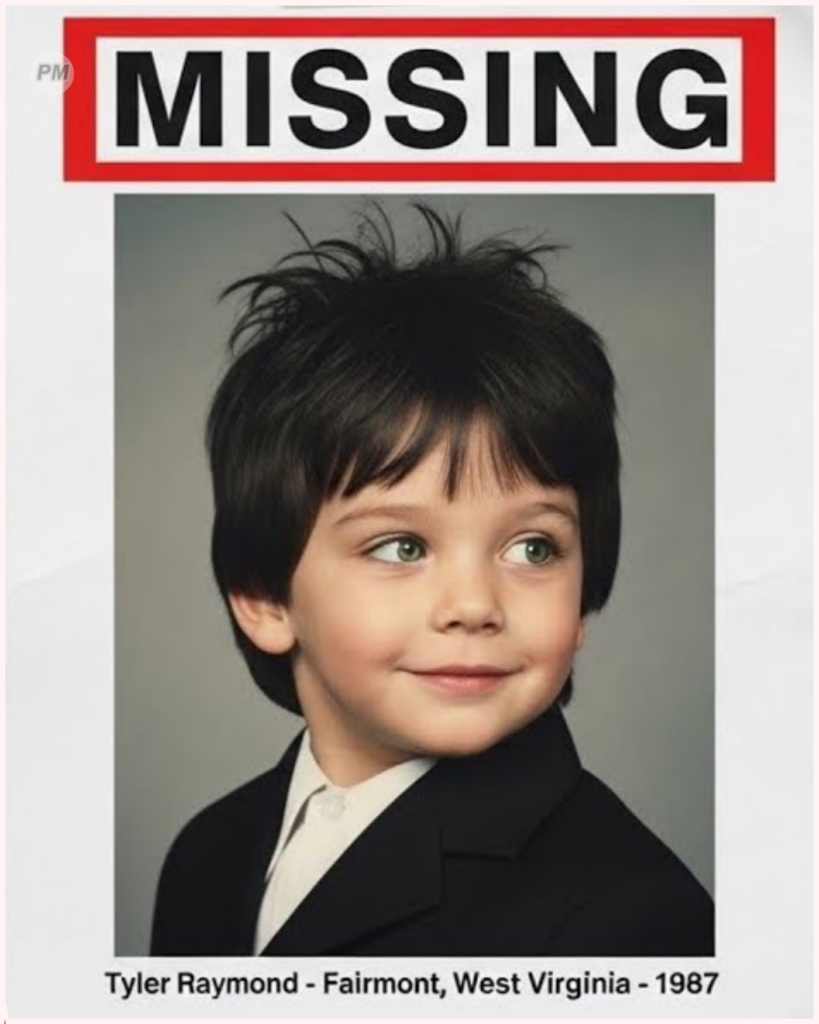
"Home
“Home. I live on Adams Street, about a 10-minute walk from the store.” “Does anyone live with you who can verify what time you arrived home?”
“I live alone.” Walter was given a polygraph test. He passed. His house was searched with his consent.
Nothing suspicious was found. His vehicle, a 1982 Ford sedan, not a white van, was examined.
No evidence of Tyler Raymond. The white van that Carol Mitchell mentioned became a focus of the investigation.
Police canvassed the area asking if anyone owned or had seen a white van. Multiple people reported seeing white vans at various times and places.
White vans were common work vehicles. None of the leads went anywhere. By the end of February, the active search was scaling down.
The reality was setting in. Tyler Raymond was gone, and whoever had taken him had left no trace.
The months that followed were a special kind of torture for Deborah Raymond. She couldn’t work.
Her job at the County Clerk’s office granted her indefinite leave, but money was running out.
Clarence helped financially, as did the church, but charity has its limits. She spent her days in a fog, sitting in Tyler’s room, touching his toys, hoping for a phone call that never came.
The FBI agents left in March. The case remained open, but without leads, there was little active investigation.
Detective Hollis continued working it in his spare time, reviewing evidence, re-interviewing witnesses, but even he knew the trail had gone cold.
Fairmont tried to return to normal, but the disappearance had changed something fundamental. Parents became paranoid.
Children who’d once walked freely to school were now driven. Trust, the invisible glue that held small communities together, had fractured.
Theories proliferated. Some believed a drifter had been passing through Fairmont and had taken Tyler on impulse.
Others thought it was someone local, someone who’d been planning it, watching for the right moment.
A few people whispered about Deborah herself. Maybe she’d snapped. Maybe Tyler’s death had been an accident and she’d hidden the body.
That theory was investigated and dismissed. Deborah had been in full view of multiple witnesses during the relevant time period.
Walter Kinsolving, despite being cleared by the polygraph, became the subject of suspicion among certain townsfolk.
The fact that an 8-year-old had tentatively identified him was enough for some to draw conclusions.
Walter endured months of suspicious glances and whispered accusations before he finally sold his house in June 1987 and moved to Columbus, Ohio, where he had a brother.
He told people he needed a fresh start. His departure fueled more speculation. “Why would an innocent man leave?”
“Because living under suspicion is unbearable,” Detective Hollis said during a town hall meeting. “Walter Kinsolving cooperated fully with the investigation.
He passed a polygraph. His home and vehicle were searched. There is no evidence connecting him to Tyler’s disappearance.
But in the absence of answers, people create their own narratives.” Years passed. The case appeared on Unsolved Mystery television shows.
Age-progressed photos of Tyler were released, showing what he might look like at 10, 15, 20.
None of the tips generated by these media appearances led anywhere. Deborah Raymond never fully recovered.
She became a ghost in her own life, working her county clerk job mechanically, attending church out of habit rather than faith, marking each February 15th with a visit to Woodlawn Cemetery where a small memorial stone had been placed next to Michael’s grave.
The stone read Tyler James Raymond, 1982-1987, forever in our hearts. Clarence kept the store running, but his heart wasn’t in it anymore.
He retired in 2003 and sold the building. It became a thrift shop, then an antique store, then sat empty for years.
The bell above the door was removed at some point. No one remembered when. Detective Raymond Hollis retired in 2005.
On his last day, he packed up the Tyler Raymond case files, labeled the boxes carefully, and placed them in the cold case archives in the basement of the Fairmont Police Department.
He’d failed to solve it, and that failure haunted him until his death from a heart attack in 2011.
By 2020, most people in Fairmont who remembered the disappearance first hand were elderly or had moved away.
The town’s population had dropped below 18,000. The coal industry was functionally dead. Buildings stood empty on Main Street.
Tyler Raymond’s story became a local legend, the kind of thing older residents mentioned to newcomers as a cautionary tale.
“This used to be a safe place, but then that little boy vanished, and nothing was ever the same.”
It seemed likely that the truth had been buried forever, either in an unmarked grave or in the fading memories of whoever was responsible.
But truth has a way of resurfacing, especially when someone refuses to let it rest.
Part two, Detective Roberta Chen joined the West Virginia State Police Cold Case Unit in January 2023, 36 years after her father witnessed a child vanish from a grocery store in Fairmont.
She’d grown up hearing about Tyler Raymond, not frequently because Robert Chen wasn’t the type to dwell on trauma, but enough that the case had lodged itself in her consciousness like a splinter that never quite healed.
Robert had moved away from Fairmont in 1992, taking a position at Ohio State University, but he’d carried the guilt of that February afternoon with him across state lines.
“I was standing right there,” he’d told his daughter once when she was in high school and asking about his time in West Virginia.
“10 ft from that little boy. I saw him playing with toy cars. I looked away to read a soup label, and when I looked back, he was gone.
Sometimes I wonder if I’d been paying more attention, if I’d seen something.” He hadn’t finished the sentence.
He hadn’t needed to. Roberta became a police officer in part because of that story.
She worked patrol in Columbus for 8 years, made detective in 2018, and when the cold case unit position opened up in Charleston, she applied specifically requesting assignment to northern West Virginia cases.
Her supervisor understood why. “Your father was the witness,” Captain Linda Morrison said during the interview.
“That’s not a conflict of interest, but I need to know you can be objective.”
“I can be objective,” Roberta said, “but I won’t pretend I’m not personally invested.” She got the job.
The Tyler Raymond case file arrived on her desk in February 2023, one of 47 unsolved disappearances dating back to the 1960s.
The boxes were dusty, the paperwork yellowed, but everything was meticulously organized. Detective Hollis had been thorough.
Roberta spent 3 weeks reading every interview transcript, every tip sheet, every dead end lead.
She called her father, now 71 and retired in Dayton. “I’m looking at the Raymond case,” she said.
There was a long pause on the line. “Are you sure that’s wise?” “I have to try.”
“Roberta, dozens of investigators looked at that case. The FBI was involved. If there was something to find, then I’ll confirm there’s nothing to find, but I have to look.”
Robert sighed. “What do you need from me?” “Tell me again what you saw, everything you remember.”
Her father’s recollection matched his 1987 statement almost word for word, a testament to how deeply the memory had been seared into him.
He described the layout of the store, the positions of people, the timing of the bell.
He mentioned details that hadn’t made it into the official report, the smell of floor wax, the way afternoon light slanted through the front window, the precise brand of soup he’d been examining.
“There was one thing,” Robert said, “that I’ve thought about over the years. The bell rang when Martha Holbrook left.
It rang when that postal worker came in. But there was a moment, maybe 30 seconds, when I heard the bell ring very faintly, like someone was trying to open the door slowly, quietly.”
“You didn’t mention that in your statement,” Roberta said. “I wasn’t sure if I’d really heard it or if my mind was filling in gaps.
When you’re trying to reconstruct a traumatic event, memory gets unreliable. I didn’t want to send investigators chasing a phantom.”
“When did you hear this quiet bell?” “I think it was right after Martha left, but I can’t be certain.”
Roberta made a note. A quiet bell suggested someone trying to exit without drawing attention.
But who? All the customers had been accounted for, unless one of them had left, taken Tyler, and returned before anyone noticed.
She pulled the interview transcripts and cross-referenced timelines. Martha Holbrook had left at approximately 2:22 p.m.
David Sullivan had entered at approximately 2:28 p.m. That created a 6-minute window. During that window, Deborah Raymond was selecting vegetables, then checking tomato sauce prices.
Frank and Louise Garrett were at the meat counter. Jenny Morrison was in the storage room.
Robert Chen was in the soup aisle. Walter Kinsolving was examining apples near the front.
Walter Kinsolving. Roberta pulled his file. Polygraph passed, house searched, nothing found. Vehicle searched, nothing found.
He’d cooperated fully, then moved to Columbus in June 1987 after months of community suspicion.
She ran his name through current databases. Walter Kinsolving, now 71 years old, living in a retirement community in Worthington, Ohio.
No criminal record. Widowed in 2019. One son living in California. She ran his financial records from 1987, and that’s when she found it.
On February 2nd, 1987, 13 days before Tyler Raymond disappeared, Walter Kinsolving had withdrawn $8,000 in cash from his savings account at Fairmont National Bank.
The withdrawal slip was in the archived records. $8,000 in 1987 was equivalent to roughly 20,000 in 2023, a significant sum for a hospital maintenance worker.
On March 14th, 1987, less than a month after Tyler’s disappearance, Walter Kinsolving had sold his house on Adams Street for $42,000, well below the assessed value of 58,000.
A quick sale, likely for cash, to a buyer whose name Roberta didn’t recognize. On March 30th, 1987, Walter Kinsolving purchased a house in Columbus, Ohio for $55,000.
Cash transaction. The timeline was suspicious, but not conclusive. People withdrew cash for legitimate reasons.
People moved for legitimate reasons. But the pattern nagged at her. She expanded her search, looking for any other financial anomalies in the months surrounding the disappearance.
Bank records, property records, tax filings, anything that might show unusual activity. She found something else.
In April 1987, 2 months after Tyler vanished, a company called Worthington Medical Supply in Columbus, Ohio had filed paperwork for a new employee, Walter Kinsolving.
The starting salary was listed as $38,000, significantly more than his hospital maintenance job in Fairmont had paid.
Roberta called Worthington Medical Supply. The company still existed, now owned by a larger corporation.
“I’m trying to verify employment history for a Walter Kinsolving,” Roberta said to the HR representative.
“He would have started in April 1987.” “Let me check our archives.” A pause, the sound of typing.
“Yes, Walter Kinsolving, hired April 6th, 1987. Position was warehouse supervisor. Left the company in 2003.
Do you have any records of how he was recruited? Why he left his previous job?
I’m sorry, that information isn’t in our system. Our records from that era are pretty minimal.
Roberta thanked her and hung up. A warehouse supervisor position at a medical supply company wasn’t unusual, but the timing bothered her.
Walter moves to Columbus, gets a better paying job almost immediately, buys a house with cash.
Where had the money come from? She pulled Walter’s tax returns for 1986 and 1987, available through state records.
His reported income for 1986 was $26,000. For 1987, it jumped to 41,000, consistent with the new job starting in April.
But there was no reported income that would account for having enough cash to buy a house outright.
Either Walter Kinsolving had savings he hadn’t reported, tax evasion, a crime, or the money had come from somewhere else.
Roberta spent 2 days considering whether she had enough to justify reopening the investigation. Unusual financial activity wasn’t evidence of kidnapping.
Walter had been cleared in 1987. She had no physical evidence, no witnesses placing him with Tyler, nothing but a suspicious timeline and money that didn’t quite add up.
But she also had something the 1987 investigators hadn’t. Modern investigative techniques and 36 years of distance.
She decided to find Carol Mitchell. Carol Mitchell had been 8 years old in 1987 when she told FBI agents she might have seen a man carrying something near a white van outside Raymond’s General Store.
Her testimony had been deemed unreliable, the testimony of a child with an active imagination.
Now, in 2023, Carol Mitchell was 44 years old, living in Pittsburgh, working as a pediatric nurse at UPMC Children’s Hospital.
Roberta found her through social media and sent a carefully worded message explaining that she was investigating cold cases and would like to speak about something Carol had witnessed as a child.
Carol responded within hours. I’ve thought about that day for 36 years. Yes, I’ll talk to you.
They met at a coffee shop in Pittsburgh’s Shadyside neighborhood on a gray morning in March.
Carol was petite, with dark hair cut short and tired eyes that suggested too many overnight shifts.
She ordered black coffee and got straight to the point. You want to know what I really saw?
Carol said. I want to know what you remember, Roberta replied. Memory changes over time, that’s normal.
But sometimes there are details that stick, things you might not have mentioned because you were afraid or confused.
Carol wrapped her hands around her coffee cup. I was eight. My mom and I were walking past the store.
She was talking to me about school or something and I wasn’t really listening. I was looking around and I saw a man come out of the store carrying something wrapped in a blanket.
You told the FBI this in 1987, Roberta said. I told them I saw a man with a blanket.
I didn’t tell them I recognized him. Roberta felt her pulse quicken. Why not? Because he saw me see him and he put his finger to his lips.
Carol demonstrated, index finger pressed to her mouth, the universal gesture for silence. Then he smiled at me.
Not a friendly smile, a scary smile. The kind that says, “If you tell anyone, something bad will happen.”
You were 8 years old, Roberta said gently. That must have been terrifying. I had nightmares for years, but I convinced myself I’d imagined it, or that maybe he’d been carrying laundry, or that it wasn’t connected to the missing boy.
I wanted to believe that because believing he’d threatened me meant believing I could have saved Tyler Raymond and didn’t.
Carol, you were a child. You’re not responsible for what happened. Carol’s eyes filled with tears.
I know that logically, but logic doesn’t erase guilt. Roberta pulled out a folder containing photographs from the 1987 investigation, copies of the images shown to Carol as a child.
You identified Walter Kinsolving tentatively. You said, “Maybe him.” Do you remember why you weren’t certain?
I was certain, Carol said quietly. I pointed to his picture because it was him.
But my mother kept saying I had an active imagination and the FBI agents seemed skeptical and I started doubting myself.
Eight-year-olds are easy to intimidate, especially when adults tell you you’re wrong. Are you certain now?
Carol looked at Walter Kinsolving’s 1987 photograph, a man in his mid-30s with dark hair, an ordinary face, the kind of person you’d pass on the street without a second glance.
That’s him. I saw him carry something wrapped in a blanket from the store to a white van.
He threatened me to stay quiet and I did because I was eight and scared.
Roberta made extensive notes. Did you see where the van went? It drove away down Main Street.
I don’t know where it went after that. What kind of van was it? White, panel van style, no windows on the sides.
There might have been writing on it, but I don’t remember what it said. Did Walter Kinsolving own a white van in 1987?
The police said he owned a Ford sedan. They searched it. Roberta nodded. The 1987 investigators had searched Walter’s personal vehicle.
But what if he’d had access to another vehicle? A work vehicle, perhaps? She pulled the employment records for Walter Kinsolving from 1987.
He’d worked at Marion County General Hospital in Fairmont as a maintenance supervisor. She called the hospital’s current administration office.
I’m trying to verify what vehicles your maintenance department used in 1987, Roberta said. That’s very specific, the administrator replied.
I’m not sure we have records going back that far. This is for a police investigation.
Anything you can find would be helpful. Two days later, Roberta received an email with scanned documents from the hospital’s archived fleet logs.
In 1987, the maintenance department had operated three vehicles, two pickup trucks and one 1983 Ford Econoline van, white, used for transporting equipment and supplies.
Walter Kinsolving, as maintenance supervisor, had regular access to that van. The van had been sold at auction in August 1987, 6 months after Tyler’s disappearance.
The buyer was a contractor in Morgantown. Roberta tracked down the contractor, now retired, living in Florida.
That van? The contractor said over the phone, I used it for maybe 2 years, then sold it for scrap.
It was falling apart. Do you remember anything unusual about it when you bought it?
Like what? Any damage? Any signs it had been cleaned extensively? Anything that stood out?
It was an old work van. It was dirty, beat up, smelled like motor oil.
Nothing unusual. The van itself was long gone, dissolved into scrap metal decades ago. But Roberta now had a theory that fit the facts.
Walter Kinsolving had access to a white van. Carol Mitchell, a credible adult witness revisiting childhood testimony, placed him at the scene carrying something wrapped in a blanket.
His financial records showed suspicious activity, large cash withdrawal before the disappearance, quick sale of his house afterward, cash purchase of a new home in another state.
But theory wasn’t evidence. She needed more. Roberta returned to the 1987 case file, this time focusing on the physical layout of Raymond’s General Store.
The crime scene photographs showed the front entrance, the interior aisles, the back storage room.
She studied them for hours trying to understand the impossible. How does someone remove a 4-year-old child from a store without anyone noticing?
The front door had a bell. Everyone agreed they would have heard it ring. But Robert Chen had mentioned hearing a faint ring as if someone opened the door slowly.
If Walter had taken Tyler through the front door during the narrow window when Deborah was distracted and the other customers weren’t watching the entrance directly, he could have moved quickly to the van parked outside.
But why would Tyler go with him willingly? She reread the witness statements. >> [snorts] >> Walter Kinsloving was described as a family friend.
He’d attended Michael Raymond’s funeral. He’d brought Deborah a casserole. He was familiar to Tyler, not a stranger.
What if Walter had said something like, “Your mom needs help carrying something to my van?”
A 4-year-old wouldn’t question that. He’d follow a trusted adult. The timeline was tight, perhaps 90 seconds to exit the store, cross to the van, place Tyler inside, and return.
But, it was possible, especially if the van was parked close to the entrance. Roberta checked the crime scene photos again.
One showed the exterior of the store and the adjacent parking spaces. She could see parts of several vehicles, but the angle didn’t capture the full parking area.
She needed to know where Walter’s van had been parked that day. She went back through the interview transcripts looking for any mention of vehicle positions.
Nothing specific. The investigators in 1987 had focused on who was inside the store, not what was parked outside.
But, Carol Mitchell had seen the van. Roberta called her. “The white van you saw, where was it parked relative to the store entrance?”
Carol thought for a moment. “Close, right out front, maybe two or three parking spaces from the door.”
“Do you remember any other vehicles nearby?” “There was a blue car, I think, and maybe a truck.
It was a long time ago.” Roberta thanked her and hung up. A van parked close to the entrance made the theory more plausible.
Walter could have exited the store with Tyler, placed him in the van, possibly unconscious or subdued with a hand over his mouth, and returned within 90 seconds.
But, that raised another question. What happened to Tyler after that? If Walter had killed the boy immediately, where was the body?


