The calls were brief, almost casual in their tone,…
The calls were brief, almost casual in their tone, but the message was unmistakable. I know where your family lives.
I can still reach you. I haven’t forgotten. The threat that had silenced a teenager in 1979 was being refreshed and maintained across the decades by a man who understood that fear properly tended never expires.
Imagine carrying that for 32 years. Imagine building a career, raising a family, celebrating holidays and birthdays and milestones, all while a voice in the back of your head replays the same scene over and over.
The pillow, the gunshots, the promise. This is what happens. Then one day in 2011, two cold case detectives knocked on her door.
Sharf and Vanderweist had pieced together enough from Knight’s testimony to know who she was and what she might have seen.
They had the half-brother’s statement about the girl in the car. They had 32 years of case files pointing to Johnson.
What they didn’t have until they stood on her doorstep was confirmation. When the detectives confronted her with what they knew, the walls she’d built over three decades came down in a single whispered sentence.
She looked at Detective Vanderwis and said two words, “I was there.” The relief, she would later tell a reporter from the Everett Herald, was immense.
She described it as a weight being physically lifted from her body. The sensation of something she’d carried since she was a teenager finally being set down.
The secret that Gregory Johnson had locked inside her with threats and violence was finally, after 32 years, no longer hers alone to bear.
Someone else knew. Someone was going to do something about it. In April of 2011, Gregory Johnson was arrested outside his home in Seattle.
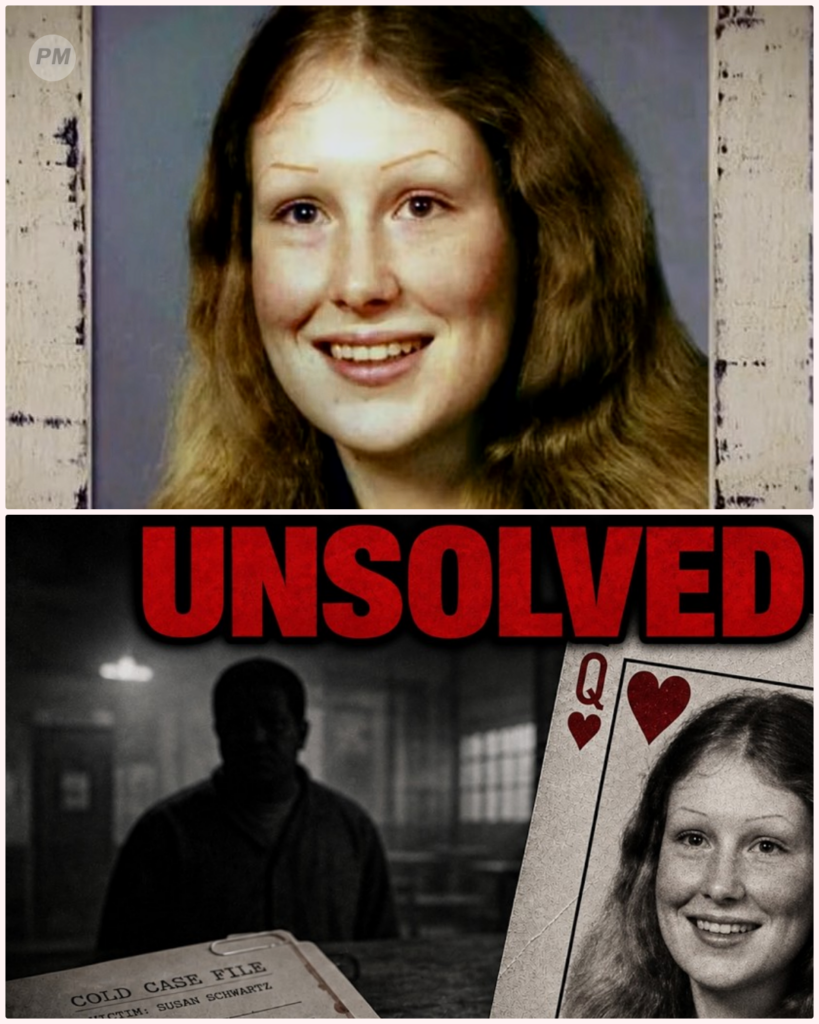
Officers approached him on the street, placed him in handcuffs, and transported him to the Snowhomeish County Jail more than three decades after he’d bound Susan Schwarz’s hands with an electrical cord and ended her life in a bathroom on Locust Way.
His bail was initially set at $1 million. When prosecutors reviewed the full scope of the evidence, including the eyewitness testimony they now had, they raised it to 5 million.
He was charged with first-degree murder. Now came the hardest part of all, not finding the killer.
They’d known who he was since 1979. The hard part was making the case stick in a courtroom with evidence that was 32 years old and a complete absence of physical forensic proof.
Prosecutor Lisa Paul weighed the risks carefully. A trial meant putting the eyewitness on the stand, forcing a woman who’d been terrorized for three decades to face her abuser in open court.
It meant building a case around testimony that a defense attorney would attack relentlessly, arguing that 32 years of fear and trauma had corrupted the witness’s memory, that her account was unreliable, that she was testifying under pressure.
It meant asking a jury to convict on words alone with no DNA, no fingerprints, and nothing physical connecting Johnson to the crime scene.
The plea deal was a calculated trade-off, less justice than the family deserved, but far more certain than a verdict that could go either way.
On January 27th, 2012, Gregory Johnson stood in a Snowhomeish County courtroom and pleaded guilty to secondderee murder in the killing of Susan Marie Schwarz.
On March 23rd, 2012, Superior Court Judge Larry McKeman sentenced Johnson to a minimum of 24 years in prison following prosecutor Paul’s recommendation of 298 months.
Because the crime predated Washington State’s Sentencing Reform Act, Johnson’s actual release would not be determined by a fixed date on a calendar.
Instead, the Indeterminate Sentence Review Board, a panel that evaluates whether prisoners have been rehabilitated enough to re-enter society, would decide whether Gregory Johnson would ever walk free again.
At sentencing, Johnson did something that revealed exactly who he was and exactly who he had always been.
He blamed Susan. He told the court that she had meddled in his relationship, that she had interfered in his marriage, that she was the one who caused the problems between himself and Karen.
After 32 years, after a guilty plea, after the testimony and the evidence and the crushing weight of what he’d done, Gregory Johnson still believed that Susan Schwarz had it coming.
He showed no remorse. Not a flicker, not a word. The Schwarz family stood up in that same courtroom and said the things that had been building inside them for more than three decades.
Gary Schwarz, Susan’s brother, addressed the court directly. He told the judge that the desire to help her friend should not have cost Sue her life.
He called the killing as senseless as Johnson’s existence. And then he said the words that carry the full weight of what this family lost.
He said that Johnson took from their family their sense of security, their belief in kindness in others, their belief in right and wrong.
But most of all, he took Sue from them forever. Gary asked the judge for one more thing.
He asked for protection for the witness, the woman who had finally come forward after 32 years of silence.
Gary was worried about what would happen if Johnson were ever released. He knew the kind of man Johnson was.
He knew that threats didn’t expire just because a prison sentence started. Sister Valerie, who had been 13 when Susan was killed and had grown up in the shadow of an unsolved murder that defined her childhood, wrote a letter to the judge expressing the complicated anguish of imperfect justice.
She was conflicted about the plea deal. Seconddegree murder, not first. A minimum sentence, not a life sentence.
And she struggled with the witness’s decades of silence. The knowledge that someone had known who killed her sister and had said nothing for 32 years.
Even as Valerie understood the terror that had kept this woman quiet, understanding and acceptance are two very different things.
In January of 2012, before the sentencing, the Schwarz family met the witness for the first time.
The woman who had watched their sister die. The woman who had carried their family’s tragedy as her own secret burden for three decades.