Her name, the date of her murder, the case number,…
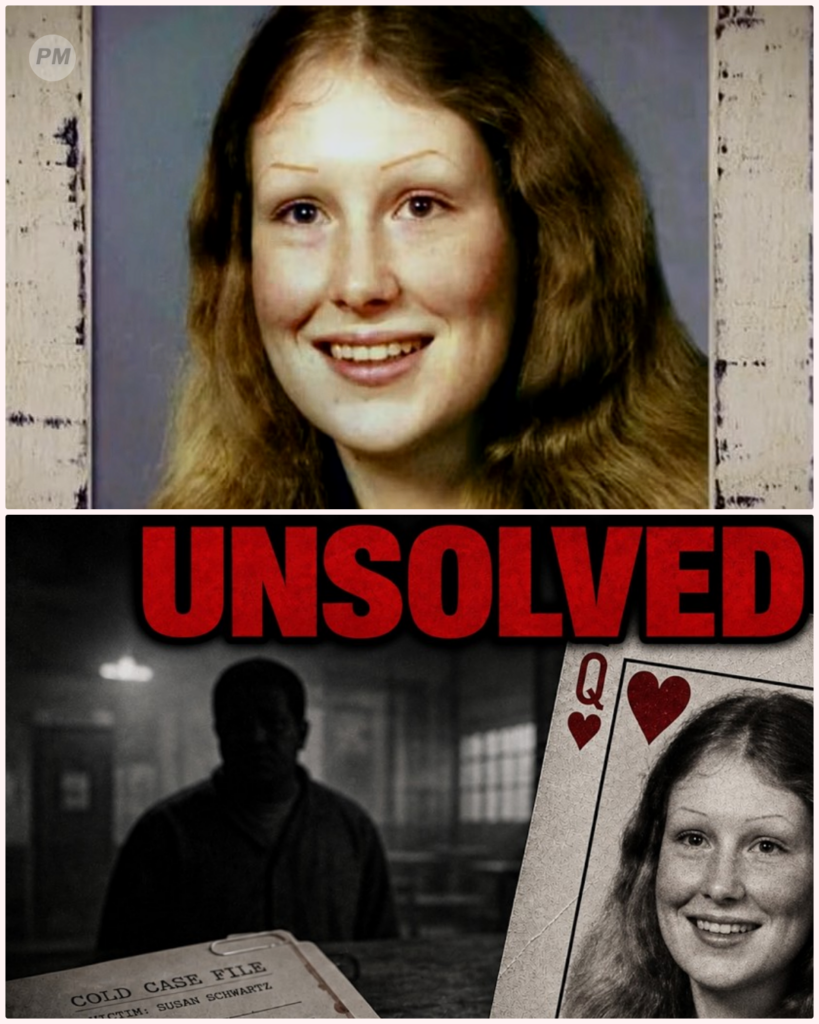
Her name, the date of her murder, the case number, the tip line, everything printed in clean type beneath a photograph of a young woman with reddish auburn hair who’d been dead for more than 30 years.
Knight knew that face. He knew the name and he knew exactly who had killed her.
Knight contacted the Snowomish County Sheriff’s Office and told the detectives what he’d been carrying since October 22nd, 1979.
On the day of the murder, Knight said he had been fishing on a pier.
Gregory Johnson drove up in his car, pulled over, and asked his half-brother for a favor.
He needed Knight to say they’d been fishing together all day. A false alibi, a cover story.
When Knight asked why he needed an alibi, Johnson’s answer was blunt. Because I killed Sue.
Knight agreed to cover for him. He was the killer’s half-brother. And in 1979, that kind of blood loyalty wasn’t something you questioned, especially when the person asking was Gregory Johnson, a man who’d already demonstrated what he was capable of doing to people who crossed him.
You didn’t say no to Gregory Johnson. Not if you knew what was good for you.
And so Knight kept his mouth shut and the alibi held. And the years started stacking up, one on top of another, with the truth buried under family silence and mutual self-interest.
But Knight had noticed something else that day. A detail that had stayed with him across three decades of prison walls and sleepless nights.
There was a girl sitting in the front seat of Johnson’s car, young, quiet, terrified looking, present on the day of a murder and never heard from since.
The playing card had done its job. The Queen of Hearts, sitting in the hand of the one man who had heard a confession directly from the killer himself, had finally prompted someone to talk.
It had taken 3 years of the cards circulating through the prison system, 3 years of being shuffled and dealt and discarded by inmates who had no connection to this case.
And then the deck landed with the one person who did. Detectives Jim Sharf and Patrick Vanderwe now had something they’d never had before in 32 years of investigating this murder.
They had a name for the girl in the car. She’d been in the case file since 1979, listed among the people in Gregory Johnson’s circle.
The teenage girlfriend, whose name had been written down by the original investigators and then left uncontacted, unintered, and ultimately forgotten.
She was no longer a teenager. She was now in her early 50s, and finding her was about to unlock the final piece of a puzzle that had defeated investigators for more than three decades.
The woman that Sharf and Vanderweis tracked down had built an entirely different life from the one Gregory Johnson had trapped her in as a teenager.
She’d become a nurse. She’d raised children. She’d lived a crimefree, quiet existence in Washington State for decades, as far from the violence of her youth as a person can get without leaving the state entirely.
She had met Johnson when she was around 17 years old, roughly 9 months after her own father died.
She was grieving, vulnerable, unmed in the way that a teenager who’s just lost a parent can be.
Johnson saw that vulnerability and moved in on it with precision. He pulled her away from her mother, isolated her from the people who cared about her, and moved her into his world.
The relationship turned violent almost immediately. She was a teenager living with a man who hit her, controlled her, and made it clear that disobedience carried consequences she didn’t want to imagine.
On the morning of October 22nd, 1979, Johnson told her they were going somewhere. He said they were visiting someone who owed him money and drugs.
It sounded routine, or at least as routine as anything sounded in Gregory Johnson’s world.
She got in the car and didn’t ask questions because asking questions was dangerous. They drove to a small house on Locust Way in Alderwood Manor.
Johnson told her to go inside and grab some items. She did what she was told the way she always did what she was told because doing otherwise meant getting hurt.
Inside the house, she saw Susan Schwarz. And then she watched Gregory Johnson pull Susan from the shower, strike her across the head with a pistol hard enough to stun her, force her to the bathroom floor, bind her hands behind her back with an electrical cord, press a pillow over her head, and fire.
When Johnson looked up from the floor, he saw his girlfriend standing there watching, frozen in the doorway.
He turned the gun back towards Susan and fired again. And then he said something that would echo in this woman’s mind for the next 32 years of her life.
He told her, “This is what happens to people who mess with his life.” Then he made her a promise.
If she ever told anyone, anyone at all, what she’d seen inside that house, he would kill her and he would kill her mother.
She was a teenager. She had just watched a man execute another human being at point blank range.
The man holding the gun, the man she lived with, the man who already hit her was now telling her that her mother would die if she opened her mouth.
She believed him completely. For 32 years, she kept that secret. She never told the police.
She never told her family. She never told the therapists or the friends or the colleagues she accumulated over three decades of building a normal life on top of an abnormal foundation.
She became a nurse, a career dedicated to saving people while carrying the memory of watching someone die.
She became a mother raising children while knowing that the man who had murdered Susan Schwarz was still out there, still free and still dangerous.
And he reminded her of that danger. Even after Johnson was released from prison on his robbery and drug sentences, he called her mother’s house.
