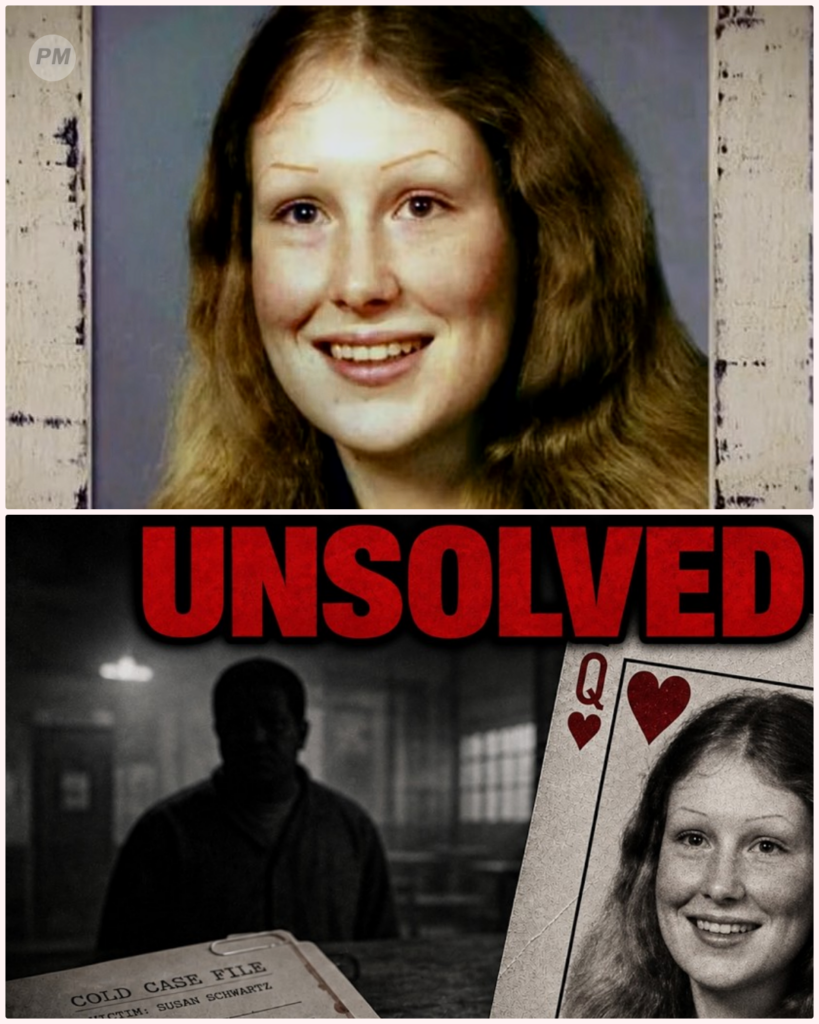
Mccclure had been bound with an electrical cord
Mccclure had been bound with an electrical cord. She’d been gagged. She’d suffered severe head injuries.
The method was so close to what had happened to Susan Schwarz 7 years earlier that detectives couldn’t ignore the overlap.
Two women, two murders, both involving electrical cords used as restraints, both involving blunt force trauma to the head, and both connected to the same family.
Knight was sentenced to life without parole for the Mccclure killing. And when Snowhomeish County detectives went back to Johnson to question him about Susan’s murder, Johnson pulled a move that tells you everything about the kind of man he was, he tried to pin it on his own brother.
Johnson told the detectives that he’d driven Knight and two other men to a house to commit a burglary and that Knight later admitted to killing Susan during the job.
It was a calculated lie designed to redirect suspicion while casting himself as a peripheral player.
Just the driver, just the guy who didn’t know what was going to happen inside, not the one who pulled the trigger.
The detectives didn’t believe him. The story contradicted the evidence and itself in ways that were obvious, even without additional proof.
But belief and proof are two different things in a courtroom. And once again, the Snowomish County Sheriff’s Office didn’t have the proof.
The investigation into Susan Schwarz’s murder went officially cold. The file was closed, shelved, and left to gather dust alongside hundreds of other unsolved cases from the 1970s and 1980s.
For the Schwarz family, the years that followed were a particular kind of torture. Not the sharp agony of a fresh wound, but the dull, grinding ache of a question that never gets answered.
Who killed Susan? And why couldn’t anyone prove it? Henry Schwarz, Susan’s father, was living in Kirkland and aging without resolution.
He went through the 1980s, the 1990s, and into the 2000s carrying the weight of his daughter’s unsolved murder.
Years later, when he was 82 and a reporter finally called with news, he described the way he’d coped by saying he had to play like it never happened.
He buried the pain so deep that it became just words. A sentence he could repeat without feeling anything because feeling something would have destroyed him.
Think about that for a second. A father burying the murder of his daughter so deep inside himself that it becomes nothing more than a phrase he can recite.
That’s not healing. That’s survival. Valerie Schwarz was 13 years old when her big sister was killed.
She grew up in the shadow of that loss. The kind of childhood defined not just by grief, but by the particular injustice of knowing that the person responsible was still walking around, still breathing, still free.
Every birthday Susan missed, every holiday, every family dinner with an empty chair. 32 years of that.
Meanwhile, Gregory Johnson kept cycling through the criminal justice system like a man on a conveyor belt.
He was imprisoned from 1985 to 2000 for armed robbery. 15 years behind bars. And when the state of Washington finally let him walk out the gates, he didn’t go straight.
He picked up drug charges and went right back in for another 6 years. He was a career criminal who kept getting caught, kept getting sentenced, and kept getting released.
The system processed him again and again, stamping him through on robbery charges, drug charges, the kind of convictions that carry years, but not decades.
The one crime he was never held accountable for, the execution of a 24year-old woman in her own bathroom, was the worst thing he’d ever done.
And it was the one the system never t touched. There’s a particular cruelty to that.
A man serves prison time for lesser crimes while the worst thing he’s ever done remains hidden.
He comes and goes from institutions processed and released, processed and released. And the whole time the crime that should have defined his life in a courtroom sits in a filing cabinet, unsolved and growing cold.
The case file sat in a drawer at the Snowhomeish County Sheriff’s Office, growing older every year.
Detectives came and went. New murders took priority over old ones. Susan’s case became the kind of file that young detectives hear about from older ones in the breakroom.
The one that got away. The one that nobody could crack. The one that made veteran investigators shake their heads and say, “We know who did it.
We just can’t prove it. But Detective Barry Fagan couldn’t let it go. He’d worked the case long enough to know it in his bones.
And around 1999, when it became clear he wasn’t going to solve it himself, he did the next best thing.
He handed the file to a detective named Jim Sharf. Because Fagan believed Sharf was the kind of investigator who wouldn’t give up on a dead girl from Alderwood Manor.
Fagan was right. In February of 2005, the Snowomish County Sheriff’s Office did something that would change the trajectory of Susan’s case and several dozen others.
They formed a dedicated cold case unit. Jim Sharf was one of the founding detectives alongside Patrick Vanderwis and Joe Dunn.
Their job was simple to describe and almost impossible to execute. Take the cases that everyone else had given up on and solve them with whatever tools existed, old and new.
Susan’s file was one of the first they pulled off the shelf. Sharf and Vanderwis started where any modern cold case investigator would start.
They went back to the physical evidence. Nearly a hundred items from the original crime scene, items that had been sitting in evidence storage since 1979, were sent to the state crime lab for DNA testing using techniques that hadn’t existed when Susan was killed.
If there was genetic material anywhere on the electrical cord, on the shell casings, on the pillow, on anything from that bathroom, this was the technology that would find it.
Every single item came back with the same result. The only DNA recovered from the evidence, belonged to Susan Schwarz herself.
