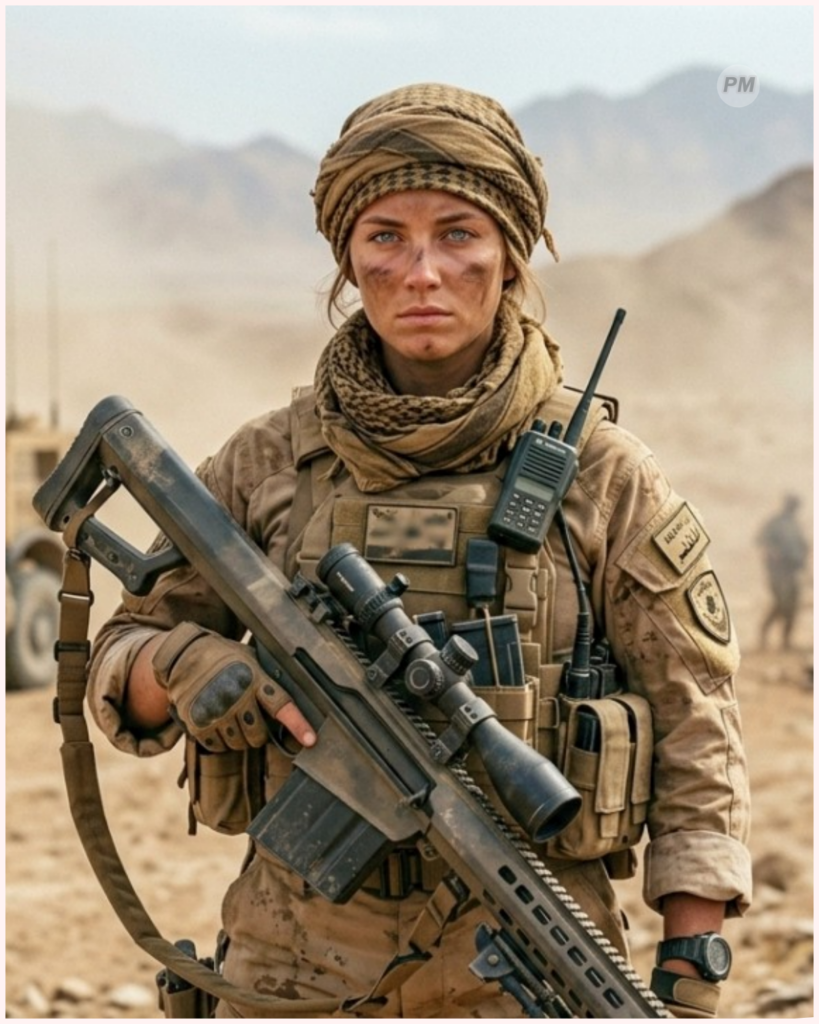
They called her the trainee, not because anyone asked her age or checked her record or took 30 seconds to look at the way she moved.
They called her the trainee because she was small, because she was female, because her uniform carried no combat patch, no deployment ribbon, nothing that would tell a story worth hearing.
She sat at the back of the C-130 cargo bay with her field pack between her boots and her rifle secured vertical against her shoulder.
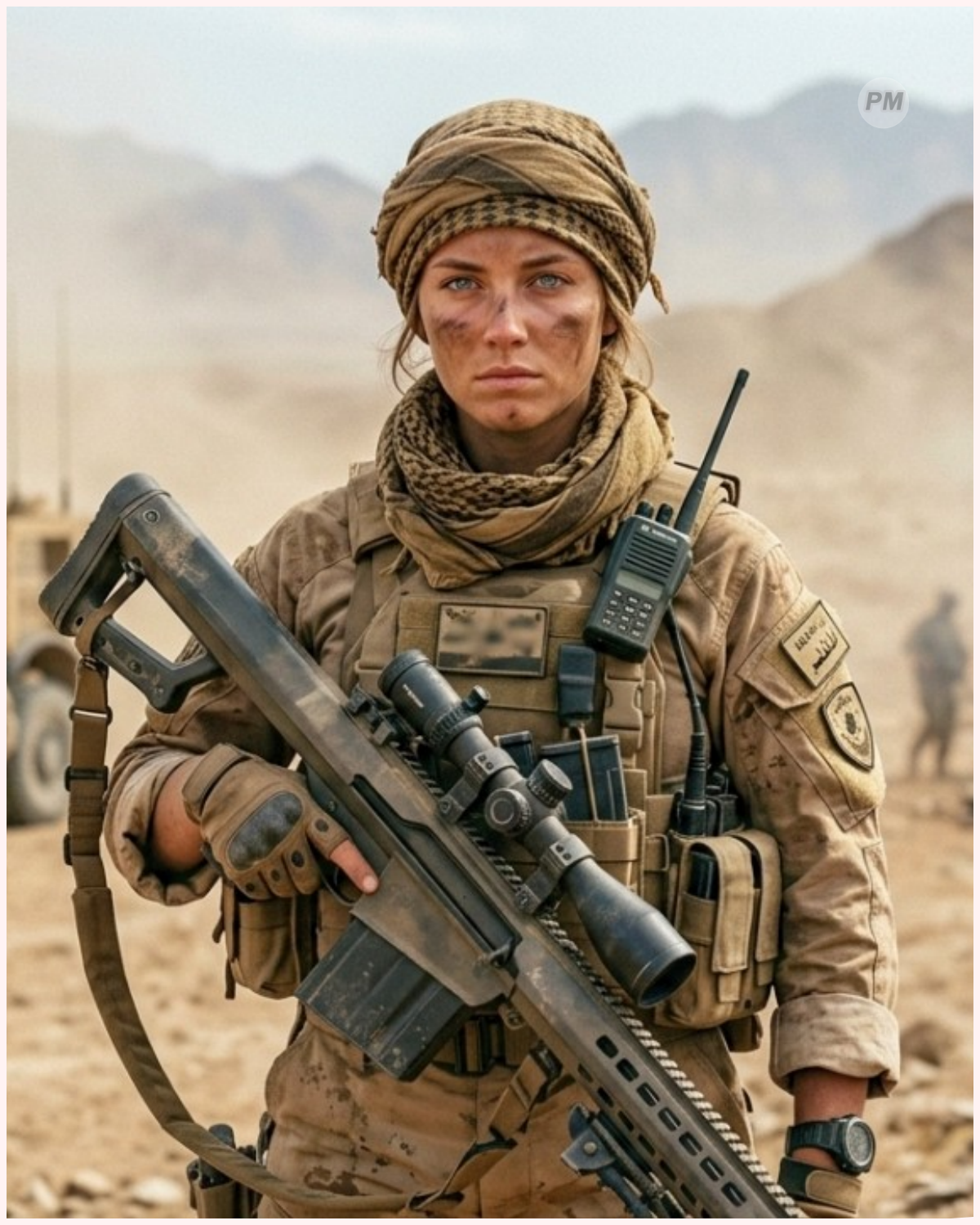
And nobody looked at her for more than 2 seconds. Nobody asked her name. The plane shuddered through turbulence somewhere over the Atlantic and the fluorescent strip lighting above the rows of jump seats turned everyone the same color, pale, tired, slightly hollow around the eyes.
41 soldiers in full kit heading toward a forward operating base in the desert that most of them had never seen, carrying orders that had been classified, reclassified, and classified again before anyone under the rank of captain was allowed to read them.
Staff Sergeant Daniel Rourke sat across the aisle from her, three seats down, close enough to observe without being obvious about it.
He was 42 years old, former 75th Ranger Regiment, with a face that had been rearranged by two deployments to Afghanistan and one to Iraq and a habit of watching people the way a man watches weather.
Not to admire it, but to understand what it intended to do next. He had been watching her for 11 minutes.
Corporal Dex Pruitt settled into the seat beside Rourke and leaned close enough to be heard over the engine noise.
Pruitt was 29, broad across the shoulders with a kind of confidence that comes from never having been wrong about anything important enough to matter.
“They sent us a babysitter,” Pruitt said, tilting his head toward the back of the bay.
You’re looking at the augment, Rourke said. That’s what I said, a babysitter. Pruitt studied her for a moment.
No patches, no ribbons. File came through this morning, transfer from somewhere, half the pages blacked out.
He leaned back. You know what redacted means? It means she sat behind a desk and made somebody angry.
Specialist Nora Finch was seated two positions forward of Pruitt, close enough to hear. She glanced back at the woman in the rear of the bay, then looked away without commenting.
Finch was 25, quiet in the way that intelligent people are quiet, not because they have nothing to say, but because they are always calculating whether saying it would help.
The woman’s name tape read Voss, private first class. That was it. That was the whole story the uniform told.
But Rourke was not looking at the uniform. He was watching her hands. They rested on her thighs, loose and open, the way a surgeon’s hands rest before an operation, not tense, not idle.
And the fingers of her right hand were moving. A faint tapping, barely visible, rhythmic and deliberate.
Not anxiety. He had seen anxiety in cargo bays more times than he could count.
And anxiety had a different rhythm, irregular, self-interrupting, the body arguing with itself. This was something else.
She was counting. He could not tell what. The vibrations of the airframe, maybe. The interval between turbulence pockets.
The cycling frequency of the engines. Something she had decided was worth tracking for reasons she had not shared with anyone because no one had asked.
Rourke looked away and said nothing. Her name was Elena Voss, and she had been 22 years old when her father died.
The call came on a Tuesday morning in November to a barracks phone at Fort Benning, Georgia, 6 months before she was scheduled to graduate from the Army’s sniper school.
The voice on the other end was a neighbor from back home, a woman named Mrs.
Aldridge who had lived three fields over from the Voss property in rural Nebraska for 40 years, and who spoke in the flat, careful tones of someone who had rehearsed what she was going to say and still did not quite believe it.
Earl Voss, massive stroke, found in the barn near the rifle rack, right hand still holding a cleaning rod.
Elena had listened to the entire thing without interrupting. She had said, “Thank you.” She had hung up.
She had sat on the edge of her bunk for approximately 4 minutes, then stood, made her bed with military corners, and walked to the range for her morning qualification session.
She shot a perfect score. She did not go home for the funeral. There was no money for a last-minute plane ticket, and she had already used her emergency leave the previous spring when Earl had his first minor episode.
“A warning shot,” the doctor said, “the body sending a message that the man inside had refused to receive.”
Earl Voss did not modify his behavior after warning shots. That was not how he was built.
He had been built from the same material as the landscape he lived in, flat, enduring, economical with everything except silence and expectation.
A former Army Ranger who had come home from two deployments to find that the world had continued rotating without him, and had decided the best thing he could do with the remaining decades of his life was raise his daughter to be someone who could not be unmade by circumstances.
Elena’s mother had died from lung cancer when Elena was 7 years old. It was a slow death and a thorough one.
And it left Earl and his daughter alone in a house that was too quiet in the evenings with a kitchen that still smelled like the woman who used to cook in it long after any reasonable memory of her should have faded.
Earl did not remarry. He did not drink himself into gentleness the way some men did.
He made breakfast every morning at 5:30, drove Elena to school when the roads were clear, and let her walk when they weren’t.
And on weekend afternoons, he took her out to the long flat field behind the barn where he had planted a row of steel targets at distances that started at 100 yards and extended over the years to 800.
He did not begin by teaching her to shoot. He began by teaching her to listen.
The wind talks before it moves anything, he told her the first afternoon sitting cross-legged in the dry grass beside her with a Shchutec M200 resting across a bipod between them.
She was 9 years old and the rifle was longer than she was. It changes frequency about 2 seconds before it changes the grass.
You hear the shift before you see it. That’s where your adjustment has to come from, not from what you’re looking at, from what you’re hearing.
She had not understood that first afternoon. By the time she was 11, she understood perfectly.
The morning she hit a steel target at 800 yards for the first time, Earl Voss did not cheer.
He did not whoop or pump his fist or ruffle her hair. He sat very still for a moment in the dry Nebraska air listening to the sound of the impact traveling back across the field.
And then his eyes went wet and he looked away toward the horizon line. And Elena watched the muscles in his jaw work for a few seconds before he got himself back under control.
She had not known then what the expression on his face meant. She was too young to read it accurately.
She understood it only later, much later, after she was old enough to recognize the particular grief that lives inside a person who has given something irreplaceable to someone they love and knows in the very moment of giving it that it means they will be needed differently from that point forward and perhaps less.
He had given her something he could not take back and he had been right to do it and it had cost him something he could not name.
She kept his cleaning rod. It was the only thing of his she carried. The C-130 began its descent 40 minutes before the scheduled arrival time.
The loadmaster moved through the bay with practiced efficiency checking restraints, exchanging three words with anyone who needed three words, and none with everyone else.
Lieutenant Garrett Hale stood and moved to the front of the seated formation gripping an overhead support strap as the plane tilted through the approach.
He was 34 years old West Point class of 2014 with a jaw that seemed to have been designed specifically to hold authority in place and eyes that had not yet learned the difference between confidence and certainty.
“Listen up,” he said loudly enough to cut through the engine noise. “We’re reinforcing second battalion at FOB Kestrel.
They’ve been engaged for 60 hours. Hostile forces are using the terrain, dunes, wadis, abandoned structures for coordinated hit-and-run attacks.
Our job is to secure grid seven and hold it until the supply convoy reaches the forward base.”
He glanced toward the rear of the bay, toward Voss. “We have one augment for this mission.
She’ll handle communications and observation. No direct engagement unless I give the order. Everyone else, standard combat formation.
He did not use her name. She did not react to being not named. She was looking at the cargo bay floor, or perhaps at something slightly below it, in the way of people whose attention has never quite been where their eyes appear to be pointed.
Questions? Nobody spoke. The ramp dropped and the desert entered the aircraft. Heat first, then light, then the particulate smell of sand and diesel, and something faintly chemical that lived underneath both of those things.
The temperature outside was 118° F, and it hit like a physical object. The platoon formed up and moved out.
Elena Voss fell into position at the rear of the formation without being told, as though she had already calculated exactly where someone like her was expected to be, and had decided to occupy that position voluntarily, rather than wait to be placed in it.
Her radio pack settled against her shoulders. Her rifle hung muzzle down. Pruitt fell into step beside Finch, 20 m ahead of her.
“She’ll fold on first contact,” he said, just loud enough for Finch to hear. Finch said nothing.
3 hours into the march, the desert became less of a place and more of a condition.
The heat was not temperature so much as pressure, something that pushed down on the shoulders and made the act of breathing require deliberate effort.
Water consumption climbed. Conversation stopped. The terrain offered no shade, no variance, nothing that would allow the eye to rest.
Elena drank less than anyone else. She moved without apparent effort. Her pace unchanged across the variable terrain.
Her gait neither rushed nor labored. At the second rest stop, everyone sat. Elena stood, turning her face slowly toward the south in the way a compass needle turns toward north.
Not a decision so much as an orientation. Her eyes tracked a sequence of points along the southern horizon, moving from left to right and back again in small, methodical increments.
Roark walked over. He crouched beside her field pack and looked at the same horizon line she was watching.
“What are you seeing?” He asked. “The wind is changing rhythm every 6 minutes,” she said.
Her voice was flat and precise, stripped of emphasis the way a technical readout is stripped of emotion.
“Something heavy is moving to the south, at least three vehicles, possibly four.” “How can you tell from wind rhythm?”
“Different masses displace air differently when they move through it. Changes the frequency in adjacent zones.
You can hear it if the ambient noise is low enough.” Roark was quiet for a moment.
“I’ll pass it to Hale,” he said. She nodded once and turned back to the horizon.
Hale received the information and looked south for a few seconds, then returned his attention to the tactical map on his tablet.
“Civilian traffic. Towns in this region are still operational.” He did not look up again.
“Thank you, sergeant.” They reached grid seven by late afternoon, a shallow depression surrounded by low ridges, sight lines extending 2 km in most directions.
Defensible on paper. On the ground it felt like standing in the center of a bowl while something looked down from every rim.
Hale called positions. Fighting holes at 50-m intervals. Elena was assigned to the headquarters element, communications and observation.
She unpacked the radio with an economy of motion that drew Rourke’s attention from across the position.
No fumbling, no referencing a manual, no hesitation at any connection point. She assembled the antenna, aligned the dish, ran the encryption check, and had a clean link to battalion in just under 6 minutes.
Pruitt had watched the whole process from his fighting hole, 15 m away. He did not say anything when he looked back at his own position.
The desert night came fast, the temperature dropping 40° inside an hour. The stars appearing in that particular density that requires the complete absence of competing light.
Wind picked up off the ridge lines, carrying fine sand that hissed against equipment and filled the gaps between thoughts.
Elena sat cross-legged beside the radio, eating a meal ready-to-eat without apparent interest in its contents.
Her eyes moving across the landscape in the same slow, methodical pattern they had maintained all afternoon.
She wore no jacket. She did not shiver. Finch set her own sleeping bag out 10 m away and lay on top of it, watching Elena’s silhouette against the stars for a while before she spoke.
“You should sleep,” Finch said. “Watch rotation puts us back on in 4 hours.” “I know,” Elena said.
“So?” “I’ll sleep when I sleep.” Finch was quiet for a moment. “You were counting something on the plane, your fingers.
What were you counting?” A long pause. The wind shifted, moved across the ridge line to the northeast, came back slightly different.
“Engine cycle interval,” Elena said. “Varies with altitude and atmospheric pressure. Tells you roughly how hard the aircraft is working and what the air density is outside.”
“Why would you need to know that?” “I wouldn’t. I just needed something to count.”
Finch stared at the ceiling of stars and decided not to ask anything else for a while.
The attack came at 4:30 in the morning. Not a full assault, a probe. Three, maybe four shooters deploying from a ridgeline 800 m to the northeast.
Launching rounds in short controlled bursts. The crack of incoming fire reached the position a half second after the muzzle flashes lit the high ground.
Contact northeast, Roark called. Already rolling into his fighting hole. Return fire, controlled bursts. The platoon responded.
Rifles opened up across the perimeter, muzzle flashes strobing in the darkness. Tracer rounds drawing red geometry against the black.
Hail was on the command net immediately, voice controlled, reading the engagement in terms of the doctrine he knew.
Elena had not moved. She remained beside the radio, now prone. Her rifle still slung at her back.
She had a small monocular pressed to her right eye. But she was not pointing it toward the ridgeline where every muzzle flash was clearly visible.
She was pointing it south. 45° off the axis of engagement. Voss, Pruitt’s voice sharp.
Get your weapon up. She did not respond. The monocular continued its slow traverse across the southern approach.
Steady, unhurried, as though the gunfire to the northeast was occurring on a different planet.
Roark fired another controlled burst, checked his sector, then glanced back at her. What are you looking at?
Tire tracks, she said quietly. Fresh, three vehicles. They circled this position approximately 2 hours ago.
What? The shooters on the ridgeline are a distraction. Her voice carried no urgency. It carried information, the way a compass carries north.
The actual assault will come from the south approximately 90 seconds. Hale’s voice came sharp over the command net.
Voss, this is not the time for independent assessment. Stay on communications. South side, she said slightly louder.
Heavy weapons team using the suppressing fire to cover their approach. I don’t see anything, Pruitt said.
Thermal signature, check your optics. Finch swung her weapon-mounted thermal sight toward the south quadrant.
Her breath stopped. She steadied the sight, counted, recounted. She’s right, Finch said. Her voice had changed.
The intellectual curiosity replaced by something older and more basic. I’ve got three, no, four heat signatures moving up the wadi.
One of them is carrying something large. Hale’s jaw tightened in the darkness. A half second of silence that contained an entire calculation.
Roark, shift half your team south. Now. They moved fast, but fast was already behind the curve.
The southern element had used the noise of the engagement to close to within 300 meters before anyone had eyes on them.
One figure dropped to a knee and raised a tube to his shoulder. The silhouette unmistakable.
The geometry of it doing something immediate and chemical to the base of the spine.
RPG. Elena unslung her rifle. The Shaddak M200 came to her shoulder in one continuous motion like water finding a level.
Her left hand found the grip. Her right found the trigger. Her cheek settled against the stock with a particular softness of someone coming home to a place they have lived for a very long time.
She turned two clicks on on elevation knob. No scope adjustment beyond that. Voss, you do not have clearance to She fired.
The sound was clean and final. A single report that seemed to compress the entire desert into one precise moment.
683 m away, the man with the rocket-propelled grenade launcher collapsed backward. The weapon left his hands.
The warhead impacted the rock face at an angle and detonated. A short, violent flash of orange and white that turned the darkness into daylight for 2 full seconds.
Long enough for every person in the position to see the remaining assault team members scatter, abandoning the approach, disappearing back into the terrain from which they had emerged.
The firefight on the ridgeline stopped. Silence settled over grid seven with the weight of something that had been narrowly avoided.
Nobody moved for 3 seconds. Then Pruitt said very quietly to nobody in particular, What in the He didn’t finish.
Hale’s voice came over the net, controlled, professional, and carrying underneath its surface a tension that was not quite anger, but was adjacent to it.
Voss, what was that? She ejected the spent casing, chambered a fresh round, and returned the rifle to safe.
The casing hit the sand and rested there, still warm. “Threat eliminated,” she said. “No friendly casualties.”
“I did not authorize that engagement.” “You were about to lose soldiers.” “That is not your call to make.”
She did not argue. She did not defend herself, did not justify, did not explain further.
She turned back to the radio and resumed monitoring the battalion frequency with the same quality of attention she had given it before the shooting started.
As though the interval between then and now had been nothing more than a brief interruption in an otherwise unremarkable night.
Roark crossed to her position. He crouched beside her in the sand and looked at her face for a long time before he spoke.
683 m, he said. In complete darkness. Moving target, one round. The target wasn’t moving when I fired, she said.
He dropped to a knee. That’s a stable platform. I had approximately 4 seconds before he achieved firing posture.
Iron sights? Yes. At 683 m. The calculation isn’t complicated. Eight knots from the northeast.
51° Fahrenheit. 1.2 MOA elevation compensation. She paused. The difficult part was the time constraint.
4 seconds is enough if you don’t spend any of them being uncertain. Roark looked at her for another moment.
Who are you? He said. She looked at him then, really looked at him in a way she had not looked at anyone since the plane.
Her eyes were gray and very still. And what lived in them was not pride and was not satisfaction.
It was something colder and more patient than either of those things. Something that had been living behind her face for a long time and had learned to be [clears throat] comfortable in the dark.
Someone who doesn’t miss, she said. She turned back to the radio. The desert resumed its silence.
Somewhere to the south, three vehicles that had circled this position 2 hours ago were retreating into the badlands carrying the information they had come to gather.
The size of the force, the position of the fighting holes, the quality of the equipment, and one additional piece of information none of them had expected to be bringing home.
That something was here. Something that heard them coming before they arrived. Something that put a single round through the darkness at a distance that should not have been possible.
And then sat back down beside a radio and went back to work. Roark stood and walked back to his position.
He lay in his fighting hole under a sky full of stars and thought about the particular way her fingers had moved on the plane.
Counting, measuring, cataloging, [clears throat] and thought about a call sign he had once read in a classified document he had not been entirely clear to read.
A call sign attached to a file so thoroughly erased it existed now only as a shape of absence.
A hole in the records where something extraordinary used to be. Ghost wind. He had assumed the operator in question was dead.
People whose files look like that were usually dead. He stared at the stars and revised that assumption.
40 m away, Ghost wind was already listening for whatever came next. The morning after the contact, Grid 7 looked different in daylight.
Not different in the way that danger looks different once it has passed. Different in the way that a room looks different after someone has moved through it while you were sleeping.
The furniture is in the same place, but you know something has changed. And the knowing sits in your chest without permission.
Roark walked the southern perimeter at first light following the tire tracks Elena had identified in the dark.
They were deep and deliberate, not the casual impressions of a vehicle that happened to pass nearby.
But the methodical circling of something that was measuring, recording, building a picture. Three distinct tread patterns, a fourth lighter set overlapping the others at the northeastern corner.
Pre-dawn reconnaissance. Professional. Patient. They had known the platoon was coming before the platoon arrived.
Hale stood at the edge of the depression with his tablet open, running the same calculation Roark had already run, arriving at the same conclusion with slightly more reluctance.
“Battalion intelligence said hit and run,” Hale said. “Battalion intelligence was looking at the last engagement,” Roark said, “not this one.”
Elena was 20 m away, seated on a flat rock at the perimeter’s edge, facing east.
She had her small weatherproof notebook open on her knee and was writing in it, unhurried, with a particular focus of someone documenting rather than thinking.
Hale walked over. Roark followed. “Talk me through what you’re seeing,” Hale said. Not a request for her assessment, more like a man who has decided to read a report he has been avoiding.
Elena looked up. She studied Hale’s face for a moment in the flat morning light, and whatever calculation she was running behind her eyes produced a result in his favor, because she turned the notebook around and held it out.
The page was covered in her small precise handwriting. Tire track measurements, approach angles, intervals between the circling passes extrapolated from the depth of sand displacement and the temperature differential between fresh and older impressions.
A diagram of the position as it would have appeared from the ridgeline. Their fighting holes marked, heavy weapons placement indicated, the headquarters element circled.
“They have our layout,” she said, “full defensive schematic. They know where our strong points are and where the gaps are.
The next assault won’t come from one direction.” She paused. “It will come from three.”
Hale studied the notebook. His jaw worked once. “We need to relocate,” she said. “We’re holding this position as ordered.”
His voice was steady. Battalion needs grid seven secured for the convoy. That’s the mission.
The mission will fail if the platoon is destroyed before the convoy arrives. The air between them went tight.
Roark took a half step to the side, creating space without leaving. Hale looked at Elena for a long moment.
The expression of a man who is right about the rules and knows in some part of himself he has not fully listened to yet.
That being right about the rules is not the same thing as being right. You’re a PFC, boss, he said.
Your job is communications and observation. You’ve given me your observation. Thank you. He walked back to the command element.
Elena watched him go. Then she turned back to the east, opened her notebook to a fresh page, and continued writing.
Roark remained beside her for a moment. He’ll come around, he said. He might, she said.
The question is whether he comes around before or after people get hurt. She said it without bitterness, without judgement, the way a meteorologist says it might rain.
The morning stretched into afternoon, and the heat climbed past its previous indignities to something genuinely punitive.
Soldiers rationed water and sought shade that did not exist, and performed the minor miracles of endurance that the infantry performs without ceremony in every desert it has ever occupied.
Elena remained at her post. At 1300 hours, she stood. The movement was abrupt enough that Finch looked up from her equipment check.
Elena had turned her face into the wind. The wind that had, in the past hour, shifted from northeast to east.
She stood very still, eyes narrowed, in the way of someone listening to something that has not yet become sound.
“Sergeant Rourke,” she called. He crossed to her. “What?” “Smell the air.” He inhaled. Sand, heat, [snorts] the chemical undertone of all desert air, and underneath all of that, something else, familiar and out of place.
“Diesel,” he said. “Heavy equipment, multiple vehicles. Within 5 km, probably less.” “Could be the convoy.”
“The convoy approaches from the south. It’s not due for another 6 hours.” She checked her watch, a habit, not a necessity.
“They’re moving parallel to our position, not toward it. That’s a staging pattern.” Rourke related to Hale.
Hale looked east, saw nothing, checked his tablet. “Civilian traffic. We’re not splitting our forces on a smell.”
Elena turned away without comment. Her jaw tightened by a fraction. The smallest visible evidence of something being compressed rather than released.
She sat back down, opened the notebook, wrote. Pruitt had been watching the exchange from his position.
He returned his attention to his rifle, but he kept glancing east. At 1600 hours, Elena spoke again.
“They’re staging,” she said, loud enough for the nearby positions to hear. East, approximately 3 km, large assault element.
They’ll move after dark. 2 hours after sunset, maybe less.” Finch answered first. “How are you reading that?”
“Dust pattern changed 40 minutes ago. Vehicle movement has stopped. They’ve reached their assembly point.
Radio chatter on unsecured frequencies increased roughly 40% in the last hour. That’s the signature of a coordinated force running final communications before going silent.”
She looked down at her notebook. They’re being deliberate, methodical. This won’t be another probe.
Hale had heard. He appeared at the edge of the headquarters element, jaw set. Voss.
Sir. I told you to stay on communications. I’m on communications, she said. I’m also telling you this platoon needs to move before 2000 hours.
We are not moving. She looked at him, the gray eyes steady, holding something more complicated than defiance.
The look of someone who has been in this exact position before and knows precisely how it ends.
And is still, despite knowing, required to say the thing that needs to be said.
Then prepare for significant casualties, she said. Sir. The silence that followed was the kind that changes rooms.
Hale’s face went through several things in rapid succession. He stopped at something cold and final.
Get out of my sight, Voss. That’s an order. She gathered her notebook and walked to the far edge of the perimeter.
She sat in the sand facing east and watched the horizon absorb the last of the afternoon light.
Roark found himself standing beside Hale. Sir, he said quietly. What if she’s right? She’s not.
Hale’s voice was controlled the way a pressure vessel is controlled. Everything held in by the integrity of the structure surrounding it.
She’s a PFC trying to make herself important. Good instincts, no experience, confuses pattern recognition for tactical command.
We follow the mission plan. That’s how this works. Roark nodded. He walked back to his position and looked east, carrying the particular feeling of a man who has said the right thing in the wrong order, who has checked the box without solving the problem.
The sun went down. >> [clears throat] >> The desert went cold. The assault began at 1945.
15 minutes earlier than Elena had predicted. The mortars came first. Four rounds in rapid succession, impacting with the precision of pre-registered fire.
Each one walking systematically across the defensive line as though someone had drawn a map of their position and handed it to the gun crew.
Which, Roark realized as he rolled into his fighting hole and sand erupted 6 m to his left, was exactly what had happened.
“Incoming!” He shouted. “All positions return fire!” The platoon responded the way trained soldiers respond.
Fast, purposeful, finding cover and sectors in the disciplined rhythm of a unit that knows its job.
But the incoming fire was coming from three directions simultaneously and the geometry of the position that had looked defensible in daylight revealed itself in the dark as something closer to a trap.
The ridgelines that had offered sightlines were now offering concealment to the attackers. Hail was on the command net immediately.
“Battalion, this is Viper 2-1. We are under heavy indirect fire. Three direction contact. Request immediate counter battery.
Over.” The response came back inside 10 seconds. “Viper 2-1, battalion. No artillery available at this time.
Air support is 45 minutes out. Recommend you hold position. Out.” 45 minutes, a technical vehicle crested the northern ridgeline at speed.
A pickup truck with a heavy machine gun mounted in the bed. The 50-calibre rounds hitting the position with a sound that was not like other gunfire.
A tearing sound. A structural sound. The sound of things being unmade. Sandbags shredded. Equipment disappeared.
Soldiers pressed themselves into the earth and stayed there. We need to take out that technical, Finch shouted.
Her voice carrying the controlled edge of someone who is frightened and working through it.
It’s going to walk those rounds right through us. Roark tried to line up a shot.
The vehicle was moving fast and irregular using the terrain, never holding a course long enough to offer a clean angle.
He fired twice. Sparks off the hood. The truck kept moving. Hail called for fire support again.
Got the same answer. And then Keller was down. The call came from the southern position.
Corporal James Keller 26 years old, caught a fragment from a mortar round that had landed 6 ft short of his fighting hole.
The fragment had found the inside of his left thigh. And the blood pattern in the sand around him was already telling a story that nobody wanted to read.
Medic, south position. Keller’s critical. The medic was already running. Elena appeared. She came from the perimeter’s far edge in a low crouch moving through the noise and the smoke and the geometry of incoming fire with the same economy she applied to everything.
No wasted motion. Nothing performed for an audience. She was carrying her rifle and nothing else.
She passed Roark’s position without looking at him. What are you doing? He said. She didn’t answer.
She moved You do She can She heard the wind coming off the ridge line at 11 knots from the north-northwest.
And she made the adjustment not as a calculation but as a memory. The way a musician makes adjustments that began as theory and became instinct somewhere in the thousand hours between.
The technical crested a small rise airborne for half a second, suspended against the star-filled sky, perfectly silhouetted, the driver’s compartment momentarily stable in a field of variables.
She fired. One round. The CheyTac spoke once into the desert night, and 800 m away, the driver’s hands left the wheel, and the technical swerved hard left, the front wheel catching on a boulder at speed.
The vehicle went over in the particular slow motion way that heavy things go over when physics finally wins the argument.
Rolling, the machine gun tearing free of its mount, the fuel tank rupturing in a secondary explosion that turned a full acre of desert into daylight for 3 seconds.
The assault element to the south saw their support vehicle destroyed, and made the only calculation the situation allowed.
They withdrew. The northern fire slackened. The mortars stopped. The eastern probe pulled back into the darkness.
Grid 7 went quiet. The burning technical lit the desert in a broad, wavering orange.
And in that light, every member of the platoon who was still standing turned and looked at the woman lying prone on the exposed rock 30 m forward of the line.
She stood, chambered a fresh round, walked back to the perimeter the same way she had left it.
Low, efficient, indifferent to the fact that every pair of eyes in the position was tracking her movement.
Pruitt’s mouth was open. He closed it, opened it again. She just “800 m,” Finch said quietly.
“Moving target. Darkness. One round.” Nobody added anything to that. Hale appeared at Elena’s position before she reached it.
His face in the firelight held something complicated. Relief and something that shared several characteristics with anger.
“You fired without authorization,” he said. “You could have drawn additional fire onto this position.
You could have” “I saved your platoon, Lieutenant.” Her voice, for the first time, carried an edge.
Not fury, something more controlled than fury and more lasting. “You can court-martial me later.
Right now, you need to update your position report to battalion and request immediate medevac for Corporal Keller.”
“Shrapnel. Left thigh. He’s hit the femoral artery based on the blood pattern at his position.”
She paused. “He has approximately 4 minutes before he loses enough volume to go into irreversible shock.
Possibly less, depending on his pressure.” Hale stared at her. Then he turned and moved toward the casualty collection point at a pace that was not quite running.
“Medic, Keller, femoral. Now.” The medic was already there. He had the tourniquet on before Hale finished the sentence.
He looked up once, found Elena in the firelight, and held her gaze for a moment in the particular way of someone who has just been given a gift they didn’t know they needed.
Keller lived. Roark sat beside Elena in the sand after the immediate chaos settled. The medevac request called in, the perimeter reset, the casualty treated and stabilized.
Elena was cleaning her rifle, not because it needed cleaning, because the routine gave her hands something to do while the rest of her processed whatever it was processing.
Earl had understood that. Some routines are not about the thing being done. They are about the person doing them.
About giving the hands honest work while the rest of you finds its way back to level.
“You were right about the timing,” Roark said. [clears throat] “The staging pattern, all of it.”
“Yes.” “Hale knows that. He knows it now. She ran the cleaning rod through the barrel with measured strokes.
Knowing it now is less useful than knowing it 3 hours ago, but it’s better than not knowing it at all.
He’ll listen next time. She was quiet for a moment, the firelight from the destroyed technical falling back toward embers.
People learn when they’re ready to learn. Sometimes what makes them ready costs something. Your file, Rourke said.
I accessed what I could. There wasn’t much. He paused. Ghost wind. Elena’s hand stopped moving.
The cleaning rod rested still in the barrel for 3 full seconds. Then she resumed, slower.
That was someone else, she said, a long time ago. 4 years isn’t It is when you’re trying to move past it.
She pulled the rod free, set it aside. Whatever you read, it won’t tell you what it felt like to make that decision.
Documents don’t carry that. Tell me, Rourke said. She looked at him. The gray eyes held something they had not held before.
Not openness, exactly, but the absence of the barrier that usually occupied that space. As though the night had cost her something in the way of maintenance, and she lacked in this particular moment the energy to rebuild what had come down.
Iron Hollow, she said. 4 years ago, I was 23. Junior operator, 2 months out of school.
We inserted at night, six of us. My job was overwatch and observation. Clean, low risk, defined.
She set the cleaning equipment aside. The village we were observing wasn’t just a supply point.
They were using it as an execution site. I watched them bring out a teacher, a man who had cooperated with coalition forces.
They made him kneel. She stopped. My team leader said, “Hold position. Observe only. Those are the orders.”
Rorke said nothing. They shot him. They brought out a woman next, young, pregnant. A pause that contains something unquantifiable.
“Same order. Do not engage. We document. We report. We extract.” “You didn’t hold.” Rorke said.
I turned off my radio. She said it with the matter-of-factness of someone describing a mechanical action, which was perhaps the only way it was possible to say it.
“Three shots. Three targets. And then their entire force knew exactly where we were.” She looked at the dying firelight.
“My team leader, Sergeant First Class Owen Grant, was killed in the first exchange after I fired.
Our comms specialist took a round through his shoulder. Lost most of the function in that arm, permanently.”
She paused. “I assumed command. I was the only one still combat effective. And you brought them out.”
“11 hours. 19 kilometers. Continuous contact.” She turned the cleaning rod over in her fingers.
“The investigation afterwards said I disobeyed a direct order, which was true. They said I had endangered my team by disclosing our position, which was also true.
They gave me a choice, court-martial or voluntary separation from special operations with reduction in rank and full classification of my record.
And you signed.” “Owen Grant had a wife and two kids in Savannah, Georgia. A court-martial would have meant a year of proceedings.
A year of his family watching the details of how he died get argued over by lawyers.”
She set the rod down. “I signed the same afternoon they offered it. What they left out of the report,” Rorke said, is that you saved lives.
I saved some lives, she said, and I ended some, and I compromised two of my teammates, one permanently.
She looked at him directly. All of those things are true simultaneously. That’s what the report doesn’t carry, the simultaneity of it.
People want one version to be the right version. It doesn’t work that way. The boy, Rourke said, the teacher’s son into the breast pocket of her uniform and removed a folded piece of paper.
She did not open it. She held it in both hands the way you hold something that has weight beyond its physical weight.
He was 12 when it happened. He ran into the mountains with the other villagers when I opened fire.
Two years later, a letter came through six different intelligence channels before someone decided to let me see it.
She looked at the paper. He’s studying engineering now, wants to rebuild the structures in his village that were destroyed.
You saved his life. I also let his father die on his knees in front of him before I did anything.
She folded the paper carefully, returned it to her pocket. Both of those things live in the same place.
They don’t take turns. They sat in silence for a while, the kind of silence that is not empty but full, carrying the weight of things said that cannot be unsaid, and things not said that do not need to be.
Then Rourke noticed her hands, in her lap, loose and open. The right hand fingers moving in that barely visible rhythmic tap he had first observed on the plane.
Counting again, or something like counting. What are you listening to? He said. The wind changed, she said, coming from the east now.
There’s something moving out there. Not vehicles this time. She tilted her head slightly, a fraction of a degree, the way a receiver tilts toward a signal.
People. A lot of them, moving on foot. Roark looked east. The darkness was complete and absolute.
“How far?” He said. “Far enough that we have time,” she said. “Not enough time to waste.”
She stood, picked up her rifle, and walked back to the radio. The debriefing tent smelled like burnt coffee and canvas, and the particular staleness of air that has been breathed by too many people for too many hours.
Major Sandra Holloway sat at the far end of a folding table with a topographic map spread open in front of her, and the expression of someone who has been given information that does not fit neatly into any of the categories she had prepared for it.
She was 49 years old, 22 years of service. She had commanded in two theaters, been passed over for promotion once, and made up the ground in 18 months, and developed in the process of finely calibrated instrument for detecting the difference between soldiers who were exceptional, and soldiers who were exceptional in ways that created problems.
Those two categories overlap more than people outside the military understood, and the overlap was her least favorite part of the job.
Hale stood before the map with his hands clasped behind his back. He had been talking for 11 minutes, precise and organized.
He had not once looked at the back of the tent, where Elena sat alone on an ammunition crate with her rifle across her knees and her notebook open on her thigh.
Holloway let the silence run after he finished. “Four wounded,” she said. “Two critical, now stable.
No KIA.” “Against a force of 70 plus.” “Yes, ma’am. Walk me through your defensive tactics during the assault.
Hale was quiet for 3 seconds. Anyone who did not know what 3 seconds of silence from a West Point officer looks like would have missed it.
Roark, standing to the left of the entrance, did not miss it. Hale turned his head and looked toward the back of the tent at the woman sitting alone with her notebook, who was not looking at him, who was writing something small and precise and paying attention to nothing in this room.
I didn’t win that fight, Major, he said. His voice was steady. It cost him something to make it steady, and he paid the cost without flinching.
She did. Holloway looked past him. Who is she? PFC Voss, our communications augment. A pause.
She assumed tactical control of the defensive fire during the engagement with my authorization. A private first class assumed tactical command?
Yes, ma’am. And performed at a level I have not personally observed in 17 years of service.
Holloway was quiet. She looked at Elena for a long moment with the careful attention of someone taking inventory.
What’s her background? Hale reached into his jacket and removed a printed sheet. He set it on the table.
She looked at it. Looked at it for longer than its content should have required because its content was almost nothing.
A name, a rank, a basic training completion date, and black redaction bars covering everything else with the thoroughness of someone who had intended the absence itself to be the message.
Ghost Wind, Hale said quietly. That’s her call sign. The tent went silent in a way that was different from the silence that had preceded it.
Holloway’s expression moved through recognition, calculation, and something that in a less controlled face might have registered as unease.
She stood, dismissed her aide, sealed the tent flap, turned back to Hale with a voice that had dropped several degrees.
What I’m about to tell you does not leave this tent. That is not a suggestion.
Understood, ma’am. Four years ago, a special reconnaissance team was inserted into hostile mountain territory for a low-signature intelligence-gathering operation.
Standard ROE, strict observational mandate, six operators. She moved to the map. The team was compromised on day three.
The team leader was killed in the initial contact. The junior operator assumed command. She stopped.
She conducted a fighting withdrawal over 19 km of mountain terrain under continuous enemy contact, 11 hours.
She maintained team cohesion, prevented additional friendly casualties, and kept them alive until extraction was possible.
Holloway looked at the map. She eliminated 31 enemy combatants during the withdrawal. Most of them precision engagements at ranges exceeding 500 m in terrain that should have made that impossible.
Hale said nothing. There was nothing to say that the numbers had not already said.
When they debriefed her afterward, Holloway continued, “Special Operations Command ran her through every psychological evaluation in their inventory.
Six separate assessments, six different practitioners.” She paused. The results were identical across all six.
No PTSD, no dissociative symptoms, no anxiety disorder, no moral injury presentation. She answered every question about the people she had killed with the precision and affect of someone reading a maintenance log.
Every question, no hesitation, no distress markers, nothing. That sounds like Hale began. It sounds like exactly what you think it sounds like, Holloway said.
And that is precisely why she is sitting in the back of this tent as a private first class instead of running a special operations unit somewhere.
She turned from the map. A weapon you cannot predict is not an asset. It is a liability with exceptional aim.
The inquiry was not truly about the rules of engagement violation. The inquiry was about what to do with a soldier whose capabilities exceeded every parameter of normal human performance.
And who had already demonstrated she would exercise independent judgment when she disagreed with her orders.
So they buried her. They gave her a choice that was not really a choice.
She signed. They classified everything. They reassigned her to standard infantry and removed every record of what she had been.
Holloway’s voice held no particular emotion. She has been serving as a private first class for 4 years.
Following orders, staying quiet until last night. Hale stood with this for a moment. With respect, Major, she saved 12 soldiers last night.
One of them would have died inside 4 minutes if she hadn’t identified the injury and specified the location.
She suppressed a coordinated assault with a force ratio of roughly 3 to 1 against us.
Whatever the system decided to do with her 4 years ago, the result is that one of the most capable soldiers I have ever served beside has been answering phones and carrying radio packs.
Holloway looked at him for a long moment. Send her in. Hale stepped outside. Elena was where she always was, seated, rifle across her knees, facing the direction that concerned her most.
She stood before Hale finished walking toward her. Handed her notebook to Rourke without explanation and walked into the tent.
The two women looked at each other across the folding table with the particular attention of people taking a measurement rather than making an introduction.
Ghost Wind. Holloway said it the way you say something you have been thinking about for longer than the conversation warrants.
I’ve read what remains of that file, which is not much. Someone was thorough. Then you know more than most, ma’am.
Sit down. Elena sat. Holloway remained standing. It was a choice, not an oversight. Last night you assumed tactical command without authorization, engaged targets without authorization, and used a call sign on an operational frequency that automatically flags 17 separate monitoring systems across four commands.
She paused. How many of those things did you know you were doing? All of them, ma’am.
And you did them anyway. People were going to die. People die in combat, boss.
That’s the nature of the work. People were going to die because of bad decisions made by people who had been given better information and declined to use it.
Elena’s voice was level. That’s different. Holloway sat down. She [clears throat] folded her hands on the table and looked at Elena the way a surgeon looks at an imaging result.
Not with feeling, but with the focused attention of someone who needs to understand exactly what they are looking at before deciding what to do about it.
“Can you follow orders?” She said. “Not in the abstract. Specifically, can you receive a command from a superior officer in a combat situation that you believe to be tactically wrong and execute it without independent deviation.
Elena was quiet for 4 seconds. No, ma’am. Holloway had apparently not expected the directness of it.
She blinked once. You’re admitting you can’t follow orders. I’m admitting that when I can see people about to die because of a decision that better information would correct, I will intervene.
Every time. I’ve tried not to. I’ve been in situations where I held the position, followed the order, stayed quiet.
She looked at her hands on her knees. The situations where I held and stayed quiet are the ones I can’t sleep through.
And Iron Hollow? You don’t sleep through that either. No. A pause. I sleep through it differently.
Holloway was quiet for a moment. Something in her expression shifted. Not softening, but adjusting.
The way a lens adjusts to bring something into a focus that changes what you’re seeing without changing what’s there.
What I’m going to write in my report, Holloway said finally, is that PFC Voss performed her duties adequately during the engagement.
That word will keep certain people from asking certain questions. It will keep your file quiet for a while longer.
It is the most useful thing I can do for you. And I want you to understand that I know it is also an injustice.
And I am doing it anyway because the alternative creates problems that neither of us wants.
I understand, ma’am. Holloway leaned forward slightly. You are extraordinarily good at what you do.
That is not in question. The question is whether the institution can hold what you are.
And the answer 4 years ago was no. I am not certain the answer is different today.
Elena looked at her directly. The answer is that 12 soldiers went home last night who might not have.
That answer doesn’t change depending on what the institution can hold. Holloway sat back. She held Elena’s gaze for a long moment.
“Adequately,” she said. “That’s what the report will say.” She stood. The conversation was over.
Elena walked to the tent entrance and paused. “One more thing, boss.” She turned. “What you did last night,” Holloway said, “the tactical coordination, the fire discipline, the way you read that engagement and managed it from an exposed position while the position was actively under assault.
That was extraordinary.” She said it the way she might say a mathematical fact, not warmly, not coldly, just accurately.
“You should know that. Even if it never appears in any document anywhere, you should know it.”
Elena held her gaze for a moment. “What matters is that they went home, ma’am, not what the document says.”
She left the tent. That night the FOB went quiet in the way forward operating bases go quiet.
Not silent, never silent, but reduced to its lowest operational frequency. Generators humming, distant watch positions cycling through their rotations.
The particular dark that exists between the end of one thing and the beginning of whatever follows it.
Elena sat alone at the edge of the comm section, away [clears throat] from the sleeping areas, away from the command post.
Her rifle was across her knees. Her notebook was closed. She was not counting anything.
The tactical radio on the common frequency hissed with the low static of an open net.
She had left it on out of habit. Four years of habit, the habit of someone who has made herself useful through vigilance rather than rank.
At 2300 hours, a transmission broke through. Any station, any station, this is Reaper 4-4.
We have a situation developing at grid 12. Multiple confirmed sniper positions. Friendlies pinned, no extraction available.
Requesting any unit with precision engagement capability to respond. Anyone, please respond. The voice was young, controlled, but young.
The kind of control that cost something to maintain. Elena looked at the radio for a long moment.
She could leave it. Someone else would respond. Someone with proper authorization, proper rank, proper documentation attached to their name.
Someone whose file was not a collection of redacted paragraphs arranged around an absence. She thought about the word adequately sitting in a report somewhere.
She thought about Earl in the barn in Nebraska cleaning a rifle that did not need cleaning because the routine was the point.
Because some things are worth doing precisely and without ceremony, regardless of whether any record will ever reflect that they were done.
She picked up the handset. Reaper 4-4, this is Ghost Wind. Send coordinates. The frequency went silent for 7 seconds.
Long enough that she thought the transmission had been lost. Then, Ghost Wind, confirm your call sign.
Confirmed. Send coordinates. A pause. Then quietly, as though the controller on the other end understood the weight of what he was about to say.
Copy, Ghost Wind. Coordinates incoming. And it’s good to have you back on the net.
She copied the grid, checked her rifle, told no one where she was going because there was no one to tell.
And because Ghost Wind had always worked alone. Grid 12 was 6 hours of darkness and patience and the particular stillness that settles into the body when every extraneous thing has been stripped away and what remains is only the essential.
Three sniper positions, elevated, well concealed. The kind of work done by someone who knew what they were doing and had done it before.
The wind at grid 12 came from the northwest at 32 km/h gusting to 65.
Dust made the air the color of dirty glass. Visibility was measured in meters rather than kilometers.
She laid prone on a ridge that offered a sight line most people would not have identified as a sight line.
She closed her eyes. She listened to the wind the way Earl had taught her.
Not for its sound, but for its frequency, the way it changed in the hundreds of a second before it changed direction.
The way it spoke its intentions before it acted on them. The first position, 1,100 m.
She heard the wind shift a half second before it registered in the dust patterns.
She fired between gusts. The position went silent. The second, 900 m. A moving target repositioning between shots.
She tracked the movement pattern, found the interval, fired once. The third was the one that mattered.
The position that had pinned the friendlies against a rock formation and prevented their extraction.
3,200 m. The kind of distance that exists in its own category. Not a longer version of a difficult shot, but a different problem entirely.
One that requires you to account for the curvature of the Earth’s surface in your calculation.
That requires you to fire at a target you cannot see clearly, trusting the physics in the wind and the accumulated body knowledge of a woman who had been listening to the desert since she was 7 years old in a Nebraska field while her father sat beside her and cried in the particular quiet way of a man who has just given his daughter something he cannot take back.
She controlled her breathing until it was indistinguishable from the wind. She fired. 3,200 m away in the dark, the position went silent.
11 shots, 11 confirmed, zero friendly casualties. When she walked back into the FOB perimeter in the gray hour before dawn, Holloway was waiting outside the operations tent with a folder in her hands and an expression that had moved past surprise into something more complicated.
“Grid 12,” Holloway said. “Yes, ma’am.” “11 engagements, zero collateral.” Holloway looked at the folder.
“Special Operations Command was monitoring the frequency. They’ve been monitoring your activity since grid seven.”
She held the folder out. “This came down 2 hours ago.” Elena took it, opened it, read it carefully page by page.
Restoration of rank, return to Special Operations, Training Command position, >> [clears throat] >> full reinstatement of classified record.
Every credential stripped 4 years ago offered back in full with signatures from people whose names carried weight.
She closed it. She held it out. Holloway did not take it immediately. “Think carefully,” she said.
“I have.” “Voss.” “4 years ago, I was so good at what I did that I stopped noticing what it cost.”
Elena kept her arm extended, the folder between them. “I counted kills the way other people count inventory.
I slept through things I shouldn’t have been able to sleep through. That’s not capability.
That’s a person becoming a system. She met Holloway’s eyes. I’m not doing that again.
So, what will you do? Stay here. Same rank, same unit. She glanced toward the sleeping quarters where the platoon was somewhere in the uncomplicated sleep of people who had earned it.
These soldiers don’t need Ghost Wind. They need someone who watches their back and tells them the truth about what the wind is carrying.
That’s enough. Holloway looked at her for a long moment. Then she took the folder back.
“You know they’ll send someone to change your mind,” she said. “Someone with more authority than me.
Better incentives.” “Let them come,” Elena said. “I’ve been told who I am by people with authority before.
It didn’t take.” She turned and walked back to her section. Behind her, she heard Holloway say one thing more, quietly to no one in particular, or perhaps to the desert itself.
“God help the next unit that gets her.” Three days settled over FOB Kestrel like a change in weather.
Quieter, lower to the ground, carrying different things in the air. The platoon transitioned to patrol duty and perimeter security, the controlled tedium of military [clears throat] occupation.
Elena cleaned her rifle for the third time that day, not because it needed it, but because the routine gave her hands something honest to do.
And honest work had always been how she found her way back to level. She was thinking about Earl when Pruitt appeared.
He came slowly, the way people approach things they are not certain will receive them well.
He was carrying a folded piece of paper in both hands, holding it slightly away from his body.
The body language of someone carrying an offering they are not sure will be accepted.
He stopped 2 m from her. Voss, he said, then stopped, started again because the word felt insufficient for what he had come to say.
I wanted to He stopped again. We wanted Elena set down the cleaning rod. Pruitt held out the paper.
She could see it was densely covered in signatures, line after line of them in different handwriting, different pressure, different ink colors as different pens had been found and used.
It’s a letter of commendation, Pruitt said. We’re going to submit it to battalion requesting formal recognition for what you did during the engagement.
All of us signed, every member of the platoon. He paused. Some of them added notes.
Elena looked at the paper. She did not take it. Don’t submit it, she said.
Pruitt blinked. What? Don’t put my name on any official document. Don’t draw attention to the engagement beyond what’s already in the official report.
She looked at him steadily. The moment that letter reaches battalion, people start asking questions.
People pull files. People remember things that were supposed to stay forgotten. That creates problems I’m not interested in having.
But you deserve What I deserve and what’s useful are different things, Corporal. She said it without sharpness.
What’s useful is that this platoon continues to function without a personnel investigation attached to it.
Pruitt stood there holding the paper, struggling with something. Not the argument he wanted to make, but the thing underneath the argument, the actual thing he had come here to say, which had nothing to do with the letter.
I called you a babysitter, he said finally. First day, on the plane. He looked at the paper in his hands.
I want you to know that I will not look at another person the way I looked at you that day.
Not because you proved me wrong.” He stopped. “Because I realized I never had the right to look at anyone that way in the first place.”
Elena looked at him for a long moment. She reached out and took the paper.
She was not going to submit it. She had already decided that. But she unfolded it carefully and looked at the signatures.
The handwriting of people who had been through something together and had found, in the doing of it, a reason to put their names on a page.
Some of them had written lines beside their names. Finch, you saw what the rest of us couldn’t.
Thank you for looking anyway. Roark, 42 years of watching people, never seen anything like it.
Honored to serve beside you. Keller, I know I was 4 minutes from gone. My kids will grow up because of you.
I don’t know what to do with that except write it down. She read each one.
The paper was soft from being handled. It had passed through many hands before reaching hers.
Each pair adding something to its weight. She folded it carefully, placed it in her breast pocket alongside the letter from the boy who wanted to rebuild his village.
Her hand rested over both for a moment before she removed it. “Thank you, Corporal,” she said.
Pruitt nodded. He turned to leave, then stopped. “Can I ask you something?” “Yes.” “Why did you come back?
After they did what they did to you, why stay in?” She considered this. Not the way she considered tactical problems, fast and convergent, but the way she considered the things that do not resolve cleanly.
“Because outside of this, I’m just someone who is very good at a thing that most situations don’t require,” she said.
“In here, at least the thing I’m good at points the right direction. She looked past him at the perimeter, at the sand in the distance in the hot, flat light.
My father spent 30 years trying to figure out what to do with what he was.
He never found a clean answer. I’m not sure there is one. She looked back at Pruitt.
But I’d rather be looking for it in a place where it occasionally keeps someone alive.
Pruitt nodded slowly. He left. Elena returned to her rifle. Hale found her that evening in the place she always went, the perimeter’s edge, facing the direction that offered the longest view.
The desert had gone orange and then [clears throat] red and was settling into the particular purple that preceded full dark, the sky deepening through layers of color that had no equivalent anywhere but here, in the specific nowhere of the far desert, with nothing between you and the horizon to interrupt the light.
He sat beside her without asking. She acknowledged him without looking. Sir. He was quiet for a moment.
This Hale, the one sitting in the sand at the edge of the perimeter in the last light, was a different version from the one who had stood in the cargo bay with his hand on the overhead strap and his certainty arranged neatly around him like equipment.
Something had been rearranged, not broken, rearranged, which is harder and more permanent. I was right about the rules, he said finally.
Yes, sir. And wrong about everything that mattered. She didn’t respond. It didn’t require one.
He had said it for himself and she understood the difference. West Point gave me four years of leadership theory, he said, tactics, command structure, decision-making frameworks under pressure, everything they could fit into four years.
He looked at the horizon. Not one course on how to recognize when you’re the problem.
That’s a harder course to teach, she said. Major Holloway told me some of what’s in your file, not all of it.
Enough. He was quiet for a moment. They took something extraordinary and tried to make it ordinary because it didn’t fit in any of the boxes they had available.
And then they were surprised when it didn’t stay ordinary. He shook his head. That’s not a failure of the soldier.
That’s a failure of imagination. Elena looked at the horizon. I’m putting in my report that you performed exceptionally, Hale said.
Not adequately. I know what Holloway said. I know the words she chose and why she chose it.
My report will say something different. That will create complications for you, sir. I know.
Your career? I know. He said it with the particular quietness of someone who has made a decision they are not entirely comfortable with and is committed to it anyway.
The truth is still the truth. I’m not willing to write a document that says otherwise.
He turned to look at her. You tried to save us before the assault started.
You gave us the information we needed, repeatedly. And I declined to use it because using it would have meant acknowledging that a private first class had seen something I hadn’t.
And soldiers nearly died for that. That goes in the report, too. She looked at him then.
That kind of honesty has a cost, sir. I know what it costs. He held her gaze.
I used the chain of command as a reason to protect something smaller than it claimed to be.
That’s worth saying out loud. Even if only once. Even if only to you. The desert was going dark around them.
The first stars appearing in the east with that desert sharpness that comes from the absence of anything between you and them.
>> [clears throat] >> If you stay in,” she said, “I’d like to request assignment to whatever unit you’re commanding.”
He looked at her. “You learn,” she said, “you can be wrong and then be different afterward.
That’s rarer than you think. Most people just get better at defending why they were right.”
He extended his hand. She shook it. A clean, brief, symmetrical gesture. No performance in it.
“One more thing,” he said, standing. She waited. “Your call sign?” Ghost Wind. “I looked up the etymology.”
He brushed sand from his uniform. “In a number of desert cultures, the term referred to a wind that moved without visible cause, that arrived without warning, that could be heard but not located.”
He looked at her. “It was considered the only honest wind because it didn’t announce itself as anything other than what it was.”
She said nothing. “Seems like a good call sign,” he said, “for someone who’s been telling the truth the whole time.”
He walked back toward the command element. Elena turned back to the horizon. The stars were coming in now, filling in from east to west, not appearing so much as becoming visible, as though they had been present all along and were simply waiting for the light to stop obscuring them.
They flew out 4 days later on the same model of aircraft they had arrived on.
The C-130’s engines cycled up in the predawn dark, and the platoon loaded in the particular organized haste of people who have been told the window is specific and means what it says.
Elena sat at the back of the cargo bay, same position, same posture, rifle secured vertical, field pack between her boots.
No additional ribbons, no new insignia. The uniform looked exactly as it had looked when she had boarded the aircraft that brought her here.
But Rourke sat down beside her this time, not across the aisle, not in the nearest available seat, beside her, deliberately, with the settled purposefulness of a man who has decided something and is acting on the decision without making a presentation of it.
Finch sat across from them, giving Elena a nod that carried more than a nod usually carries.
Pruitt, four seats forward, caught her eye and held it for a moment before looking away.
Something in his face had been rearranged, too. The same process, different person, same result.
Someone who had been one way and was now another, carrying the knowledge of the difference.
The ramp closed, the engines climbed, the aircraft rolled and lifted, and the desert fell away beneath them in the particular way it always falls away, not receding so much as returning to what it actually is, which is enormous, which is the thing that the people standing in it can never quite see because they are too close to the scale of it.
Nobody spoke for a while. The engine noise filled the space where words would have gone, and nobody seemed inclined to compete with it.
Then Rourke turned slightly toward her. He didn’t raise his voice above what the moment required.
Your father, what was the first thing he ever taught you? >> [snorts] >> Not about shooting, before that.
Elena looked at the cargo bay wall for a moment, at the rivets in the wiring and the utilitarian blankness of a military aircraft interior stripped of everything except function.
“He took me out to the field,” she said. “I was seven. My mother had just died.
He didn’t know what to say to me. He was not a man who found words easily, and grief made him quieter than usual, which was already very quiet.”
She paused. “He sat me down in the grass and told me to close my eyes and just listen.
Not for anything specific, just listen to what was there. And I heard the wind moving through the grass before it moved the grass.
A couple of seconds before. The sound of it shifting direction before the direction actually shifted.
She looked at him. He said, “The wind always tells the truth before it touches anything.
People don’t. Your job is to learn which one matters more in any given moment.”
Roark was quiet for a while processing that the way you process something that arrives as simple and opens the longer you hold it into something larger.
“He sounds like someone worth knowing,” he said. “He was,” she said. “He was exactly that.”
The aircraft leveled out at altitude, the engines settling into their cruising rhythm. The vibration becoming the ambient condition it always becomes on a long flight.
Not noticeable anymore, just present. The way certain things are present once you’ve accepted them.
Elena’s right hand rested on her knee. The fingers were still. Not counting. Not measuring.
Just resting. She thought about the folder she had handed back without hesitation. About a word adequately sitting in a report that would be filed and forgotten.
>> [clears throat] >> About a boy in a distant city studying the mathematics of how to build things that last.
About Owen Grant’s children in Savannah growing up with a father-shaped absence that she had helped create and could not undo.
About Earl’s cleaning rod in the pocket of her field jacket worn smooth where his hand had held it 10,000 times.
All of those things were true simultaneously. They lived in the same place. They did not take turns.
She had handed back the folder because the folder offered her a return to the person she had been before she understood that.
The person for whom the kills were inventory and the stillness afterward was simply what efficiency felt like.
She did not want to be that person again. She was not sure she could be that person again.
Which was perhaps the most honest thing she had discovered in four years of trying to figure out the difference between what she was capable of and what she was willing to become.
She closed her eyes. In the front of the bay, the tactical radio left on the common frequency, standard procedure during transit, carried one last transmission before the aircraft climbed out of the operational area’s range.
The voice was calm and clear. A ground controller at FOB Kestrel running through the standard departure checklist, clearing the frequency for the next operational period.
All stations, FOB Kestrel, Ghost Wind departing station. Net is clear. Out. Static, then silence.
Then the steady, indifferent sound of engines carrying people home. >> [clears throat] >> Roark looked over at Elena.
Her eyes were closed. Her breathing had slowed and deepened, finding the long, even rhythm of genuine sleep.
The kind that arrives without being chased, that comes to people who have made a decision they can rest inside.
The first sleep, maybe, in four years that had not required her to negotiate with the dark before it would let her in.
He thought about everything the desert had held in the past two weeks and everything it had released.
He thought about a woman who had been offered everything she had lost and had returned it because she had decided, somewhere in the desert night between grid seven and grid 12, that the thing worth keeping was not the rank or the record or the call sign.
It was the choice, the first real one she had made in 4 years. Not the choice of when to fire, or whether to intervene, or how to bring 11 soldiers home through 19 km of contact.
Those were not choices in the way that mattered. Those were just her doing what she was.
The choice was this, to remain a person rather than become a system. To stay in the place where the things she was good at pointed in the right direction, and to do it as herself, rather than as a designation.
He looked out the small porthole window at the desert falling away into distance below.
Sand and rock, and the particular emptiness that is never actually empty, that holds in its silence everything that has ever moved through it honestly.
The desert kept its secrets, but it kept this one differently. Not buried, not erased, not filed under redacted and forgotten >> [clears throat] >> in a system designed to produce forgettable things.
It kept it the way the desert keeps everything that has moved through it with intention.
In the ground, in the light, in the wind that tells the truth before it touches anything.
Ghost wind had departed, the net was clear, and somewhere over the Atlantic, with stars visible through a small scratched porthole, and an engine’s honest noise filling the space where silence would have been, a soldier who had been called a trainee on the first day, and who had never once been a trainee, finally rested.