He reviewed the case from the beginning
He reviewed the case from the beginning. Phelps was known for his meticulousness. He printed copies of reports, gathered statements, and reviewed Marlo’s phone and bank records.
There were no anomalies. All card transactions had stopped on the day they disappeared. The phones were last connected to the network at 9:00 in the morning near the parking lot, and never again.
The detective had three possibilities: an accident, an animal attack, or a crime. The first two were ruled out.
There was no body and no signs of a struggle. The third remained only a hypothesis because no evidence of a crime was found.
Phelps spent several days in the local archives. There he came across an old report about the disappearance of a hunter back in the late ‘9s in the same area.
The man was not found, but his belongings contained photos of the same trail that Marlo had been walking.
The detective noted this in his report, but the police did not attach any importance to it.
According to Phelps, the only clue came when he met with a local hunter named Harold Whitley.
The man said that on the same August weekend when the Marlo disappeared, he was hunting near Russell Lake.
It was late afternoon, he recalled. The sun was setting and I heard a scream in the depths of the forest.
It sounded like a woman’s scream, but it didn’t sound like a cry for help, more like something short, broken, like a fright.
Whitley thought it was an echo or an injured animal, and didn’t tell anyone. Only a few months later, when he heard about the disappearance, did he remember the sound.
The recording of his testimony was included in the case, but it did not develop.
Phelps wrote in his report, “A scream that lasted a few seconds in a dense forest cannot be considered evidence.”
Over the years, the case faded. No new witnesses came forward. Every year on August 15th, relatives would come to the Whitewater Creek trail head parking lot, leave flowers at the trail head sign, and hold a short ceremony.
The police archive was filled with only reminders of the next inspection with no results.
Meanwhile, [music] rumors began to spread in the local villages. Some said that strange lights were seen in the mountains at night.
Others said that the rangers had several times come across abandoned camps with things that did not belong to anyone.
However, none of these reports were officially confirmed. By the end of 2017, Marlo’s story had become another legend of the Willamett forest.
Quiet, elusive, and uncertain. For the police, it remained a case without prospects. For the families, it was a burden that made it impossible to move on.
Alex’s father still went there every summer. He would stop at the same parking lot, turn off the engine, and sit in silence, listening to the silence.
And the forest, just like 6 years ago, was silent in response. August of 2018.
6 years have passed since the Marlo couple disappeared into the woods of Willilamett. They were hardly talked about anymore, and the case was filed in the archives among dozens of similar ones.
Open, no action. But it was then that an accident brought Marlo’s name back to the pages of police reports.
That summer, Opel Canyon attracted the attention of a small group of climbers. They were looking for new roots among the rocks where no tourist had ever set foot.
These people had nothing to do with the search for the missing. They were just experienced climbers who wanted to make a new route for training.
There were three of them, all from Portland. Opel Creek Canyon is a place both picturesque and dangerous.
The old coniferous trees there are so dense that even in the daytime it is semi- dark under them.
The slopes are steep, covered with stones and moss. The water below makes a constant noise.
The hum emanating from the rocks and seeming to be the voice of [music] the depths themselves.
The locals rarely go further than a few hundred yards, the paths [music] are blurred and phone signals disappear immediately.
The group set off at dawn. They plan to climb to the western slope, which was not marked on sports maps.
The weather was calm. A light fog hung between the fur trees. The wind moved the tops of the trees from time to time, and it seemed that the forest was breathing.
Around noon, they came to a narrow ledge that stretched along a cliff. It offered a view of a dark green ocean of crowns.
One of the participants, according to a later report, [music] noticed an abnormal shape among the branches, something rectangular, not like a natural structure.
At first, they thought it was a hunting platform or the remains of an old bridge.
But when they got closer, they could see the outline of the structure. Among the [music] dense spruce trees stood a tree older than all the others.
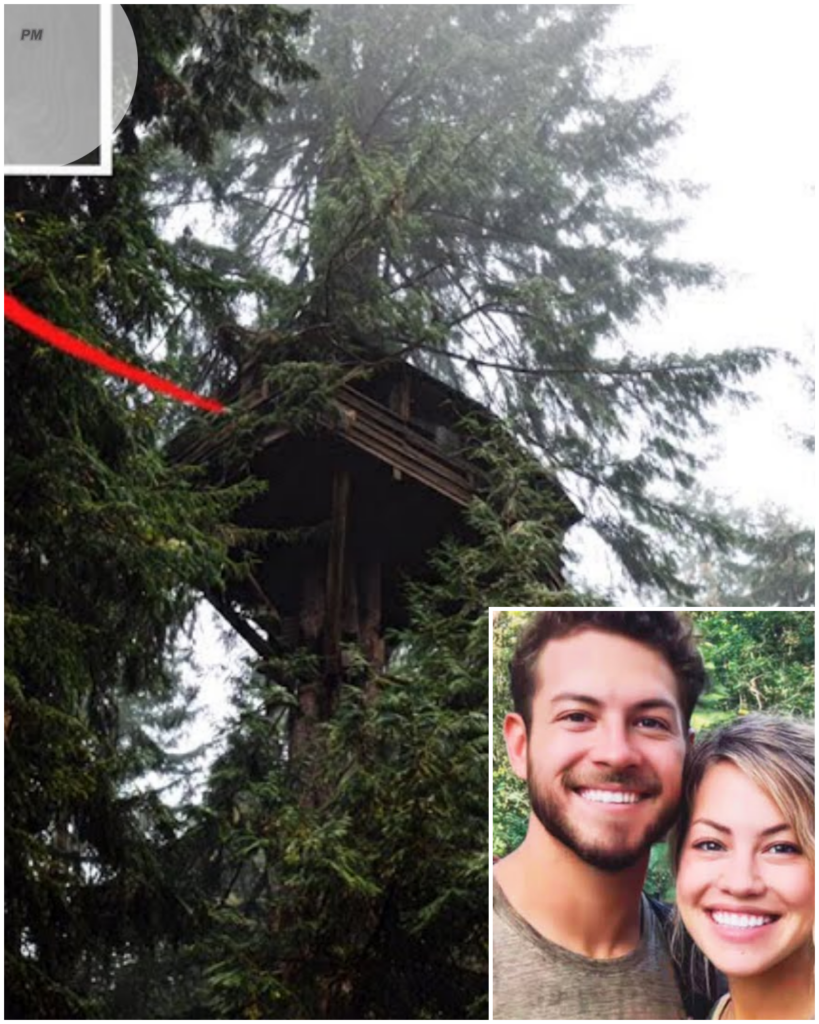
A massive Douglas fur, its trunk several feet in diameter. High up among its branches [music] barely visible through the fog and moss, was the silhouette of a hut.
The structure looked as if it had merged with the tree. The lower part of the trunk was braided with old ropes, and under the roots were dark traces [music] of a former staircase.
At first, they did not dare to come closer. Even from below, it was clear that the structure had been there for decades.
The boards had turned gray with moisture, [music] and the roof was covered with a green carpet of moss.
The windows were covered [music] from the inside, so it was impossible to see anything.
But something else caught my eye. The tree under the hut looked like [music] it had been burned.
The bark was darkened in several areas as if [music] from an old fire and charred fragments of branches lay around.
