You can't put a rookie in the seat for a tier 1 ex…
You can’t put a rookie in the seat for a tier 1 extraction. Lieutenant Mitchell scored top of his class at Nellis.
Hayes snapped, his eyes narrowing. He needs combat hours, and this is a routine overwatch.
Moreover, you clocked out at 0200 last night. By my calculations, you are short on your mandatory crew rest by exactly 18 minutes.
You are fatigued, Captain. “18 minutes.” Sarah’s voice rose, the injustice of it burning her throat.
“I was debriefing the intelligence officers on the anti-aircraft movements in this exact sector. You’re grounding me over a technicality.”
“I am grounding you because you are arrogant and insubordinate and you think this squadron cannot function without you.”
Hayes stepped closer, his chest puffed out, invading her personal space. “I am the commander of this squadron.
I determine who flies. You will sit in the TOC and watch the screens, and you will learn how a textbook mission is executed.
Are we clear?” Before Sarah could respond, First Lieutenant Bradley Mitchell shuffled into the briefing room.
He looked painfully young, his helmet bag clutched tightly in his hands, his eyes darting nervously between Sarah and the Colonel.
Mitchell wasn’t a bad kid, but he was entirely untested, a political appointment whose father had stars on his collar.
He looked terrified. Bradley Mitchell had been the best student in his class at Nellis, and he knew it the way only a twenty-three-year-old who has never been wrong in public can know anything.
His father wore stars, and the path had always been lit for him: the right schools, the right instructors, the right letters in his file.
He had fifty hours in the A-10, every one of them flown in the clean Nevada sky, against targets that did not shoot back.
He had fired the GAU-8 on a range, in daylight, at a rusted tank hull that sat still.
He had never flown in weather that closed over a ridge like a lid. He had never heard a missile warning in his headset.
He had never watched a man die on a radio frequency while someone screamed for air support that was not coming.
The other pilots in the squadron liked him well enough and worried about him in the way veterans worry about a kid who has been given too much too fast.
They had all been rookies once, but none of them had been handed a tier-one extraction in the Korengal as their first combat sortie.
That valley had a reputation that traveled in whispers at every base in Afghanistan. The ridges were steep enough to hide a gun behind every fold, the weather turned in minutes, and the enemy there did not run from airplanes.
They waited for them, patient as stone, and they had spent years learning exactly where a jet had to fly to kill them.
Mitchell did not know any of that. He knew the manual, and the manual said the mission was a routine overwatch.
He believed the manual, because the manual had never lied to him before. “Sir, I’m ready,” Mitchell stammered, avoiding Sarah’s furious gaze.
“Excellent, Bradley,” Hayes smiled, a thin, predatory expression. “Grab your gear. We step to the jets in 10.
Sarah stood in the center of the room, her hands balled into tight fists at her sides.
She wanted to scream, to throw the heavy ceramic coffee mug at the wall or drag Hayes to the base commander, but she knew military bureaucracy.
Hayes had cited safety and crew rest. On paper, his decision was bulletproof. In the air, it was suicide.
She grabbed her helmet bag and stalked out of the briefing room, the heavy door slamming shut behind her.
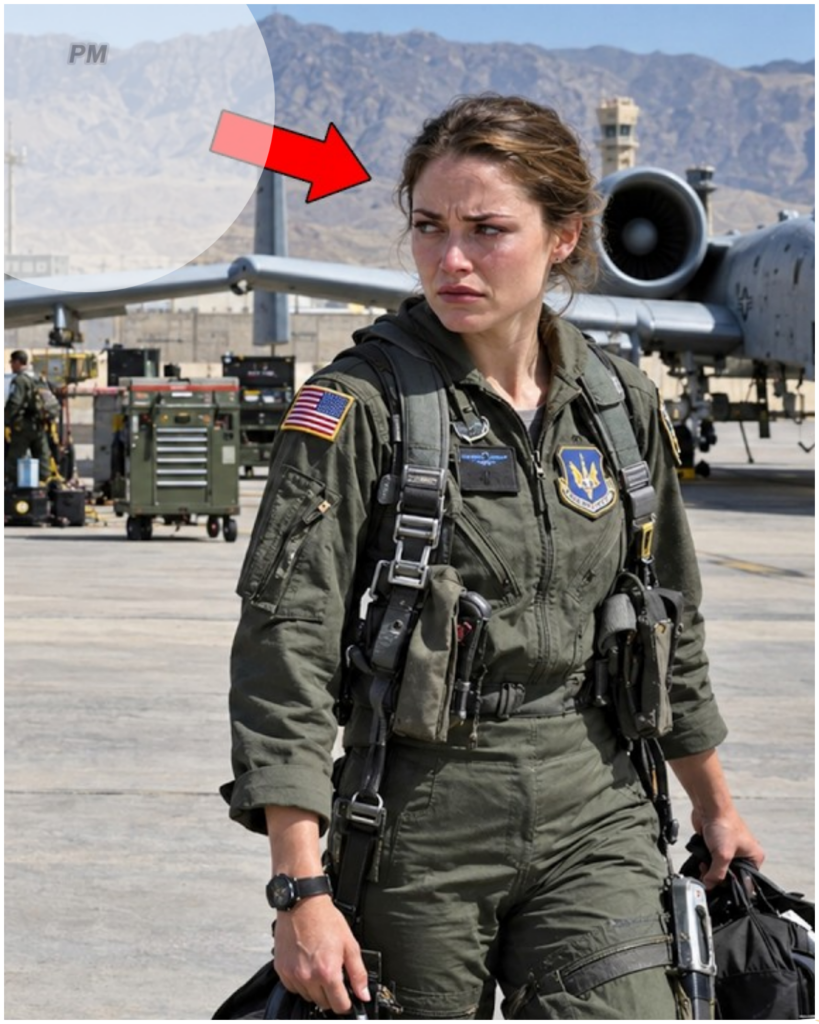
She walked out onto the blistering tarmac, the heat radiating through the soles of her boots.
50 yards away, two heavily armored, A-10 Thunderbolt II attack aircraft sat on the flight line, their massive engines whining as the ground crews spun them up.
The A-10 was an ugly, brutal machine built entirely around a massive 30-mm rotary cannon designed to chew through tank armor.
It was a brawler’s jet. It required a pilot who wasn’t afraid to get dirty, to fly down in the mud where the bullets were flying.
Sarah watched as Hayes and Mitchell climbed the boarding ladders and strapped into the titanium bathtubs of their cockpits.
She watched the canopies close, sealing them inside. A heavy, sickening knot formed in her stomach.
She had a sixth sense about combat, a primal instinct honed over hundreds of hours under fire.
As the two heavy jets taxied down the runway and roared into the hazy Afghan sky, that instinct was screaming.
The tactical operations center was a cavernous windowless bunker bathed in the eerie blue glow of dozens of monitor screens.
The tactical operations center was the one room on Bagram where the war never slept and the sun never rose.
It was a low concrete box sunk into the earth, cold from the air conditioning and lit by the blue glow of forty screens.
On the main wall, a digital map showed the Korengal as a jagged scar, and two blue icons crawled along it like slow insects.
On another screen, the Predator feed showed the valley in grainy black and white, the river a pale ribbon at the bottom of the canyon, the compound on the eastern slope a cluster of pale rectangles.
Analysts sat in rows with headsets clamped on, speaking in the flat, clipped murmur of people who had learned not to raise their voices when the picture got bad.
Master Sergeant Roy Henderson had run that room for three tours, and he knew the difference between a quiet valley and a valley holding its breath.