Her hands found the switches before her eyes did,…
Her hands found the switches before her eyes did, and the old sequences came back in order: battery, APU, JHMCS, ejection seat armed, oxygen on.
Holden’s helmet was a little loose, and she cinched the strap tight and told herself she would deal with the fit later, if there was a later.
Outside the canopy, a Flanker lined up for a strafing run on the flight line, and she could see the smoke from its gun pods already curling in the air.
She did not have five minutes for the warm-up. She had perhaps forty seconds before the sky fell on her.
She pushed the throttles forward and felt the twin engines answer, fifty-eight thousand pounds of thrust pressing her into the seat like a hand on her chest.
The taxiway was short and the jet was heavy, and the numbers said she would run out of concrete.
Katherine had spent her whole career making numbers do what people said they could not.
She held the brakes, let the engines scream, and released them. She dropped into the cramped, ultramodern cockpit of the F-15EX.
For 2 years, she had flown a flying warehouse. Now the cockpit felt like slipping on an old, perfectly tailored glove.
Muscle memory forged in the fires of hundreds of combat hours took over instantly. Her hands danced across the avionics panels, flipping the main power relays, aligning the inertial navigation system and arming the ejection seat.
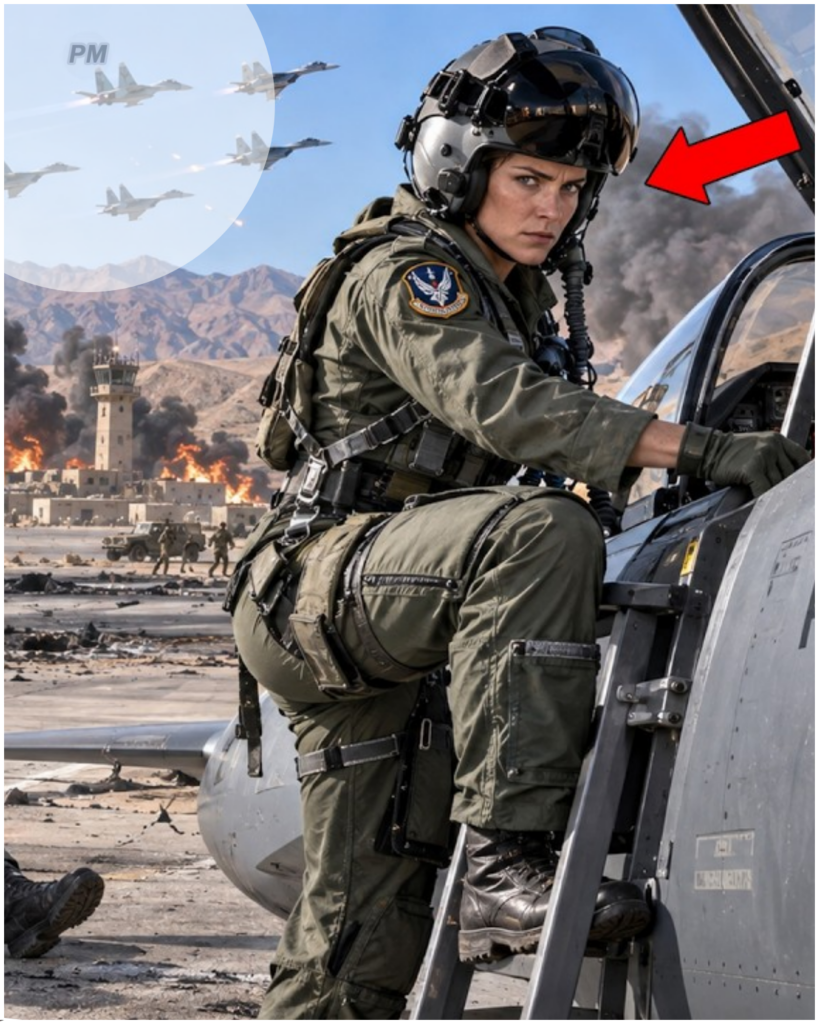
Clack, clack, switch, switch. She grabbed the helmet sitting on the side console Holden’s helmet equipped with the joint helmet mounted queuing system JHMCS.
She jammed it onto her head, plugging in the coms and oxygen umbilical. It was a little loose, but she tightened the chin strap through the canopy.
She saw a Su-35 lining up for a strafing run right at the flight line.
“Time’s up,” Katherine muttered. She slammed the canopy shut, the hydraulic seal hissing as it locked her into her own world.
She bypassed the standard 5-minute warm-up protocols. She didn’t have 5 minutes. She had about 40 seconds before 30 mm explosive shells turned her into pink mist.
She shoved the throttles forward. The twin general electric F110-GE-129 engines roared to life, kicking out 58,000 lb of combined thrust.
The heavy jet lurched forward off the pad. Katherine didn’t bother with the steering till she hit the taxi way.
She swung the nose violently to the right, aligning the F-15EX with the 3,500 ft stretch of unbroken concrete.
It wasn’t enough runway. Standard Physics said a jet loaded this heavy would roll off the end of the concrete and explode in the desert dirt.
Katherine pinned the brakes with her toes and slammed the throttles entirely past military power, deep into maximum afterburner.
The engines screamed, a massive pillar of blue flame erupting from the exhaust nozzles. The entire airframe shook violently against the brakes, begging to be unleashed.
She released the brakes. The F-15EX shot forward like a cannonball. The acceleration was punishing, crushing Katherine deep into the ejection seat.
The airspeed indicator on the HUD skyrocketed 100 knots. The end of the taxiway was rushing at her with terrifying speed.
Dirt and scrub brush loomed just beyond the concrete. 180 knots. It wasn’t enough. Katherine didn’t care.
She hauled back on the stick. The heavy nose of the eagle pitched up. The main landing gear scraped the very edge of the concrete, chewing into the dirt for a fraction of a second before the immense thrust of the twin engines simply overpowered gravity.
The F-15EX clawed its way into the sky, dragging a massive plume of dust behind it.
Just as her wheels left the ground, a line of 30 mm tracer fire from the diving Su-35 chewed up the exact spot she had been occupying a second before.
Part three, the ascent. Mayday. Mayday. Jackal base is under attack. Repeat, Jackal is under heavy attack.
The radio channel was a chaotic mess of screaming ground controllers and automated distress beacons.
High above the airspace, loitering out of harm’s way, was an E-3 Sentry AWACS aircraft, call sign Overlord.
Aboard the AWACS, Major General Arthur Hayes, a stern, battleh hardened commander who had built the region’s air defense strategy, stared at his radar scopes in disbelief.
General, the radar intercept officer shouted. Hostiles confirmed eight bogeys, fast movers, matching Su-35 profiles.
They’ve decimated Jackal’s defenses. General Hayes gripped the edge of the console. Where is our combat air patrol?
Where is Holden’s squadron? Trapped on the ground, sir. Wait, wait. I have a single fast mover launching from Jackal.
IFF transponder shows it’s an F-15EX. Call sign Reaper 1:1. Sir, somebody got off the ground.
Hayes felt a surge of hope. Holden. Thank God. Patch me through to him immediately.
In the cockpit of the soaring F-15, Katherine was currently wrestling with the sheer physical assault of 9 Gs.
She had pulled the jet into a near vertical climb right off the deck, rocketing through 10,000 ft in seconds, trying to gain the crucial energy advantage before the enemy realized she was there.
The climb was the most dangerous part of the takeoff, because a jet that has just clawed its way off a short runway is slow, heavy, and blind to everything except the sky directly ahead of it.
Katherine pulled the nose up until the horizon fell away beneath her and the desert became a brown carpet far below, and she felt the G-forces press her down into the seat the way they had pressed her two years ago in a different jet over a different valley.
Ten thousand feet came and went in seconds. The air thinned, the engines sang, and the radar warning receiver stayed mercifully quiet for the first few heartbeats.
She knew the Flankers would see her. A single F-15EX climbing out of a burning base is not a subtle thing.
But every second she spent climbing was a second she spent gaining the one thing that mattered more than anything else in a fight: energy.