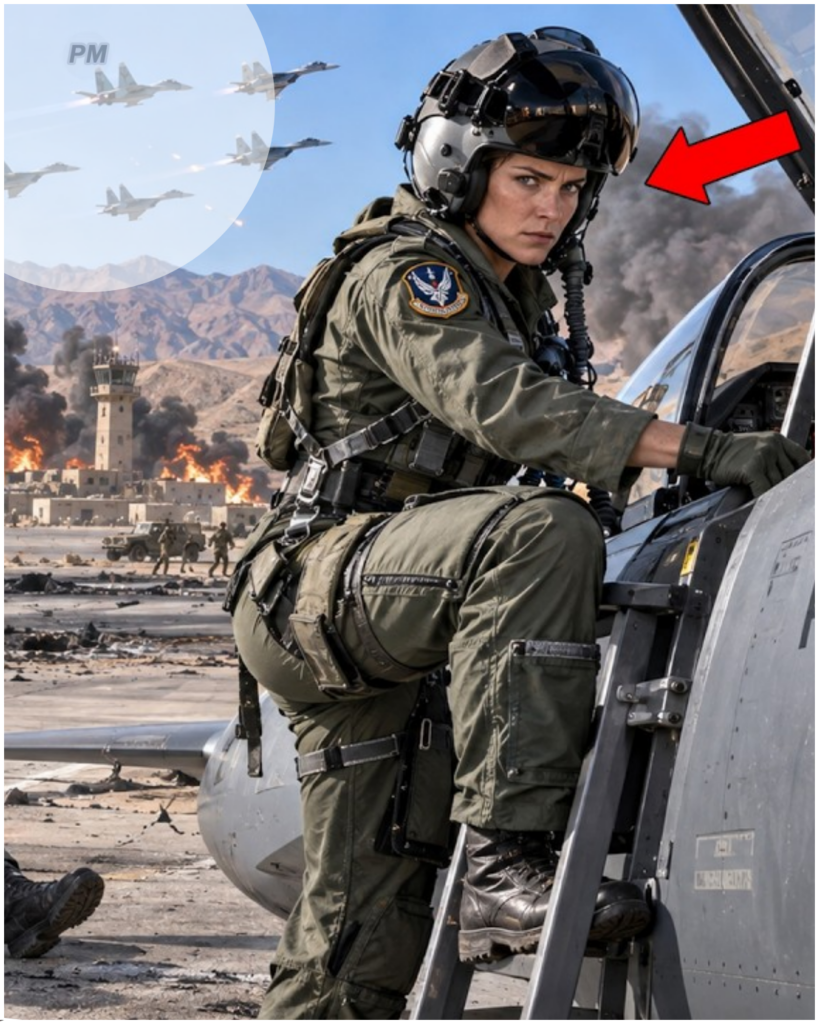
Wyatt's voice on the command net was calm and dist…
Wyatt’s voice on the command net was calm and distant, the voice of a man reading a risk matrix instead of listening to people die.
His intelligence picture said a missile system was in the valley, and his order was simple: abort, return to base, let someone else solve it.
Katherine did the math in her head the way she always did. Altitude, dive angle, weapons release point, egress route, fuel to the nearest strip.
The numbers said she could make the run and survive it. The numbers did not say anything about her career, and she stopped listening to that part.
She clicked the radio off, rolled inverted, and dove for the floor of the ravine while the ground fire climbed to meet her.
The ground fire was relentless and the SEALs were out of time. Colonel Thomas Wyatt, the theater commander sitting comfortably in an air-conditioned command center 300 m away, ordered Katherine to abort her strafing run.
Wyatt’s intelligence claimed there was a functional SA-8 surface-to-air missile system in the valley, and he wasn’t willing to risk his multi-million dollar stealth jet.
Katherine had listened to the screams of the seals on the radio. She had calculated the geometry, the radar warnings, and the fuel.
And then she deliberately clicked off her radio. She dove into the ravine, breaking every altitude restriction in the book and dropped her payload precisely on the insurgent mortar positions, saving Henderson and his men.
She took a lucky 23 mm anti-aircraft round through her right wing for her trouble, barely keeping the dying F-35 aloft long enough to crash land at a friendly dirt strip.
The SEALs called her a hero. Colonel Wyatt called it insubordination. Wyatt needed a promotion, and an F-35 taking severe damage under his command looked terrible on a readiness report.
To save his own skin, he launched a full court-martial, painting Katherine as a rogue, reckless maverick who endangered national security.
The brass gave her a choice. Face a dishonorable discharge and prison time or accept a quiet demotion, a permanent grounding from fighter aircraft, and a transfer to air mobility command.
She chose to keep flying, even if it meant trading supersonic stealth for four turboprop engines and a cargo bay.
But the ghost of Kandahar followed her. The fighter community was a small, insular high school.
The court-martial was not a trial. It was a ceremony, and Katherine understood that the moment she walked into the windowless briefing room and saw the panel of officers who had already decided what her story meant.
Wyatt’s staff had written the narrative before she arrived: a reckless pilot, a damaged jet, a commander who had acted correctly.
Henderson’s after-action report, which called her the reason his men were alive, was read aloud in a flat voice and then set aside as if it were a character reference instead of evidence.
The deal came the way such deals always come, quietly, from a colonel who would not meet her eyes.
Plead to the lesser charge, accept the demotion, accept the grounding from fighters, accept the transfer, and the word prison would never be spoken again.
She signed because flying mattered more than the patch on her shoulder. Two years of cargo runs followed.
Two years of dawn departures, of pallets and manifests, of sleeping in tents that smelled of jet fuel and dust.
The fighter community talked, the way small communities always talk, and by the time the story reached Holden it had been sanded down to a single sentence.
She was a washout who could not handle the stick. Rumors warped the truth. To Holden and his ilk, Katherine wasn’t a hero who made the hard call.
She was a wash out who couldn’t handle the pressure of the stick. Katherine strapped into the left seat of the C-130’s cockpit, listening to the heavy drone of the APU.
Her co-pilot, a fresh-faced lieutenant named Daniel Hayes, looked at her sympathetically. “You shouldn’t let them talk to you like that, Captain.”
Hayes murmured, flicking a series of overhead switches. It’s just noise, Danny, Katherine replied, staring out the reinforced glass at Holden’s immaculate F-15EX sitting on the alert pad.
The jet was a masterpiece of modern engineering, loaded to the teeth with AIM-120D AMRAAMs and AIM-9X Sidewinders.
It was fueled, armed, and ready for the afternoon combat air patrol. Still,” Hayes muttered.
“They don’t know what you did for Chief Henderson’s team, and they never will,” Katherine said, her eyes tracing the lethal lines of the F-15’s fuselage.
“Run the pre-flight checklist. Let’s get this bus back to Ramstein before I die of heat stroke.”
Part two, hell in the sand. FOB Jackal was nestled in a strategic choke point, a sliver of desert, bordered by the towering jagged peaks of the Zafran corridor.
It was supposed to be a secure logistics hub covered by an overlapping umbrella of Patriot missile batteries and early warning radar networks.
It was supposed to be impenetrable. At 1,400 hours, the illusion of safety shattered. Katherine was halfway through the C-130’s engine run-up sequence.
The four Rolls-Royce turboprops thrumming with massive power when the base’s master alarm system shrieked.
It wasn’t a drill tone. The jamming attack was the kind of thing the briefers always warned about and no one truly believed would happen to them.
For three minutes the Patriot batteries stared at empty sky while their screens filled with ghosts, and the early warning net heard nothing but static.
On the ground, the first sign of trouble was not a siren. It was the sound of the mountains themselves tearing open, the roar of afterburners echoing off the canyon walls a half second before the jets appeared.
The lead Flanker came in low and fast, its rockets already away, and the runway intersection simply ceased to exist as a usable surface.
Concrete slabs the size of cars rose into the air and fell back in pieces.
The second jet put its bunker buster through the roof of the command center with a precision that told Katherine everything she needed to know about who had planned this.
These were not amateurs. They had studied Jackal, they knew the blind spots, and they had come to erase the base, not to harass it.
It was the high-pitched oscillating wail of an imminent air raid. “What the hell?” Hayes shouted over the engine noise, looking at his console.
