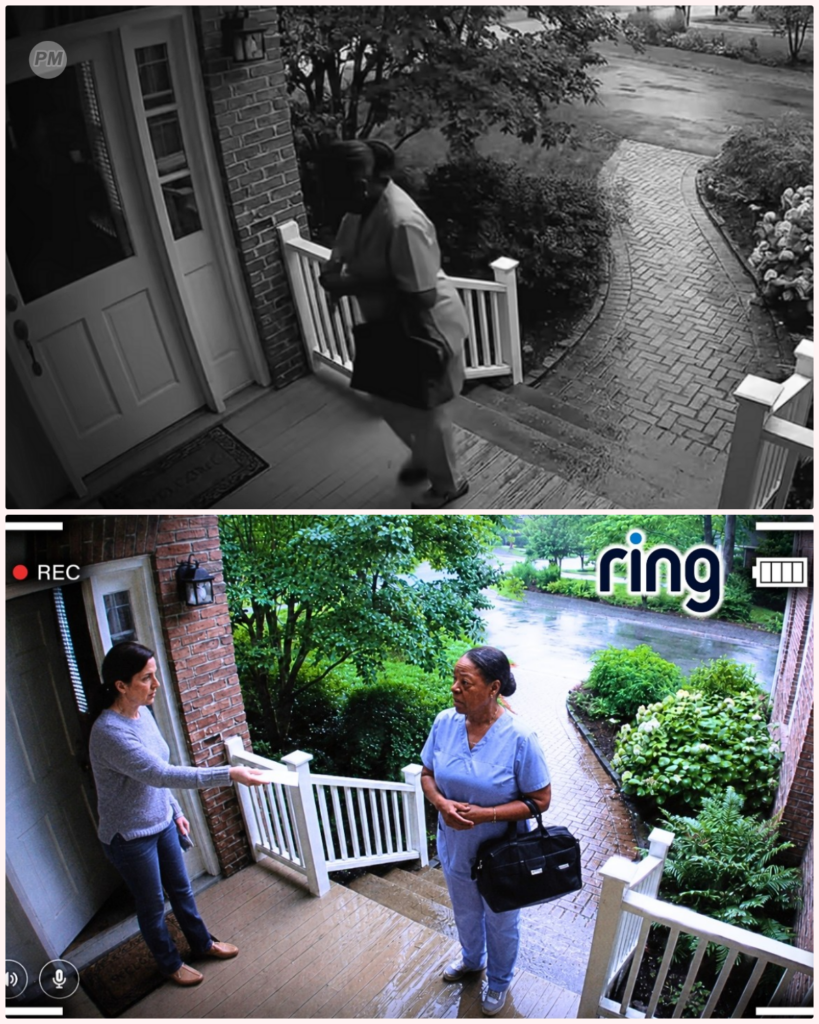
>> The security camera mounted above the front door of the Pembroke house on Magnolia Drive in Florence, South Carolina had recorded the same image every morning for 39 years.
A woman arriving at 6:45 a.m. The footage from the final morning, July 18th, 2024 shows her the same way it had always shown her.
Uniform pressed, bag over one arm the slight pause at the door that was not hesitation, but habit.
The pause of someone who knows a house so thoroughly that entering it requires a moment of deliberate intention.
The way you pause before stepping into a river you know well because you respect its current.
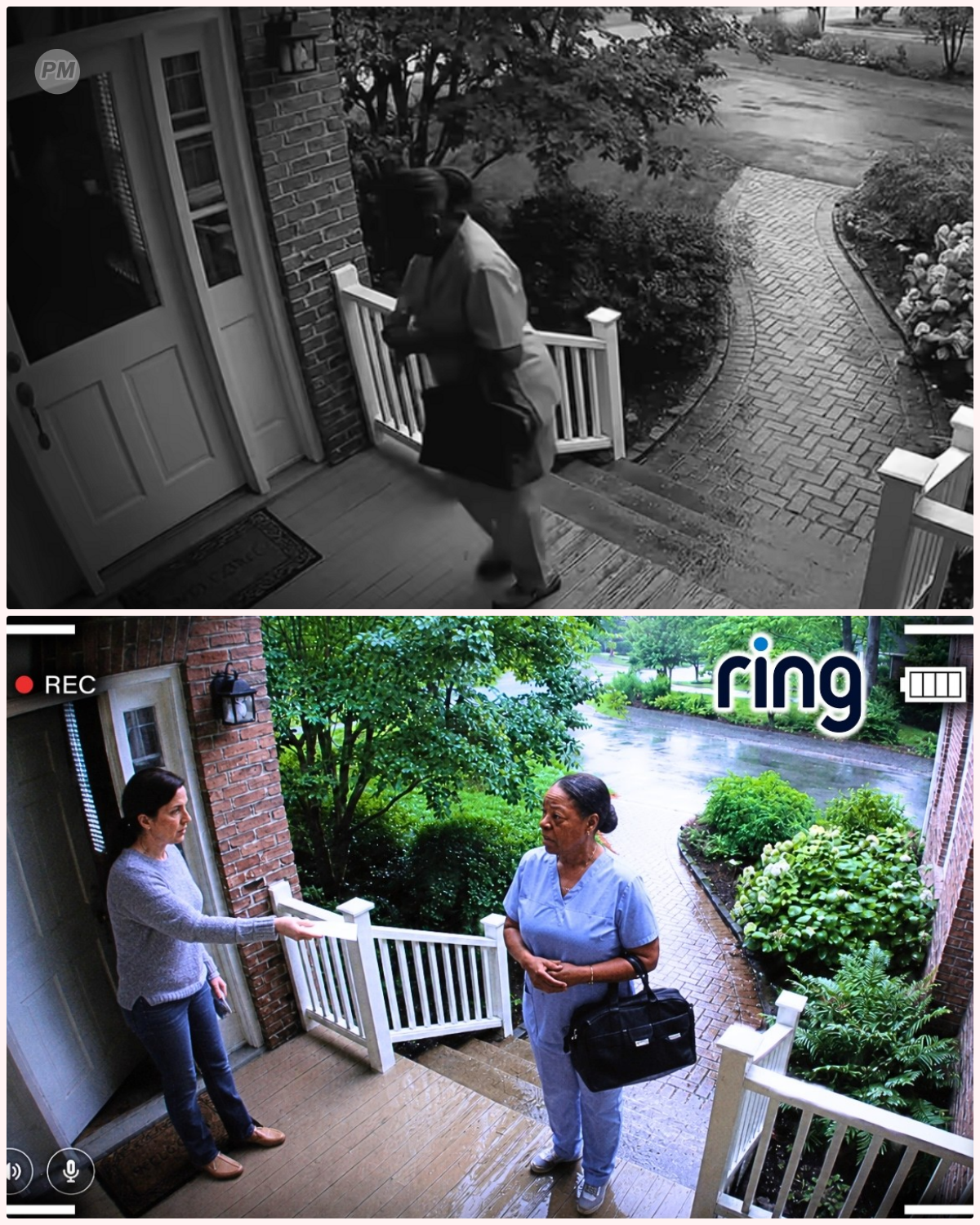
She had a key. She had always had a key. She was 61 years old and she had been working in this house since she was 22.
Her name was Celestine Okafor. She did not know on the morning of July 18th that Arthur Pembroke had died in his sleep 4 hours earlier.
She did not know that his children had already called the family attorney. And she did not know that the will the will Arthur had updated 18 months ago the will she had witnessed him sign at the kitchen table on a Tuesday afternoon in January of 2023 had been replaced.
The camera recorded her arriving at 6:45 a.m. The way it had recorded her arriving at 6:45 a.m.
For 39 years. It would not record her arriving again. Celestine Okafor had come to work for the Pembroke family in the spring of 1985 the year she turned 22.
She had grown up in Marion County, 40 miles north of Florence, the second of five children in a family where work was not a topic of discussion, but simply the condition of life.
She had finished high school, completed a domestic management certificate program at a vocational school in Florence, and been placed with the Pembroke household through an agency that no longer existed.
Arthur Pembroke was 51 years old when Celestine first arrived at Magnolia Drive. He ran a regional construction supply company that his father had started in the 1950s.
His wife, Miriam, managed the household and the social calendar with the precision of someone who had learned early that precision was a form of power.
They had three children, Claudia, 23, already married and living in Columbia. Warren, 20, finishing his second year at Clemson.
And a younger daughter, Faye, 17, still at home. The job, as initially described to Celestine, was straightforward.
Cooking, cleaning, household management, grocery coordination. Standard domestic work for a prosperous household. The pay was modest, but reliable.
Celestine was good at the work. She was precise, thorough, and discreet. That last quality being the one the Pembrokes valued most without ever articulating it.
She understood early that discretion in a household like this one was not merely professional courtesy.
It was the invisible architecture of the entire arrangement. What happened inside the Pembroke house, the arguments between Arthur and Miriam, the years when Warren’s drinking became a subject that was not discussed, Faye’s troubles in her early 20s, the slow accumulation of financial decisions that did not always go well stayed inside the house.
She stayed. She stayed when Miriam developed rheumatoid arthritis in the early 1990s and the work expanded to include physical care that had not been part of the original arrangement.
She stayed when the pay was not increased to reflect the expanded responsibilities. She stayed when Arthur, distracted by a difficult period in the business, stopped acknowledging the expansion at all and Miriam accepted it as natural.
She stayed when Faye moved away and the house became quieter and lonelier and the work became less about management and more about presence.
Miriam Pembroke died in 2009 after a long decline. Celestine had been her primary caretaker for the final 3 years, bathing her, managing her medications, sitting with her during the difficult nights when the pain was bad and sleep would not come.
None of this was in any written agreement. None of it was additionally compensated. After Miriam’s death, Arthur was alone in the house for the first time in 40 years of marriage.
He was 75 years old. His children visited occasionally. The house on Magnolia Drive had 15 rooms and one occupant and a woman who arrived every morning at 6:45 a.m.
What happened in the years between Miriam’s death and Arthur’s was not romantic in any dramatic sense.
It was quieter than that and more ordinary. And in its ordinariness, perhaps more significant.
Arthur began waiting for Celestine’s arrival the way people wait for the predictable things they have come to depend on.
He began asking her to stay for lunch, then for dinner. He began telling her things.
Celestine listened. She had always listened. But now Arthur was listening back. He told her once, over dinner on a Tuesday in the fall of 2018, that she was the most consistently present person in his life.
That everything else had come and gone, the business, the social world, the children who had built their own lives far from Magnolia Drive.
But she had been there every morning for 33 years. He told her he was embarrassed that he had never adequately acknowledged that.
She told him it was not necessary. He said it was necessary to him. In January of 2022, Arthur Pembrook asked his long-time attorney, Gerald Finch, to update his will.
Arthur wanted to leave the majority of his estate, the house on Magnolia Drive, the investment portfolio accumulated over decades, and the proceeds from the partial sale of the construction supply business to Celestine Okafor.
The total value at the time of the revision was approximately $8.3 million. Gerald Finch drafted the document according to Arthur’s instructions.
He noted, as he was professionally required to note, that the revision would effectively exclude Arthur’s children from the primary inheritance.
Arthur acknowledged the note. He said his children were financially comfortable and had been for decades.
He said Celestine had given 40 years of her life to his household and had been compensated at a fraction of what that contribution was worth.
He said he was correcting an imbalance, not creating one. The will was signed on a Tuesday afternoon in January of 2023.
Celestine was present in the kitchen clearing lunch when Arthur and Gerald Finch sat at the dining room table.
She was not told what was being signed. Arthur had not wanted to tell her in advance.
He knew her well enough to know that she would have objected. Gerald Finch left with the original.
Arthur retained a copy in a fireproof box in his study closet. Celestine did not know the box existed.
Arthur Pembroke died on July 18th, 2024 at approximately 2:30 a.m. He was 90 years old.
Claudia Pembroke received a call at approximately 3:15 a.m. She called Warren. By 7:00 a.m., Claudia and Warren had both driven to Florence and were in the house on Magnolia Drive.
Celestine arrived, as always, at 6:45 a.m. She was met at the door by Claudia, who told her that Arthur had passed and that her services were no longer needed.
She was handed an envelope containing a check for 2 weeks’ pay and asked to return her key.
Celestine Okafor stood on the porch of the house she had arrived at every morning for 39 years and was handed a check for 2 weeks’ pay.
She returned the key. She drove home to Calhoun Street. She did not yet know about the will.
Gerald Finch called Claudia Pembroke at 9:30 a.m. On the morning of July 18th. The call lasted 22 minutes.
Gerald Finch had held the original copy of Arthur’s 2023 will in his office files for 18 months.
He had also, in the 30 years of managing the Pembroke family’s legal affairs, developed a financial relationship with the family that extended well beyond standard attorney fees.
Claudia Pembroke had referred three significant corporate clients to his firm. Warren Pembroke had invested in a real estate venture that included a silent partner connected to a shell company linked to Gerald Finch’s brother-in-law.
Within 48 hours of Arthur’s death, a new document appeared in the probate filing submitted by Gerald Finch’s office.
The document was a will. It bore Arthur Pembroke’s signature. It was dated March the 2024, 15 months after the January 2023 document.
Under the terms of the March 2024 document, the estate was divided equally among Arthur’s three children.
Celestine Okafor was not mentioned. The document did not legally exist because Arthur Pembroke had not signed it.
The January 2023 will contained an embedded digital creation record, a timestamp reflecting when the original template had been generated.
That timestamp read January 14th, 2023. The March 2024 document contained a digital creation record as well.
It also read January 14th, 2023. The document reportedly created in March 2024 had been generated from the same template file as the January 2023 document.
The same file with its contents replaced, printed on new paper, notarized with a stamp belonging to a notary whose commission had expired in November 2023, 4 months before the document was allegedly signed.
The March 2024 will had been created in the 48-hour window between Arthur Pembroke’s death and the probate filing.
Gerald Finch had not created a new will. He had altered an existing document and hoped no one would look closely enough at the file properties to notice.
The person who looked closely enough was Faye Pembroke. Faye was 56 years old and had been estranged from her family for most of the preceding 20 years.
She had not been contacted when Arthur died. Warren had called her and she had not answered.
She heard the news 3 days later through a cousin. She drove to Florence alone without telling her siblings and let herself into the house using a key she had never returned because no one had ever asked for it.
In Arthur’s study, in the closet where she had found his important papers since childhood, she found the fireproof box.
Inside was the copy of the January 2023 will. She read it. She read it again.
She took photographs of every page. She drove to an attorney’s office in Sumter that afternoon.
The civil case was filed in Florence County Probate Court on August 9th, 2024. It named Gerald Finch, Claudia Pembroke, and Warren Pembroke as respondents.
It alleged will forgery, document fraud, and breach of fiduciary duty. The criminal investigation found in Finch’s office emails subpoenaed under the fraud investigation a thread between Finch and Claudia Pembroke beginning at 9:47 a.m.
On July 18th, 17 minutes after their phone call. Claudia’s first message, the original, has to disappear.
What do we need to do? Finch’s response, I handle it. You handle Faye. Claudia’s reply, Faye won’t answer.
Leave her. This case sits at the intersection of two things worth understanding clearly, elder financial abuse and the specific vulnerability created by informal caregiving arrangements.
Elder financial abuse is the fastest growing category of financial crime in the United States.
The National Council on Aging estimates that older Americans lose approximately $36.5 billion annually to financial exploitation.
The majority of perpetrators are family members or individuals in positions of trust. The majority of cases are never reported.
What Arthur Pembroke did, updating his will to reflect a genuine debt of gratitude, was legal, ethical, and within his full rights.
What his children and his attorney did in response was not. But the mechanism that made the fraud possible was a structural gap.
The gap between Arthur’s intention and its legal protection. The January 2023 will was valid, but its existence was known to only four people.
Arthur had believed that having an attorney he had trusted for 26 years hold the original document was sufficient protection.
It was not sufficient because the attorney was the threat. Specific steps that reduce this vulnerability.
File a copy of the will with the probate court directly during the testator’s lifetime.
This creates a public record that cannot be replaced without the court’s involvement. Arthur’s will was never filed during his lifetime.
It existed only in Gerald Finch’s office and in a fireproof box. A second protective step is independent legal counsel.
Arthur used Gerald Finch, the same attorney who had served his family for 26 years, and who had financial entanglements with his children.
An independent attorney retained specifically for the will revision and with no relationship to the family, would have stored the original outside the family’s sphere of influence.
A third step is direct disclosure to the beneficiary. Arthur chose not to tell Celestine about the will.
His instinct inadvertently kept her unaware that she had any legal standing to protect. If Faye had not driven to Florence alone and remembered where her father kept his important papers, Celestine Okafor would never have known that 40 years of her life had been worth $8.3 million to the man she had served.
The system did not save Celestine. A woman who had been estranged from her family for 20 years and still knew where her father kept his important papers saved Celestine.
Gerald Finch was disbarred and received 4 years in state custody plus restitution. Claudia Pembroke was convicted and sentenced to 6 years, parole eligibility at 3.
Warren Pembroke negotiated a plea agreement, 18 months of supervised release plus forfeiture of his estate share.
The January 2023 will was validated by the Florence County Probate Court in March 2025.
The estate, reduced by legal costs, was transferred to Celestine Okafor in the amount of $7.1 million.
She was 62 years old. Faye Pembroke did not attend the probate hearing. She did not attend either trial.
She gave a deposition, answered the questions she was asked, and returned to her life.
When a journalist attempted to contact her after the verdict, she declined to be interviewed.
A mutual acquaintance, asked later what Faye had said about the case, reported that she had said very little.
That she had gone to Florence because she wanted to say goodbye to her father in her own way.
That she had found the box because she had always known where he kept things.
That she had done what seemed obvious to do. She had not been trying to save anyone.
She had simply looked in the right place. Celestine Okafor was asked, in a brief statement issued through her attorney, whether she had known about the will.
She said she had not. She was asked whether she would have continued working for Arthur Pembroke if she had known.
She said the question did not have a simple answer because the work and the relationship were not the same thing.
She was asked whether she had anything to say to Arthur’s children. She said she did not.
The last paragraph of her statement read, “I worked in that house for 39 years because the work was mine to do.
What Mr. Pembroke chose to do with his estate was his to decide. I am grateful that the court has honored his decision.
I do not intend to say anything further about this matter.” She did not say anything further.


