He ran the secondary bus sequence exactly as the m…
He ran the secondary bus sequence exactly as the manual described it, and the jet punished him for it.
The moment he cut the main power to cycle the bus, the pitch-yaw compensator maxed out, convinced by its own sensors that the aircraft was inverted.
The computer threw the rudders hard left to correct a roll that was not happening, and the stick turned to concrete in his hands.
Hayes fought it the way he had fought everything in two wars, with muscle and will, and the simulator fought back with perfect, tireless hydraulics.
He came out of the box gray-faced and shaking, his Nomex flight suit stained dark with sweat down the spine, and he said the words that would haunt the room for the rest of the day.
He had tried the secondary bus. It did not work. Wyatt went second, and Wyatt was a different kind of pilot, a technician in a flight suit, a man who believed that every problem had a procedure if you looked hard enough.
He tried a negative-G push, unloading the airframe to stall the compressor, starve the engine, and force a hard manual restart.
In theory it was elegant. In the simulator it was a disaster. The hydraulic arms hissed and lifted the cockpit into the air, mirroring the exact telemetry of Cole’s dying jet, and Wyatt threw the virtual aircraft into a dive, yanking the stick back with both hands, boots stomping the rudder pedals.
The computer read every input as hostile and locked the hydraulics tighter with each one.
The rig clanked and sighed and lowered itself back to the floor, and Wyatt unlatched the canopy without a word.
He stared at the floor mat, and everyone in the room understood what that stare meant.
There was no procedure for this. The other two senior men took their turns after that, and the room stopped keeping track of who was failing and started keeping track of the altitude instead.
Thirty thousand feet. Twenty-nine thousand. The numbers fell on the screen in a rhythm that sounded like a countdown.
A technician whispered from the server racks that Cole had twelve minutes of altitude left, and nobody corrected him, because everyone had done the same math.
Two hours they had been at it, running every permutation in the manual and then permutations outside the manual, and the jet had beaten every one of them the same way: the second anyone tried to override the hydraulics, the master alarm triggered a fail-safe, and the loop closed again.
It was a closed loop, Hayes said, pacing in front of the console, and he was right.
What none of them understood yet was that the loop was not the jet’s failure.
The loop was the jet doing exactly what it had been designed to do. The closed loop had a sound, and by the second hour everyone in the room knew it by heart.
It began with the master alarm, a two-tone shriek that meant the flight computers had detected a disagreement and chosen to protect the aircraft by taking it away from the pilot.
Then came the fail-safe, a heavy electronic clunk that the simulator reproduced with perfect fidelity, and then the silence while the system rebooted and decided, all over again, that the pilot was the problem.
Hayes heard it three times. Wyatt heard it twice. The other two men heard it once each, and after that nobody volunteered anymore.
The altitude calls kept coming from the server racks, each one lower than the last, and Cole’s voice over the radio kept getting thinner, the oxygen mix in his mask running down with every minute.
“Groom Lake, this is Ghost One,” he said, and then he stopped asking for magic tricks, and then he stopped asking for anything at all, and the room understood that the man in the sky had started doing the math on his own mortality.
They were applying the physics of a dog fight to a software glitch. They were pulling breakers, fighting the stick, trying to overpower the actuators with pure force.
But the jet wasn’t fighting them. The jet was having a panic attack. Sarah understood machines better than she understood people.
The X-44’s computer was designed to save the pilot. Right now, its sensors were feeding it contradictory data.
It thought it was falling out of the sky, so it was locking the controls to prevent the pilot from making it worse.
Every time Wyatt yanked the stick, the computer registered it as a hostile, erratic input and locked the hydraulics even tighter.
A loud, piercing alarm shrieked through the room. Critical impact. The words flashed in unforgiving neon red across the main screen.
The simulator rig sighed, lowering heavily back to the floor. Wyatt unlatched the canopy and pushed it open.
He didn’t say a word. He just shook his head, staring at the floor mat.
“Two hours,” Hayes muttered, pacing in front of the console. “We’ve run every permutation in the manual.
We’ve run permutations outside the manual. It’s a closed loop. The second you try to override the hydraulics, the master alarm triggers a fail safe.”
Harrison rubbed his eyes, pressing his palms hard against his face. The room went silent, save for the rhythmic mocking beep of the radar transponder tracking Cole’s descent.
“30,000 ft, 29,000. He’s got 12 minutes of altitude left,” a technician whispered from the server racks.
Harrison swallowed hard. He reached for the primary comm’s switch. He was going to tell Cole to make his peace.
Commander. The voice wasn’t loud, but it cut through the heavy, stale air of the room like a scalpel.
Harrison turned. Hayes stopped pacing. Wyatt looked up from the floor. The voice was not loud, but it cut through the heavy, stale air of the room like a scalpel, and every head turned at once.
Sarah Miller pushed off the cinder block wall and walked toward the center of the room, her boots loud on the concrete in the sudden silence.
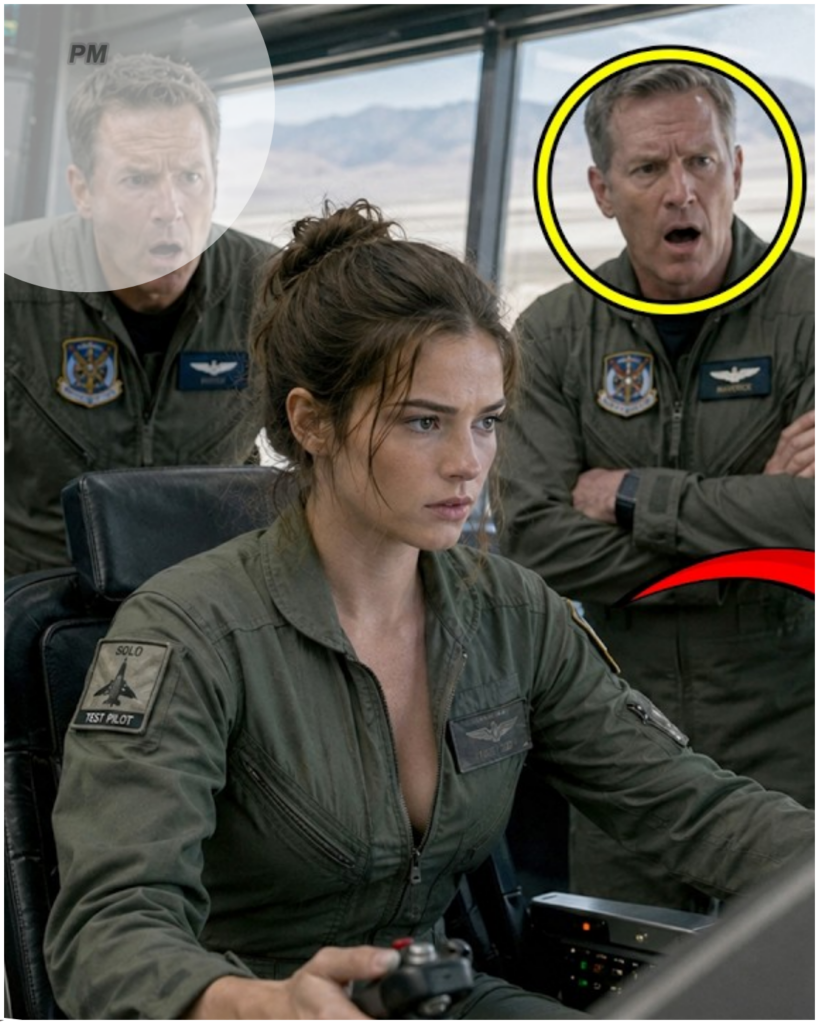
Her flight suit hung open to the sternum over a sweat-darkened olive drab t-shirt. Her hair was pulled back into a messy, uneven knot.
There were dark purple bags under her eyes, and her ribs ached with a dull throb with every step.
She did not look like a savior. She looked like a woman who had not slept, who had been sitting in a corner for two hours watching other people fail, and who had finally run out of patience.
Hayes laughed, short and cynical, the laugh of a man who had already decided what he was hearing.


