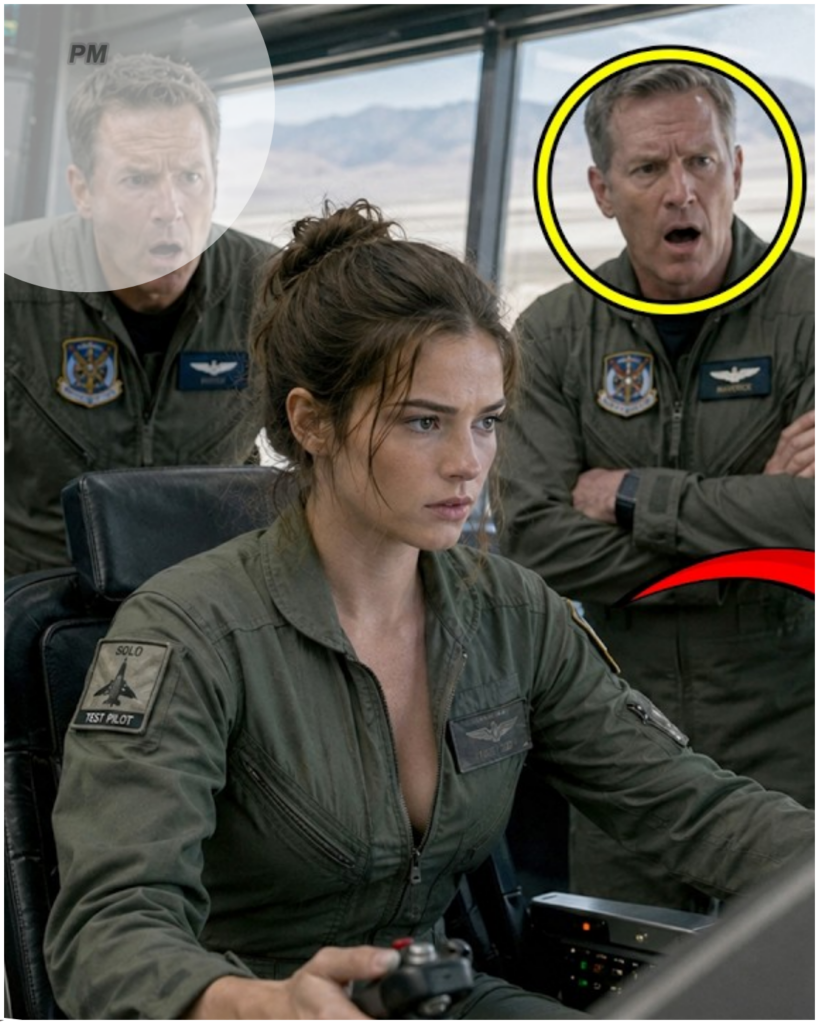
I can't outmuscle it, commander
I can’t outmuscle it, commander. The stick turns to concrete.” “Then Wyatt goes in,” Harrison snapped.
“Try a negative G push, stall the compressor, starve the engine, and force a hard manual restart.”
Captain Wyatt didn’t argue. He climbed into the sim, strapping the heavy harness over his chest.
The hydraulic arms of the rig hissed, lifting the cockpit into the air, mirroring the exact telemetry of Cole’s dying jet.
Leaning against the cool cinder block wall in the back of the room, Sarah Miller methodically chipped black nail polish off her left thumb.
She wasn’t supposed to be here. She was a line pilot. A combat veteran pulled off rotation to test weapons integration, nursing a bruised rib from a nasty high-G dogfight exercise 3 days ago.
She had been sitting in the corner for 2 hours, watching the Air Force’s most decorated test pilots brutalize the simulator.
She tasted copper in the back of her throat. Sarah Miller had not planned to be a test pilot.
She had planned to fly fighters, and she had, for years, off carriers and desert strips, in weather that grounded everyone else, in aircraft that other pilots complained about.
She was good in a way that made instructors nervous, because she did not fly by the book.
She flew by feel, and then she went back and read the book to find out why the feel had been right.
When the Air Force pulled her off rotation for weapons integration testing, it was supposed to be a punishment posting, a quiet corner where a pilot with too much initiative could do no harm.
Instead she had turned it into a laboratory. She spent her days strapped into jets that were not finished yet, firing weapons that were not certified yet, writing reports that engineers actually read, because her reports told them what the machine was doing instead of what the manual said it should do.
Three days earlier she had flown a high-G dogfight exercise that went wrong in the ordinary way that exercises go wrong: a hard break, a sudden reversal, a rib cracked against the harness when the jet bit the air at the wrong angle.
The flight surgeon had wanted to ground her. She had talked him out of it with the promise that she would sit out the heavy maneuvering and stick to the simulator, which was why she was in the bunker at all.
The bruise ran in a dark purple band across her left side, and every breath reminded her it was there.
She had not slept properly in two nights, and the coffee in her stomach was acidic and old.
None of that showed on her face. What showed was a woman who had learned, somewhere between her first combat sortie and her last, that panic was a luxury the person in the room could least afford.
She understood machines better than she understood people, and she had never apologized for it.
People lied about what they felt. Machines did not lie. They told you exactly what was wrong with them if you knew how to listen, and Sarah had spent a decade learning to listen.
She could hear a compressor stall before the gauges showed it. She could feel a hydraulic pump dying through the soles of her boots.
The other pilots called it instinct, which was their way of saying they could not explain it and did not want to try.
Sarah called it attention. She paid attention to the jet the way other people paid attention to each other, and the jet, in return, told her its secrets.
That was why she was still sitting in the corner after two hours, eyes on the telemetry, while four decorated men took turns failing in the simulator.
She was not waiting for her turn. She was waiting for the machine to finish telling her what was wrong.
She had learned to listen to machines the hard way, in a jet that nobody else wanted to fly.
Two years earlier, during weapons integration trials, a missile had refused to separate from its rail, hanging half-released under the wing while the jet shuddered and the warning panel lit up like a Christmas tree.
The engineers on the ground wanted her to jettison the whole rack. She refused, because she could hear the problem: a release solenoid clicking twice instead of once, a sound so small that the telemetry did not even register it.
She cycled the arming switch by hand, felt the click change, and the missile dropped clean.
The report she wrote afterward was three pages long and contained a single sentence the program office underlined in red: the machine told me what was wrong before the instruments did.
From that day on, the engineers sent her the jets nobody else could figure out, and she figured them out, one by one, by listening.
Acidic coffee churned in her empty stomach. She was exhausted, but her eyes never left the massive screen displaying Cole’s telemetry.
Over the overhead speakers, Cole’s voice crackled. The oxygen mix in his mask was thinning.
Groom Lake, this is Ghost One. I’m at 32,000. Controls are still locked. Any magic tricks down there?
His voice didn’t crack, but it lacked its usual arrogance. It was the quiet hollow tone of a man doing the math on his own mortality.
“Stand by, Ghost One,” Harrison said into his headset. “Wyatt’s in the box. We’re working a hard restart sequence.”
In the simulator, Wyatt was fighting for his life. The heavy mechanical clanking of the rig echoed through the room as Wyatt threw the virtual jet into a dive.
He was trying to muscle the aircraft, yanking the flight stick back with both hands, his boots stomping the rudder pedals.
Sarah stopped picking her nails. She watched the data stream scrolling down the left side of the screen.
They’re doing it wrong. The thought wasn’t a sudden burst of heroic inspiration. It was a dull, irritating realization, the kind you get when you watch someone push a pull door over and over again.
Wyatt was a textbook pilot. So was Hayes. So were the other two senior men who had taken their turns sweating in the box.
They treated the X-44 like a mechanical beast that needed to be tamed. Hayes went first, because Hayes always went first.
He was the senior test pilot on the program, a man with two thousand hours in the X-44 airframe alone, and he climbed into the simulator the way he climbed into everything: certain that the problem was a lack of aggression.


