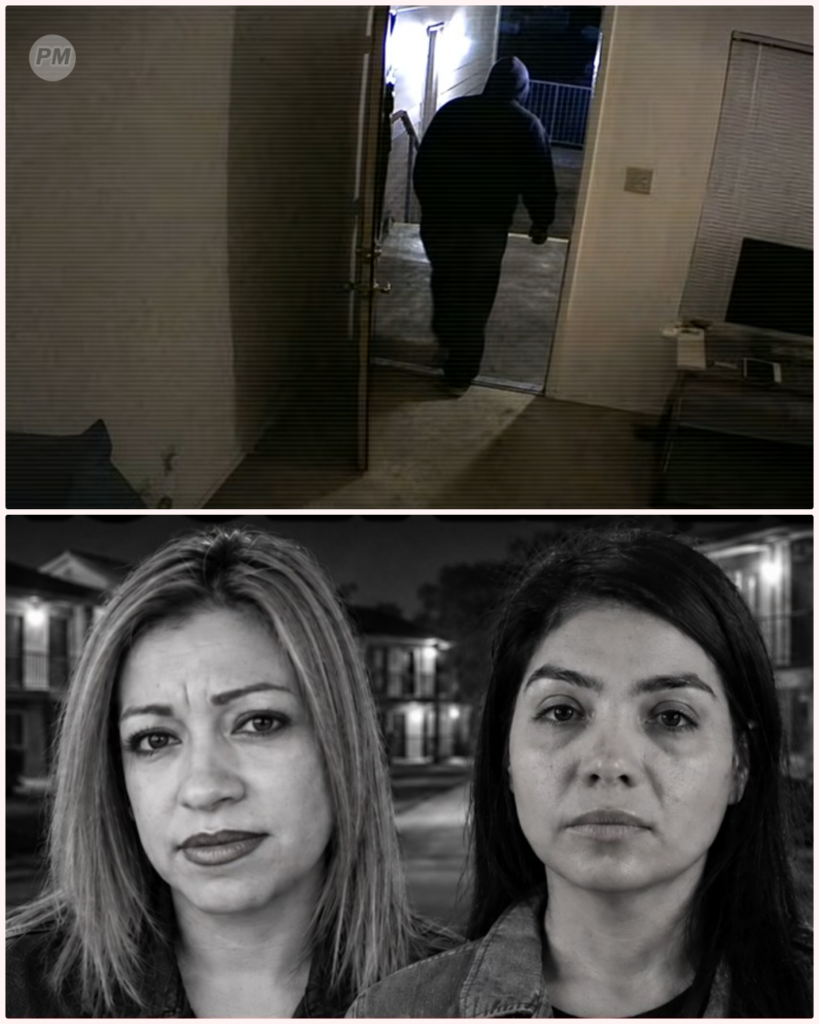
Law enforcement can collect them without a warrant…
Law enforcement can collect them without a warrant, without notification, and without the person’s knowledge or consent.
It’s a technique that has been used in cold cases for years. Sometimes with coffee cups, sometimes with cigarette butts, sometimes with chewing gum.
In this case, it was a plastic fork. The items were packaged, [music] documented, and sent to a forensic crime lab for DNA extraction and comparison.
The result came back definitive. DNA recovered from one of those plastic forks matched the genetic profile of the blood droplet found on the lower shelf of a bedroom television stand in Iraimma Chavez’s apartment on January 20th, 2012.
The profiles were the same. The woman who had left a quarter-sized circle of her own blood at a murder scene 14 years earlier and the woman who had eaten lunch at a DFW restaurant in May 2026 were, according to the DNA analysis, one and the same, a single droplet of blood, a discarded plastic fork, 14 years apart.
And they told the exact same [music] story. Arlington Police Department obtained a capital murder warrant for Mayor of Velasquez.
On July 16th, 2026, members of the department’s fugitive unit, violent crime unit, and covert investigations unit converged on a location in Hurst, a quiet suburb tucked northeast of Arlington.
They located Velasquez there. She was taken into custody without incident. There was no chase, no standoff, no confrontation of any kind.
She was arrested, transported, and booked into the Arlington City Jail before being transferred to the Tarant County Jail.
14 years, 5 months, and 27 days. That’s how long it took from the morning Irma Chavez was found dead on her kitchen floor to the afternoon the woman police say killed her was sitting in a Tarant County jail cell.
More than 5,000 days, more than 170 months, an entire generation of time in which a family grieved without answers.
Detectives carried a file they couldn’t close and a vial of blood sat in storage, waiting for the science to catch up.
The charge was capital murder. Under Texas law, a killing committed during the commission of a robbery qualifies for capital murder, which carries the state’s most severe penalties up to up to and including the death penalty.
Prosecutors in Tarant County alleged that the killing occurred while Velasquez was committing or attempting to commit a robbery.
The stolen television from Iraima’s apartment, the TV that was taken while the surveillance recording device was left behind, served as the basis for the robbery element that elevated the charge.
Velasquez was initially held in the Tarant County Jail without bond. A district judge denied bail on the grounds that the charge was capital murder and the evidence supporting it included a direct DNA match to the crime scene.
For Irisima’s family in Newevalon, Mexico, the arrest represented the first real substantive piece of news they had received in 14 years of waiting.
Not we’re still working on it. Not there’s nothing new. An arrest, a name, a woman in handcuffs.
On Wednesday, July 22nd, 2026, at 10:30 in the morning, Arlington Police and the FBI held a joint news conference inside the Arlington Police Department to announce the arrest to the public.
Police Chief Al Jones spoke first. He stood at the podium and [music] praised the persistence of his department’s homicide investigators, some of whom had carried the Chavez case for years, between other assignments.
He praised the partnership with the FBI Dallas field office and called investigative [music] genetic genealogy a tool that was fundamentally reshaping law enforcement’s ability to deliver justice in cases that had gone cold for years, even decades.
And he said that above everything else, he was most thankful to be able to tell the family of Iris Machavez that an arrest had finally been made.
FBI Dallas special agent in charge Joseph Rothrock took the podium next and placed the Chavez case inside the broader context of [music] genetic genealogies impact across the country.
He said the bureau’s IGG [music] program had now helped contribute to solving close to 250 cases [music] in 30 states since its inception.
Every one of those cases involved a victim whose family had been waiting for answers and a DNA profile that traditional databases could not decode.
The technology was new, but its impact was already staggering. But it was the lead detective, Tracy Dixon, who delivered the moment that everyone in the room would carry with them long after the microphones were turned off.
Dixon had worked the Chavez case. She had carried the file, studied the crime scene photos, reviewed the surveillance footage, and lived with the weight of knowing that a killer was walking free while a family in Mexico waited for a phone call.
When she stepped to the microphone and began describing the moment she told family about the arrest, her voice changed.
It went quiet. It started to break. She said that being able to share that news with the family is the reason detectives give so much of themselves to this work.
That everybody who touches a case like this feels the family’s pain. That the reason they push through years of dead ends, years of files that refuse to move, [music] years of phone calls where they have nothing new to say is for that one moment.
The moment when you can finally pick up the phone and deliver something other than silence.
There were reporters in that room who had covered hundreds of press conferences, routine arrests, [music] drug busts, traffic fatality updates.
They said later that Dixon’s voice was the thing that made this one different. The way it cracked, the way she didn’t try to cover it up or power through it.
She just let it happen. Let the emotions sit there in the room because [clears throat] the case had earned it.
14 years had earned it. From Noevo Leon, Mexico, Iraima’s sisters spoke to reporters by phone after the news conference ended.
What they said landed harder than any DNA [music] statistic or legal argument that had been presented that morning.
They said they had never heard of Myra Velasquez. They had no idea who this woman was.
Nobody in the family recognized the name. Their sister had apparently been killed by someone the family didn’t even know existed.
A friend they’d never met, never been told about, never seen in a photograph or heard mentioned on a phone call.
And then they said the thing that mattered most. They said that finally, after 14 years of waiting, after 14 years of phone calls that went nowhere and holidays that carried the weight [music] of an open wound, there was going to be justice for their sister.
This story could end there. The arrest, the DNA match, the emotional press conference, the family in Mexico hearing a name they didn’t recognize in feeling for the first time in 14 years.
