That could have been half the people walking down…
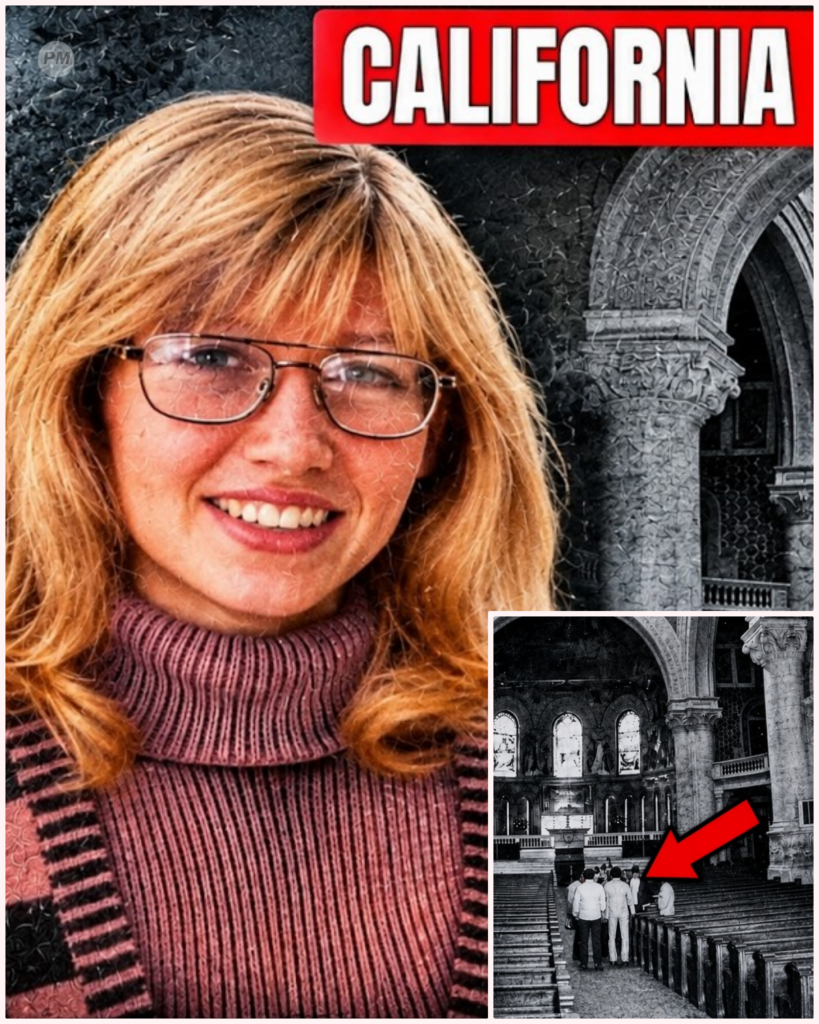
That could have been half the people walking down Palm Drive. But it was hard to ignore because just one night later, someone matching a similar description had been seen walking into Stanford Memorial Church.
Right around the time Arus was killed. And yet, as far as the record shows, there was very little follow-up on this lead.
Investigators did ask Bruce about it. He said he had no idea who the man could be.
He’d never heard anything about a visitor at her office. If that conversation had troubled Arlus, she never told her husband, and she would never get the chance to tell anyone.
On October 18th, Arlus came home to Bismar for the last time. Another memorial service was held for her at the Bismar Reform Church, the church her parents had helped build.
The church where she’d grown up teaching Sunday school. The same church where just two months earlier she had walked down the aisle as a bride.
The family who had gathered there to celebrate her wedding in August were back in those same pews in October.
This time to say goodbye. Arles Perry was laid to rest in her hometown.
She was 19 years old. If you’re still here with me, tell me where you’re watching from tonight and what time it is.
Every city, every state, every story matters here. That’s what we’re building at Graved Docks, a place where names like Arlus Perry don’t fade into an old case file.
Because back in Bismar, the story was far from over. Less than 2 weeks after her burial, someone came to the cemetery and took the temporary marker from her grave.
It was the only one stolen in the entire cemetery. And for a city that was already grieving, that changed everything.
People started to whisper, “What if whoever did this wasn’t a stranger in California at all?
What if they were from Bismar? What if they had followed Arus more than 1500 miles west and then come back home?”
Those fears only grew when people learned something detectives had released. Two of Arus’ personal belongings had been taken from her the night she died.
Remember what the FBI profile said? Someone who might hold on to personal items as keepsakes.
And then Bruce’s parents came forward with something that would send this case down a very dark road.
A story about what Arles had been doing during that year she spent in Bismar, waiting to join her husband out west.
According to Bruce’s parents, during that long year apart, Arlus and a friend had driven over to Mandan.
It’s the town just across the Missouri River from Bismar. They had gone there with a mission.
As part of her work with Young Life, Arlus and her friend were reportedly trying to reach members of a local group and bring them to Christianity.
That group was called the Process Church of the Final Judgment. It was a fringe religious movement and it had picked up a dark reputation.
It was rumored to have ties to Scientology and to Satanism. And around Bismar, stories had circulated for years that its members gathered for rituals in local parks and in caves outside of town.
To a lot of people back home, the pieces seemed to fit a little too well.
A trusting young woman who’ tried to reach a secretive group. A grave marker stolen weeks after her burial.
Personal belongings missing in a church, the setting of her death. But investigators weren’t convinced.
They could never confirm Arless had ever actually visited the group. And beyond the fact that it happened inside a church, they didn’t see anything about the case that pointed to a ritual.
Even Reverend Kelly, the man who’d first called the scene symbolic, later walked back what he’d said.
It didn’t matter. The rumor had taken on a life of its own. And as the years went by, it only grew.
Stories spread about how Arus had been found. Claims that the scene had been arranged into some kind of symbol.
Investigators disputed those claims flatly. They said those stories simply weren’t true. But a story like that is hard to bury.
And in 1987, 13 years after Arless died, it came roaring back. That year, a journalist named my Terry published a book called The Ultimate Evil.
In it, Terry took the Perry’s story seriously, and he criticized investigators for brushing aside any link between Arus and the Process Church.
He claimed the sandy-haired man who’d visited her at the law firm the day before she died was a member of the group, someone who had followed her all the way to California.
He even suggested Arus might have started that little argument with Bruce on purpose. Just so she could slip away alone that night.
Terry also pointed to a series of caves outside Bismar. He claimed they’d been used by the group for rituals, and Bismar took notice.
Curious locals started heading out to see those caves for themselves. So many people went that the caves eventually had to be closed off.
And for a lot of folks, that only made things look more suspicious. If there was nothing out there, why shut them down?
Back in town, the book was everywhere. Local bookstores sold out. The public library had a waiting list of more than 50 people, and it had to cut down how long anyone could keep a copy.
When Mory Terry came to Bismar to talk about his work, he sold out a venue with around a thousand seats.
And there was still a line wrapped around the block. Organizers had to move the event to a bigger space at the last minute just to fit everyone in.
In a quiet North Dakota city, the murder of a hometown girl had become the story everyone was talking about.
But the ultimate evil wasn’t really just about Arles Perry. At the heart of Terry’s book was one of the most notorious names in American true crime, David Burkowitz, the man New York City came to know as the son of Sam.
Between 1976 and 1977, Burkowitz terrorized New York. He killed six people and wounded seven others.
After his arrest, he claimed his neighbor’s dog had told him to commit the crimes.
He was found competent to stand trial and he was sentenced to six life sentences.
And from behind bars, Burkowitz started writing letters. In 1978, 4 years after Arus died, one of those letters made its way to North Dakota.