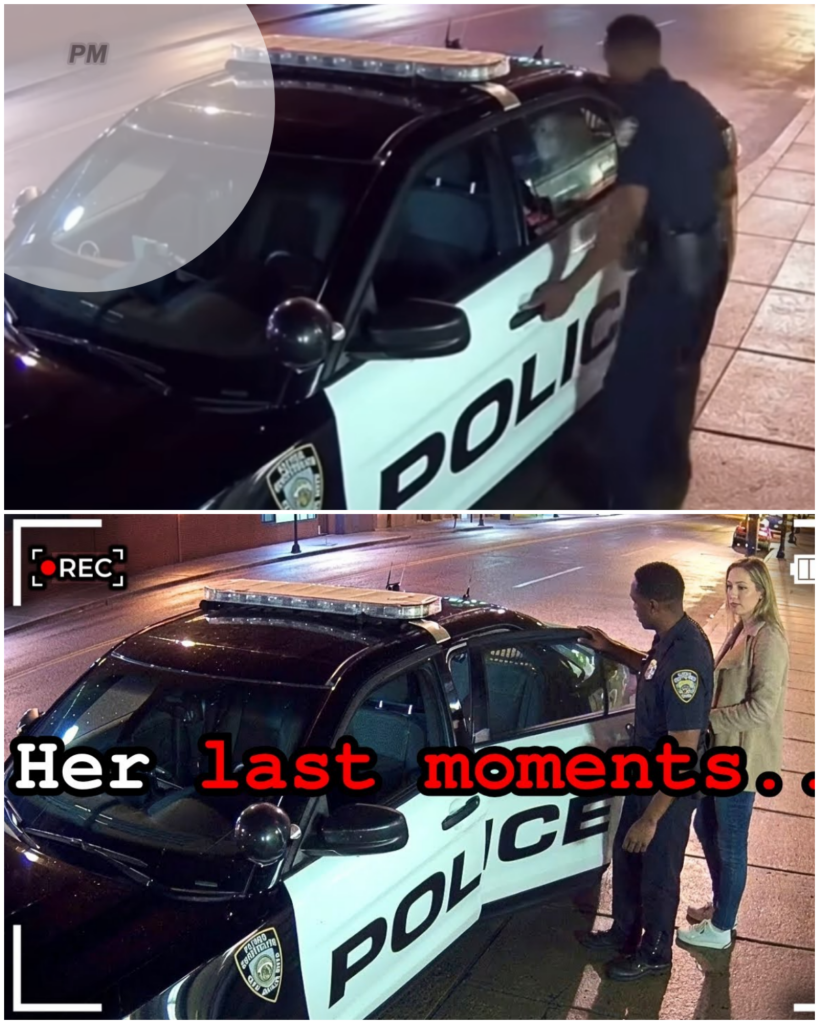
She heard Terrence respond that he would handle it…
She heard Terrence respond that he would handle it. She heard him tell dispatch it was probably nothing.
Low priority. She heard all of it. That was the point. Here is what happened in those 16 hours.
The patrol car turned off Route 14 onto County Road 7. No street lights, no houses, no cameras.
Amber asked where they were going. He said he needed to check something. Possible break-in at an old property would only take a minute.
She believed him. At 12:07 a.m., the car stopped at the grain silo. He got out, walked to her door, opened it, asked her to step out, said he needed a witness.
Standard procedure. She stepped out. The taser hit her at 12:08 a.m. She regained consciousness at 12:34 a.m.
Inside the silo. Concrete walls, no windows, one door locked from outside, hands zip tied, ankles bound, duct tape over her mouth.
He sat across from her. He did not touch her. He talked for 4 hours and 47 minutes.
He talked. He told her everything when he first saw her. How long he had been watching.
Her schedule, her habits, her fears, her family, her mother’s address in Chicago, her younger sister’s name, her sister’s workplace.
He told her he could reach any of them whenever he wanted. He told her he had been doing this for a long time.
He told her she was not the first. And then at 5:21 a.m., he left.
He locked the door. [music] He drove home. He showered. He put on a fresh uniform.
He went to work. He took Tina’s report. He told her not to worry. Here is what investigators still do not understand.
Why did he let her go? At 2:47 a.m. On December 10th, 39 hours after he took her, Terrence returned to the silo.
He unlocked the door. He cut the zip ties. He cut the rope. He removed the tape.
He handed her a bottle of water. He gave her a burner phone with one number saved.
911. He said three words. [music] You are free. Then he walked out, got in his patrol car, drove away.
Amber waited 11 minutes, convinced it was a trap. At 2:58 a.m., she called 911.
She gave her location. She gave his name. She said he was a police officer.
Three patrol cars arrived at 3:24 a.m. Terrence was arrested at 4:17 a.m. At his residence.
He was in bed. When they put the cuffs on him, he smiled. The arresting officer testified that he said only one thing.
Ask her if she feels safe now. That is when investigators realized this was never about assault.
It was never about murder. It was about control. It was about proving he could reach her any time.
It was about making her live with that knowledge forever. Letting her go was the final move.
Now she would spend the rest of her life looking over her shoulder. The trial lasted 3 weeks.
Terrence was charged with kidnapping, false imprisonment, stalking, misuse of law enforcement databases, impersonating a police officer during commission of a crime.
The prosecution presented the photographs, all 847 of them, the folders, all 23 of them, the 73 pages.
Read into the record one by one, the basement room. Photographs shown to the jury.
His ex-wife, Laura, took the stand on day 8. She had been subpoenaed. She did not want to testify, but she did.
She told the court she had found a folder in 2018. Not 73 pages, just 12.
A woman named [music] Paige who worked at the pharmacy on Oak Street, photographs taken through the pharmacy window, a schedule of her shifts, a map of her route home.
Laura confronted him that night. He told her she was imagining things. He told her she was paranoid.
He told her she was crazy. And then his voice got very quiet. He told her if she ever mentioned it to anyone he knew where her mother lived.