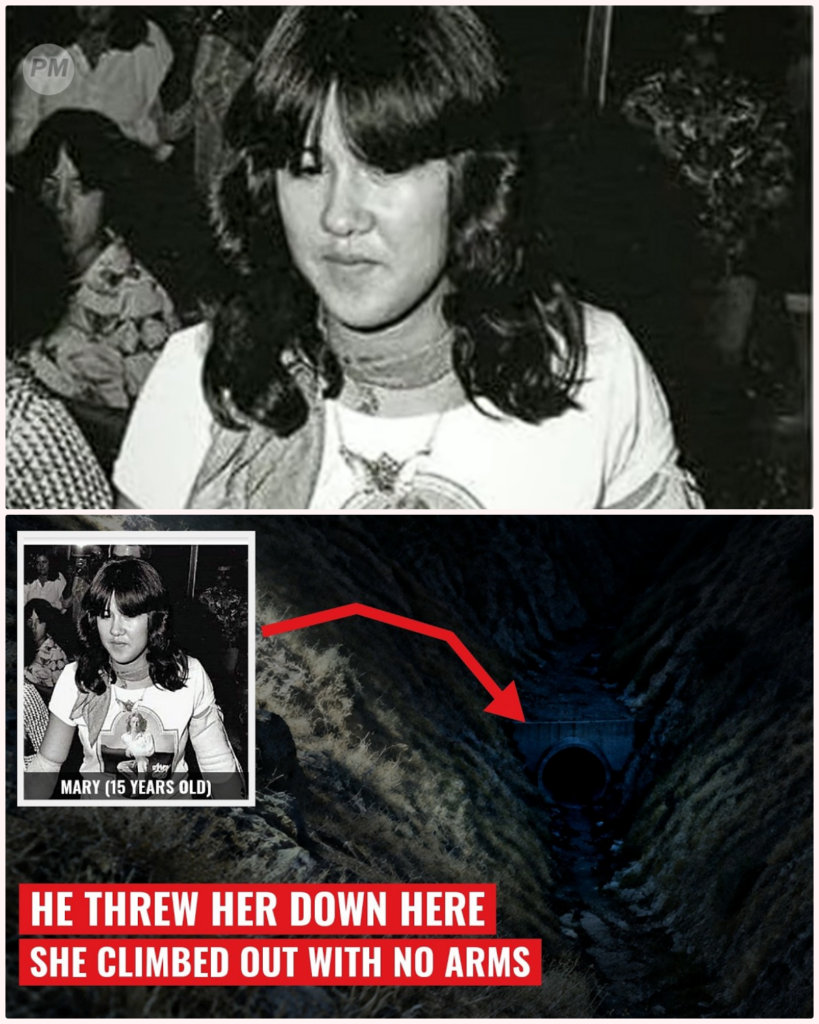
Then she was asked if the man who did those things…
Then she was asked if the man who did those things was in the courtroom.
>> [clears throat] >> Mary Vincent raised her prosthetic arm and she pointed the hook straight at Lawrence Singleton.
>> [clears throat] >> That hook says everything. He had taken her arms so she could never point at him.
20 years later in front of a jury, she pointed anyway. She described the moment later.
“I was on the witness stand,” she said. “I pointed right at him. For an instant I saw him and then he was gone.”
When it was time for closing arguments, Jay Pruner stood up and laid the two stories side by side.
“20 years ago,” he told the jury, “Mary Vincent got into Mr. Singleton’s van. Some 20 years later, Roxanne Hayes got into Mr.
Singleton’s van. She, unlike Mary Vincent, did not survive her meeting with Lawrence Singleton.” John Sky, for the defense, asked the jury to let his client die of old age.
He asked them to imagine one day opening the newspaper and reading that Lawrence Singleton had died in his jail cell, lonely and alone and despised, the jury voted 10 to 2 for death.
Before the judge passed sentence, Singleton spoke. “I’m sorry about the death in this case,” he said.
“I’ll have to carry it on my conscience for the rest of my life.” He did not mention Mary.
On April 14th, 1998, Judge Mitchum sentenced Lawrence Singleton to death. This time there was no ceiling, no 14 years, no good behavior clock, no trailer.
He was going to Florida’s death row, and he was never coming out. His lawyers appealed.
One of their arguments was that Mary should never have been allowed to show the jury her prosthetic arms.
On February 15th, 2001, the Florida Supreme Court rejected every argument and upheld the death sentence.
The state’s lawyer on the appeal said Singleton had a deeply ingrained hatred and dislike of women.
He did not live long enough for the sentence to be carried out. At 10:30 on the night of December 28th, 2001, Lawrence Singleton died of cancer in the prison hospital at the North Florida Reception Center in Lake Butler, Florida.
He was 74, an old man on Florida’s death row. He died in a way exactly as his own lawyer had asked the jury to picture, in custody alone and despised.
Reporters called Mary Vincent for her reaction. Her answer was was not what people expected.
She did not say she was relieved. She did not say she felt free. Mary Vincent was morally opposed to the death penalty, and reports at the time said she felt his life should be spared.
Even so, she had wanted to see this end in a courtroom on the court’s terms.
And then she said the sentence I promised you at the start. I feel like I was cheated again.
Cheated by a law that gave him 14 years. Cheated by a parole system that let him out after eight.
And now cheated one last time by a death that came on his own schedule instead of the court’s.
So, what happened to Mary? The girl who could not draw a straight line became an artist.
That is her own description. >> [clears throat] >> “I couldn’t draw a straight line.”
She said. She has said the talent is something that woke up in her after the attack.
She draws in chalk pastels holding the chalk in prosthetic arms. Many of which she has built and adapted herself.
She likes to tinker. She has made arms out of spare electronic parts. She made one just for bowling.
When she took her driving test, she told the examiner, “Look, no hands.” Her pictures are of women.
Strong, upbeat, powerful women. One newspaper called them female action figures. She became an advocate for victims.
In 1998, the same year she faced him in Tampa, she went to Washington and testified in support of a bill to stop murderers, rapists, and child molesters from getting a second chance.
She has stood in front of rooms full of teenagers and told them what one ride cost her.
In 2009, speaking at a victim’s rights event in Ventura County, she said something that may be the truest line in this whole story.
“I will never get over being attacked, but I can move past it. Her two sons grew up.
She married again. Today she lives quietly near the water in Washington state with her husband Tony.
When strangers reach out to shake her hand, she has a line ready. I’ll take two if you got them.
>> [snorts] >> And when people ask her how she carries what happened, she gives them something she had to learn the hardest way there is.
Let go of the hate, she says, long enough to realize how good it feels when it’s all gone.
She did not get the justice she was owed in 1979. California law did not have room for it.
But because of her the law changed. Because of her sketch, a neighbor picked up the phone.
Because she climbed out of that culvert, Lawrence Singleton was caught the first time. And because she chose to fly to Tampa when nobody made her, a jury watched a hook rise in a courtroom and understood exactly who they were dealing with.
Roxanne Hayes’s three children grew up without their mother. She is the reason this story still matters.
Not because of what Singleton did in 1978, but because of the eight years someone decided was enough.
If this story stayed with you, tell me in the comments how many years you think he should have served for what he did to Mary.
And I will see you in the next one.

