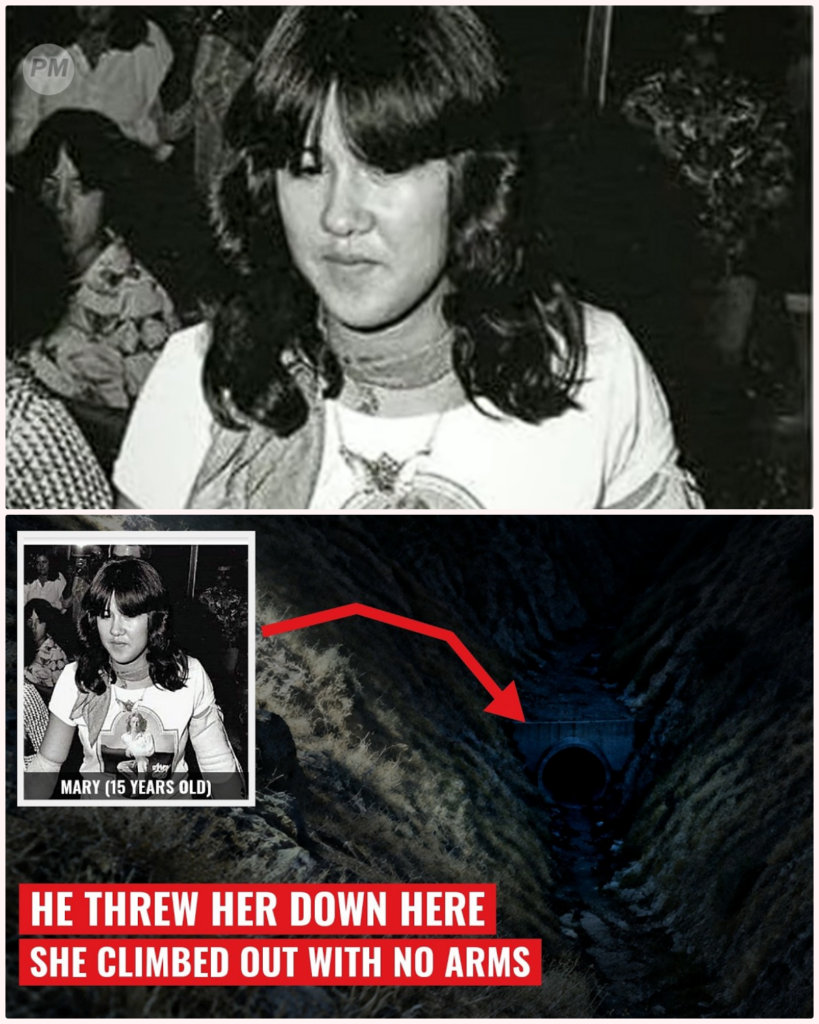
You do not need the details to understand it
You do not need the details to understand it. He tied her up. He assaulted her again and again through the night.
A jury later convicted him of rape and of several other sexual crimes against her.
She was 15 years old, alone with him in the dark, and nobody in the world knew where she was.
When it was over, Lawrence Singleton made a decision. Prosecutors argued he wanted to silence her, so she could not identify him.
He took a hatchet, and he cut off both of her arms below the elbow.
Then he carried her to the edge of a drainage culvert below an embankment of Interstate 5, near a place called Del Puerto Canyon, in Stanislaus County.
He threw her over the side. It was about 30 ft down. He left her at the bottom to die, and he drove away.
He was sure she would not live through the night. He was wrong. Mary Vincent woke up at the bottom of that culvert.
She has told this part of the story many times since. And the thing that comes through every time is how clear her mind was.
She knew she was badly hurt. She knew she was losing blood. And she knew that if she stayed down there, she would die.
And he would get away with it. She has said she was talking to God the whole time she was awake.
And then she remembered the thing an adult had told her years before in the Philippines.
If you are bleeding and there is nothing else, press the wound into the dirt.
So, she pushed what was left of her arms down into the mud at the bottom of the culvert.
The cold, wet earth packed the wounds and slowed the bleeding. Doctors would later say it probably saved her life.
Then she started to climb. >> [clears throat] >> She had no hands. She used her upper arms.
She used her face. She used her knees and her feet. 30 ft of dirt and rock up the side of a ditch in the dark, naked and bleeding.
She slipped back. She tried again. And she made it to the top. She was on a dirt road in empty hills.
She did not know where she was, but she knew the highway was somewhere up there, so she started walking toward it.
She walked for miles. Most accounts put it at around 3. She has said the only instruction in her head was simple.
Just keep walking. And the whole way she held her arms straight up over her head.
Somehow she had worked out that keeping them raised would slow the blood. She held her arms up over her head to slow the bleeding.
Picture that walk. Picture that walk. A 15-year-old girl in the hills naked and bleeding with her arms raised.
She kept going. She reached the road in the early morning. A car came. It slowed and it drove on.
Then a second car came. Inside was a young couple. Accounts describe them as vacationers who happened to be passing.
And And some tellings add that they were lost. They saw her and they stopped.
The couple got her into their car and drove her to a hospital. Their names have never been widely published.
But if they hadn’t taken that wrong turn the story of Mary Vincent would have ended on the side of that road.
At the hospital doctors fought to keep her alive. She had lost a terrible amount of blood.
She was in shock. By every rule she should have been unconscious. And this is where Mary Vincent did the thing that ended Lawrence Singleton’s freedom.
She refused to go under. In her own words she grabbed a cop and told them to get paper and a pen.
Before the surgeons, before rest, before anything, she sat with a police sketch artist and worked through his face.
She has said she described him the way you would describe someone to a blind person.
The shape of his head, his thinning hair, his eyes, his age, his voice, the blue van with no seats in the back, the milk jug, the name, Larry.
She kept going until the drawing looked like him. Only then did she let herself sleep.
The sketch went out to the public. And it was so close to the real man that within [clears throat] days, a friend and neighbor of Lawrence Singleton’s looked at it and recognized him.
The neighbor picked up the phone. Police arrested Singleton soon afterward. It could have gone so differently.
Singleton had planned for her to be found dead or never found at all. And instead, a 15-year-old girl had climbed out of the hole he left her in, walked to the road, and drawn his face for the police before she would let the sedatives take her.
Within about 2 weeks, Mary was fitted with her first pair of prosthetic arms. There is a photograph from 1979 of her wearing them.
She is a teenager in that picture with feathered ’70s hair, and she is smiling straight into the camera.
The state of California needed a little under 6 months to bring Lawrence Singleton to trial.
The prosecutor was Donald Stahl from the Stanislaus County District Attorney’s Office. He knew what he had, a living witness, a sketch, a van, and a girl who was ready to sit in the same room as the man who had done this to her and tell a jury what happened.
Singleton had a different story. He insisted he had been framed. In his version, whatever happened to that girl had been done by somebody else.
He clung to that for the rest of his life. It made no sense. It did not have to make sense to him.
[clears throat] Mary took the stand. She was 16 by then. She sat in the witness chair with her new prosthetic arms.
And when she was asked if the man who had attacked her was in the courtroom, she raised her new new arm and pointed straight at him.
She has described what she felt in that moment and is not what you would expect.

