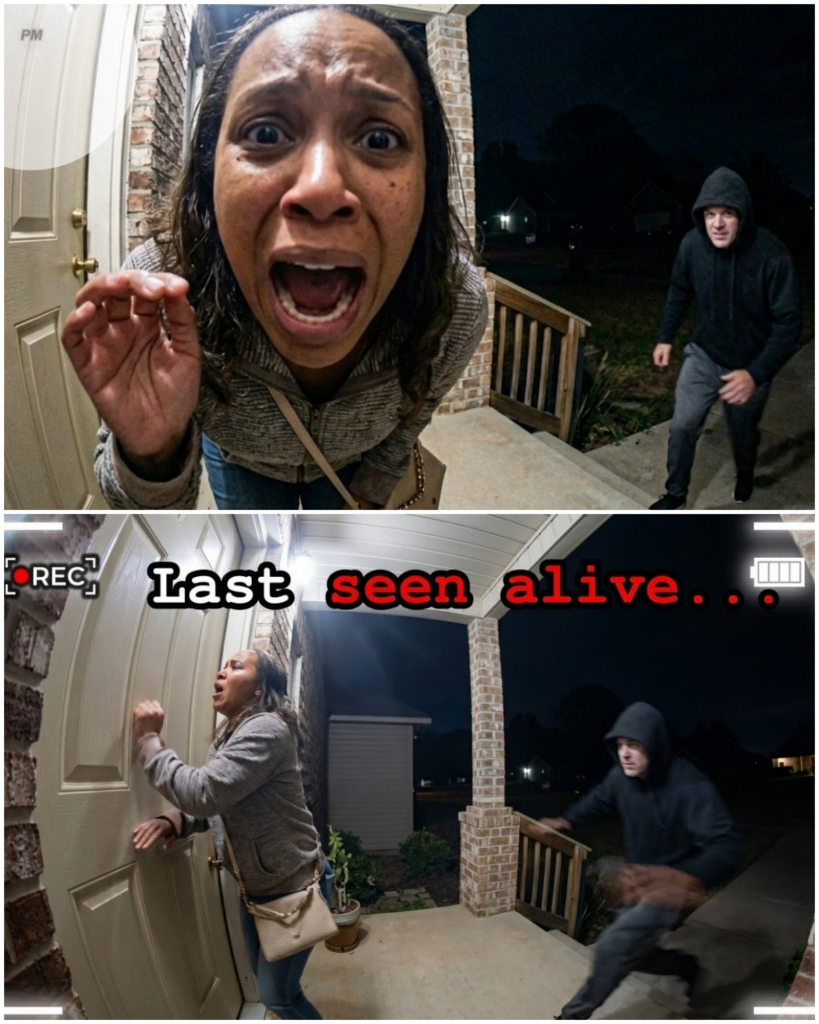
No card
No card. She did not bring them inside. By June, she saw the man. Twice.
Same grocery store, same week. Ball cap, sunglasses, average height. He never approached, just watched.
Destiny wrote in her notes, “He wants me to know he’s there.” By July, the paranoia was consuming her.
She stopped going out after dark. She checked her locks three times before bed. She watched every car that passed her apartment.
She was living in fear. And on July 9th, she made the decision that she thought would save her.
She went to the police. Destiny Porter had moved to Carbondale in 2017. She had grown up in Springfield, Illinois, 2 hours north.
Her parents still lived there. Her father worked in manufacturing. Her mother was a retired school teacher.
Destiny had attended the University of Illinois, graduated with a degree in nursing in 2015.
For 2 years, she worked at a women’s health clinic in Champagne, intake nurse, patient coordination, counseling support.
But in 2017, she left nursing. She never explained why to her parents. She simply told them she needed a change.
She moved to Carbondale, applied for a position at the public library, started as a part-time assistant.
Within a year, she was full-time. Her life in Carbondale was quiet, routine, predictable. She worked at the library 5 days a week, Tuesday through Saturday.
Her shifts were always the same, noon to 8:00 p.m. She lived alone. She had no close friends in Carbondale, no romantic relationships.
Her co-workers described her as polite, reserved. She ate lunch alone in the breakroom with a book.
She did not attend staff events. Her supervisor, Janet Hollis, told investigators that Destiny was the most reliable employee she had ever managed.
If Destiny was late, you knew something was wrong. She was never late. Destiny’s routine was identical every day.
She woke at 10:00 a.m., made coffee, ate breakfast, read for an hour. She left for work at 11:30 a.m.
The drive took 14 minutes. She worked her shift without deviation, helped patrons, shelved books, processed returns.
At 8:00 p.m., she clocked out, drove home, arrived by 8:20 p.m. She made dinner, watched television, read before bed.
She called her parents every Sunday at 7:00 p.m. The calls lasted 15 to 20 minutes.
She had no social media accounts, no online presence beyond a library email address. Her life was small, contained, safe until January 2023.
That was when the call started and Destiny’s carefully constructed world began to collapse. The stalking did not happen all at once.
It was gradual, methodical, designed to destabilize. In January, the calls were an annoyance. Destiny blocked the numbers, moved on.
By February, the car outside her apartment made her uneasy. But she told herself it could be anyone, a neighbor, a visitor.
In March, the note under her windshield wiper changed. Everything. You don’t see me, but I see you.
That was when Destiny realized this was not random. Someone was watching her. She started checking her surroundings constantly, looking over her shoulder in parking lots, scanning every car on her street.
She stopped walking to her car alone after work. She asked a coworker to walk with her.
The coworker, a woman named Lisa, later told investigators, “Destiny seemed scared, but she never told me why.
She just said she didn’t like walking alone at night.” In April, the calls became personal.
You look tired today. Destiny had been tired that day. She had worked a double shift, dark circles under her eyes.
How did he know? And on July 9th, she made the decision that should have saved her life.
She went to the police. Destiny walked into the Carbondale Police Department at 217 p.m.
On July 9th, 2023. She carried her folder, every page, every photograph, every note. She told the desk officer she needed to file a report about ongoing harassment and stalking.
She was directed to an interview room on the second floor. 11 minutes later, Officer Marcus Row walked in.
Marcus Row was 41 years old. He had been with the Carbondale Police Department for 12 years.
He worked primarily in community outreach, victim support, nonviolent incident response. He was known in the department as patient, calm, good with people who were scared.
He introduced himself, shook Destiny’s hand, sat down across from her at the small table.
He asked her to start from the beginning. Destiny opened her folder. She walked him through everything.
The calls, the car, the notes, the flowers, the man at the grocery store. Marcus Row listened.
He did not interrupt. He took notes on his departmentisssued tablet. He asked, clarifying questions.
Can you describe the man you saw at the grocery store? Destiny shook her head.
Not clearly. He always wore a hat, sunglasses. I never saw his face. The car you saw in February.