A promise to a friend who had died with an IED shr…
A promise to a friend who had died with an IED shrapnel in his chest thousands of miles from the Montana wilderness he loved.
Duke watched Kira disappear into the communication center and his jaw tightened. She moved like her father, economical, aware, every step purposeful.
She scanned the compound without seeming to scan it, cataloging positions and angles with eyes that saw more than they should.
Marcus’ eyes. The same pale gray that could read terrain like a book. The same unwavering focus that came from knowing exactly where you were and what you could do from that position.
Duke had watched her for 7 months. Had seen the way she calculated distances without thinking about it.
Had noticed how her gaze always found the high ground, the choke points to the places where a shooter would position.
Had recognized the discipline in her stillness, the control in her silence. That kind of discipline didn’t come from communications training.
It came from something deeper. Something Marcus Ashford would have given his daughter. “Damn it, brother,” Duke muttered to the ghost of a man 33 years gone.
“She’s exactly like you said she’d be.” In his pocket, Duke carried a letter sealed, yellowed with age, written in Marcus Ashford’s careful handwriting in 2016, 6 months before an IED turned him into a memory and a folded flag.
The letter was addressed to Kira. Duke had promised not to give it to her until she became who she was meant to be.
He had a feeling that day was coming soon. Could feel it in his bones the way old soldiers feel incoming weather.
Something was building. Some convergence of circumstance and necessity that would force Kira Ashford to stop hiding and become what her father had trained her to be.
Duke just hoped she would survive it. He pulled out the letter, traced Marcus’ handwriting with one callous finger.
I’m keeping my promise, brother, he whispered. I’m watching over her, but you better be watching, too, because what’s coming is going to change everything.
Inside the communications center, Kira powered on her equipment with the smooth efficiency of 7 months practice.
Banks of radios hummed to life, screens flickered through boot sequences. The room smelled like old coffee and electrical components, and the particular staleness of a bunker that never quite got enough air.
Private Wyatt Fletcher looked up from his console, 21 years old, fresh-faced, still carried the earnest enthusiasm that combat hadn’t beaten out of him yet.
He had been at Fob Liberty for 3 months, had watched Kira work with something approaching awe.
Morning specialist Ashford. Kira nodded, didn’t waste words. She logged into her station and began running diagnostic checks.
Fletcher watched her hands move across the keyboard with practice precision. She could troubleshoot problems in minutes that took him hours.
Could maintain signal integrity through weather that turned everyone else’s comps to static. Could coordinate three different operations simultaneously without breaking a sweat.
He had asked her once how she did it. She had said practice. What she hadn’t said, “My father taught me to stay calm when everything is falling apart.
Taught me to focus when the world is screaming. Taught me that communication is the difference between mission success and men coming home in boxes.
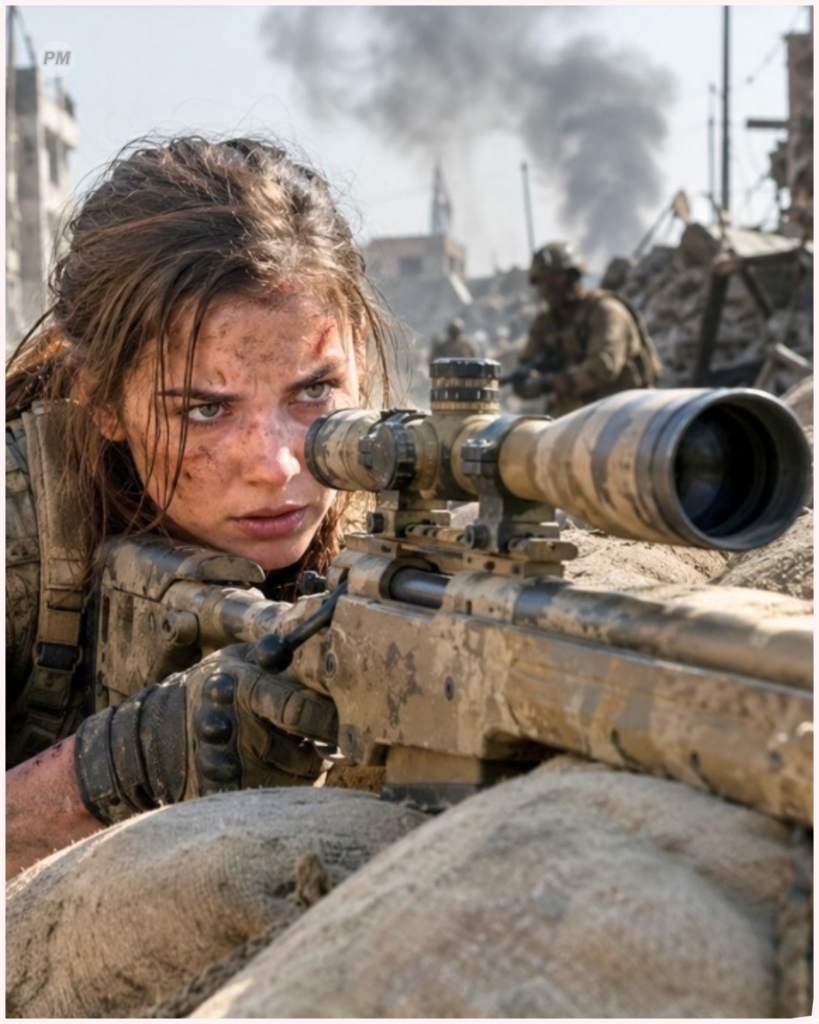
What she didn’t say, “I learned these skills lying in grass with a rifle, where staying calm meant hitting a target at 600 m and losing focus meant missing and disappointing the man who believed in me more than anyone else ever had.”
The door banged open. Sergeant Randall Moss filled the doorway. 40 years old, 15 years in, a career built on doing the absolute minimum required and making everyone else pick up the slack.
He had soft hands and a softer middle and the kind of eyes that looked for weakness the way predators looked for injured prey.
He dropped a stack of manila folders on Kira’s desk hard enough to make Fletcher jump.
Frequency reports, Moss said. Need them done by 1800. Kira glanced at the stack. 12 reports.
Moss’s work. Work he was supposed to have completed 2 weeks ago. Work that would take 6 hours if she was fast eight if she was thorough.
These are assigned to you, Sergeant. Moss smiled. The kind of smile that had teeth but no warmth.
They’re assigned to you now, specialist. Unless you want me to tell the exo you’re having trouble keeping up with basic duties.
I’m sure he’d be very interested to know that our top communication specialist can’t handle a simple workload.
Fletcher’s face went red. He opened his mouth to protest. Kira caught his eye and gave the smallest shake of her head.
The young private subsided, fuming, his hands clenched into fists under his desk. Understood, Sergeant Moss left.
The door slammed behind him. Fletcher exploded the moment the footsteps faded. “That’s not fair.
Those are his reports. He can’t just dump his work on you because he’s too lazy to do his job.”
“Fair doesn’t matter,” Kira said quietly. She opened the first folder, began scanning the frequency data.
“The work matters. Getting it done matters. Everything else is just noise.” “But it’s not right.”
Right and fair are luxuries, Fletcher. She pulled up a spreadsheet, started entering data. We don’t always get luxuries.
Fletcher stared at her. How do you do it? How do you just take it?
Kira’s hands paused on the keyboard for just a moment. She thought about her father, about the hours they had spent in the Montana wilderness.
About the lesson he had taught her when she was 12 years old, lying in position for 3 hours waiting for a windshift.
Fair doesn’t hit the target, little one. Skill does. Focus does, discipline does. Everything else is just noise that distracts you from what matters.
I do it because the mission matters more than my ego, she said finally. Because these reports, even though they’re his responsibility, still need to be done because if they’re not done, someone might die from bad frequency coordination.
And I can’t control what Sergeant Moss does. I can only control what I do.
Fletcher absorbed this, then quietly. Your dad. He taught you that, didn’t he? Kira looked at him.
Really looked at him. Saw the young soldier still trying to figure out how the world worked.
Still believing that fair and right meant something in a place where death came from a ridge line you couldn’t see.