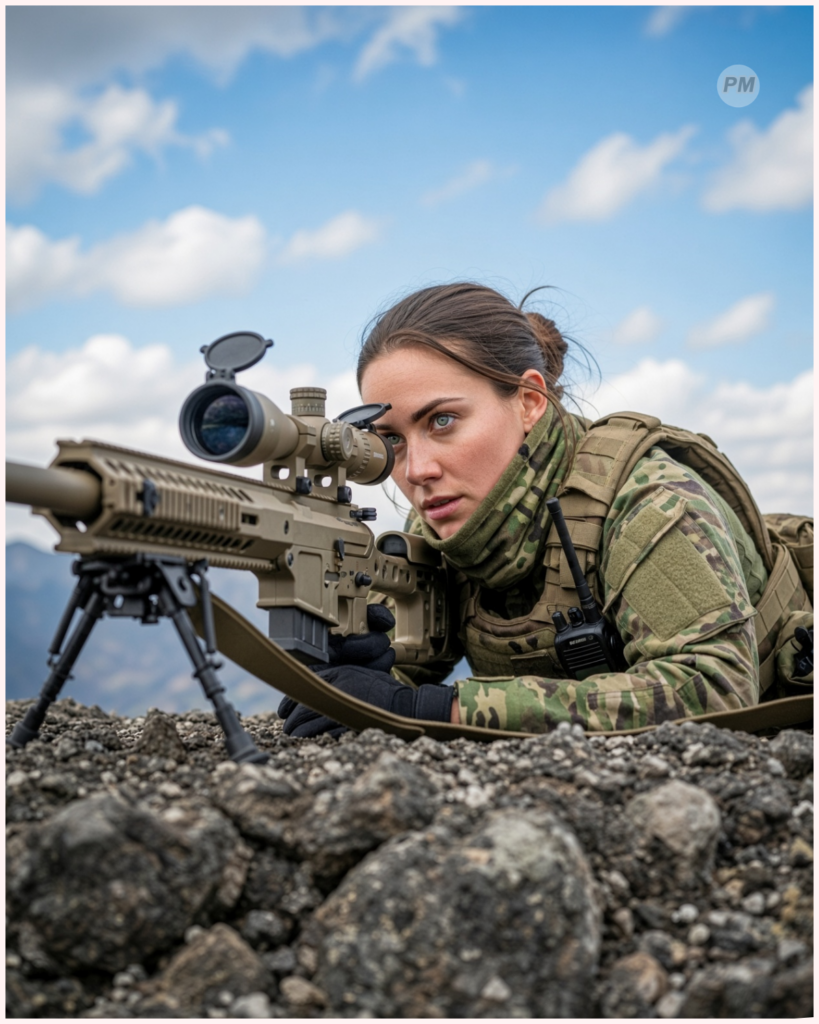
The scope’s reticle cut through mountain air like a scalpel through flesh. 3,218 m. Distance that separated professionals from legends, the living from the dead.
Wind howled across the ridge at 65 km/h, carrying snow that stung like broken glass.
-15° C, cold that made metal burn skin, turn breath to ice crystals before it left the lungs.
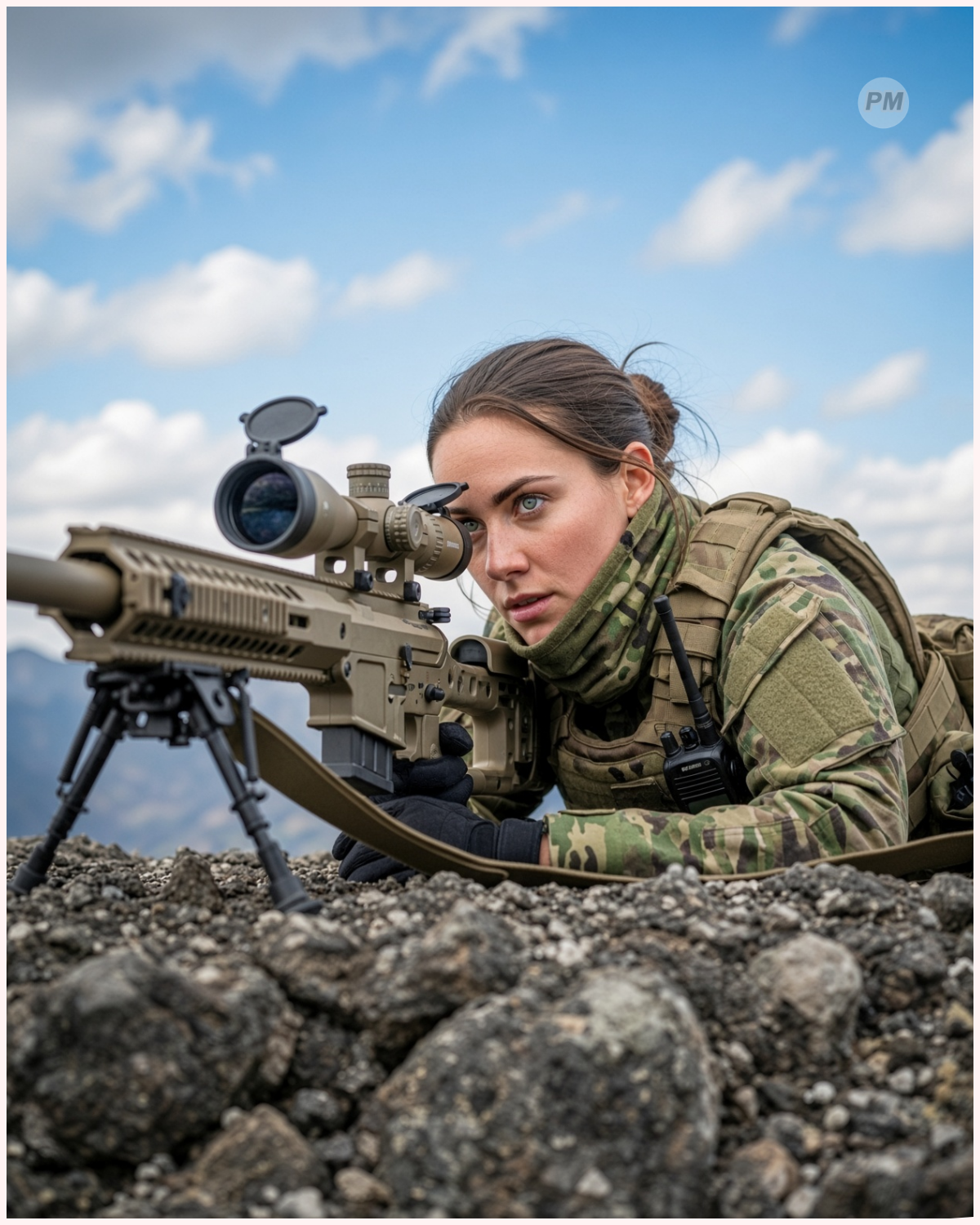
Through the magnified lens, the target appeared no larger than a thumbnail. A man in winter camouflage positioned behind a boulder formation that should have made him invisible to anyone without patience, training, and 5 years of rage to fuel them.
The calculations flashed through her mind with mechanical precision. Wind drift, 4.2 m. Bullet drop, 11.7 m.
Coriolis effect at this latitude, 0.3 m right. Air density at altitude reduced by 18%.
The round would take 4.1 seconds to reach its target. 4.1 seconds where the earth would rotate, where wind would shift, where a thousand variables could transform perfection into failure.
Her finger rested against the trigger. 2 lb of pressure. She could feel the break point, that microscopic moment before the sear released and physics took over.
One breath in through the nose. Cold air filled her lungs, burned her throat. Half breath out through slightly parted lips.
Her heart rate dropped. 90 beats per minute. 70. 50. 42. The world narrowed to a tunnel.
Everything outside, cold, wind, the weight of what she was about to do, faded to white noise.
She fired. The rifle’s recoil was familiar, almost comforting, like shaking hands with an old friend who’d seen you at your worst and never judged.
The suppressor swallowed most of the sound, turning the crack of supersonic death into a whisper.
Through the scope, she tracked the bullet’s flight, watched or imagined she watched the tiny disruption in air as the round tore through atmosphere, spinning at 280,000 rotations per minute, carrying with it the mathematics of violence.
4.1 seconds. The target jerked backward. His weapon clattered against stone, the sound reaching her 3 seconds after impact, after the laws of physics finished their work.
He fell away from his position, tumbling down the slope in a miniature avalanche of snow and regret.
The woman behind the rifle lowered the weapon. Her hands were steady. Her face was blank, emotionless, the mask of someone who’d done this so many times it had become routine, mechanical, inevitable.
She keyed her radio. Her voice was barely louder than the wind. “They’ll never know it was me.”
Then the mountain swallowed her, and she was gone. Five years earlier. The Syrian border smelled like diesel fuel and desperation.
March 2020, when the world was holding its breath for different reasons, when a virus was just beginning to teach humanity about invisible threats.
But Lieutenant Kira Ashford dealt in visible threats. Threats you could see through a scope, calculate, eliminate with precision and mathematics.
She was 29 years old then, young enough to still believe in the clarity of orders, old enough to have learned that clarity was often an illusion.
Her hair was darker then, pulled back in the severe regulation bun that revealed a face all hard angles and focus.
Gray eyes that looked at targets, not people. Because people were complicated, but targets were simple.
She lay prone on a ridge overlooking a compound that intelligence said housed a high-value terrorist.
A man named Khalid Hassan. Age 47, former Iraqi colonel, current arms dealer, suspected of facilitating weapons transfers that had killed 18 American soldiers in the past year.
The dossier was specific, detailed, convincing. 1,847 m away, Hassan stood in the compound courtyard talking on a satellite phone.
Surrounded by guards, yes, but exposed. Confident. The arrogance of a man who thought himself untouchable.
Kira’s spotter, a sergeant named Mitchell, called out wind speed 40 km/h, left to right, gusting to 45.
She adjusted her scope. The CheyTac M-200 was precision machined to tolerances measured in microns, chambered in .408, capable of reaching past 2,000 m with accuracy that made other rifles look like toys.
“Temperature?” She asked, her voice flat. 38 Celsius, barometric pressure dropping. All data, all variables, all feeding into the equation that separated a successful shot from a wasted round.
Her radio crackled. Colonel Dalton Rivers, commanding from the tactical operations center, 3 km away.
63 years old, voice like gravel and gunpowder. A man who’d seen enough wars to know they never really ended.
“Ghost 7, this is overwatch. Target confirmation?” Kira studied the man through her scope. Hassan matched the photographs.
Same build, same distinctive scar running from his left ear to his jawline. Same silver-streaked beard, same way of holding himself, that particular combination of military bearing and criminal confidence.
“Confirmed,” she said. “Target matches profile. I have the shot.” Silence on the radio. 3 seconds, 5, 10.
Then Rivers’ voice, steady and certain. “Permission to fire. Make it clean.” The world contracted to the space between her eye and the scope.
She entered the zone, that perfect stillness where thought disappeared and only physics remained. She felt the trigger break, felt the rifle kick, watched through the scope as the bullet crossed 1,800 m of desert air in 2.9 seconds.
Hassan’s head snapped back. He crumpled like a puppet with cut strings. His guard scattered, shouting, weapons raised, searching for a threat they’d never see.
“Target eliminated,” Kira reported, her voice empty of emotion. “Clean hit, center mass.” “Copy, Ghost 7.
Good shooting. Extract to rally point alpha.” She broke down her position with practiced efficiency.
45 seconds to pack her gear, 60 seconds to move 200 m from her hide.
Another 3 minutes to reach the vehicle that would carry her back to base. Mission complete.
Another name crossed off another list. Number 143. She didn’t know then that in 48 hours, her entire world would detonate.
The operations center erupted like someone had kicked an anthill. Kira sat in a plastic chair bolted to a concrete floor, watching men in suits and uniforms swarm around computer terminals, shouting into phones, pointing at screens that showed news feeds in a dozen languages.
On the largest monitor, a photograph of Khalid Hassan. But the caption beneath it didn’t say terrorist or arms dealer.
It said, “CIA asset killed in apparent friendly fire incident.” The words made no sense.
She read them three times, each iteration feeling more unreal than the last. A man in a gray suit, no name tag, no rank, just that particular blend of authority and anonymity that screamed intelligence community, stood before her.
Behind him, two military police officers. Their presence was not subtle. “Lieutenant Ashford,” the suit said, his voice carrying the carefully neutral tone of someone delivering a cancer diagnosis.
“We have a problem.” “Sir, I don’t understand. The target was confirmed. Colonel Rivers gave the order.”
“The target was Khalid Hassan. Yes.” The suit pulled up a chair, sat at eye level with her, a technique she recognized.
“Make yourself equal, create false intimacy, prepare the subject for bad news. What we didn’t tell you is that Hassan was one of ours.”
The floor seemed to tilt. “What?” “Deep cover, non-official cover actually. Been embedded with Syrian arms networks for 3 years.
His intelligence prevented two major attacks on US installations in the past year alone.” Kira’s mind raced, trying to find the angle, the explanation that made this make sense.
“Then why was he on the target list? Why did intelligence “There was a communication breakdown.”
The suit’s face showed nothing. “Compartmentalization failure. The dossier you received was outdated, flagged for elimination before Hassan was recruited as an asset.
It should never have reached operational status, but Colonel Rivers confirmed Colonel Rivers was working from the same compromised intelligence you were.
The suit leaned back. This is a monumental [ __ ] Lieutenant. And monumental fuckups require monumental responses.
She understood then. Understood with the cold certainty of someone watching a news titan. You’re making me the scapegoat.
The suit didn’t deny it. That was answer enough. There are political dimensions you don’t appreciate, he said quietly.
Hassan’s work was known to certain allies. His death has created a diplomatic nightmare. People want accountability.
They want someone to blame. I followed orders. You followed compromised orders. And in the eyes of the investigation, you had access to updated intelligence that should have flagged Hassan as friendly.
The fact that you didn’t see it suggests negligence at best, willful disregard at worst.
It was a lie. She knew it was a lie, but lies with the weight of institutions behind them became truth through sheer momentum.
You can fight this, the suit continued. Go through the court-martial process. Drag it out for months, maybe even win, though I doubt it.
Or or or you disappear tonight. We stage a training accident. Lieutenant Kira Ashford killed in the line of duty.
Full honors. Your record stays clean. And you get to live. She stared at him.
In exchange for what? Your silence, forever. The last person she saw before disappearing was Colonel Dalton Rivers.
They met in a parking garage at 0200 hours. Rivers’ face looked 10 years older than it had 3 days ago.
The lines around his eyes had deepened into crevices. His hands shook slightly as he handed her a manila envelope.
“Everything you need,” he said, his voice rough. “New identity, K Miller, birth certificate, social security number, driver’s license, credit history that goes back 10 years.
You’re a ghost now, Kira, a real one.” She took the envelope. It weighed almost nothing, but felt heavy as a coffin.
“They offered you a choice, too, didn’t they?” She asked quietly. Rivers looked away. “Retire quietly or watch them prosecute you for giving an illegal order based on faulty intelligence.
So, you chose your pension over the truth.” “I chose your life over the truth.”
His voice cracked. “They were going to charge you with treason, Kira. Knowingly killing a CIA asset.
Death penalty. I couldn’t I couldn’t let that happen.” She wanted to hate him, wanted to feel rage at his cowardice, his willingness to let a lie stand.
But looking at his face, seeing genuine anguish there, she felt only exhaustion. “Did you know?”
She asked. “About Hassan being an asset?” Rivers met her eyes. For 3 seconds he said nothing.
Then, “No, I swear to God I didn’t know.” She wanted to believe him, chose to believe him, because the alternative was unbearable.
“Disappear,” Rivers said. “Go far away. Change your name, your life. Forget you were ever a soldier.”
“And if I can’t forget?” “Then learn to live with ghosts.” He put a hand on her shoulder.
“I’m sorry, Kira, for all of it. She left without saying goodbye. Some goodbyes were too heavy for words.
Present day, five years later. The mop handle was fiberglass, hollow, made a particular sound when it hit the floor, a dull thunk that echoed through empty hallways at 0600 hours when most of Fort Bragg was still asleep.
K Miller pushed the mop cart with a slow, methodical pace of someone who’d done this job for years.
Because she had. Five years of mopping floors, emptying trash, cleaning toilets. Five years of being invisible.
She was 34 now. Her hair was grayer, artificially so, dyed to add 10 years to her appearance.
She wore thick-framed glasses that didn’t correct any vision problem, but changed the shape of her face just enough.
She walked with a slight slouch, shoulders rounded, head down. Body language that said, “Don’t see me.
Don’t remember me. Don’t care.” And it worked. Soldiers walked past her every day without a second glance.
Janitors were furniture. Part of the background. Necessary, but invisible. Like air or electricity. A young lieutenant, fresh-faced and arrogant in the way only 23-year-olds with gold bars could be, rounded a corner without looking, bumped directly into her cart, spilling cleaning solution across the floor.
“Watch it, lady,” he snapped, not breaking stride. K, she thought of herself as K now, had to, because Kira Ashford was dead and buried five years ago, said nothing.
Just pulled out more paper towels and started cleaning. The lieutenant was already gone. Already forgotten her.
Perfect. She finished mopping the hallway and pushed her cart into the operations building. This was her favorite assignment, though she’d never admit why.
The operations building housed briefing rooms, communications centers, tactical planning spaces, places where real missions were planned, where real soldiers prepared for real wars, places she wasn’t allowed anymore.
A briefing was underway in conference room three. She could see through the small window in the door.
12 soldiers in combat fatigues sitting around a table covered in maps and satellite imagery.
The lights were dimmed for the projector. Kay moved her cart closer, pretending to mop the hallway just outside.
The door wasn’t quite closed. Sound leaked through. A woman’s voice, authoritative and crisp. Bravo 12, your objective is a weapons cache in the Montana mountains, Black Rock Canyon, grid coordinates November 73482.
Kay’s hands tightened on the mop handle. Intelligence indicates the facility was abandoned 18 months ago, likely empty, but we need confirmation.
You’ll insert via Black Hawk at 0400 hours tomorrow. Hike in, verify the cache is neutralized, and extract via the northern ridge.
The voice continued laying out details, entry route, extraction point, expected duration, all standard, all routine.
Except it wasn’t routine. Not to someone who’d spent five years studying patterns, who’d memorized every failed mission report she could access through old passwords that still worked if you knew how to hide your digital footprint.
Black Rock Canyon, narrow approach, high ridges on both sides, single entry point. It was a kill box, classic ambush terrain.
And the intelligence profile, abandoned facility, likely empty, easy in and out, matched word for word the intelligence that had been fed to her team in Syria five years ago.
K’s heart rate elevated for the first time in months. She forced herself to keep mopping, keep moving, keep being invisible.
The briefing ended. Soldiers filed out talking in low voices about gear checks and ammunition loads.
The woman leading the briefing, Captain Morgan Hayes, according to the name tag on her uniform, was last to leave.
Tall, blond hair in a tight bun, blue eyes that looked like they’d seen their share of bad decisions and lived to regret them.
Hayes locked the door behind her, didn’t even glance at the janitor mopping nearby. K waited until the hallway was empty.
Then she pulled out her phone, a cheap burner replaced every month, and took a photo of the mission briefing still visible through the window.
Black Rock Canyon, grid coordinates, insertion time. She had 18 hours. The janitor’s closet on the third floor of building seven looked like a janitor’s closet.
Mops, brooms, industrial cleaning supplies stacked on metal shelves, a utility sink stained with years of chemical runoff, concrete floor, bare bulb overhead.
But behind the shelving unit, hidden by a false wall that K had installed herself three years ago, was something else entirely.
A laptop, military grade, encrypted, connected to the internet through a VPN that bounced her signal through 14 countries.
A small filing cabinet containing printed documents, mission reports, intelligence summaries, personnel files, all acquired through a combination of old access codes and social engineering.
And a locked case containing items she told herself she’d never use again. Kay sat at the laptop and started digging.
Black Rock Canyon weapons cache. First mentioned in intelligence reports 14 months ago. Anonymous tip.
Same format as hundreds of other tips that flow through channels every day. Most were garbage, dead ends, wild goose chases.
But this one had legs. Satellite imagery showed structure consistent with weapon storage. Thermal readings suggested recent activity.
Enough evidence to warrant a verification mission. Kay dug deeper, traced the intelligence back through channels, following the digital breadcrumbs that most analysts wouldn’t bother with.
The anonymous tip had come through a cutout in Vienna. The cutout had connections to a private military contractor.
The contractor had ties to Her blood went cold. Preston Thorne. She hadn’t heard that name in five years, had tried very hard not to think about it.
Because thinking about Preston Thorne meant thinking about Syria, about Hassan, about everything that had destroyed her life.
Thorne was CIA, or had been. Gray operator who transitioned into the private sector, running guns and intelligence for whoever paid enough.
Ruthless, brilliant, utterly without conscience. In five years ago, he’d been the one who’d compiled the dossier on Khalid Hassan.
The one who’d marked Hassan for elimination. The one who’d set Kira Ashford up to take the fall.
Now he was feeding intelligence about Black Rock Canyon. Using the same format, the same channels, the same pattern.
Kay pulled up satellite imagery of Black Rock Canyon from three different sources. Government, commercial, private.
Cross-referenced them looking for discrepancies. There, on the commercial satellite pass from 6 days ago, heat signatures in positions along the ridge.
Seven distinct sources, evenly spaced, too evenly spaced to be natural. Too coordinated to be coincidence.
Sniper hides. Bravo 12 wasn’t walking into an abandoned weapons cache. They were walking into an ambush.
The same ambush that had gotten her burned 5 years ago. Just wearing different geography.
She checked the time. 1800 hours. Bravo 12 would deploy in 10 hours. K stood, walked to the lock case, and opened it with a key she wore on a chain around her neck, hidden under her shirt.
Inside, a ghillie suit compressed and vacuum sealed, a ballistics calculator, a rangefinder, a worn leather logbook filled with handwritten entries in her own careful script.
147 entries. 147 kills. Each one documented with date, location, range, conditions, outcome. She’d sworn she’d never add to that number.
Had sworn she was done being a weapon. Done taking orders. Done trusting intelligence that turned people into targets.
But if she did nothing, 12 soldiers would die in Montana tomorrow. 12 people who’d never know they were walking into a trap designed 5 years ago for someone else.
K closed the case, locked it again. She had a choice to make. Dalton Rivers’ ranch sat 40 miles outside Fort Bragg at the end of a dirt road that turned to mud when it rained and dust when it didn’t.
200 acres of nothing much. Scrub pine, rocky soil, a creek that ran dry 6 months of the year.
It was perfect. Kay drove there in her 12-year-old Honda Civic, the kind of anonymous car that cameras forgot as soon as it passed.
She arrived at 2000 hours, just as the sun was setting and painting the sky in shades of copper and blood.
Rivers sat on his porch in a rocking chair that had been old when he was young.
At 68, he looked like a man carved from driftwood and bad memories. His hair had gone completely white.
His face was weathered in the way only decades of sun and stress could achieve.
But his eyes were still sharp, still the eyes of a colonel who’d sent men into harm’s way and lived with the consequences.
Those eyes widened when he saw Kay walking toward the porch. Jesus Christ, he said, his voice barely above a whisper.
Kira? She stopped at the base of the porch steps. It’s Kay. Has been for 5 years.
You can’t be here. If anyone sees No one sees me anymore, Colonel. I’m invisible.
You made sure of that. Rivers stood slowly, like a man who’d taken too many hard falls and knew there were more coming.
What do you want? Bravo 12, Montana mission, tomorrow morning. His face went carefully neutral.
The expression of a man who knew how to hide reactions. I’m retired. Have been for 5 years.
I don’t know anything about current operations. Don’t lie to me, not now. Kay climbed the steps, stood face-to-face with him.
It’s the same play, same intelligence format, same terrain profile. Preston Thorne is running the same op that burned me in Syria, and Bravo 12 is walking into it blind.
Rivers’ jaw tightened. How do you know Thorne is involved? Because I never stopped watching, never stopped tracking the patterns.
She pulled out her phone, showed him the intelligence analysis she’d compiled. Anonymous tip through Vienna cutout, contractor connections, satellite imagery showing sniper positions.
It’s all there if you know how to look. Rivers studied the screen for 30 seconds.
When he looked up, something in his face had shifted. The careful neutrality was gone, replaced by something that might have been shame.
“Even if you’re right,” he said quietly, “what do you expect me to do? I’m a retired colonel living on a pension.
I have no authority, no pull, no way to stop this mission.” “You could warn them.”
“Based on what? The intelligence analysis of a janitor who’s supposed to be dead? They’d laugh me out of the building.”
“Then I’ll go myself.” Rivers’ expression hardened. “No, absolutely not. 12 people, Colonel. 12 soldiers who don’t know they’re bait.
And what about you? You blow five years of hiding for what? To play hero?
To prove you’re still relevant?” His voice rose, sharp with something that sounded like fear.
“They’ll arrest you the moment you show your face, court-martial you for desertion, for breaking your agreement.
You’ll spend the rest of your life in Leavenworth.” “Better than spending it watching people die when I could have stopped it.”
They stared at each other. The sunset had faded to twilight, and the porch light cast harsh shadows across Rivers’ face, making him look older, more fragile.
“Why?” He asked finally. “Why risk everything for people you don’t know?” Kay thought about that, thought about five years of mopping floors and emptying trash, and being invisible.
Five years of watching soldiers walk past her, young and confident, and unaware that the woman scrubbing their toilets had more confirmed kills than most of them would ever see.
Five years of hiding from what she was. “Because I’m done being invisible.” She said.
Rivers held her gaze for 10 seconds. Then he turned and walked into his house without a word.
Kay waited. Didn’t move. Just stood there in the gathering darkness listening to crickets and the distant sound of a truck on the highway.
Five minutes later Rivers emerged carrying a long case. Military grade hard plastic secured with combination locks.
He set it on the porch, knelt beside it, worked the combination. The locks clicked open.
Inside wrapped in foam and preservation cloth was a CheyTac M-200 rifle. The exact model she’d used in Syria.
The same weapon that had put 147 people in the ground. “I kept this.” Rivers said, not looking at her.
“Told myself it was evidence, but that was a lie.” He pulled out the rest.
Ghillie suit still in its vacuum seal, ballistics computer, rangefinder, and a worn leather logbook.
“I think I think I always knew you’d come back. That you couldn’t stay hidden forever.
That whatever you are, whatever they made you, it doesn’t just disappear because you want it to.”
Kay picked up the logbook, ran her fingers over the cover. Her handwriting on the first page.
Operational record, Lieutenant Kay Ashford. “I also kept this.” Rivers said. He pulled an envelope from his jacket pocket.
“Your last performance review before Syria, before everything.” She opened it. Her hands were steadier than they should have been.
“Lieutenant Ashford demonstrates exceptional skill in long-range marksmanship. 147 confirmed kills across three deployments. Zero civilian casualties.
Zero friendly fire incidents. Her judgment under pressure is impeccable. Her ethical standards are beyond reproach.
She represents the absolute best of what we ask soldiers to be. Recommended for promotion to captain and assignment as chief sniper instructor.
Signed, Colonel Dalton Rivers. The paper shook slightly in Kay’s hands. “I wrote that 2 weeks before Syria,” Rivers said.
“Meant every word. Still do.” She looked up at him. “You knew Hassan was the real target, didn’t you?”
“Thorne told you.” Rivers’ face went through several expressions before settling on exhausted honesty. “Yes.”
The word hung in the air like smoke. “They came to me the day after the shot,” he continued.
“Told me Hassan was CIA, but that his cover was blown anyway. Said the elimination was politically necessary.
Gave me a choice. Retire quietly with full pension or fight it and watch them destroy both of us.
They had evidence planted in my communications. Fabricated, but convincing.” “They threatened to prosecute you for treason.
Death penalty.” “So, you chose silence.” “I chose your life. Same choice I’d make again.”
His voice cracked. “I’m sorry, Kira. For the lie. For the cowardice. For letting you think you’d failed when you’d done exactly what they wanted.”
Kay looked at the rifle case. At the weapon that had defined so much of her life.
“The mission tomorrow,” she said. “If I’m right, if it’s an ambush, then you’ll be walking into the same trap that destroyed you 5 years ago.”
“Yes.” “Alone.” “Yes.” Rivers nodded slowly. “What do you need from me? She hadn’t expected that.
Had expected argument, resistance, more attempts to talk her out of it. Why are you helping me now?
Because 5 years ago I chose your life over truth. Tomorrow I’m choosing both. He picked up the rifle case, handed it to her.
This is yours, always was. And Kira, whatever happens tomorrow, whatever you have to do, you’re not the one who failed in Syria.
They did. The system did, not you. K took the case. It was heavier than she remembered.
She left without another word. Some things were too heavy for thanks. The supply convoy left Fort Bragg at 0200 hours heading northwest toward the Montana operational area.
Three trucks carrying equipment and ammunition for forward operating bases scattered across the mountain territory.
K Miller was supposed to be cleaning the depot loading bay. Instead, she was in the back of the third truck hidden behind crates of MREs and ammunition boxes.
The drive would take 18 hours. Bravo 12’s Black Hawks would get there in four, but they were leaving later, timing their arrival for dawn insertion.
K had time. She used it to prepare. Changed out of her janitor clothes into base layers designed for extreme cold, black, fitted, technical fabric that wicked moisture and retained heat.
Over that, the ghillie suit, a second skin of burlap and artificial vegetation that would make her invisible against mountain terrain.
She checked the rifle with hands that remembered every millimeter of its construction. Barrel condition, excellent despite 5 years in storage.
Scope rings, tight. Optics, clear. Action, smooth. Rivers had maintained it like it was his own.
The ballistics computer booted up, showing software three versions out of date. She’d have to calculate some things manually, but that was fine.
She’d done it before in places where computers died and only mathematics kept you alive.
The logbook lay open beside her. 147 entries. She flipped through pages, seeing missions, seeing faces she’d erased from the world with precision and policy.
She pulled a pen from her pack, paused, then wrote, “Entry 148 to 158 anticipated.
Montana operation, Black Rock Canyon, protective action, non-official, unauthorized, final.” If she survived tomorrow, this would be the last page she ever wrote.
If she didn’t survive, at least someone would know she tried. The truck rumbled through the darkness, carrying a ghost toward the mountains.
The Montana mountains emerged from darkness like the spine of some ancient beast breaking through stone.
Dawn came slowly here, painting the peaks in shades of gunmetal and ash before the sun remembered how to make gold.
Kira lay motionless in her hide position, 400 m above Black Rock Canyon. She’d been here for 2 hours since 04:30, since before the supply convoy had even stopped rolling.
The driver never knew she’d slipped out somewhere in the wilderness darkness, never noticed the equipment crate that was suddenly lighter than its manifest claimed.
The ghillie suit made her part of the landscape, sagebrush and mountain scrub, granite and shadow.
Her body temperature had dropped to 91° F, a quirk of her physiology that Army doctors had noted in her file years ago and never quite understood.
Abnormally low baseline temperature made her harder to spot on thermal imaging, made her body consume less energy in cold environments, made her a ghost even before she decided to become one.
Through her scope, she studied Black Rock Canyon with the patience of a predator. The canyon was exactly what the intelligence briefing had described.
A narrow defile, 200 m long, winding between ridge walls that rose 60 ft on either side.
One entry point, one exit. Perfect terrain for an ambush if you had the high ground.
And someone had the high ground. She’d spotted the first sniper hide at 0500, just as the light became strong enough to work with.
A subtle pile of rocks at 11:00, 200 m across the canyon. Too geometrically perfect to be natural.
Too strategically positioned to be accident. By 0530, she’d identified all seven positions. 11:00, 1:30, 2:15, 4:00, 7:00, 9:30, 10:15.
Overlapping fields of fire, no dead angles. Each position carefully constructed to cover sectors while remaining invisible to anyone below.
Classic sniper ring. The kind of setup that took hours to build, days to plan.
The kind of setup that only happened when someone knew exactly where the target would be and exactly when they’d arrive.
Kira pulled out her ballistics calculator, started running numbers for each position. Ranges from 1,000 to 2,000 m.
Wind conditions variable, gusting between 40 and 65 km/h. Temperature dropping as altitude increased. Barometric pressure fluctuating.
Seven targets, 11 rounds in her magazine, four in reserve. Margin for error minimal. She heard them before she saw them.
The distinctive thump of rotor blades, still distant but closing. Two Black Hawks coming in low from the southeast, following terrain to avoid radar detection.
Bravo 12 was on schedule. Kiera keyed her radio to their tactical frequency, tried to transmit a warning.
Static. The frequency was encrypted, rotating codes every 30 seconds. Without the current authentication, her transmission was just noise.
She tried the emergency channel, same result. The Black Hawks grew louder. 30 seconds out, 20.
Kiera made a decision. Target one, 11:00 position, 1,234 m. The sniper there was already acquiring his target.
His rifle barrel shifting slightly as he tracked the incoming helicopters. She had maybe 15 seconds before he fired.
10 seconds before Bravo 12 landed. Five seconds to save lives she’d sworn she was done saving.
Kiera’s breathing slowed. Her heart rate dropped below 40. The world contracted to the space between her eye and the scope.
Wind, 45 km/h, left to right. Temperature, minus eight Celsius. Humidity, 18%. Altitude difference, 212 ft.
Shooting slightly uphill, which meant the bullet would impact high. She compensated, adjusted, calculated. One breath in, half breath out.
Pause at the bottom of the respiratory cycle. Fire, the suppressed Shai Tac whispered. The recoil was familiar, almost gentle.
Through the scope she watched the bullet’s impact. The enemy sniper at 11:00 jerked backward, his weapon tumbling from nerveless hands.
The Black Hawks touched down in the canyon below. Soldiers poured out, 12 of them, moving with practiced efficiency toward cover positions.
None of them knew they’d just been saved. Target two, 1:30 position, 1,456 m, higher elevation, partial cover behind a boulder.
The sniper there was shifting, trying to understand where the shot had come from, trying to locate the threat.
Kira was already tracking him. Her rifle moved with mechanical precision, micro adjustments for the increased angle, for the shift in wind direction as the helicopters’ downdraft disturbed the air currents.
She fired before he could process what was happening. Target two dropped. In the canyon, Bravo 12 was fanning out, moving toward the supposed weapons cache location.
Captain Morgan Hayes in the lead, calling out positions, establishing a perimeter. They still didn’t know.
Target three, 2:15 position, 891 m, closer, but harder. The sniper was prone on a flat rock outcropping, smaller profile, better concealment.
And he was smart. He’d seen his companions fall, knew there was a counter sniper somewhere in the terrain, was trying to locate the threat before engaging his primary target.
Kira watched him through her scope, watched him scan the ridges with his own optics, searching for the muzzle flash, for movement, for any sign of where death was coming from.
He was looking too far north, expecting a military counter sniper team positioned in standard overwatch locations, not expecting a ghost 400 m to his southwest in terrain too exposed for a conventional sniper to use.
His scope swung past her position, didn’t pause, didn’t register the impossible shape that might have been human or might have been just another sagebrush growing from rock.
Then his barrel shifted, targeting one of the Bravo 12 soldiers below, a staff sergeant with red hair, tall, distinctive.
Garrett Wolfe, according to the dossier Kira had memorized. Target three’s finger moved toward the trigger.
Kira fired first. The bullet had to pass through a gap between two pine trees, thread a corridor barely 18 inches wide, had to account for the thermal rising from the sun-warmed stone, which would push the round slightly right.
She made the shot. Target three’s rifle discharged as he fell, the round going wild, impacting harmlessly into the canyon wall 20 feet above Wolfe’s head.
In the canyon, the soldiers froze. “Contact!” Hayes’s voice carried across the distance. “Sniper fire!
Find cover!” They scattered, professional and fast, diving behind rocks and into depressions. But they were confused.
The shot hadn’t been aimed at them, had come from the wrong direction. Nothing made tactical sense.
“Where is he?” Someone shouted. “I don’t know.” “Anyone got eyes on the shooter?” Kira was already acquiring target four.
4 o’clock position, 1,820 m. The farthest shot yet. The sniper there would be repositioning, smart enough to recognize that his hide was compromised, trying to find new cover.
But he had to expose himself to move, had to rise from prone to a crouch, had to scramble across 15 feet of open ground to reach the next boulder cluster.
15 feet, 3 seconds of exposure. Kira tracked him. Her scope moved smoothly, following his movement with a kind of muscle memory that came from doing this a thousand times in a dozen countries against enemies who’d learn to fear the horizon.
She couldn’t see him directly. He was behind a ridge, only his heat signature visible as a subtle distortion in the air.
The shimmer of human body temperature meeting cold mountain atmosphere. She aimed 6 in left of where the shimmer ended, calculating where his body had to be based on the physics of heat dispersion, based on standard movement patterns, based on the biomechanics of how humans ran.
She fired blind. 2 seconds later a body tumbled into view, rolling down the slope, catching on an outcrop, going still.
Target four eliminated. 18 seconds had elapsed since her first shot. Four targets down, three remaining.
In the canyon, Hayes was shouting into her radio. Serpent base, this is Bravo 12.
We’re taking fire from multiple positions. Request immediate air support. The response crackled back. Negative, Bravo 12.
All air assets committed. Earliest response time, 90 minutes. 90 minutes. They’d all be dead in 10.
Kira shifted her aim to target five, 7:00 position, 620 m. Closer now. The sniper there was moving between cover positions, relocating after watching four of his companions die in less than half a minute.
He was panicking, making mistakes, running when he should have been crawling, exposing himself when he should have stayed hidden.
Kira led him by 3 ft, accounting for his speed, his direction, the mathematics of interception, Where he was going to be, not where he was.
She fired. He stopped moving. Stopped forever. 24 seconds. Target six. 9:30 position. 410 meters.
The closest target. In a narrow crevice, only his rifle barrel visible. A slim line of metal in shadow.
Kira couldn’t see his body. Couldn’t see his head. Couldn’t see anything except that barrel in the faint outline of his scope.
She aimed at the base of the barrel. Where physics and human anatomy dictated the shooter’s head had to be.
Where the intersection of weapon geometry in body position left only one possible location. She fired at what she couldn’t see.
The barrel tilted, then fell. An arm went slack, sliding into view. 31 seconds. One target left.
Target seven. 10:15 position. 2100 meters. The farthest, the hardest, the most dangerous. This sniper had watched six people die and learn from it.
Had repositioned three times since the engagement started. Each time moving to better cover, better angles.
Making himself harder to find. But Kira was better. She watched not the ground, but the air itself.
Watched the way dust moved in invisible currents. The heat shimmer rising from rocks. The micro variations in atmospheric pressure that she could read like others read books.
She saw him. Not his body. Not his position. But his presence. The way he disturbed the environment just by being there.
She calculated a three-dimensional trajectory in her head. Accounting for Coriolis effect from the Earth’s rotation.
Spin drift from the rifle’s twist rate. Every variable that separated good shooters from legends.
Wind had shifted, now coming from the northwest at 52 km/h, gusting to 60. The bullet would drift right, would drop 11.3 m over this distance, would take 4.8 seconds to reach target.
4.8 seconds where anything could change, where the target could move, where wind could gust, where physics could decide that today perfection wasn’t enough.
Kira exhaled completely, let every molecule of air leave her lungs. Held in that perfect moment of stillness, where the body became a machine, and the machine became absolute.
She fired. The bullet seemed to hang in the air forever. She tracked through the scope, watching, or imagining she watched the tiny disruption as supersonic metal tore through atmosphere.
4.8 seconds. Through the scope, she saw the distant figure slump, saw him fall away from his rifle, saw the weapon clatter against stone.
47 seconds total. Seven targets, seven kills. Perfect violence delivered with mathematical precision. Kira lowered the rifle.
Her hands were steady. Her face showed nothing. In the canyon below, Bravo 12 was regrouping.
They’d stopped taking fire, were trying to understand what had just happened. Captain Hayes keyed her radio again.
“Unknown friendly, identify yourself.” Kira pulled out her own radio, adjusted frequency, bypassed encryption by using an old emergency authentication code that should have expired years ago, but might, if she was lucky, still work.
She pressed transmit. Her voice was barely louder than the wind. “Call sign Ghost Seven, former operator.
I’m here to keep you alive. Silence on the channel. 5 seconds, 10. Then Hayes’ voice, sharp with disbelief.
Ghost 7 was KIA 5 years ago, Syria operation. Intel lied about a lot of things, Kira replied, including that.
More silence. She could imagine the confusion in the canyon. Could see them looking at each other, trying to make sense of a dead woman’s voice coming through their radios.
How do we know you’re friendly? Hayes demanded. Because I just killed seven snipers who had you zeroed.
If I wanted you dead, you’d be dead. Garrett Wolfe’s voice cut in. Captain, I saw one of the impacts.
Rock formation at 2:00. Had to be at least 2,000 m. That’s not amateur hour.
Could be the enemy counter sniper, someone else said. Could be a trap. Kira pulled out her phone, took a photo of herself, face visible, old military ID card beside her face, scope in background showing her position overlooking the canyon.
Sent it through encrypted link to Hayes’ tactical computer. 30 seconds later, Hayes’ voice came back.
Different tone now, shocked recognition. That’s Lieutenant Ashford? Kira Ashford? Was, Kira said. Now I’m just someone trying to stop history from repeating.
You’re supposed to be dead. I got better. A sound that might have been a laugh, might have been something else.
Ghost 7, Hayes said carefully. We’re pinned in a canyon with no air support and 90 minutes until extraction.
What’s the situation? Kira scanned the terrain through her scope. The seven snipers were down, but they’d been the outer ring.
The real objective, the supposed weapons cache was still 800 m northwest. In a cave complex built into the ridge wall, and she could see movement there.
Lots of movement. “You’re in a pre-planned kill box,” Kira said. “Same setup that burned me in Syria 5 years ago.
Intel was compromised. The weapons cache is occupied. I count 40-plus hostiles, heavy weapons. They were expecting you.”
“Jesus Christ,” someone muttered. “Who set this up?” Hayes asked. “Preston Thorne, arms dealer, former CIA.
He’s running the same operation that destroyed my career, and he wants you all dead to cover his tracks.”
Wolf’s voice. “How do you know Thorne is involved?” “Because I’ve spent 5 years tracking his patterns, and because” Kira adjusted her scope, zooming in on the cave complex entrance, “I can see him right now, in the command tent, 800 m northwest of your position.”
She took another photo, sent it. Showed a man in his 50s, gray hair, distinctive scar from ear to neck, standing beside communications equipment, talking into a satellite phone.
“That’s him,” Hayes confirmed. “Intel photos match. He’s calling in reinforcements,” Kira said. “You’ve got maybe 10 minutes before this gets worse.
Need to decide now. Extract and live, or push forward and complete the mission.” Hayes was quiet for 15 seconds.
Command decision. The kind that define careers and lives. “If we extract, Thorne disappears. Sets up another trap.
Kills another team. This ends today, or it never ends. Am I reading that right?”
Kira thought about 5 years of hiding. 5 years of mopping floors while men like Thorne operated with impunity, using soldiers as pawns in games they didn’t know they were playing.
That’s correct. Then we need a new plan. And Ghost 7, I’m putting you in tactical command.
Ma’am, I’m not in your chain of command. You are now. You’ve got the high ground and the long gun.
What’s the play? Kira pulled out her tactical computer, started overlaying data. Enemy positions, terrain features, approach routes, extraction points.
A plan formed. Dangerous, maybe suicidal, but possible. “I need 30 seconds to brief.” She said.
“Everyone shut up and listen.” The radio went silent. “Wolf, Sullivan, you’re on suppressing fire.
Northern wall, 30-second bursts. Make them think you’ve got a full squad.” “Copy. Donovan, you’re on smoke.
Create a screen across the eastern approach, thermal and visual.” “On it.” “Hayes, get your wounded to secondary cover.
Rock formation 40 m east. Low profile. They stay there with security element.” “Understood.” “I’ll take the sniper positions.
There’s three more I can see from here. Machine gun nests. I eliminate those, you move.”
Wolf’s voice cut in. “Ghost 7, you’re talking like you can see through walls.” “I can’t see through walls.
I can see heat signatures, muzzle flash positions, movement patterns.” She paused. “And I’ve been doing this since before you enlisted, Sergeant.
Trust the process, Hayes. Execute on your mark, Ghost 7.” Kira acquired her next target, a machine gun position at 12:00, 1,100 m.
Two-man crew. The gunner visible, the assistant gunner hidden, but betrayed by the shadow he cast, by the way ammunition belts draped over the position.
She aimed for the gunner first, center mass, the kind of shot she could make in her sleep.
Fire. The gunner dropped. The assistant gunner started to react, reaching for the weapon. Kira had already chambered another round, already acquired the secondary target, already calculated the minor adjustment needed.
Fire. Both down. Move, she called into the radio. Bravo 12 moved like they’d trained for this, which they had.
Smoke grenades tumbled through the air, bursting into thick white clouds. Wolfe and Sullivan opened up with suppressing fire, controlled bursts that kept heads down without wasting ammunition.
Enemy return fire was sporadic, confused. They’d expected an ambush, not a counter ambush, expected to have the advantage of surprise and position, expected their sniper ring to still be operational.
Kira found target nine, another machine gun position, 1,400 m. But this crew was smarter.
They’d seen what happened to the first position, were staying low, using cover effectively. She watched them for 40 seconds, waiting, patient.
There. The gunner shifted, just for a moment, just long enough to check his sector.
Kira fired through a gap between two boulders, thread the needle shot, 18 in of clearance.
The bullet found flesh. Target nine eliminated. In the canyon, Bravo 12 had reached secondary cover.
Casualty secured. They were regrouping, preparing for the next push. Ghost seven, Hayes called, we’re in position.
What’s next? Kira scanned the cave complex, the real objective, where Thorn was, where the evidence of his conspiracy would be.
“I’m going in,” she said. “Negative. Too exposed. You’ll be cut off. You need someone to flank them, draw their attention.
I’m the only one with the position to do it.” “That’s a suicide run.” “No,” Kira said quietly.
“That’s what I was trained for.” She broke down her position. 45 seconds to pack the rifle, strip ghillie suit down to just enough for concealment while mobile.
Another minute to move 200 m along the ridge, using terrain to mask her movement.
The temperature was dropping. She could feel it. -18° C now. Her body temperature was at 90°.
Hypothermia was setting in. Her hands were starting to shake. Not from fear, from cold.
She pushed it aside. Pain was just information. Cold was just physics. Neither could stop her if she didn’t let them.
She moved through the enemy perimeter like smoke. Like the ghost they’d named her. Sentries passed within 5 m, never saw her.
Their thermal scopes swept over her position, registered her as ambient temperature. Just another cold rock in a field of cold rocks.
At 200 m from the cave complex, she encountered a motion sensor grid. Invisible laser tripwires networked to an alarm system.
Kira stopped, closed her eyes, listened. Each sensor emitted a faint electronic hum. 38 Hz.
Just at the edge of human hearing, but she’d always heard frequencies others couldn’t. Another quirk in her physiology.
Another advantage that had made her useful. Made her dangerous. She mapped the grid by sound alone, found the gaps, the blind spots where sensors didn’t quite overlap, threaded through them with her eyes closed, navigating by audio alone.
Wolf’s voice, distant on the radio. How is she doing that? Kira didn’t answer. Was already at the cave entrance, could hear voices inside, could hear Preston Thorne on the satellite phone, his voice carrying that particular tone of someone used to being obeyed.
Syria 2020 was clean, Thorne was saying. Asset elimination, politically necessary. Ashford was the perfect scapegoat, no family, orphan, expendable.
Kira’s blood went cold for reasons that had nothing to do with temperature. Rivers knew the truth, Thorne continued.
We gave him a choice, career over conscience. He chose the smart option. She moved closer, stayed in shadow, listened.
The girl never knew Hassan was the target. Orders came from Langley. The whole operation was designed to look like an intelligence failure.
Clean hands all around. Understanding crashed over her like ice water. Intel hadn’t been wrong.
She hadn’t been framed for a mistake. She’d been framed for success. Hassan had been the target all along.
A liability eliminated. And Kira had been the weapon they’d used, then discarded when the politics got messy.
Rivers had known, had stayed silent, had let her believe she’d failed when she’d done exactly what they wanted.
Five years. Five years of guilt and shame and hiding. All built on a lie.
Kira’s hands tightened on her rifle. Her body temperature was down to 89 degrees, severe hypothermia.
Her vision was starting to blur at the edges, but her aim was still steady.
She stepped into the tent. Thorne spun, hand moving toward his sidearm. Kira’s rifle was already aimed at his center mass.
Don’t. They stood 4 m apart. The tent suddenly very small, very quiet. Thorne’s surprise lasted maybe 2 seconds.
Then his face settled into something that might have been amusement. The ghost made flesh, he said.
I wondered when you’d show up. Five years, Kira said. Her voice was flat, empty.
You let me think I failed. You didn’t fail. You succeeded perfectly. Thorne slowly raised his hands.
Hassan was a liability. You eliminated him. We just couldn’t admit the CIA kills its own when politically convenient.
So you burned me instead. You were the narrative that made sense. The mistake, the scapegoat.
He tilted his head. Rivers knew from day one. We told him everything. Gave him a choice.
Protect you by staying silent or fight us and watch you hang for treason. You’re lying.
Am I? Thorne nodded toward the satellite phone on the table. Call him. Ask why he never fought for you.
Ask why he took early retirement and a full pension while you were cleaning toilets.
Kira’s finger tightened on the trigger. 1 lb of pressure. She could feel the breakpoint.
But she needed to know. She pulled out her own phone with her left hand, keeping the rifle steady with her right.
Dialed Rivers’ number, put it on speaker. It rang twice. Kira? Rivers’ voice rough with concern.
Where are you? What’s happening? Did you know? Her voice was colder than the mountain air.
About Hassan being the real target? Silence. Long enough that she had her answer before he spoke.
Yes. The word hit harder than any bullet. “They came to me the day after the shot,” Rivers continued, his voice breaking.
“Said Hassan’s cover was blown. Said the elimination was politically necessary, but couldn’t be official.
They had evidence planted in my communications. Threatened to prosecute you for treason. Death penalty.
I I couldn’t let that happen.” “So, you let me think I’d killed the wrong person.
Let me run. Let me hide.” “I kept you alive.” “You kept yourself comfortable.” Kira’s vision was blurring from cold, from rage, from grief.
“Five years, Colonel. Five years I believed I’d failed. You were 29 years old. They would have executed you.
I made the only choice I could.” Kira hung up, looked at Thorne. “So, what now?”
Thorne asked. “Kill me? Prove you’re the weapon they made you?” Her crosshairs centered on his forehead.
147 people she’d put in the ground. One more wouldn’t make a difference. Except it would.
She thought about the young sniper she’d let run. The one with the family photo on his rifle.
Thought about five years of choosing to be invisible rather than violent. Thought about who she wanted to be versus who they trained her to be.
Kira lowered the rifle. “I’m done being anyone’s weapon.” Thorne lunged. Knife appearing from somewhere.
Fast for a man his age. Combat reflexes that hadn’t dulled with time. Kira side-stepped, grabbed his wrist, twisted, heard bone crack.
The knife clattered to the ground. 15 seconds of hand-to-hand combat. She broke his wrist, dislocated his shoulder, put him in a chokehold that cut blood flow to the brain without crushing the windpipe.
He went limp, unconscious, not dead. She zip-tied his wrists behind his back, gagged him with his own belt.
“You’ll face trial,” she said to his unconscious form. “Real justice, not a bullet.” Outside, she could hear engines, vehicles approaching, reinforcements that Thorne had called.
Kira keyed her radio. “Bravo 12, enemy QRF inbound. Estimate 30-plus hostiles. Get to the extraction point now.”
“Hayes, what about you?” “I’m getting evidence, then I’ll cover your movement.” “Negative, Ghost Seven.
We don’t leave people behind.” “You’re not leaving me. I’m staying so you can go.”
She grabbed Thorne’s satellite phone, his laptop, document folders scattered across the tactical table, stuffed them in her pack, then she climbed to the roof of the cave complex, found a position with good sightlines, settled the rifle.
Her body temperature was at 87°, critical hypothermia. Her hands were shaking now, vision narrowing.
She had maybe 30 minutes before shutdown, before her body simply stopped working. 30 minutes to keep Bravo 12 alive.
The first enemy vehicle appeared, technical with mounted machine gun. She aimed for the gunner, fire.
Kill number eight for this operation, 148 total. Second vehicle. She took out the driver.
The truck veered off the road, crashed into a boulder. Kill nine. Third vehicle. RPG gunner standing through the sunroof, preparing to fire at Bravo 12’s position.
Kira fired just as he pulled the trigger. Her bullet hit him mid-torso. His hands jerked.
The RPG launched wild, spinning off into empty sky, exploding harmlessly 200 m from any friendly position.
Kill 10. Her hands were shaking badly now. Each shot required more focus, more compensation for her own tremors.
Target 11. Enemy commander coordinating the assault. 1,700 m. She had to fire between heartbeats, in that microsecond when her body was perfectly still.
She took the shot. Missed by 6 in. First miss. Her vision swam. She chambered another round with fingers that could barely feel the metal.
Deep breath, forced her body to cooperate, fired again. Kill 11. The enemy commander dropped.
Resistance collapsed. Without leadership, without their sniper overwatch, the enemy force broke and scattered. Kira tried to stand.
Her legs wouldn’t cooperate. She collapsed on the roof, body temperature at 86°. She keyed her radio one more time.
Bravo 12, clear to extract. Then everything went black. The sound of helicopter rotors pulled Kira back from the edge of nothing.
They were distant at first, then growing louder. The distinctive thump, thump, thump of Black Hawk blades beating air into submission.
She couldn’t move, couldn’t feel her extremities. Her body had shut down everything nonessential. Conserving what little heat remained for the core organs that kept her alive.
Heart, lungs, brain. Everything else was negotiable. Temperature, 86° Fahrenheit, 12° below normal. The kind of cold that killed people who didn’t get help fast.
Voices shouting. Someone was rappelling down from the helicopter, even though it hadn’t fully landed.
The pilot was holding position 3 ft off the unstable roof surface. Military boots hit the roof beside her head.
Kira! She knew that voice, had heard it in briefing rooms and bad decisions, in moments of clarity and cowardice.
Colonel Dalton Rivers, 68 years old, flying into a hot landing zone to pull out a ghost he’d help create.
Strong hands gripped her tactical vest, started dragging her toward the helicopter. Bullets pinged off the rotor housing.
The enemy hadn’t given up entirely. A few diehards with more courage than sense were still taking shots at the obvious target hovering above the cave complex.
Rivers didn’t hesitate, didn’t take cover, just hauled her into the Black Hawk like she weighed nothing.
Adrenaline giving an old man strength that shouldn’t have been possible. The helicopter banged hard, gaining altitude fast.
Kira’s vision swam in and out of focus. She saw Rivers’ face above her, weathered and desperate.
Saw a medic cutting away her outer layers, exposing skin that had gone gray-white with cold.
“Body temp 86°,” the medic was saying, his voice tight with professional concern. “Severe hypothermia, starting rewarming protocol.
Get me those heat packs, now!” “How long?” Rivers demanded. “Sir, how long does she have?”
The medic hesitated, met Rivers’ eyes. “She survives the next 6 hours, she’ll make it.
But it’s going to be close.” Rivers took Kira’s hand. She could barely feel it, could barely feel anything except the cold that had settled into her bones like permafrost.
“I came back,” Rivers was saying, his voice thick with something that might have been tears or rage or both.
I made a call I regret every day for 5 years. Not today, not again.
Kira tried to speak. Her jaw wouldn’t work properly. Hypothermia had locked her muscles, turned speech into an impossible luxury.
But she managed one word. Barely a whisper. Barely audible over the rotors. Why? Rivers understood.
Because I failed you once as a mentor, I won’t fail you as a friend.
Then the world went dark again and there was only cold. When consciousness returned, it came in fragments.
Hospital room, white walls, antiseptic smell. The steady beep of monitors tracking vitals that were slowly, grudgingly returning to normal ranges.
Kira’s first coherent thought was that being warm hurt worse than being cold. The rewarming process felt like being stabbed with a thousand hot needles.
Every nerve ending in her body was screaming. Every muscle ached with the kind of deep, bone-level pain that came from pushing too hard for too long.
Her second thought was that she was alive, which meant complications. She opened her eyes.
The room swam into focus. Standard military hospital. Fort Bragg Medical Center, judging by the building layout visible through the window.
Evening light painting everything in shades of amber. Rivers sat in a chair beside the bed.
He’d been there a while judging by the empty coffee cup stacked on the side table and the exhaustion carved into his face.
He looked older than 68. Looked like a man who’d aged a decade in 3 days.
“You’re awake,” he said. Statement, not question. Kira’s throat was raw. Speaking took effort. “How long?”
“72 hours. You’ve been in and out, mostly out. Rivers leaned forward. Doctors say you’ll recover fully, no permanent damage.
Rhabdomyolysis from the cold stress, some kidney function issues, frostbite on your toes, but you’ll heal.
She processed that. 3 days. 72 hours of lost time while her body fought to survive its own shutdown.
Bravo 12? She asked. All survived. Hayes took shrapnel in the shoulder. Wolfe has a concussion from a near miss.
Sullivan broke an ankle during extraction. But they’re alive because of you. Thorne? In custody.
Military police have him at a secure location. The evidence you recovered, satellite phone records, communications logs, financial transactions, it’s damning.
Ties him to weapons trafficking, intelligence manipulation, conspiracy to commit murder. Rivers paused. And it proves Syria was a sanctioned assassination.
That you were set up to take the fall. Kira closed her eyes. Felt the weight of 5 years lift slightly, replaced by something else.
Not vindication, exactly. More like exhausted clarity. What happens now? She asked. There’s going to be a tribunal, full investigation.
CIA is already scrambling to contain the damage. Your name is being cleared. Full exoneration.
They’re offering reinstatement, promotion to major, Medal of Honor recommendation. I don’t want it. Rivers studied her face.
You haven’t even heard the full offer. Don’t need to. Kira opened her eyes, met his gaze.
I spent 5 years hiding because I thought I’d failed. Now I know I succeeded at something worse.
Either way, I’m done being what they made me. What they made you was exceptional.
What they made me was a weapon. Weapons don’t get to choose their targets, don’t get to question orders, don’t get to be human.
She shifted in the bed, wincing at the protest from muscles that had been pushed past their breaking point.
I choose different now. Rivers was quiet for a long moment. Then he nodded slowly.
Fair enough, but there’s one thing you need to do before you walk away. One conversation you need to have.
With who? Bravo 12. They’re waiting outside. Have been since you came out of critical condition.
Rivers stood. They deserve to hear it from you, whatever you decide. He left without waiting for her response.
The door closed with a soft click. Kira stared at the ceiling, counted the acoustic tiles.
147 visible from this angle. Same number as the kills in her logbook. Coincidence? Probably.
Or the universe having a sense of irony. The door opened again. Captain Morgan Hayes entered first, shoulder bandaged, arm in a sling, but moving with a kind of stubborn determination that defined good officers.
Behind her, the rest of Bravo 12. Wolf with his head wrapped, Donovan with burns on his hands from handling hot shell casings, Sullivan on crutches.
All alive. They arranged themselves around the hospital room with the awkward uncertainty of combat soldiers in a place designed for healing.
Hayes spoke first. Lieutenant Ashford, it’s just Kira now. I’m not military anymore. You saved our lives.
That makes you whatever rank you want to be. Hayes pulled up a chair. We’ve been briefed on what happened in Syria, what they did to you.
I’m sorry. Not your fault. No, but I’m part of the system that did it.
We all are. Hayes glanced at her team. And we wanted you to know we’re filing formal testimony, every one of us, stating for the record that you acted with exceptional skill and moral judgment.
That you saved 12 lives at risk to your own. That whatever they tried to make you carry, you don’t have to carry it alone anymore.
Wolf stepped forward. I said you look like you couldn’t fire a shot. I was wrong about everything.
And I’m teaching my kids different because of you. Donovan, you had a shot on that kid, the young sniper.
You didn’t take it. That’s not what weapons do. That’s what humans do. Sullivan, I named my daughter Kira.
Hope she’s got half your courage and twice your wisdom. One by one, they spoke, offering not just gratitude, but something deeper.
Recognition, respect, the kind of acknowledgement that came from shared experience, from seeing someone at their worst and their best, and understanding that the difference mattered.
When they were done, Kira found she didn’t have words adequate for what she was feeling.
So, she settled for simple truth. Thank you for seeing me, for letting me choose who I wanted to be instead of what they made me.
Hayes stood. Whatever you decide to do next, go seven, you’ve got 12 people who owe you their lives.
You ever need anything, you call. Understood? Understood. They filed out, leaving her alone again with her thoughts and the monitors tracking her return to baseline humanity.
The tribunal convened 3 weeks later in a secure facility at Fort Bragg. Military judges, Department of Defense lawyers, CIA representatives in suits that cost more than most soldiers made in a month.
The room was designed to intimidate, all dark wood and American flags and the weight of institutional authority.
Kira sat at the defendant’s table, though she wasn’t being charged with anything. Not anymore.
Now she was a witness, a victim. The narrative had shifted. Preston Thorne sat 30 ft away, flanked by his own lawyers.
His wrist was in a cast from where she’d broken it. His face showed nothing.
Perfect military bearing, even in disgrace. The evidence was presented over 6 hours. Communications logs showing Thorne’s manipulation of intelligence, financial records proving payments to the operatives who’d set up the Black Rock Canyon ambush.
Testimony from Bravo 12 describing the kill box they’d walked into. And the Syria files, declassified now, no longer deniable, showing that Khalid Hassan had been marked for termination by CIA upper management.
That the operation had been sanctioned. That Kira Ashford had been selected as the shooter precisely because she was expendable, orphaned, without family to raise inconvenient questions.
The prosecuting attorney presented it all with clinical precision, building a case not just against Thorne, but against the system that had enabled him.
When it was Kira’s turn to testify, she walked to the stand on legs that still ached from frostbite damage.
Sat in the chair, placed her hand on a Bible she didn’t believe in anymore, and swore to tell truth she’d been punished for living.
“Lieutenant Ashford,” the attorney began. “Just Kira,” she corrected. “I resigned my commission this morning.”
Murmurs through the courtroom. The attorney paused, recovered. “Ms. Ashford, can you describe what happened in Syria in in 2020?”
She could, did, laid out the mission in clean, factual language. The target, the shot, the aftermath, the lies she’d been told and the lies she’d believed.
And you spent five years believing you’d made a mistake? Yes. When in fact you’d followed orders perfectly, eliminated the target you were assigned?
Yes. How does that make you feel? Kira considered the question. How did it feel to know she’d been a perfect weapon, used and discarded?
How did it feel to know that competence and morality weren’t the same thing? It makes me feel, she said slowly, like the question of whether I’m a good soldier and whether I’m a good person are two different questions.
And I’m done prioritizing the first one. The attorney moved on to Black Rock Canyon, made her recount the shots, the tactics, the decision-making process.
Made her quantify her expertise in terms the tribunal could understand. 11 confirmed kills in one operation, seven of them in under one minute at ranges exceeding 2,000 m.
Is that accurate? Yes. And you did this while suffering from severe hypothermia, while unauthorized and unsupported.
Why? Because 12 people were going to die if I didn’t. Even though acting meant revealing yourself, ending five years of safety.
Yes. Why risk that? Kira looked at the tribunal judges, at the CIA representatives, at Thorne sitting with his perfect military bearing.
Because I’ve taken 158 lives in service to this country. I was told each one was necessary and maybe they were, but I don’t trust necessary anymore.
Don’t trust systems that turn people into targets and soldiers into weapons and then discard both when the politics get messy.”
She leaned forward. “I risked everything because I’m done watching people die for lies. Done being silent while men like Preston Thorne play games with lives.
Done choosing safety over truth.” The courtroom was absolutely silent. “So yes, I revealed myself.
Yes, I broke protocol and yes, I’d do it again because saving 12 lives mattered more than staying invisible.”
The attorney nodded slowly. “No further questions.” The defense attorney stood. A man in his 50s with silver hair, an expensive watch.
“Ms. Ashford, you claim to be done being a weapon. Yet you killed 11 people in Montana.
Doesn’t that contradict your stated principles?” “No.” “No? You don’t see the hypocrisy in claiming moral superiority while actively engaging in violence?”
“I see the difference between offensive violence and defensive violence. Between killing because someone ordered me to and killing because lives were at stake.”
Kira met his eyes. “There was a seventh sniper in that ring. Young kid, maybe 19.
He had a family photo on his rifle. I had the shot. I didn’t take it.
I disabled his weapon instead and let him run. That’s the difference.” “You made a tactical decision to spare an enemy combatant?”
“I made a moral decision to spare a child.” “But you killed his companions without hesitation.”
“They were actively trying to kill American soldiers. He was panicking, missing his shots. Different threat levels, different responses.”
She paused. “I learned something in 5 years of mopping floors, that every person I killed was someone’s son, someone’s father, someone’s story that ended because I was following orders.
And maybe those orders were right. Maybe they were necessary. But I’ll never know for sure.
So now I choose differently. I use violence only when there’s no other option. And I live with that choice.
The defense attorney tried several more angles. Tried to paint her as unstable. As insubordinate.
As someone whose testimony couldn’t be trusted because she’d faked her own death and lived under false identity.
Kira answered each question with the same flat honesty that had defined her sniper work.
No embellishment. No drama. Just facts and the weight they carried. When she stepped down from the stand, she felt lighter than she had in five years.
The tribunal deliberated for six hours. Returned with verdicts that surprised no one who’d been paying attention.
Preston Thorne. Guilty on all counts. Conspiracy to commit murder. Intelligence manipulation. Weapons trafficking. Recommended sentence.
25 years military prison. No possibility of parole. The CIA officials who’d sanctioned the Syria operation.
Reassigned. Demoted. Some facing their own prosecutions. The institutional machinery protecting itself by sacrificing the individuals who’d gotten caught.
And for Lieutenant Kira Ashford, posthumously restored to active duty for purposes of the verdict.
Full exoneration. All charges dropped. Record cleared. Offered reinstatement at rank of major. Position as chief sniper instructor.
Medal of Honor recommendation for actions in Montana. The lead judge read the verdict, then looked directly at Kira.
Miss Ashford. The tribunal recognizes the exceptional circumstances of your case, the injustice you suffered, the service you’ve rendered.
We’re prepared to offer full restoration of rank, back pay for 5 years, and assignment to any position you desire.
What do you say? Kira stood. The room waited. I appreciate the recognition, the acknowledgement of what happened, but I decline all offers.
Confusion rippled through the courtroom. The judge frowned. You understand what you’re refusing? Full military career, honors, financial compensation.
I understand perfectly. Kira’s voice was calm, clear. I’ve taken 158 lives. I was told each was necessary, told I was serving my country, protecting people, making the world safer.
And maybe that was true. Maybe every single one of those shots was justified. She paused.
But I’ll never know for sure. Because I was following orders from a system that just proved it’s willing to sacrifice its own people for political convenience.
A system that turned me into a weapon, used me, then threw me away when I became inconvenient.
So I’m done. Done taking orders without question. Done trusting that necessary means right. Done being what you made me.
The judge leaned back. What will you do? Learn how to live without a scope.
Help other people do the same. And remember that before I was a weapon, I was a person.
I’d like to try being that again. She walked out of the courtroom, left behind the uniforms and ranks, and all the weight of institutional expectations.
Outside, Rivers was waiting. He testified earlier, admitted his own complicity in the Syria cover-up, taken his share of blame and consequences.
He’d be losing his pension, facing possible charges of obstruction. But, he was smiling. You really turned them down.
Did you think I wouldn’t? I hoped you would, feared you wouldn’t. Rivers pulled an envelope from his jacket.
I have something for you. Inside was a deed, property transfer, 200 acres in Montana, not far from where Blackrock Canyon had nearly become her grave.
My ranch, Rivers explained. I’m signing it over to you, free and clear. It’s not much, but there’s a house, some land, space to breathe.
Colonel, I can’t. You can, and you will, because I owe you 5 years, and because I’m tired, tired of carrying secrets, tired of living with choices I regret.
I’m moving to Florida, going to sit on a beach and try to figure out how to be something other than a soldier.
He pressed the envelope into her hands. Build something there, something that helps people instead of hurting them.
And Kira, forgive yourself for Syria, for all of it. You didn’t fail, they did.
Kira took the deed, looked at this man who’d betrayed her and saved her, and now was offering her a future.
Thank you, Dalton. It was the first time she’d called him by his first name, the first time he’d been something other than Colonel Rivers.
He nodded, smiled, walked away toward whatever future he was building for himself. Six months passed like water through fingers.
Summer in Montana was different from winter, warmer, obviously, but also louder. Birds and insects, wind through pines instead of wind through bare rock, life instead of the silence that had defined Kira’s winter operation.
The ranch house was small, two bedrooms, kitchen, living room with a fireplace that actually worked.
Kira had spent 3 months renovating it herself, learned carpentry and plumbing and electrical work, learned skills that built things instead of destroying them.
The land was beautiful in ways she’d never taken time to notice before. Rolling hills, creek that ran clear and cold, mountains in the distance purple and blue and infinite.
She wasn’t alone on the property. Rivers had left behind the framework for something he’d called a veteran recovery program.
A handful of people, former soldiers dealing with PTSD, traumatic injuries, the weight of combat that didn’t stop just because you came home.
Kira expanded it, built cabins on the property, brought in counselors and therapists, created space for people to heal at their own pace, in their own ways.
She didn’t teach marksmanship, didn’t train snipers, didn’t talk about tactics or missions or the 158 people who died behind her scope.
Instead, she taught what she’d learned in 5 years of mopping floors and hiding from herself, taught presence, patience, the kind of awareness that came from watching instead of hunting.
The difference between silence chosen and silence imposed. On a Tuesday morning in September, a 19-year-old woman arrived, former army specialist, medic, haunted eyes that Kira recognized from her own mirror.
They sat on the porch with coffee as the sun painted the mountains gold. “My dad taught me to shoot,” the young woman said, “said it was important, self-defense, empowerment, and maybe it was, but then I deployed and I saw what guns actually do to bodies.
And now I can’t I can’t reconcile who I thought I’d be with what I saw.
Kira understood that division, lived in that space between ideals and reality. “My father taught me to shoot, too.”
She said, “Trained me from 8 years old. I became exceptional at it. Best in my generation, they said.
And they weren’t wrong. But being good at something doesn’t mean you should do it.”
“What do you do instead?” “I teach people when not to shoot. How to recognize the difference between threat and fear.
How to live with what they’ve done and what’s been done to them.” Kira paused.
“And I teach people that healing isn’t weakness, that choosing peace over violence is harder than the opposite.”
The young woman was quiet for a moment. Then, “Were you really Ghost Seven, the sniper from the tribunal?”
“I was someone who forgot how to be human. Don’t make my mistake.” They sat in comfortable silence, watching the morning light, listening to birds that sang because they could, because they were alive, and that was enough.
A truck pulled up the dirt road. Garrett Wolfe climbed out, holding an infant carrier.
His daughter, 6 months old now, named Kira, though everyone called her Kay to avoid confusion.
“Brought someone to meet you.” Wolfe said, grinning, “and to say thanks again. We’re passing through on our way to Yellowstone.
Family vacation.” Kira took the baby carefully. Kay had Wolfe’s red hair and her mother’s blue eyes, and the kind of perfect innocence that made the world feel like it might be worth protecting after all.
“She’s beautiful.” Kira said. “She is, and she’ll grow up knowing that the woman she’s named for saved her father’s life.
Saved 12 lives. Chose principle over orders. Wolfe’s expression turned serious. She’ll know that sometimes the bravest thing you can do is choose not to fight.
Other visitors came throughout the day. Sullivan on his crutches, healing slowly but healing. Donovan with his wife and twin boys.
Hayes, promoted to major now, overseeing reforms in how intelligence was vetted and missions approved.
Each brought thanks. Brought updates on how they changed their own corners of the military world.
Small shifts, new protocols, different conversations about orders and morality, and the space between following commands and following conscience.
By evening they were gone. The ranch was quiet again. Just Kira and the veterans in residence in the mountains that didn’t care about rank or orders or the weight people carried.
She walked to the top of the highest hill on the property, carried something she’d kept in a locked drawer for 6 months.
Her logbook. 158 entries. 158 lives ended by her hand, her skill, her willingness to follow orders without question.
She’d read through it the night before. Every entry, every name where she’d known it, every mission, every justification she’d been given.
Some of those kills had been righteous, clear threats, people actively trying to harm others.
Those she could live with. Some were ambiguous. Enemy combatants in wars she didn’t start.
Soldiers following their own orders. Those sat heavier. And some, like Hassan, she’d never know the truth of.
Would never be certain if the orders had been right or wrong or something more complicated than either word could capture.
She dug a hole at the top of the hill, deep enough that rain wouldn’t expose it.
Shallow enough that she’d always know where it was. Placed the logbook inside, covered it with earth and rock, and mountain soil that had seen more violence than she ever would.
“You don’t define me anymore.” She said to the buried book, to the ghosts, to the weight she was choosing to put down.
The sun was setting, painting the sky in colors that had no names. Kira stood there, hands empty for the first time in 20 years, and felt something she’d almost forgotten.
Peace. Not the peace of victory, not the peace of mission complete, but the deeper peace of choosing who you wanted to be instead of accepting who others made you.
She walked back down the hill as darkness fell. The ranch house lights were on, warm and welcoming.
Inside, people were healing, growing, learning that strength came in forms beyond violence. And Kira was healing, too.
Learning that the opposite of being a weapon wasn’t being useless. It was being human, being present, being someone who chose life over death, even when death would have been easier.
She’d been Ghost Seven, the invisible sniper, the legend they tried to bury. But that ghost was gone now, buried on a hill in Montana with a logbook full of names and numbers and justifications that didn’t matter anymore.
Now, she was just Kira Ashford, 34 years old, owner of a ranch in the mountains, teacher of things that had nothing to do with killing and everything to do with living.
And for the first time in 5 years, maybe for the first time in her entire life, that was enough.
The mountains stood silent witness. The stars emerged one by one. And somewhere in the darkness, a woman who’d been trained to end lives chose instead to help people reclaim theirs.
Not with a rifle, not with orders, just with presence and patience, and the hard-won knowledge that being exceptional at destruction didn’t mean you had to keep destroying.
She chose different. She chose peace. She chose herself. And that, finally, was the mission that mattered most.