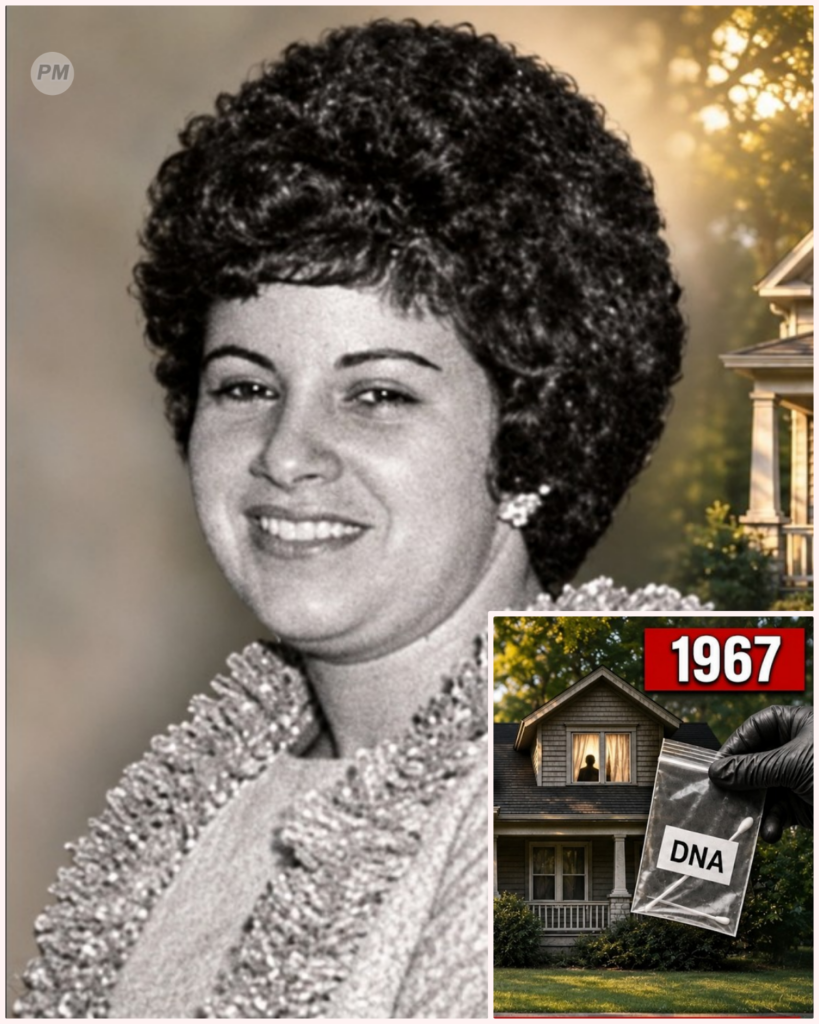
Something pale and still draped partly with a dark…
Something pale and still draped partly with a dark covering. They went down to investigate.
It wasn’t a mannequin. Nancy Vogel’s body was in the back of her own car.
She had been beaten. There was a black eye on the right side of her face, bruising on the back of her head.
Her hands had been bound in front of her with a thin cord. She had been strangled with a rope or tie.
And then there were the details that would haunt investigators for years and that revealed something deeply unsettling about whoever had done this.
NY’s clothes had been removed and folded neatly beneath her body on the back seat.
Not thrown, not torn off and discarded. Folded. An army blanket that had been on the floor of the car had been draped partially over her body.
Her shopping bags from Valley Fair were still in the vehicle, undisturbed. The car had been driven from Little Ferry across the river into a residential neighborhood in Ridgefield Park and parked calmly on a quiet street as if it belonged there.
Whoever had done this was not panicked. They had not dumped the car in a ditch or abandoned it on a highway shoulder.
They had taken the time to position it neatly, deliberately, in a place where it might sit undiscovered for days.
Then they walked away. And for 43 years, that is exactly where the trail ended.
The case landed on the desk of Bergen County prosecutor Guy Kalesi. He was one of the most experienced prosecutors in New Jersey at the time, and the evidence told him something immediately.
Nancy Vogle knew her killer. Kalissi said as much publicly. The folded clothing, the way the body had been arranged, the signs that Nancy had been in the car willingly, at least initially, before the violence began, everything pointed towards someone she had interacted with voluntarily, someone she recognized, or at the very least, someone she had no reason to fear.
This was not a stranger ambush in a dark parking lot. This was someone from NY’s world.
That assessment turned out to be exactly right. Nancy and Richard Cottingham lived in the same small burrow of Little Ferry.
They likely recognized each other the way everyone in a town that small recognizes everyone else.
Investigators in 2010 would later confirm that they believed Cottingham and Vogle knew each other, though the precise nature and depth of that familiarity was never fully established.
But in 1967, being right about the general profile of the killer was essentially useless without the tools to narrow it down to a specific person.
Think about what investigators did not have. No DNA testing. The forensic science of extracting and matching genetic material from crime scenes would not exist in any usable form for another 20 years.
No surveillance cameras at Valley Fair or along Brinkerhoff Street or at any point along NY’s route that night.
No cell phone records because cell phones would not be invented for another 16 years.
No digital trail of any kind. No credit card transaction history beyond the physical receipts found in the car.
No automatic license plate readers. No social media. No email. Nothing that a modern investigation would take for granted in its first hour.
What they had was shoe leather and instinct. Detectives went door to door. They interviewed NY’s friends, her family, the regulars at the bingo hall, the employees at Valley Fair.
They checked alibis. They looked at known offenders in the area. They ran down every lead and every tip that came in.
They did everything the technology and methodology of 1967 allowed them to do, and none of it pointed to a quiet, recently arrived 21-year-old named Richard Codingham, who happened to live in the same small town.
He had no criminal record, no complaints lodged against him by neighbors or co-workers, no history of violence that was known to anyone.
He was, by every observable measure, unremarkable. And in a murder investigation that hinged on identifying a familiar face in a victim’s social orbit, being unremarkable was the most effective camouflage imaginable.
The investigation wound down, not with a press conference or a formal announcement, but with the slow, grinding reality of a case that had run out of places to go.
Leads dried up. Witnesses had nothing more to offer. The forensic evidence pointed to a known attacker, but could not name him.
There was no dramatic moment where a senior detective declared the case cold. It just happened.
The calls slowed. The interviews stopped producing new information. Other cases demanded attention because Bergen County didn’t stop producing crime while detectives worked the Vogle file.
Eventually, the folder was placed in the unsolved records at the Bergen County Prosecutor’s Office in Hackinack, filed alongside the other cases that had outlasted the effort to solve them.
And there it sat. The years passed and they passed cruy. NY’s children, William and Karen, grew up without their mother.
They were toddlers when she died. They would have had only fragments of memory at best, impressions more than images, the echo of a voice they couldn’t quite place.
They started school, made friends, celebrated birthdays, learned to ride bikes, had their hearts broken for the first time, and they did all of it carrying the knowledge that their mother had been taken from them.
And nobody could explain why or by whom. Every milestone that should have had a mother present didn’t.
Every question about her went unanswered or was answered only with the kind of vague reassurance that adults offer children when the truth is too heavy to hand over.
Her husband Henry carried the weight of it differently. He knew what the investigators had found.
He knew the condition his wife’s body was in. He knew what the prosecutor believed.
And he lived the rest of his life knowing that the man who had done that to Nancy was still out there somewhere unnamed and unpunished.
And NY’s mother, Carmela Skiava, kept living in Little Ferry, kept getting older, kept wondering who had killed her daughter and why.
A mother who has buried a child and doesn’t know who is responsible carries a specific kind of grief.
It doesn’t settle. It doesn’t fade into the background the way normal loss eventually does.
It sits in the chest sharp and persistent because the wound was never closed. Carmemella asked.
She waited. She hoped. The answer never came. Meanwhile, 4 miles from the courthouse where NY’s file gathered dust.
The man who had strangled her was building what looked like a perfectly ordinary life.
And behind that ordinary life, he was becoming something that no one in Little Ferry could have imagined.
Richard Francis Cotttingham was born on November 25th, 1946 in the M Haven section of the Bronx, New York City.
His father was an executive at Metropolitan Life Insurance, a white collar professional who provided the family with a comfortable, stable upbringing.
When Cottingham was still a toddler, the family moved out of the Bronx to Dumont, New Jersey, and then a few years later to Rivervale, settling into the quiet, treelined Bergen County suburbs that were filling up with young families in the post-war boom.
Codingham graduated from Pascac Valley High School in Hillsdale, New Jersey in 1964. He ran cross country and track.
Yearbook photos show an unremarkable teenager with an unremarkable expression. Classmates who were later asked to remember him struggled to recall anything specific.
He wasn’t the class clown or the bully or the loner everyone whispered about. He was the kid who blended into the background.
The one you might nod to in the hallway without ever learning his name. After graduation, he worked briefly at Metropolitan Life, following his father’s footsteps into the insurance world.
Then in October 1966, he took a job as a computer operator on the night shift at Blue Cross Blue Shield of Greater New York in Manhattan.
He was 19 years old, commuting from New Jersey, e into Midtown, working overnight in a largely empty office building while the city operated on a different frequency outside the windows.
That night shift was important. It would define the architecture of Cottingham’s double life for the next 14 years.
During the day, he lived in Bergen County. At night, he traveled into Manhattan and occupied a different world entirely.
Time Square in the late 1960s and 1970s was not the sanitized tourist destination it would later become.
It was a warren of peep shows, adult theaters, cheap bars, and transient motel. The people who moved through that ecosystem after midnight were often vulnerable, often invisible, and often the last people anyone would notice if they disappeared.
By 1967, Cottingham was living in Little Ferry, the same small burrow where Nancy Vogle lived with her husband and children at 63 Bertilada Avenue, walking the same streets, shopping at the same stores, passing the same houses.
Nancy Vogel’s murder that October was his earliest confirmed killing. He was 20 years old, turning 21 the following month.
And according to his later confessions, it may not have been his first act of violence, only the first one that ended in death.
After killing Nancy, nothing in Cottingham’s outward life changed. Not that year, and not for a long time afterward.
In 1970, he married a woman named Janet. They had three children together and moved to Loi, New Jersey, another small Bergen County town a few miles from Little Ferry.
