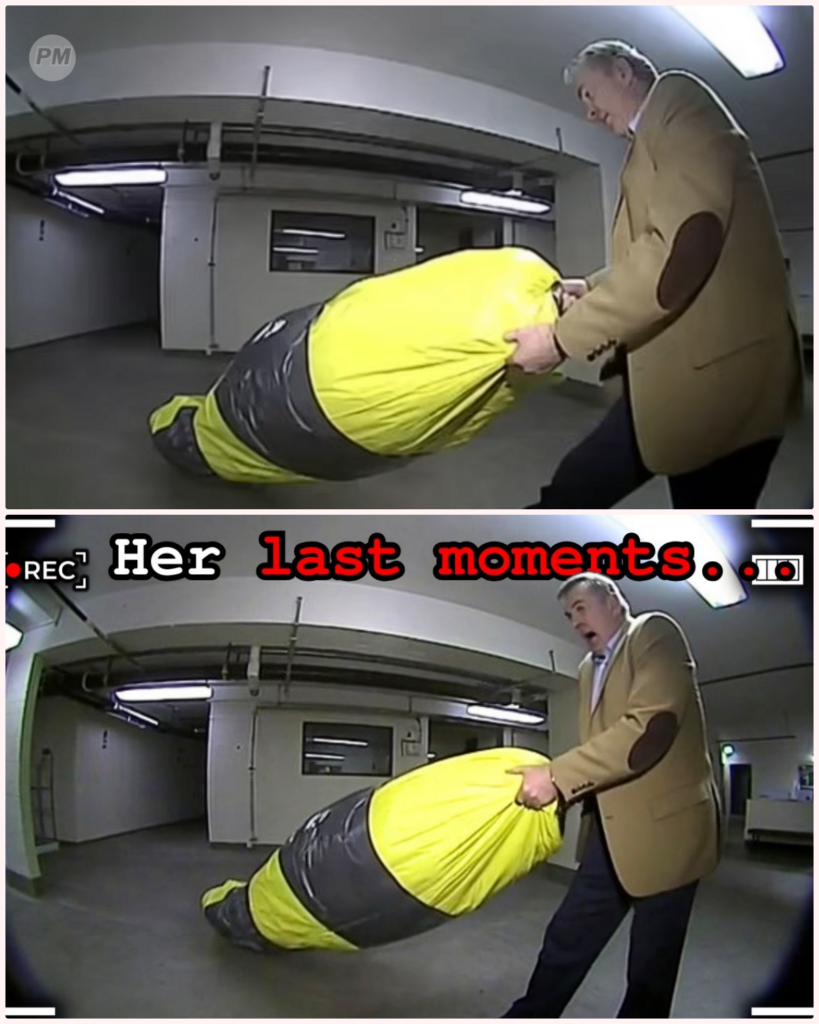
The figure was Malcolm Nightshade
The figure was Malcolm Nightshade. Robert rewound the footage. He watched it again. Malcolm dragged the bundle from the storage area toward the garage.
The bundle was the size of a person. Robert’s stomach turned. He picked up the phone.
He called the police. Detective Laura Briggs arrived at the school at 9:15 a.m. Robert showed her the footage.
She watched it twice. She did not speak. She picked up her radio. She called for backup.
Officers arrived at 9:30 a.m. They went to the basement parking garage. They found Malcolm’s car, a black SUV.
They approached the trunk. They opened it. Inside, Lila Sinclair, wrapped in plastic, dead. Officers went to Malcolm’s office.
He was at his desk, preparing for a meeting with parents. He looked up when they entered.
He saw their expressions. He knew. He did not resist. He did not speak. He stood up.
He put his hands behind his back. They arrested him. Lila’s mother was notified at 11:00 a.m.
She collapsed when she heard. She had spent 32 days hoping, praying, believing her daughter would come home.
Now, she knew the truth. Malcolm Nightshade was charged with kidnapping, false imprisonment, and first-degree murder.
The trial began in March 2017. It lasted 2 weeks. The prosecution presented the security footage.
The jury watched Malcolm drag Lila’s body down the corridor. They saw the struggle, the effort, the intent.
The defense argued that Lila’s death was not intentional, that Malcolm had intended to hold her, not to kill her, that her death was the result of her own refusal to eat, not his actions.
The jury did not believe him. Forensic evidence showed that Lila had been restrained for weeks.
She had bruises on her wrists and ankles, marks on her throat, evidence of repeated trauma.
She had not died from starvation alone. She had died from the cumulative effects of torture, malnutrition, and psychological trauma.
Malcolm was convicted on all charges. He was sentenced to life in prison without the possibility of parole.
He showed no emotion when the verdict was read. He did not apologize. He did not look at Lila’s mother.
He simply stared ahead, empty. Cases like this force us to confront an uncomfortable reality.
We trust people based on their titles, their positions, their reputations. Malcolm Nightshade was a principal, a principal of the year, a man parents trusted with their children.
And for 32 days, he held a woman captive in the basement of the school where he worked.
No one suspected him. No one questioned him. Because he was exactly the kind of person we are taught to trust.
This is why vigilance matters. This is why we must teach people, especially young people, to recognize when something feels wrong, even when that feeling involves someone in authority.
Lila Sinclair trusted Malcolm because she thought she knew him. But we never truly know anyone, not completely.
And that is the lesson that costs lives. Lila Sinclair was buried on October 18th, 2016.
Her mother stood at the grave. She had waited 32 days Now, she had them.
But the answers did not bring her daughter back. Washington High School installed additional security cameras throughout the building.
The basement was sealed. The storage rooms were emptied. The East Wing renovations were completed.
The building moved on. But the people did not. Teachers who had worked with Malcolm for years questioned how they had not seen it, how they had not known.
Parents who had trusted him with their children felt betrayed. Students who had admired him felt sick.
The community learned a lesson, that trust is not the same as safety, that authority does not equal virtue, that predators do not announce themselves.
They hide. They wait. They use the systems designed to protect us to commit the very crimes we fear most.
Malcolm Nightshade is in prison. He will die there. He has never expressed remorse. He has never explained why.
He simply exists. A reminder that evil does not always look like evil. Sometimes, it looks like a teacher, a mentor, a man who wins awards and earns respect.
And sometimes, it hides in the basement of a high school, waiting for someone to trust it.
The case of Lila Sinclair is closed. But in Gary, Indiana, people still talk about it, about the principal who won principal of the year, about the woman who came back to thank him, and about the security camera that finally showed the truth.
