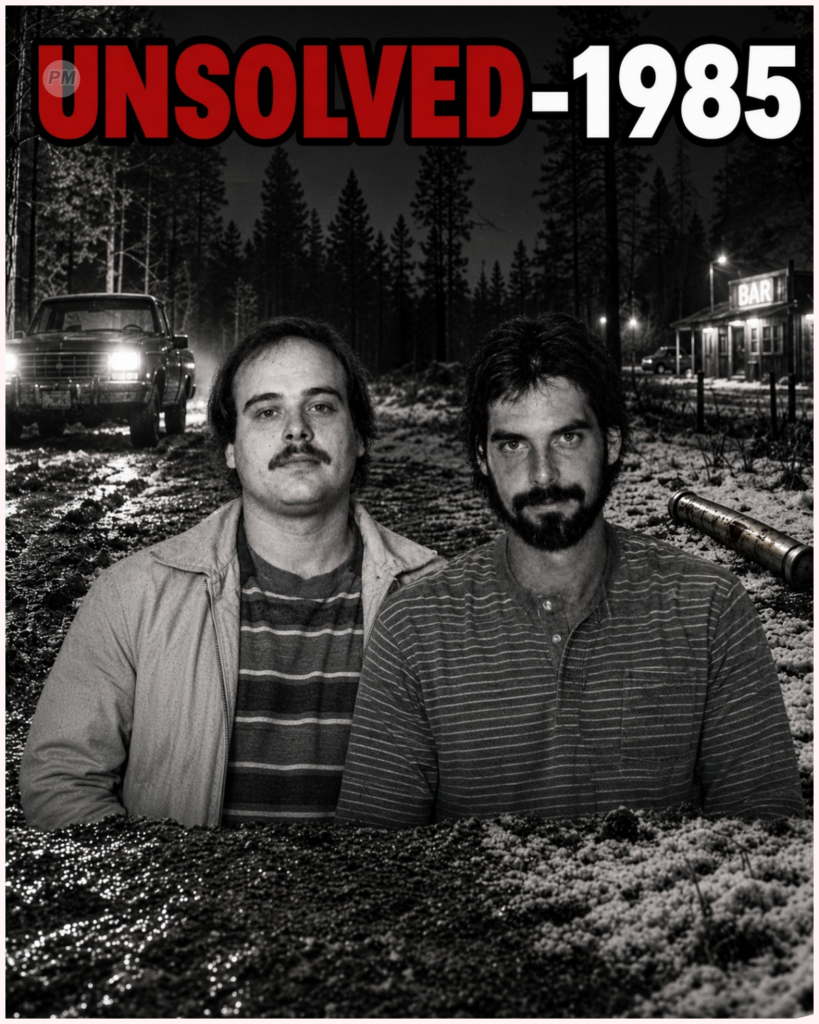
A 27-year-old man saving money to propose to his g…
A 27-year-old man saving money to propose to his girlfriend, so terrified he lost control of his body.
And the killers laughed in his face. Then they beat him to death. The same baseball bat, the same fists, [music] the same feet, until both bodies lay motionless on the cold ground.
A few minutes after Boudreaux and Emery climbed back into the house through the bathroom window.
>> [music] >> There was a knock at the door. Boudreaux opened it. Coco Duval stood there.
And he said [music] one sentence that Boudreaux would hear echoing in her head for the next 18 years.
You didn’t see anything. Pigs have to eat, too. That was not a vague threat.
That [music] was an explanation where the bodies would go. The Duval brothers later told many people on many different occasions that they had cut up the two hunters, run them through a wood chipper, and fed them to their vicious pigs.
Tiles Black 1980 Ford Bronco was [music] taken to scrapyards the Duval brothers owned or frequented and taken apart piece by [music] piece, disappearing forever, just like its owner.
Neither the bodies nor the vehicle were ever [music] found. Not one bone fragment, not one drop of blood, not one piece of metal.
If the story about the pigs was true, there was nothing to find. >> [music] >> And the Duval brothers knew that.
That is why they dared to brag. That is why they did not [music] need to hide it.
Because even if everyone knew, no one could prove anything. No bodies, no physical evidence, no murder weapon.
Word against word, and who would believe a drunk in a bar over two men the whole town was afraid to look in the eye?
And so time [music] passed. Months became years. Years became a decade. The Duval brothers lived free, [music] moving through the community, drinking in the bars where they had killed, and once a year, or more [music] often, they stopped by Barbara Boudreaux’s house to remind her to keep her mouth shut.
They mentioned her pretty niece, the tone gentle, but the meaning not gentle at all.
One of Boudreaux’s dogs was shot dead. Another was run over right in the front yard, the vehicle deliberately leaving the road to hit the animal.
By the mid-1990s, the disappearance of David Tile and Brian O’Gion was dead. The case file sat in a cabinet, covered in dust, opened by no one.
The original investigators had retired or transferred. [music] The leads had run dry. Every November, the Tile and O’Gion families still appeared in front of cameras, still put out appeals, still asked [music] the same question they had been asking for more than 10 years.
If someone knows something, please speak [music] up. And every November, the answer was still silence.
The state of Michigan was betting that time would do what the justice system had failed to do, that the families would accept it, that the case would fade from public memory, that the Duval brothers would die as free men, and that whole dark chapter would close itself.
They did not know about Robert Lesneski. Michigan State Police Detective Robert Lesneski, nicknamed Bronco, inherited the cold case in the late 1990s, >> [music] >> more than 15 years after Tile and O’Gion disappeared.
The case came to him not because someone believed it could be solved. It came to him because it had to sit on someone’s desk, and Bronco was the one who got it.
>> [music] >> But Bronco was not the kind of detective who takes a file and files it in a cabinet waiting for retirement.
He was the kind of person who, once he picked something up, could not put it down.
He started reading, thousands of pages of files, hundreds of reports, dozens of statements, all piled in disorganized boxes that had not been properly organized for more than a decade.
He read every page. He recoded every document. He reorganized the whole chaotic pile of paper into a system he could work with.
And the more he read, the more he was pulled in. The case haunted him.
Bronco worked [music] hundreds of hours off the clock, unpaid, asked by no one. He re-interviewed old witnesses, people who had talked to investigators 10, 12, 15 years earlier.
Some remembered more than they thought. Some remembered less than they claimed, but Bronco wrote it all down, compared it with the old files, looking for contradictions, gaps, things that did not match.
He always carried a shovel in the trunk of his car, not because someone told him to, but because every time he drove the forest roads around Mio and saw a piece of metal sticking out of the ground, he stopped and dug.
It might be trash. It might be scrap from an old car, but it might also be part of the black Ford Bronco that had vanished 15 years earlier.
He never found it, but he never stopped looking. New tips still trickled in now and then, and Bronco chased every one.
Most led to dead ends, like the hundreds of tips before them, but one tip changed everything.
A woman contacted Bronco and said she knew another woman she believed knew something about the disappearance of the two hunters.
That woman lived near a bar in Luzerne, where Till and Ongjin had been seen playing pool and teasing the servers on the night they disappeared.
[music] Her name was Barb Boudreau. Bronco had no address, >> [music] >> no phone number, only a name and a general area near the bar, so he started knocking on doors.
Every day after his shift, after dark, Bronco drove without a badge to the area around Linker’s Lounge and knocked on every house.
>> [music] >> Hi, I’m Detective Lesneski from the Michigan State Police. I’m looking for a woman named Barb Boudreau.
Do you know where she lives? >> [music] >> No, sorry to bother you. Then the next house, then the next, then the next, day after day.
This lead seemed headed for a dead end like the hundreds before [music] it. But Bronco was not the kind of person who left a lead unfollowed to the end.
One more door, then one more door, and one more door as the light was fading.
