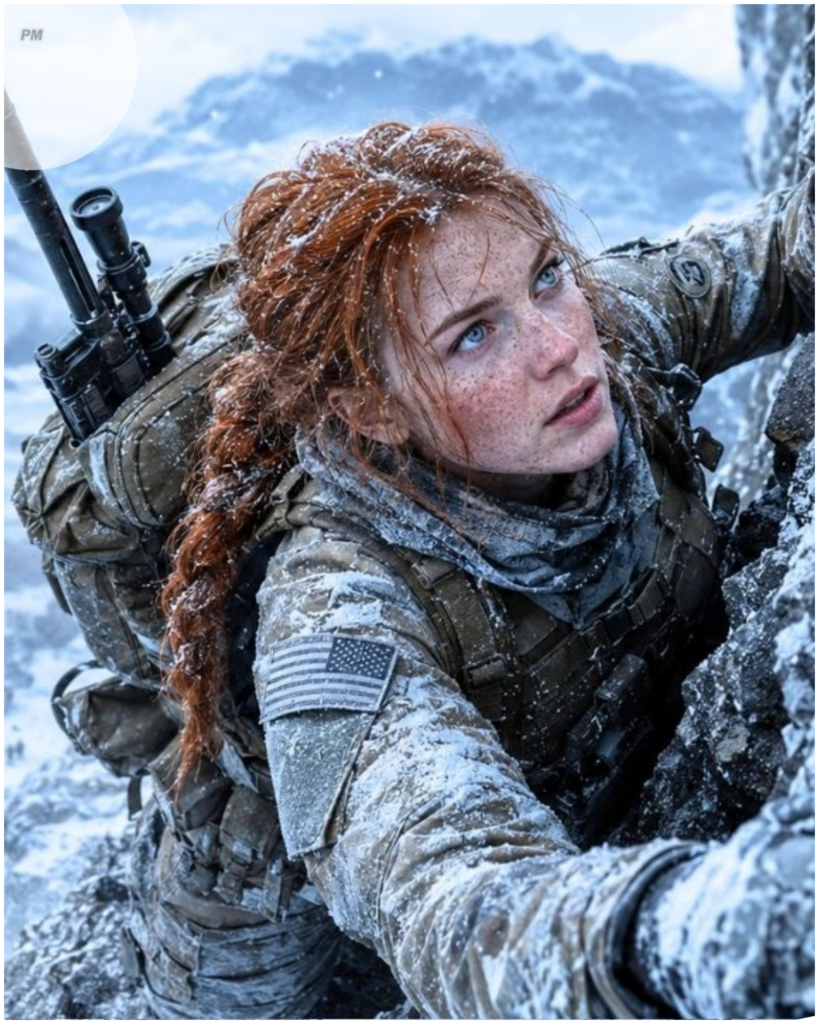
"They know who I am," she said
“They know who I am,” she said. “They know what you did,” Foster corrected, though his voice carried little comfort.
“Five confirmed eliminations at extreme range in the middle of a coordinated ambush that was supposed to succeed without resistance.
Whoever’s running this network just watched their demonstration fail spectacularly because of one sniper they didn’t account for.
That message isn’t a threat, Ava. It’s worse. It’s a business decision. They’re not planning to retaliate out of anger.
They’re recalculating. Recalculating what? Foster met her eyes and the grim certainty in his expression told her the answer before he spoke it aloud.
Whether you’re a problem to eliminate, he said, or an asset worth acquiring, the words hung in the tent’s stale morning air like smoke that refused to clear.
Ava had faced threats before more times than she could count more times than the sanitized version of her service record would ever reveal.
But there was something uniquely unsettling about being evaluated. Wade considered for value by an enemy who saw her not as a soldier to be defeated, but as a resource to be assessed.
The way a buyer inspects a piece of equipment before deciding whether it’s worth the asking price.
“Let them try,” Ava said. And there was iron in her voice now, cold and absolute.
“That’s exactly what worries me,” Foster said. “Because organizations that think this way, that talk about assets and elevated priority instead of enemies and casualties.
They don’t operate like the fighters we’re used to facing out here. They’re patient. They’re resourced.
And they don’t give up just because their first attempt failed.” A runner ducked into the tent before Ava could respond, breathless, his young face pale with the particular urgency of someone delivering news he didn’t fully understand, but knew was important.
“Captain, sir, signals just intercepted something. They said you’d want it immediately.” Foster took the printed transcript from the runner’s shaking hand and read it in silence, his expression shifting from tension into something closer to alarm.
“What is it?” Ava said. “It wasn’t a question. Movement, Foster said. Reconnaissance flights picked up vehicle activity approximately 11 km northeast of our position, moving toward us, currently paused, just outside detection range of our standard patrol routes.
He looked up at her. Six vehicles, organized formation, moving with a discipline that doesn’t match typical insurgent activity in this region.
Ava was already on her feet, her mind snapping into the same crystalline focus that had carried her through the ambush the previous day.
How long until they could reach the base? If they’re planning a direct assault, two hours, maybe less.
And if they’re not planning a direct assault, Fosters’s jaw tighten, then I don’t know what they’re planning.
And that scares me more. Outside the command tent, the base was beginning to stir with the particular tension of soldiers who could sense, even without official announcement, that something dangerous was approaching.
Ava found Ethan near the ammunition depot, already moving with purpose, distributing extra magazines to Marines who were checking their weapons with the grim efficiency of men who had buried friends only yesterday and had no intention of losing more today.
You heard, Ava said, falling into step beside him. Whole base heard within 10 minutes, Ethan said, not looking up from the crate he was unpacking.
Foster doesn’t waste time keeping secrets when lives are on the line. He paused, glancing sideways at her.
You think it’s them? The people behind the ambush. I think Ava said carefully that whoever ordered yesterday’s ambush just found out it failed because of me specifically and now there’s a formation of vehicles heading this direction that doesn’t move like the insurgents we usually deal with.
I don’t believe in coincidences that convenient. Ethan’s handstilled on the ammunition crate. So what do we do?
We stop reacting, Ava said, and we start anticipating. Where’s Foster planning to position defensive lines?
Standard perimeter reinforcement. Why? Because standard isn’t going to be enough. Ava said already turning toward the command tent, her mind racing through terrain, angles, choke points, everything she’d cataloged in her notebook since the very first morning she’d walk this base’s perimeter.
If this is the same network that planned the valley ambush with that level of precision, they’re not going to throw six vehicles at a fortified position headon.
That’s not how patient people operate. There’s something else happening that we’re not seeing yet.
She found Foster hunched over the terrain map exactly where she expected him already deep in the calculations of defensive strategy.
I need to say something, Ava said. And I need you to actually consider it instead of dismissing [clears throat] it as instinct without evidence because that instinct has been right every single time since I arrived on this base.
Foster looked up and something in his expression told her he had already learned that lesson thoroughly enough not to need reminding.
Talk. Six vehicles moving in disciplined formation pausing just outside our detection range, Ava said, tapping the map.
That’s not an assault force preparing to charge a fortified position. That’s a demonstration force or a diversion.
Diversion from what? That’s what worries me, Ava said. Because I don’t know yet. But if I were running this operation and my last attempt to disrupt this base failed because a single sniper dismantled five prepared positions in under 10 minutes, I wouldn’t send my next wave in for a repeat performance against an enemy who’s already proven capable of that.
I’d use the visible threat to draw attention and resources toward the front while the real move happened somewhere else entirely.
Foster’s eyes moved across the map, tracing the base’s perimeter, the supply routes, the vulnerable points Ava had documented over her days of quiet reconnaissance.
Somewhere else, like where Ava’s finger moved to a spot on the map that made her blood run cold the moment she considered it, the detention area where Briggs is being held.
Foster went very still. You think they’re coming for him? I think Ava said that a man who sold information for money is worth far more to this network dead and silent than alive in talking to counter intelligence officers.
Especially now that they know we’ve identified him, arrested him, and started pulling threads from his phone that already led us to two more compromised assets at other bases.
If Briggs starts naming names under formal interrogation, this network’s entire operation across multiple locations could unravel.
That’s not a risk they can afford to take. The full weight of what she was suggesting settled over the tent like a physical pressure.
Foster grabbed his radio immediately barking orders to reinforce the detention area. But even as the words left his mouth, Ava was already moving her instincts, screaming that whatever was about to happen, it was happening faster than anyone anticipated.
She reached the detention area just as the first explosion tore through the perimeter fence 200 m to the west.
A diversionary charge that sent Marines scrambling toward the brereech exactly as Ava had feared, drawing eyes and rifles away from the smaller, quieter structure where Briggs sat under guard.
“Eyes on the detention tent!” Ava shouted, sprinting the final distance, her rifle already coming off her shoulder.
“This is the diversion. This is the diversion. Do not pull the detention guards.” But confusion was already spreading through the camp.
Radios crackling with conflicting reports. Marines torn between the explosion at the western fence and the urgent warning coming from a sergeant who despite everything she’d proven over the past two days was still fighting the base’s ingrained instinct to respond to the loudest threat rather than the smartest one.
Ava reached the detention tent to find two guards still in position. Weapons raised scanning the darkness beyond their small perimeter of light with the tense alertness of men who understood even without her warning fully reaching them that something was wrong.
Anyone approach? Ava asked breathless. Negative, Sergeant. But the guard’s sentence died in his throat as a suppressed round took him in the shoulder, spinning him backward before he even registered the muzzle flash from the darkness beyond the tent line.
Ava was moving before he hit the ground, dragging him back behind cover as the second guard opened fire blindly into the shadows.
Hold your fire. Identify your target. Ava snaps, scanning the darkness through her scope with the same predatory calm that had carried her through the valley ambush, refusing to let panic dictate her actions, even as adrenaline screamed through her veins.
There, a shape low and fast, moving between two supply crates 30 m out, clearly trained, clearly professional, nothing like the disorganized insurgent fighters this base typically dealt with.
Ava fired once and the shape dropped and didn’t move again. Contact 30 meters southwest of the detention tent.
She called into her radio, already swinging her rifle toward a second point of movement she’d caught at the edge of her peripheral vision.
Multiple hostiles. This is not the diversion repeat. The real assault is on the detention area.
Inside the tent, she could hear Briggs shouting, panicked, pulling against restraints that suddenly represented not safety, but a death sentence if the men coming for him succeeded.
Ava fired again, catching a second shape as it broke from cover. And for a moment, the assault seemed to hesitate.
Whoever remained recalculating in the face of resistance, they hadn’t expected to encounter this quickly.
Then Ethan arrived breathless, three Marines behind him, having finally cut through the confused chaos of radio chatter to understand where the real threat lay.
Perimeter secure at the fence. That explosion was a diversion, just like you said. Ethan gasped, dropping into cover beside her.
Fosters’s rerouting everyone back this direction now. Too slow, Ava muttered, tracking movement through her scope.
They’re already inside the wire. A third shape emerged from the darkness, moving with terrifying speed directly toward the detention tents entrance.
And Ava understood in that instant that this man wasn’t trying to extract Briggs. He was trying to silence him permanently before reinforcements could arrive.
She fired, catching him midstride, and he collapsed just 3 m from the tent flap.
Close enough that Ava could hear Briggs’s terrified sobbing through the canvas wall. For a long, suspended moment, the darkness beyond the tent went silent.
“Status!” Ava called out, not lowering her rifle, every instinct, still screaming that this wasn’t over.
“No further movement.” One of the Marines reported sweeping the perimeter with a handheld light.
Foster arrived moments later with a full response team, his face carved from stone as he took in the scene.
The three fallen attackers, the wounded guard being tended by a medic. Ava still crouched in firing position, scanning the darkness for a threat that had for the moment retreated.
Report, he said. Three hostiles down professional operators, not local insurgents, Ava said, finally lowering her rifle.
The explosion at the fence was exactly what I feared. A diversion to pull our attention while a dedicated team came for Briggs.
Fosters’s jaw tightened as he looked toward the detention tent where Briggs’s terrified sobbing had finally quieted into shaking, disbelieving silence.
They tried to kill their own source rather than risk him talking. “That confirms everything,” Ava said.
“This isn’t a loose network of opportunists. This is an organized operation with resources, discipline, and the willingness to eliminate their own people the moment those people become liabilities.”
Briggs isn’t just a suspect anymore. He’s a witness who almost got murdered for what he knows.
Inside the tent, when Aba finally entered to check on him, Briggs was shaking so violently he could barely speak.
His face streaked with tears, the reality of what had almost happened, finally completely shattering whatever composure he’d managed to hold on to since his arrest.
“They tried to kill me,” he said, his voice cracking. “My own people, the ones I was working for, they sent men to kill me.”
Yes, Ava said, simply sitting across from him, offering no false comfort, because false comfort wasn’t what this moment required.
Why? Briggs asked. And there was genuine broken confusion in his voice. The particular bewilderment of a man realizing too late that the people he trusted with his loyalty had never valued him as anything more than a disposable tool.
Because you became a risk the moment we arrested you, Ava said. Everything you know, every name, every detail about how you were recruited, how payments were made, what you were told about their operations, all of that became a liability the second you sat down in an interrogation tent.
They didn’t send men to rescue you, Briggs. They sent men to make sure you never talk.
Briggs stared at her, and something in his expression shifted the last fragile illusion he’d been clinging to, finally collapsing entirely.
I thought maybe I don’t know what I thought that they still needed me that there was some kind of loyalty.
There’s no loyalty in what you were part of. Ava said only utility. You stop being useful to them and now you’re a liability and liabilities get eliminated.
That’s the entire philosophy of the people you were selling secrets to. Do you understand that now?
Briggs nodded slowly, tears still tracking down his face. And for the first time since his arrest, something in his posture shifted from fear into something closer to resolve.
Then I want to tell you everything, he said. Not because I’m scared, though God knows I am.
[clears throat] Because I want them to lose. I want whatever they’re planning to fail completely.
If that’s the only thing I can still do right in this entire mess, then I want to do it.
Ava studied him for a long moment, weighing the sincerity in his broken voice against the memory of the man who had mocked her mercilessly just days before, and found somewhat to her own surprise that she believed him.
“Then start talking,” she said. “Everything, every detail, no matter how small it seems.” Over the following hour, Briggs poured out details with the desperate thorowness of a man trying to purchase some measure of redemption through information.
Names he’d heard in passing, descriptions of meeting locations, details about how payments had been transferred through a network of intermediaries designed to obscure the ultimate source of the money, and near the end, a detail that made Ava’s blood run cold with sudden terrible clarity.
He mentioned once, Briggs said that this whole operation, the network across multiple bases, wasn’t really about disrupting supply lines or gathering intelligence for its own sake.
He said it was building towards something bigger. A single operation coordinated across every base they’d compromised, planned for a specific date.
He never told me. He called it, and I remember this exactly because it stuck with me.
He called it the convergence. Foster, who had entered partway through the confession and stood listening in tense silence, stepped forward, now his expression grim.
Did he give any indication of timing, any date, any window? Briggs shook his head only that it was close, weeks, not months.
He seemed eager, like something was accelerating faster than even he expected. Ava exchanged a look with Foster and in that shared glance passed the full terrible understanding of what they were now facing.
This wasn’t isolated sabotage anymore. This wasn’t even a regional network of compromised assets feeding information for money.
This was the early architecture of something coordinated, patient, and dangerously close to execution. Something that reached across multiple bases and had already proven willing to sacrifice five Marines as nothing more than a demonstration of capability.
We need to get this information up the chain immediately. Foster said, “Every base with a suspected compromise needs to be alerted, and we need to move faster than they expect.”
