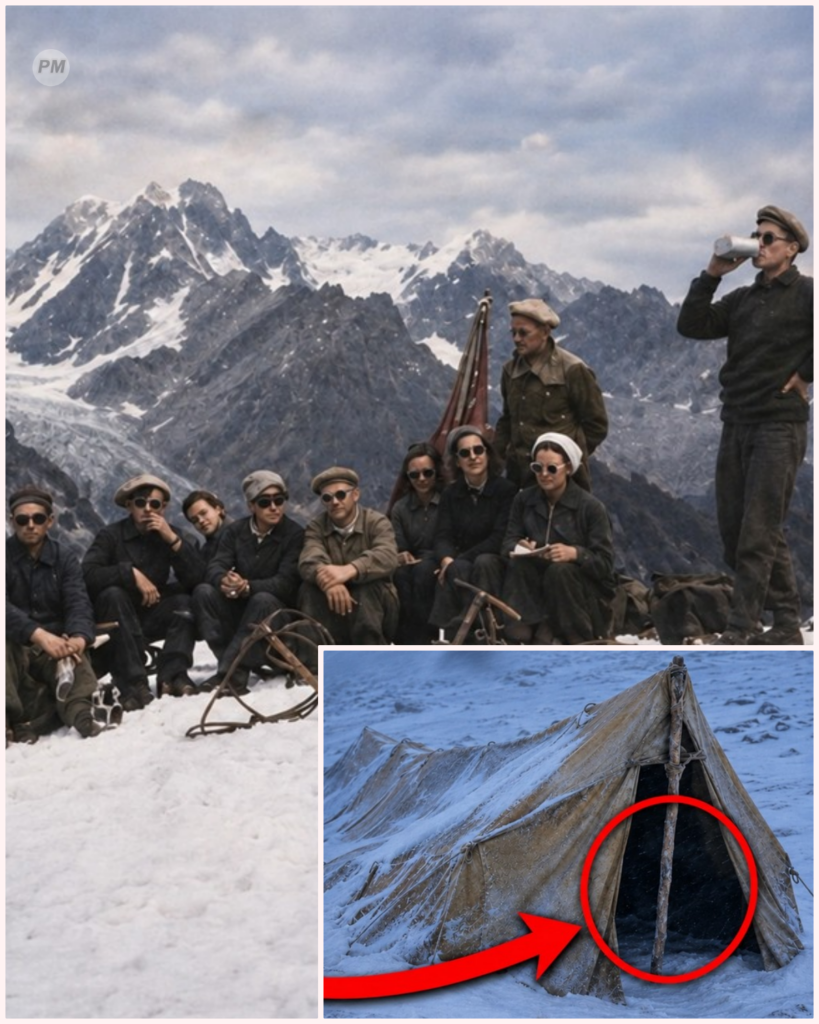
At first, they considered whether it might be a sh…
At first, they considered whether it might be a shadow rather than snow movement. Footage taken the following day showed the feature still presented, making a passing cloud an unlikely explanation.
Even then, they didn’t treat the image as a definitive answer. Specialists disagree about the exact kind of instability with a valid resolution.
Their uncertainty led to a further expedition rather than a stronger claim than the picture could support.
In January 2022, guides Oleg Demanenko and Dmitry Borisov traveled into the area. They documented traces of two slab avalanches on the eastern slope less than 3 kilometers from the old camp.
The researchers reported that one small avalanche became difficult to see within about an hour of wind transported snow covering it.
The finding directly challenged the claim that avalanches didn’t happen nearby. It also demonstrated how quickly some traces could disappear under the conditions observed.
But make the lack of dramatic scar weeks after the original incident less decisive than it might first appear.
But the nearby avalanche is still nearby, and a model winter is still a modern winter.
But 2022 observations didn’t replay the last night. Their value was narrower and stronger. They showed real terrain and real snow behavior compatible with key parts of a hypothesis previously dismissed as impossible.
The follow-up paper included an especially important comparison. Some conditions during the modern avalanches resemble those constructed for the Dyatlov incident.
Others were different. The newer slabs were softer, the slopes steeper, the lower edge hadn’t been cut in the same way, and the trigger was probably different.
Those differences are not a minor footnote. They prevent a useful observation from becoming an exaggerated conclusion.
The fieldwork established avalanche activity in the area and supported the presence of locally steep terrain.
It didn’t prove that the same mechanism occurred in the exact camp on February 1st, 1959.
The original model also has a defined scope. It can explore how the slab might release after a delay and whether its compact could matter.
It doesn’t reconstruct the hiker’s full behavior after leaving the tent. The hikers themselves made the boundary explicit.
That leaves us with several levels of confidence. The tent existed and was abandoned. Searchers found it and recorded its condition.
The forensic examiner identified cuts from the inside. A physics-based model shows how a particular snow instability could provide a trigger.
Later surveys and observations support important environmental assumptions. The complete sequence of human decisions remains unavailable.
