Their experience didn't make them immune to danger…
Their experience didn’t make them immune to danger, but it matters when interpreting the abandoned camp.
This wasn’t a group that had simply forgotten what shelter and warm clothing were for.
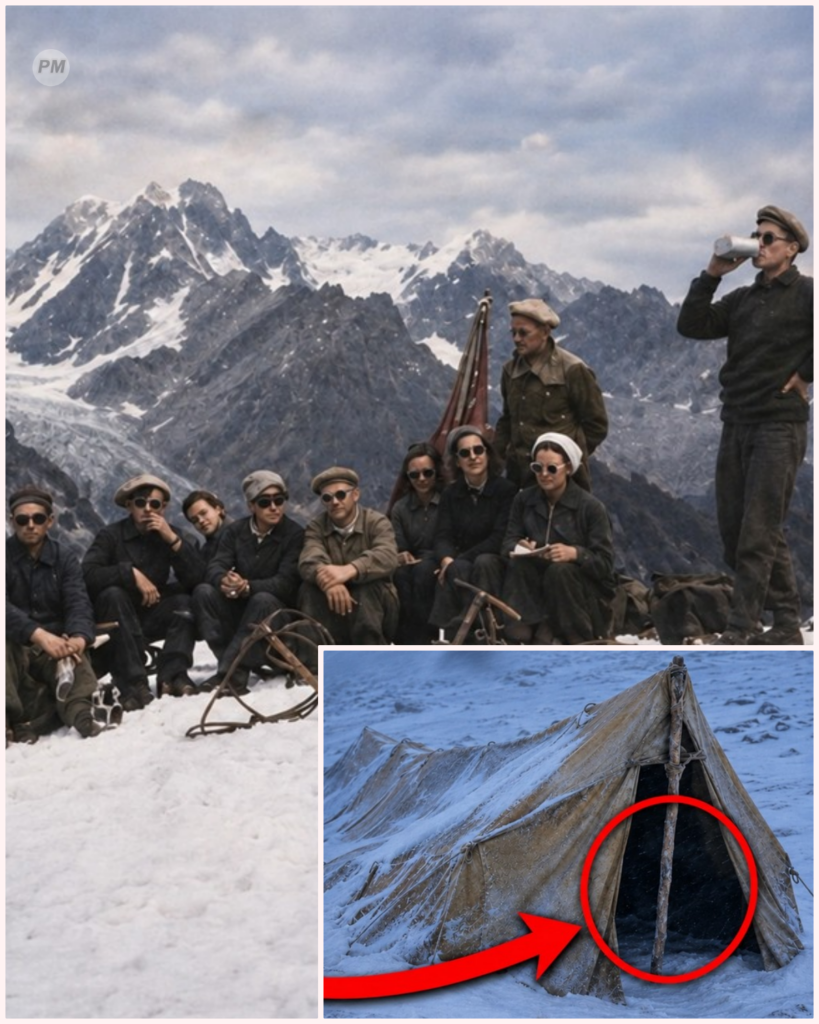
On February 26th, a search team found the tent. In his later testimony, searcher Boris Slobtsov described the entrance and visible and much of the structure beneath snow.
Inside were food and bedding. The camp hadn’t been packed away for the next day’s travel.
Slobtsov also described tracks below the tent, some visible because the surrounding snow had been removed by wind.
His testimony didn’t provide perfectly counted, uninterrupted trail for every member. It recorded observations made during a search after weeks of changing conditions.
The tent underwent a forensic examination. The expert distinguished tears from cuts and identified three cuts made from the inside.
That’s more specific than saying the whole tent had been slashed. The fabric contained different kinds of damage, and the report didn’t assign one cause to all of it.
Farther downhill, [music] the search found evidence of a fire near the forest. The hikers were located in separate groups and positions.
[music] They were the last four discovered under snow in May. None survived. The investigation recorded cold exposure and serious injuries.
The central question was why the group had left its shelter. Something had taken the group from a prepared camp into a much more vulnerable situation.
The surviving objects and locations offered fragments of the sequence. They didn’t preserve the words spoken inside the tent or identify the first person to notice danger.
It is tempting to fill those gaps with a shouted warning or a sudden collective panic.
We cannot know those things. We can instead examine the problem the group faced in physical terms.
If the tent became unsafe, leaving it could be an immediate response to one danger and while exposing the hikers to another.
The difficult question is what could have made the first danger urgent enough. A snow slab is one possibility.
To take it seriously, however, it must answer more than the simple observation that the camp stood on snow.
The first objection is visible in the landscape. The mountain side appears gentle. Even the slope was too shallow.
Why would snow release above the tent? The answer proposed by Gaume and Schweizer begins below the smooth surface.
Snow can cover irregular ground. A slope that looks moderate once seen across [music] a large distance may contain shorter, steeper sections.
