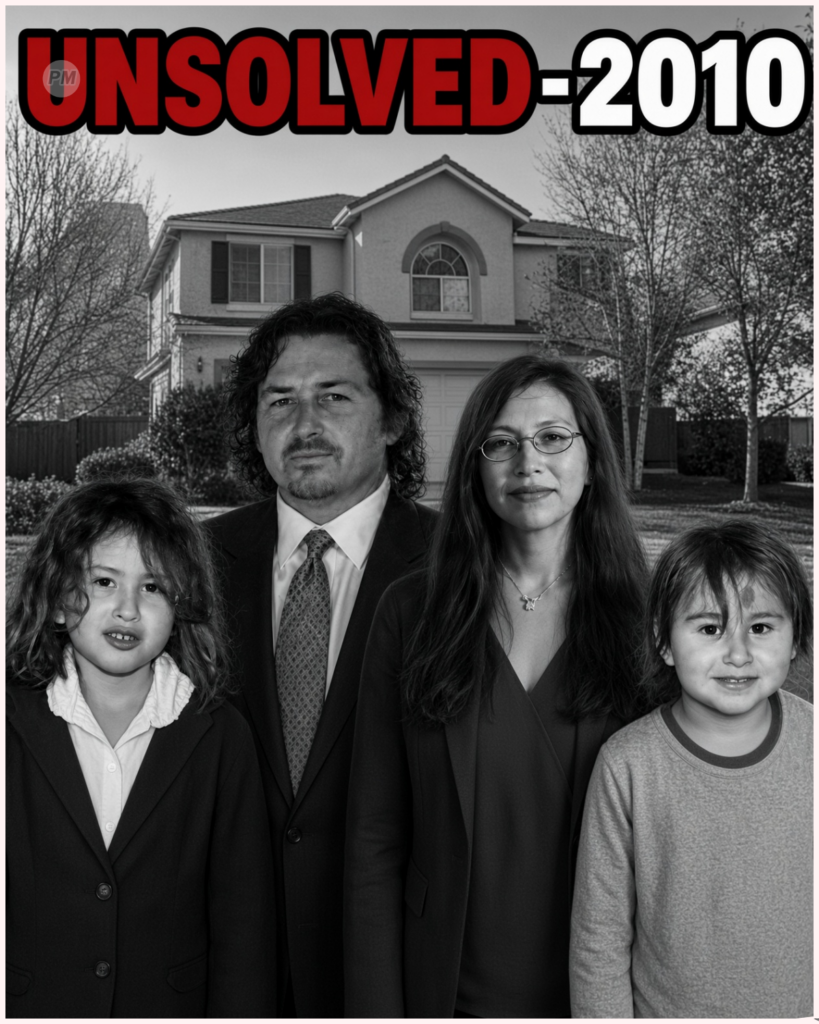
[music] with the car at the border, the video of f…
[music] with the car at the border, the video of four figures, and the computer search history.
The story assembled itself into a neat, dangerous picture. The Mday family had voluntarily gone to Mexico.
No crime, no victims, just a family that decided to leave without telling anyone. That was the conclusion the San Diego County Sheriff’s Department accepted.
That was the theory they announced to the media, and that was why they stopped looking.
But there was one person who did not accept that story. Patrick McE knew his son would never leave the dogs without a word, would never cut off contact with his father, would never take two small children to Mexico without any preparation.
Patrick looked at the evidence the police called compelling and saw something completely different. Someone had staged it all.
Someone wanted the world to believe the McE family had left and someone had succeeded.
The San Diego County Sheriff’s Department made a decision that would later be criticized as the most serious mistake in the entire case.
They concluded that the Mday family had voluntarily left the country. Not a crime, not a kidnapping, just a family choosing to disappear.
With that conclusion, the intensity of the investigation dropped sharply. The case was transferred to the FBI on the grounds that the agency had experience working abroad.
But in reality, the handoff was more like pushing a file to another desk than expanding the investigation.
The FBI chased hundreds of leads related to Mexico, checking airports, bus stations, hotels, tourist centers, all of them dead ends.
On February 23, 2010, detectives notified Interpol to search for the Mday family possibly in Mexico.
On February 25, flyers were distributed along the border. No results, no trace. The family of four seemed to have dissolved into thin air on the other side of the border.
And that was exactly what their killer wanted everyone to believe. While the justice system looked south, Patrick McE looked in every direction.
He had no badge, no authority, no investigative team. He was just a father looking for his son.
But Patrick had something the police lacked, an absolute refusal to accept the wrong answer.
He began investigating on his own. He obtained access to Joseph’s email and started reading every message, hundreds of emails, searching for anything unusual, any lead the police might have missed.
He called Joseph’s friends, colleagues, [music] customers, anyone who had been in contact with his son in the weeks before the disappearance, and he found things that kept him awake at night.
In November 2010, Patrick contacted detectives and reported suspicious activity by one of Joseph’s business partners.
He had found mismatched financial transactions, money moving in the company accounts that Joseph could not have approved if he was in Mexico without a phone or computer.
Patrick told police he believed someone was exploiting his son’s absence to drain money from the business.
Police noted it, then did nothing. The lead was filed under checked, no results, and along with hundreds of other leads, no one had the time or will to pursue fully.
Patrick Mday stood before the wall that every cold case victim’s family knows too well.
He had information. He had intuition. He had a persistence no investigative team could match.
But he had no power to make anyone listen. He later told CBS News that he had a list of three people he suspected might be involved in the family’s disappearance.
I was exhausted and had too much information on three potential suspects, he said. All of them had motive.
No one listened. Not yet. And while Patrick fought alone, the outside world began to forget.
The media moved on to other cases. The public lost interest. The blurry border video had given them a sufficiently satisfying answer.
The family went to Mexico, maybe started a new life, maybe had reasons no one knew.
People tend to accept the comfortable answer over the correct one. And the story of the family left voluntarily was far more comfortable than the alternative.
3 years passed. From [music] 2010 to 2013, the McStake case sat in the state investigators call cold.
No new leads, no new witnesses, no new developments. The file sat in a drawer.
Occasionally, a small article would mention the disappearance, usually on an anniversary, but nothing changed.
The Mday family became one of thousands of unsolved missing person’s cases across America. Names in a database, photos on a missing person’s website, and nothing more.
But Patrick did not forget. Michael did not forget. Susan Blake, Joseph’s mother, did not forget.
They lived every day with the hole left by four loved ones. And they lived every day with the question no one could answer.
Where are they? Then came November 11, 2013. An off-road motorcyclist was riding through the desolate desert near Victorville, California, about 100 m north of the McE home in Fbrook.
Victorville sits on the southwestern edge of the Mojave Desert, a dry, scorching landscape where people rarely set foot unless they have a reason.
And sometimes that reason is to bury something they don’t want found. The motorcyclist stopped when he saw something protruding from the sand.
Small, round, white. A skull. A small skull, the skull of a child. Investigators were called to the scene immediately.
As they began to dig, they found not one but two shallow graves, each containing multiple sets of remains, four in total, two adults and two children, buried in desert sand covered with rocks and dirt, only a few feet below the surface, shallow enough that time and wind had begun to [music] expose them.
And beside the remains, investigators found a three-lb sledgehammer buried in the dirt with them.
Not a knife, not a gun, a sledgehammer, the kind of tool you buy at a hardware store to break concrete.
