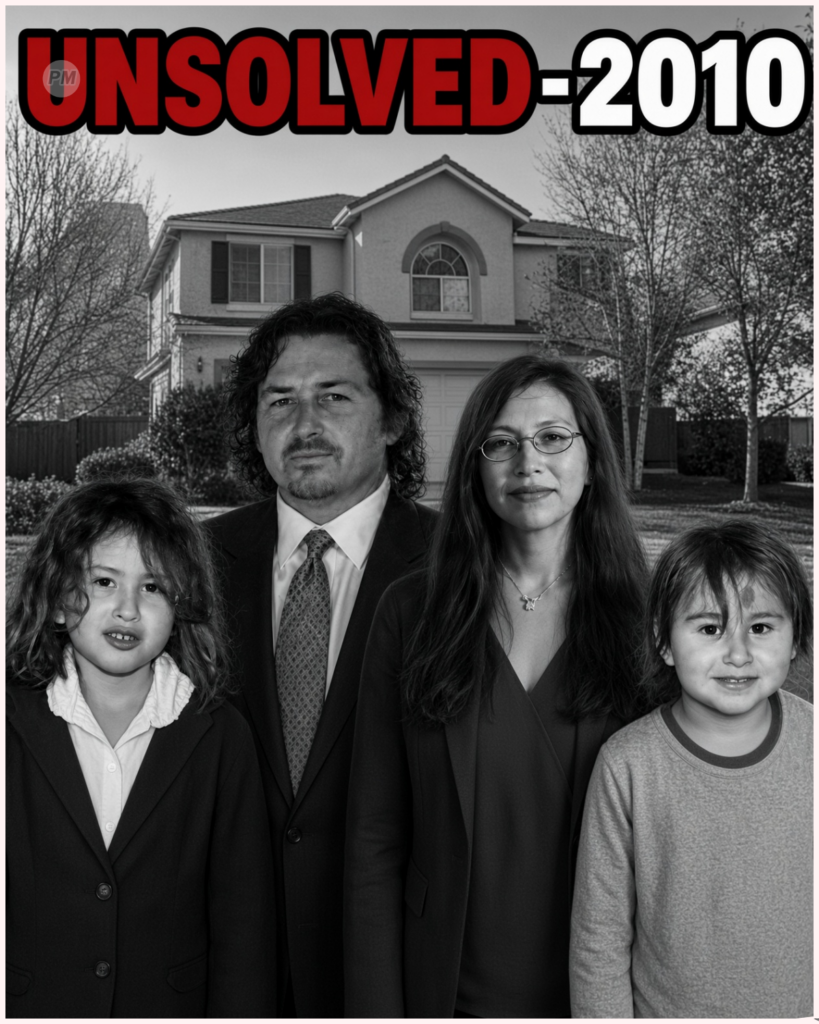
We developed the theory that if there was a meetin…
We developed the theory that if there was a meeting, it was a very quick termination, said a man who owed $43,000, addicted to gambling, about to lose his only source of income, and just caught stealing from his partner.
That was motive. And the next evidence showed Merritt not only had motive, he had opportunity.
Cell phone records showed Merritt’s phone pinging off towers near the desert area where the bodies were buried, just 2 days after the family disappeared.
His phone was in Victorville, not at his home in Homeland, not anywhere he had a reasonable reason to be, but in the desert near the exact spot where 3 years later a motorcyclist would find a small skull protruding from the sand.
And more. When investigators collected DNA samples from inside the Mday family’s Isuzu trooper, the car found near the Mexican border, they found Merritt’s DNA inside.
This directly contradicted Merritt’s own statement. In an interview with San Diego detectives in February 2010, Merritt had clearly said he had never driven that car, never sat in it, never touched it.
His DNA said otherwise. But perhaps the most shocking detail was not in the financial records or the phone data.
It was on television. In 2014, after the Mday family’s bodies had been found, but before anyone was arrested, Chase Merritt appeared on a cable news program.
He sat in front of the camera and expressed his grief over the loss of the Mday family.
He appeared worried, sad, full of sorrow. And then he said a sentence that investigators would replay dozens of times.
I’m sure I was the last person he saw. Merritt said about Joseph, not the last person he spoke with, not the last person he contacted, the last person he saw.
And he spoke about Joseph in the past tense. Not Joseph is, but Joseph was a small slip in language.
The kind of slip ordinary people don’t notice, but investigators are trained to hear. You only speak about someone in the past tense when you know for certain they are dead.
And at that point, no one yet knew for certain that the Mday family was dead, except the person who killed them.
Then came the detail that if you read it in a novel, you would say the author was making it up.
Chase Merritt was writing a book about the disappearance of the Mday family. The killer was writing a book about his victims and he called Patrick McDeay, Joseph’s father, the man who had spent four years searching for his son to propose collaborating.
He wanted me to read what he was writing, Patrick recalled. He started reading it to me.
He said, “Why don’t we collaborate on writing a book?” Patrick McAe said he played along in hopes of gathering information.
He hid his disgust, hid the suspicion boiling inside him, and listened to the man he increasingly believed had killed his son, read aloud a draft about the very murder.
Think [music] about that. A father sitting listening to the man who killed his son tell the story of the loss, pretending to grieve, pretending to search for the truth while the truth was sitting on the other end of the line.
That is not courage. That is the kind of self-control most people never have to test.
And that was when Patrick McAe knew the final pieces were falling into place. About a year ago, Patrick said, “The pieces started fitting together and Merritt climbed to the top of my radar list.”
In November 2014, nearly one year after the bodies of the McStay family were found in the desert, Charles Chase Merritt was arrested and charged with four counts of first-degree murder in the deaths of Joseph Mcay, 40, his wife, Summer, 43, and their two sons, Giani, 4, and [music] Joseph Jr., three.
The charges included the special circumstance of multiple murders, making Merritt eligible for the death penalty.
Merritt, [music] 57 at the time of his arrest and a resident of Homeland California, [music] appeared in court in Victorville, wearing a shirt and tie and pleaded not guilty to all four counts.
He was held without bail. And from the [music] first moment he stood before the judge, Merritt insisted on one thing, he would never stop insisting.
He was innocent. But between Meritt’s denial and the day the actual trial began stretched nearly 5 years of waiting, 5 years of delays, motions, legal arguments, changes of counsel, and preparation.
The preliminary hearing took place in 2015, during which Judge Michael Smith ruled that there was sufficient evidence to put Merritt on trial.
The evidence included the QuickBooks [music] checks, DNA in the family’s Isuzu trooper, and cell phone location data near the graves.
There was no direct physical evidence linking Merritt to the sledgehammer or to the murder scene inside the Fbrook house.
No fingerprints [music] of his on the weapon. No DNA of his at the burial site.
No eyewitness who saw him commit the crime. The entire prosecution case from beginning to end was built on circumstantial evidence.
Circumstantial evidence. That was [music] the phrase both sides would repeat throughout the trial, but with completely opposite meanings.
[music] For the prosecution, circumstantial evidence, when sufficiently plentiful and consistent, [music] was stronger than direct evidence because individual pieces could be explained by coincidence.
But all of them pointing to one person could not. For the defense, circumstantial evidence was the definition of reasonable doubt.
You cannot convict a person of killing four people on inferences and theories. The actual trial opened in January 2019 at San Bernardino Superior Court.
It would last more than [music] 4 months and become one of the most closely watched criminal trials in Southern California that [music] decade.
Prosecutors opened with a statement they would spend 4 months proving. All four members of the Mday family were killed by blunt force trauma to the head.
Prosecutor Dar told the jury. Then he built the picture of motive, means, and opportunity.
Motive. Merritt owed Joseph $43,000, was addicted to gambling, owed more than $20,000 in taxes, and was about to be fired from his only source of income.
Greed and self-interest drove a man to kill an entire family of four, the prosecutor said, means the three-PB sledgehammer found in the grave, the kind of tool a welder like Merritt would use every day.
Opportunity. Merritt himself claimed to be the last person to see Joseph on February 4 at Chick-fil-A, and no one else witnessed that meeting.
Prosecutors then presented the chain of financial evidence, the backdated QuickBooks checks, the call impersonating Joseph to delete the account, the money flowing from Earth inspired products into Meritt’s hands after the family was already dead.
They presented the cell phone data. Merritt near the desert graves 2 days after the family disappeared.


