On Saturday the 8th of August 2026, a 17-year-old girl who had lived all her life in a static caravan walked into the village shop in Hemsby on the Norfick coast to buy a pint of milk and saw a baby photograph in the window that [music] stopped her where she stood.
It was a missing person’s appeal. A poster taped to the glass beside the lottery sign, a little curled by the sun.
Missing for 17 years, it said in black capitals. Eisel Marlo taken from her pram in Lickster, 7th of August 2009.
Aged 8 months. Under the words was a photograph of a baby laughing with a round face and a few wisps of dark hair wearing a little yellow cardigan with four buttons shaped like ducks.
The girl knew that cardigan. She had it at home in a biscuit tin under her bed.
She had been told since she could talk that it was the only thing she had left of her mother, her heart thumping.
She touched the skin behind her left ear. There was a small raised mark there, the color of a strawberry that she’d had all her life.
In the photograph on the glass, in the baby’s dark hair just behind the left ear, there was a small raised mark the color of a strawberry.
With her cracked old phone, she photographed the poster three times, her hands unsteady. What happened next would unravel something buried for 17 years.
But first, I want you to know who this girl was. If you enjoy stories like this one, please subscribe and hit the bell and tell me in the comments where in the world you’re watching from and what time it is there.
This is a dramatized story. Names and some of the details are fictional. Now, let me take you back to the beginning.
The girl’s name was Poppy Dunore. She was 17 and she would be 18 on the 2nd of December.
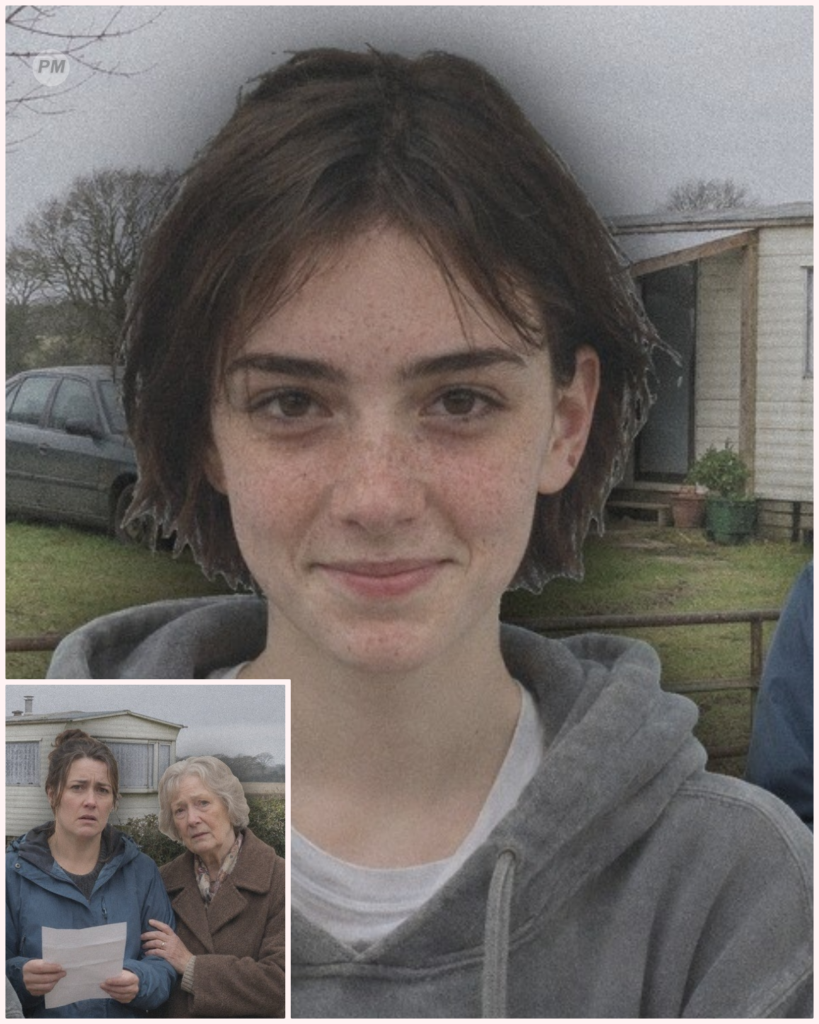
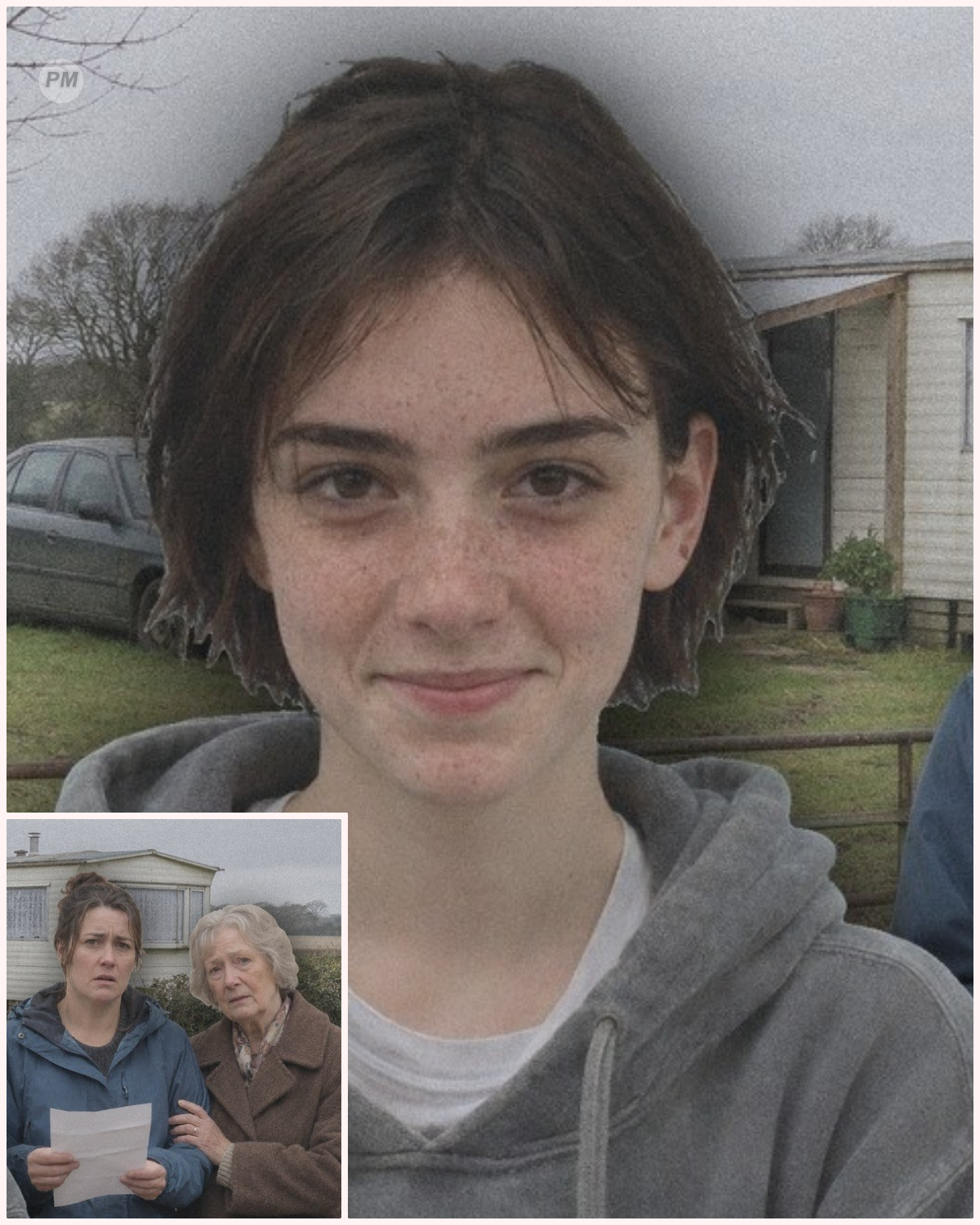
She was small for her age with dark hair that she cut herself and a freckled serious face and a way of listening to people with her head slightly tilted as though she were trying to hear something under what they said.
She had lived all her life in a static caravan. It was a white and green caravan, the old kind with a long window and a tin roof parked in a numbered row at the back of Marram Sands Holiday Park, a mile along the dunes from the village.
Number 42. In the summer, the park filled up with families from the Midlands with inflatable dingies and barbecues and screaming children, and the sea was loud all night.
In winter, the site was closed and empty. The owner turned a blind eye to the few people who stayed on for a small sum in the caravans at the back because there was nobody else to look after them.
Poppy’s grandmother had stayed for as long as Poppy could remember. Her name was Brenda Dunore.
Everyone on the site called her Nan. She was 74 with white hair in a net and a face like a walnut.
A retired primary school teacher who had taught half the village to [music] read. She was strict and funny and tender in that order.
She made porridge every morning on a two- ring hob. She read aloud every night with the [music] voices, and she had taught her granddaughter everything she knew at the little fold down table, from long division to Latin names for seaweed, because Poppy had never been to school.
It had never seemed odd. That was the thing about it. Brenda had always said that the schools in the county were rough and that a clever girl could learn more with a good book and a good teacher than in a classroom of 30.
Poppy had a library card and the use of a computer at the village hall on Tuesdays and a shelf of encyclopedias she had read twice.
She had swam in the North Sea every morning of her life in all weathers.
She could name every bird on the beach by its call. She could draw anything.
A gull, a lifeboat, a face in four lines. She had friends on the site in the summers who went home in September and a friend at the chip shop called Callum who was 16 and had asked her to the pictures in Yarmouth twice.
There were rules, of course. [music] Brenda had rules the way other people had furniture, no photographs.
Poppy had been in about four in her whole life, and Brenda had kept them all.
No social media, no names on the internet, no talking to strangers about where she lived, no doctors.
Brenda believed in cod liver oil and fresh air. And she said when Poppy had once asked that the National Health Service had lost half her records [music] when the surgery caught fire in 2011 and that it was easier not to start again.
Poppy had a vague notion that other people’s lives were more complicated. She had never minded.
She knew some things about herself and she had never doubted them. She had been born in Norfolk on the 2nd of December 2008.
Her mother, Brenda’s daughter-in-law, had died when she was a baby. Her father, Brenda’s [music] only son, had died in a road accident in Spain.
The winter she [music] turned two on his way to a job. She had no one else.
She had no cousins. She had no aunts or uncles, no photographs of her mother, and only the vaguest idea what her mother had looked like.
She had a grandmother and a caravan and a sea. She had three small things that had come from the time before she could remember.
They were the things she kept in the biscuit tin. The first was the yellow cardigan, hand crocheted with four tiny [music] buttons shaped like ducks, one of them slightly crooked, as though somebody had sewn it on in a hurry.
It was far too small for her now. She had worn it as a baby, and she kept it folded in tissue.
The second was a gray knitted rabbit with one eye missing, whose name was Mr.
Biscuit, and who had slept [music] on her pillow for 17 years, and the third was the mark, a little strawberry colored mark behind her left ear, which Brenda used to kiss when she was small, and called her Lucky Penny.
She stood in the doorway of the shop that Saturday morning, a pint of milk going warm in her hand.
Outside on the green, a boy was flying a kite. A woman was shouting at a dog.
Somewhere beyond the dunes, the sea was doing what it always did. And in the [music] window in front of her, laughing.
A baby in a yellow cardigan looked back. [music] I need to tell you about a different morning now.
130 miles away on a different kind of street. On Friday the 7th of August 2009, a 22-year-old woman called Kirsty Marlo stopped outside Henry’s Bakery on the Narbara Road in Leicester.
At 20 11 with her 8-month-old daughter in a pram. It was a warm, bright, ordinary morning.
The road was busy. There was a queue inside the shop and the pram was too wide to bring through the door.
So she did what a hundred women on that road did every day. She put on the brake, tucked the blanket around the baby, and went in.
She was gone for 4 minutes. When she came out with a cheese and onion pasty and a bottle of water, the pram was empty.
At first she thought somebody had picked her up. She turned round laughing, looking for a friend or a neighbor.
Then she saw that the blanket had been folded back and that Eizela’s little knitted rabbit was gone, and the world did the thing that it does.
The people in the bakery would remember afterwards that she did not scream. She made a noise, one low sound, as if she had been hit, and the pasty fell out of her hand.
The baby’s name was Ela Rose. She had been born on the 2nd of December, 2008, a month early.
A small, wideeyed girl with a mop of dark hair and a mark behind her left ear.
She had been wearing a yellow crocheted cardigan with four buttons shaped like ducks, which Kirsty’s gran had made.
She had a gray rabbit whose name was Mr. Biscuit. And by the afternoon, she was on the front page of every newspaper in the country.
I want you to understand what happened to Kirsty Marlo next because it is the reason this story has a second heart.
The police were not unkind to begin with. They searched every shop and flat on the road.
They looked at CCTV which turned out to be little use because the bakery’s camera faced [music] inwards and the only footage from the street showed a white van moving off at about 25 11 with no registration plate in view.
A man in a nearby shop remembered a figure with a baby. He could not say if it was a man or a woman.
The appeals went out. A reward of $50,000 was offered, but a detective asked Kirsty on the second day who Isa’s father was.
And Kirsty said that she did not really know. It was true in its way.
She had met him in the autumn of 2007 [music] in a service station on the M1 where she was working behind the counter.
A tall, charming Lori driver in his 20s who called himself Rick Stone. He had been kind and funny and attentive when she told him in January 2009 that she was pregnant.
He had gone very quiet and a week later he had stopped answering his phone.
She had no address. She had a mobile number which was now dead. She had a first name that was not his own and a surname that when the police checked every stone who drove a lori in the East Midlands belonged to nobody.
They looked for 6 months. They never found a Rick Stone. By the end of the second week, there were people saying that he did not exist.
[music] You can guess the rest. A woman who had left her baby outside a shop, a father nobody had ever seen.
A story that seemed to some too convenient. One tabloid ran a headline, “Where is EA’s mom’s mystery man?”
Another printed the [music] words in small type under a photograph of Kirsty leaving the police station.
“What is she hiding?” She received letters at her flat. Someone put a dead bird through the door.
She lost her job. Her friends began to cross the road. She moved twice. She was never charged and never cleared because there was no body and no baby and nothing to clear her of.
She did not stop. Every year on the 7th of August, she stood outside Hendry’s Bakery with a poster.
And every year the newspapers asked whether this was the year she’d tell the truth.
In 2013, a girl in Doncaster claimed to be Eisela and was found to be a 15-year-old runaway with a grudge against her foster family.
In 2019, a woman in Cardiff wrote to say her adopted daughter had a birthmark and it was a freckle.
Each time the police checked. Each time Kirsty went to the station with a hope she was ashamed of and came home with nothing.
By 2026, she was 39. She worked in a call center. [music] She lived in a rented flat above a dry cleaners in Leicester with a box room that she kept as a nursery with a cot [music] and a mobile of paper ducks and a yellow blanket.
She had no husband and no other children. She had a campaign and a Facebook page with 11,000 followers and a phone that she never switched off.
And on the 17th anniversary, with the help of the police, she put up posters.
Back in Hemsby, in a caravan at the end of a row, Poppy Dunore knew none of this.
She knew only that a small, ordinary rhythm of her life [music] now seemed strange to her, and she was seeing it for the first time.
On the first Tuesday of every month, as far back as she could remember, [music] her grandmother put on her good coat and took the bus into Great Yarmouth.
She was gone for the whole afternoon. She said she was collecting her post from [music] a box she rented at the sorting office because the site had no letter boxes.
She came back at 5 with a plain brown envelope stamped with a picture of a Spanish flag or a king in profile, and Poppy had never asked about it.
Brenda said it was from an old friend, a woman she taught with, who had retired to the sun, and sent her a little something each month, a card with a few pounds in.
Poppy had seen the money once by accident when the envelope [music] had split in Brenda’s bag, a bundle of 20s, a fat little roll.
Brenda had put it in the old tea caddy on top of the fridge, and had said, “Don’t be nosy, my lamb.”
[music] And that had been that. There were other things too that she had taken for ordinary.
When she was five, her grandmother had taken [music] a cardboard box of photographs from under the bed and fed them one by one into the stove on a cold January evening.
Too sad, she’d said. They remind me of your father. Poppy had cried, and Brenda had held her and cried too, and neither of them had mentioned it again.
The cardigan and the rabbit had survived because they were in the tin. The certificate of her birth, her grandmother said, had gone in the fire at the surgery.
Her father, God rest him, had been killed on the road in Spain. She did not even know his face.
She walked back along the dunes with the milk in the wind, with the phone in her pocket.
The caravan was the last in the row. The door was open and she could smell onions.
Brenda was sitting at the fold down table in her apron with a bowl of potatoes and a knife, humming as she hummed every Saturday a half-remembered hymn.
Poppy came up the steps and stood in the doorway and without a word held out the phone.
Why would a woman who adored a child who taught her to read and swim and draw never once let her be photographed?
Why would she burn every picture of a baby? And what would you do if the person you loved best in the world looked you in the eye and told you that you were wrong?
If you want to know, stay with me, hit like, and subscribe because what Poppy did next was the bravest and most terrifying thing she had ever done.
Brenda Dunore looked at the phone. She looked at it for a long time. She had stopped humming.
The knife was still in her hand, and the potato she’d been peeling lay in the bowl half-skinned, and Poppy saw something go across her grandmother’s face that she had never seen there before.
A color like ash from the forehead down. “What’s this?” Said Brenda. “It’s a poster.
It’s in the window of the shop, Nan. It’s the cardigan.” Poppy’s voice was shaking.
Look at the buttons. [music] Look at the little ducks. Half the babies in England wore yellow cardigans in 2009, said Brenda, and put the knife down carefully on the table.
It was the fashion. They had a pattern in Woman’s Weekly. I made two myself.
It’s got the mark nan. Lots of babies have strawberry marks behind the left ear.
Lots of babies. Poppy went to the bed and knelt and pulled out the biscuit tin.
She opened it on the table between the potatoes and the salt and took out the little cardigan which she had folded in tissue paper for as long as she could remember.
She spread it flat. Four duck buttons, one of them, the third, slightly crooked as though sewn in a hurry.
She turned the phone round so that her grandmother could see the picture and held the cardigan beside it.
In the photograph on the screen, in the baby’s yellow cardigan, the third duck button was slightly crooked.
Brenda didn’t speak. Her hands were on the table and Poppy saw that they were shaking, too.
You said it was mom’s, Poppy said. You said she made it for me. You said she died when I was a baby.
Nan, who is Isa Marlo? Nobody, said Brenda. A poor little girl who was taken from her mother and God help her, and I hope they find her.
And you are not her. You’re my poppy. Her voice had risen. You are not going to do this to me.
Do you hear? You are not going to take a coincidence and make a story out of it.
I have given you everything. I have given you my whole life. I’m not saying you did anything.
Put that away. Her grandmother stood up. She was shorter than Poppy by an inch.
She was 74 and she shook with rage [music] and with something else that wasn’t rage.
Put it away and put that tin away and we’ll say no more about it.
Your father, God rest him, would turn in his grave.” It was the first time in her life that Poppy had walked out of the caravan without being asked.
She went down to the sea. She sat on the wet sand in the wind with the poster glowing on her phone, and she watched the gulls come in.
She was not crying. She was cold all through. She tried to do what Brenda had taught her to do with a problem, to take it apart in steps.
And she had got as far as the first step when she realized that she did not know what she was looking for.
All she had were questions and every one of them was about a thing she had never thought to ask.
Why had she never had a doctor? Why had there been no school? Why did a woman who loved children never let one be photographed?
Why had her grandmother burned the album? That night she lay in her bunk at the far end of the caravan listening to her grandmother breathing in the dark.
It was the wrong kind of breathing. It was the breathing of someone who was lying awake.
The next morning she went back to the shop. The man behind the counter was Mr.
Pat, who had owned it for 20 years and who sold her a bag of chocolate buttons every Friday.
She asked him about the poster. He said it came every August. A police woman from Leicester posted them to every shop on the east coast along with a roll of tape.
Same one as last year, I think. Maybe they’ve done a new one. Poor woman.
[music] The mother. They say she did it herself. You know, never trust a woman who says she doesn’t know the father.
He shrugged. [music] 17 years though. Imagine. Does it get a lot of calls? Poppy [music] said from people who say they’ve seen her.
Every year, said Mr. Pat cheerfully. Cranks mostly. Last year a lad swore he’d seen her in a Gregs in Chromemer.
You thinking you’ve seen her? No, said Poppy. I don’t know. She did the only other thing she could think of.
At 1 that afternoon, she told Brenda she was going to meet Callum, which was almost true, [music] and she took the bus into Great Yarmouth.
Callum, who was 16 and tall and freckled and [music] worked the fryer at the Seabbze Chippy, met her at the bus station.
She told him everything on the way. He listened with his mouth slightly open. When she’d finished, he said, “Pops, that’s mad.
[music] That’s absolutely mad.” And then after a bit, you’ve got to tell someone. On the way from the bus station, they passed the sorting office, the gray building where her grandmother rented her little numbered box on the first Tuesday of every month.
And Poppy found herself wondering for the first time who in the world wrote every month to a woman who said she knew nobody.
Then they reached the police station on Middlegate Street, a squat building with blue doors.
The desk was staffed by a heavy, kindly man with reading glasses on a cord.
He was patient in the way that people are [music] patient when they have heard a thing a great many times.
She put her phone on the counter with the photograph [music] and explained. He took off his glasses.
He explained that EA Marlo’s case belonged to Lester Shear police, not to Norfolk. And that there was a dedicated hotline which was on the poster.
People do ring you know love. He said dozens every week around the anniversary. We get all sorts psychics.
Folk who have seen a face in a pram. A man last year who said she was living in a lighthouse.
He looked at her kindly. “Have you got your birth certificate with you? A passport, a doctor’s letter, anything with your name?”
“I haven’t got any of those things,” said Poppy. He was quiet for a moment.
“No birth certificate, no doctor, never been to school.” “I was taught at home,” said the officer.
He did not say anything else, but she saw him write something on a pad, and she knew with a cold sinking of her stomach what it was that he was thinking.
A girl with no papers and a story and a poster. He smiled at her and slid a leaflet across the counter with a phone number on it and read.
“Give them a ring,” he said. “Tell them everything you told me. It’ll be somebody who knows what to do.”
She and Callum sat on the bus shelter outside [music] in the gray drizzle. Callum looked at the leaflet.
“They won’t believe you.” “I know,” said Poppy. “What are you going to do?” She did not answer.
She had been staring at the number on the poster all day and at the strange soft searching face of the woman whose photograph was printed underneath it.
Kirsty Marlo in a blue anorak outside a bakery holding a picture of a baby looking straight into the camera as if she knew somebody was on the other side.
At 10 5 Poppy took out her phone and dialed. The woman on the end of the line was polite and a little weary.
She took Poppy’s name and her phone number and the name of the caravan park.
She said that a detective would be in touch. Poppy put the phone down, feeling as if she had posted a letter into a river.
At 9:00 that evening in the dark on the shingle bank behind the dunes where the signal was good, the phone buzzed.
Is that Poppy? This is Detective Sergeant Lauren Okafor, Leershure Police. I run the Islam Marlo inquiry.
The voice was low, brisk, and careful. The voice of a woman who had made this call before.
I’m going to be honest with you because I think you’d prefer it. I get a lot of calls at this time of year.
I’ve had two girls in the last 15 years who were quite sure they were Isla.
Neither was One of them was 15 and wanted attention, and the other was a very sad young woman who had been told a story by her adoptive father.
“I’m not saying you’re either of those. I’m saying I have to ask you a lot of questions.”
“Okay,” said Poppy. She told her everything. The [music] cardigan, the crooked button, the mark behind her ear, the way she had never had a doctor or a school or a photograph, the monthly envelope.
She heard herself talking faster and faster, and she knew as she did it how it sounded, and she did not care.
At the end, she said, “And I have a rabbit.” The line was quiet for a moment.
A rabbit? A gray knitted one with one eye missing. His name is Mr. Biscuit.
I’ve had him as long as I can remember. Okafor did not answer. In the silence, Poppy could hear her breathing and a door being closed somewhere in a building far away.
Poppy, she said at last, who have you told that? Only you. Why? Because we never released that.
In 17 [music] years, it has never been in a newspaper or on a poster or on the internet.
When EA was taken, her mother told us she had a rabbit that she called Mr.
Biscuit, and we kept that back on purpose [music] so we could tell a real call from a false one.
Her voice had changed. She was trying very hard to keep it level. I’m not going to tell you what I think.
I can’t. I don’t know what you are yet, but I’d like to take a swab from your cheek tomorrow [music] at Great Yarmouth Police Station.
Is there an adult you trust who can come with you? No, Poppy said. I’d rather not tell my gran yet.
That’s fine. Come on your own. If you’re all right with that, a colleague will meet you.
A pause. Poppy, please don’t take this as a promise. If there’s a match, it will take a few days.
I’m not going to tell Kirsty. Not until I’m sure she has been hurt 17 times over.
I won’t do it on 18th. She took the swab on Wednesday the 12th of August in a bare room at the back of the police station on Middlegate Street from a young woman in a blue paper suit.
It took 12 seconds. It was the shortest and strangest 12 seconds of Poppy’s life.
Callum waited outside on a plastic chair eating a Twix. Afterwards, she walked out into the sunlight and [music] could not feel her feet.
She was home by 4:00. She had a lie ready about the bus. She did not need it.
Brenda was sitting in the doorway of the caravan in the sun on the folding chair with a mug of tea going cold in [music] her lap.
And she looked up as Poppy came along the row and she knew. Poppy saw her.
No. In a village like Hemsby, a police car in the wrong place on the wrong afternoon is news.
The woman at the next caravan had seen it. The woman at the next [music] caravan had told her.
Neither of them said a word. Brenda stood up slowly and went inside and closed the door.
For two days, the caravan was very quiet. Brenda made the porridge and read aloud in the evenings, but she read the same page twice, and she stopped doing the voices.
She did not ask where Poppy had been. She did not say anything about the police.
She looked at Poppy once or twice across the table with an expression that Poppy could not read.
Tender and terrified and terribly tired. And then she [music] looked away. On the Thursday night, she came and sat on the edge of Poppy’s bunk in the dark, as she hadn’t done since [music] Poppy was small.
She stroked her hair. She said, “You know I love you, my lamb.” In a voice that sounded like it was coming from the bottom of a well.
I know, Nan. Whatever happens, you know that. What’s going to happen? Said Poppy. But her grandmother only kissed her on the forehead and went back to her own bed.
When Poppy woke on Friday the 14th of August, it was after 8, and the sun was already hot on the tin roof, and the caravan was silent.
She knew before she sat up. The bunk at the other end was neatly made with the blanket folded in a square.
The kettle was cold. The hbook was gone from the shelf. The tea caddy that always sat on top of the fridge with the envelopes in it was gone.
On the table under the salt cellar, [music] there was a piece of paper torn from the back of an exercise book in Brenda’s tidy teacher’s hand.
My darling Poppy, I have done a wicked thing and I am a coward. I should have been brave a long time ago.
Please do not look for me. I am safe and I will not do myself any harm.
Your dad, God rest him, would have wanted you to be happy, and you will be.
There is money in the tin under the stove. Eat properly, keep warm. I love you more than my own life, Nan.
Poppy read it standing up. She read it three times. Then she sat on the edge of the bunk with the paper in her hand, and the whole caravan seemed to hold its breath around her.
The tin under the stove had 400 lb in it [music] in 20s. She could not stop looking at it.
In all her life, she had never known her grandmother do an impulsive thing. This was the most impulsive thing in the world.
It was also, she realized slowly, the work of a woman who had been planning to go for 17 years, and who had a bag packed and a plan in her head.
A woman who had only been waiting for someone to knock on the door. She went through the caravan like a detective.
She searched under the beds, in the wardrobe, in the biscuit tins. She found a few old school books, a hymn sheet, a knitting pattern.
She found no photographs. She found no letters. The last envelope, the one from the beginning of August, was not in the caddy, which was gone.
She was about to give up when she saw at the back of the cutlery drawer, folded into the cloth where the bread knife lived, a corner of brown paper.
It was an envelope. It was a plain brown envelope with a Spanish stamp with the picture of a king, and it had been torn open roughly at the top.
It was the one from the first Tuesday of August, and her grandmother had missed it in her hurry.
Poppy lifted it out. The notes had gone. The paper was soft with handling. [music] She turned it over and on the back where the flap had been in a small hard slanting handwriting that she had never seen before, someone had written a few lines.
It was a few lines only in blue ballpoint pressed hard into the brown paper.
Ma’am, ring this if ever she asks. Not from the site phone, not from yours.
Don’t say a word about the money. R underneath. There was a Spanish telephone number with the code for Alakante [music] and beneath that in the same slanting hand an address.
Barla Marinara Caler Ramon Gallalur Tora. Poppy sat on the floor of the caravan with the envelope in her lap for a long time.
The sun moved across the lino. Outside someone was shouting at a child. She was trying to think and the only thing in her head was a word.
Ma’am. Her father’s name had been Richard. She knew that. It was the only thing about him she had ever been told, apart from the accident.
Richard Dunore, her grandmother’s only son, who had died on the road in Spain the winter that she was two, on his way to a job.
She thought of the voice on the phone. In 17 years, it has never been in a newspaper.
A man who called himself Rick Stone. Rick. Richard. Her grandmother’s son had not died in Spain.
He lived in Spain. She went to find Callum. She did not remember getting to the chippy.
He was standing on a crate in the yard scraping the fryer. And he took one look at her face, put the scraper down, and wiped his hands on his apron.
They sat in the back of his mom’s fiesta with the door shut, and she put the envelope on the dashboard between them.
“You can’t ring that,” said Callum. Pops, you can’t if he’s the one who he’s my dad.
She laughed and [music] it came out horrible, isn’t he? He’s supposed to be dead.
If he’s alive and he did it, he’s dangerous. [music] You tell the police. I will.
I’ve got to know first. She held out her hand for his phone. Put it on speaker.
Record it, please, Callum. Please. He gave her the phone. She dialed one digit at a time.
It rang [music] six times with the long flat double ring of a foreign line and then clicked.
Behind the voice there was the noise of a bar, a clatter of glasses, a football commentary in Spanish, a woman laughing.
Hello. It was a man’s voice, horsearo and flat and unmistakably English. A Midland’s voice, she thought, though she had never known the difference.
Hello, ma’am. I told you not to ring in the day. It’s Poppy, she said.
The noise in the bar went on and the man on the other end said [music] nothing.
She counted four seconds. Five. Who’s this? His voice had dropped. It’s Poppy. I’m in Hemsby.
Nan’s gone. She left me a note [music] and I found your envelope. She gripped the phone with both hands.
You said ring if she asks. I’m asking. Are you my dad? Poppy, said the man.
His voice was quite different [music] now. Low, quick, urgent, with a kind of terrible gentleness.
Listen to me, love. Listen. Don’t say anything else on this phone. Where’s your nan?
I don’t know. Are you my dad? You’ve not spoken to anyone? No police? No one’s been to the van?
She said nothing. In the silence, she heard him breathe [music] out and the sound of a chair scraping on a tiled floor and the voice of a Spanish woman asking something and being shushed.
“You’ve not been told the right story, Poppy,” he said. “It’s [music] not what you think.
I’ll come to you. I’ll explain everything. Just don’t talk to the police. They’ll twist [music] it.
They’ll put your nan in prison. They’ll put me in prison.” You don’t want that, do you?
You don’t want to be the one that did that to her. Did what? But the line had gone dead.
Neither of them spoke. In the front of the fiesta, the recorder on Callum’s phone showed 3 minutes [music] and 14 seconds.
Poppy sat looking at it. She noticed in a far away way that her hands had stopped shaking.
Callum drove her to the police station in [music] Great Yarmouth, and they played the recording to the same heavy, kindly officer who had seen her on the Monday.
And this time he [music] did not take off his glasses. He listened with his hand over his mouth.
He picked up the phone on his desk. By 6:00 that evening, DS Lauren Okafor had driven the 130 mi from Lester with a colleague and they were sitting in the little room at the back playing the recording again.
The number said Okaphor, give it to me. It took the Spanish police 11 minutes to come back.
The mobile was registered to the owner of a bar [music] in Tora, a seaside resort on the Costa Blanca popular with British [music] expats.
It had been bought with a deposit and a lease in the winter of 2010.
The name on the business license was Ricardo Dunore, aged 45, born in Leester. No convictions, no passport record on the British side in the last 15 years.
Okafur read the details off a screen without a word and then she put her hand flat on the table and breathed out.
“We never found him,” she said to nobody. [music] “We looked for a Rick Stone.”
“17 years. Of course, we didn’t.” On Thursday the 20th of August at 11 minutes 9 in the morning, Poppy was sitting on the sea wall at Hemsby with a cup of tea going cold in her hands, watching the tide come in when her phone buzzed with a number from Lester.
She knew what it was. She stood up and she walked down the steps onto the sand away from the people before she answered it.
“Poppy,” said Lauren Okaphor. She sounded as though she had been running. I have the result from the lab.
I want you to listen carefully because I’m going to say it once and then I’m going to say it again.
The sample you gave me on the 12th matches the DNA profile of Kirsty Marlo.
The probability that she is your mother is 99.999%. A pause. You’re Isa. Do you understand?
You’re Isa Rose Marlo. You were born on the 2nd of December, 2008 in Leicester Royal Infirmary, and you have been missing for 17 years.
The tide came in over Poppy’s shoes. She did not feel it. And my mom, she said in a very small voice.
Does she know? No, said Okafer. I wanted you to be the first. I wanted you to have a choice about how.
But Poppy, I have to ask you something, and it matters. Where is your grandmother?
Poppy looked out over the gray water to the horizon where the wind farm turned slow and white.
And she remembered with a sudden clarity a thing she had forgotten a little concrete shelter on the dunes half a mile north of the site with a bench that faced the sea.
On bad days when Brenda thought nobody was looking, that was where she went to pray.
The shelter was an old concrete lookout from the war, half buried in marram grass with a slit window facing the sea and a bench inside that someone had carved with initials.
Poppy came over the dunes at half 10 out of breath with Lauren Okapor behind her and two Norfolk officers hanging back by the path.
She saw the flask first, then the tea caddy standing on the bench, then a bent figure in a good wool coat with a hbook open on her knee, who did not look up.
Brenda Dunore had been there for six days. She had slept in the shelter under her coat in the dunes within half a mile of the caravan.
She had washed in the sea. She had eaten bread and [music] apples. In the evenings when the light came on in number 42, she had walked to the edge of the dunes and stood watching it.
As she had stood, she said many times before in the early years when she could not sleep.
She had not gone far because she could not. She had planned to run and she had got half a mile.
“I knew you’d find me,” she said without lifting her head. “I knew you would, my lamb.
You were always clever.” Poppy sat down at the other end of the bench. She had thought all the way along the dunes of what she would say.
She said, “Tell me.” So Brenda told her. On the evening of Friday the 7th of August, 2009, at about 9:00, when she was 57, and a respected woman in the village, a retired teacher with a spotless name, her only son had arrived at the caravan in a white van.
Ricky was 28. He had been in trouble in his teens. Small things, nothing she could not forgive.
He had a baby in a car seat on the passenger side. He was white and sweating, and he said that the baby was his.
He said her mother was an addict. He said the council were about to take her into care and that he had to save her.
He said, “Ma’am, please, just a few days.” She had believed him. That was the thing she could never get over.
She had held that child on her lap, a little dark girl in a yellow cardigan with a gray rabbit, who had looked up at her and smiled, and she had believed every [music] word because she had wanted to.
On the Saturday morning, she saw the television. It was a small old set in the corner of the caravan, and a newsreader said, “A baby has been taken from her pram outside a bakery in Leicester.
Underneath was the same face, the same cardigan, the same little rabbit. I was sick in the sink, he said.
Brenda, I knew in the first second, [music] and I thought, I’ll take her to the police.
I’ll walk into the station and tell them I got her dressed. I got her in the push chair.
Her voice cracked. And he stood in the door of the van, Ricky. And he said, “Go on then, ma’am.
Go on. Tell them. Tell them she was in your caravan. Tell them whose caravan she was in.
I’ll say you rang me. I’ll say you asked for her. Who do you think they’ll believe?
A bloke who works in lorries or a retired teacher who’s got the baby in her hands.
Poppy said nothing. He wasn’t lying, said Brenda. That was the horror of it. I knew he wasn’t lying.
I’d have gone to prison. And I did what cowards do, Poppy. I said, one more day.
Then I said, “One more week.” He had given Kirsty a false name, she said from the beginning.
He had planned it, she thought. Even then, when Kirsty told him she was pregnant in January and said she wanted him to be named to help with the child, he had gone away and begun to think.
He had told his mother he’d lost a girlfriend. He had told her nothing else.
“A man who wouldn’t pay for a child could always take one,” he had said once in a pub, laughing.
She hadn’t understood. When he drove away from the caravan on the Saturday, he’d said, “A year, ma’am, till it blows over, then we’ll see.”
The year passed, and then another. The baby learned to walk on the sand. She said her first word, which was nan.
She grew into a funny, stubborn, silent, serious little girl. And Brenda loved her so much that on some days she could hardly stand.
In December 2010, a newspaper ran a story on the anniversary with a computer picture of what Eiza might look like at two and Ricky telephoned panicking [music] from a call box.
He said he was going to Spain. He said there was money if she kept quiet.
And he said that if she ever told anyone, she would go to prison and the girl would be taken into care and would never see anyone she knew again.
So, I said that he died, said Brenda. In the accident, I made it up that night.
I thought if she thinks he’s dead, she’ll never go looking. I thought I’m protecting her.
I thought a lot of things. She was crying now without sound. In the way of old women who have cried for years.
The cardigan was in the push chair. I couldn’t burn it. I could burn the rest.
When you were five, there was a thing on the television about Isla, a documentary with her photograph, and you looked at the screen and you said, “That baby’s got my cardigan.
I took it out of the caravan, and I burned everything. I never let you see a television again.”
And the money, it came every [music] month. £300. I never spent it on myself.
It’s all in the caddy. She laid a shaking hand on the tin. I’m not asking you to forgive me.
I know what I am. I watched that poor girl on the news every August.
Kirsty standing outside that bakery and I turned it off every time. 17 years. There was a long silence filled with the sound of the sea.
Poppy sat looking at her grandmother’s hands at the thin gold ring, the swollen knuckles, the teastain on the cuff.
They were the hands that had taught her to read. They were the hands that had stolen her from her mother.
I’ll come and see you, she said at last. It was all she could say.
I don’t know when, but I’ll come. The officers took Brenda Dunore into custody at 10 11 by the shelter with the tide going out.
She went quietly in her good coat, holding the hbook. At the top of the dune, she turned and looked back once at the girl on the bench, and Poppy raised one hand.
The next day was Friday the 21st. On the Saturday the 22nd of August at a quarter to 4 in the afternoon, Poppy sat in a plain room at Great Yarmouth Police Station with a vase of supermarket flowers on the table and a box of tissues beside it and heard a car draw up outside [music] and then a voice in the corridor quick shaking saying, “Where is she?
Is she here?” The door opened and a thin woman of 39 in a blue anorak stood in the doorway with gray in her hair and her hands clutched in front of her chest holding a small soft gray object.
She did not move. Poppy stood up for a moment. Neither of them said anything.
Then Kirsty Marlo whispered, “Oh, you’ve got my eyes.” And held out the rabbit, a gray knitted twin of Mr.
Biscuit with both its eyes, which had sat on a shelf in a cot for 17 years.
And Poppy, who had never in her life been kissed by anyone but a woman who had stolen her, stepped forward and let herself be [music] held.
Ricky Dunore had nearly 6 weeks. That was how long it took the Spanish police to find him.
He had closed the bar on the afternoon of Monday, the 17th of August, the day after a girl rang his number from a chip shop car, and had told his staff he was visiting a sick friend.
He had taken cash from the till. He had left his phone on the counter.
For 39 days he moved from one rented room to another along the Mercian coast, paying in notes and answering to a different name.
And every night he told himself afterwards he thought about the voice on the phone saying, “Are you my dad?”
On Friday the 25th of September at 10 6 in the morning, officers of the Policia National Acting on a request from Leicester police knocked on the door of a thirdf flooror flat in a back street of Cartaca.
He opened it in a vest and shorts. He did not run. According to the Spanish report, he said in English, “Is she all right?”
And then in a very small voice, “Is she with her mother?” He fought extradition for 11 days and then dropped his challenge.
On Tuesday, the 20th of October, escorted by two detectives, he landed at Stanstead. And the next day he stood in the dock of a magistrate’s court in Leicester in a gray tracksuit and heard himself charged with child abduction contrary to section two of the child abduction act 1984 [music] and with perverting the course of justice.
It might surprise you that it was section two. That section is for people who take a child without lawful authority and who are not what the act calls connected with her in-law.
A father who has never married [music] the mother and who has no parental responsibility is not a parent.
He is a stranger. The man who had called himself [music] Rick Stone, who had given Kirsty Marlo a false name so that he need never be asked for money, had been in the eyes of the crown exactly [music] that.
The maximum penalty is 7 years. The charge of perverting the course of [music] justice.
For the false name and the lies that kept the search for a man who did not exist going for 17 years is an offense at common law and carries up to life.
He pleaded not guilty. A trial was fixed for the spring. Brenda Dunore [music] was charged on the 22nd of August with the same offense of child abduction for harboring and [music] concealing a child.
She stood in Norwich Crown Court on the 5th of October, 74 years old, in her good wool coat, and said the word guilty so quietly that the judge asked her to repeat it.
She was released on bail to await sentence in the new year. The judge, a woman in her 60s, said that she had seen few cases so hard to weigh.
She said that the court would take into account Mrs. Dunore’s age, her health, her plea, and the fact that she had in the end let the truth come out.
She also said that no one in that courtroom would ever know the weight of what Kirsty Marlo had carried.
Brenda nodded. She did not ask for mercy. Poppy went to see her on the first Sunday of every month.
She took the bus to Hemsby and they sat at the fold down table in the caravan and [music] Brenda made porridge and they did not talk about it.
They talked about birds. They did the crossword together. In September, Brenda gave the police every envelope she had kept and the money that she had never touched nearly 40,000 [music] in 20s.
She asked that it go to Kirsty. Kirsty gave it to a charity for the families of missing children.
There was one more thing that I want to tell you and it was Kirsty’s.
On Tuesday the 25th of August, the tabloid that had run the headline, “What is she hiding?”
Printed a front page apology in capital letters over a photograph of a woman in a blue anorak outside a bakery.
It said it was sorry. Kirsty read it in the kitchen of the flat above the dry cleaners with a cup of tea and then she folded the newspaper in half and put it in the bin.
She said afterwards that she was not angry. She said that she hadn’t the energy.
She had a daughter. They went slowly. You cannot [music] give someone 17 years in a month.
Poppy moved into the flat on Hankley Road into the box room with a cot which Kirsty took out the day before she arrived and replaced with a proper bed.
On the wall she hung the paper ducks. On the first night Poppy lay awake listening to the sound of traffic so strange after the sea.
And at some point after midnight she heard the door open very softly and a figure stand there in the light from the landing.
As she had stood there every night for 17 years in her dreams. She did not say anything.
She just wanted to look. In September, Poppy enrolled at a sixth form college in the city to catch up on the exams.
She had never sat. She wants to study marine biology or perhaps drawing. She is learning to cross a road with a pedestrian crossing.
She has her own birth certificate now, a copy of the one registered in Leicester in December 2008, and it says Isla Rose Marlo.
She has told her mother that she would like to keep the other name as well.
Isa Poppy. She has said that she was Poppy for 17 years and that Poppy was loved.
When she turns 18 on the 2nd of December, she is going to have a party in the flat above the dry cleaners.
There will be a cake. There will be a boy named Callum who has promised to come all the way from Norfolk with a bag of chips.
A yellow cardigan with four buttons shaped like ducks, one slightly crooked, a gray rabbit with one eye, a small strawberry mark behind the left ear.
They were all that she had left of the girl she had been, and they were enough to bring her home.
Thank you for staying with me to the end. If this story stayed with you, please subscribe, hit the bell, and tell me in the comments where you are watching from tonight and who you would trust to tell you the truth.
I’ll see you in the next
