Monday the 9th of December, 2024, 10 to 8 in the morning. Amina Hussein stands at her kitchen window with a mug of tea going cold in her hand, looking down into the backyard of the house across the lane.
On the washing line, there is a dress, emerald green velvet, a cream lace collar, water dripping from the hem onto the flagstones.
It is 19 years to the day since Kaye Dunn, 15 years old, walked out of a Christmas dance in Moram and was never seen again.
And Amina knows that dress. By the end of this story, you will know who washed it, why it was hanging there that morning, and what really happened to Kaye that night.
It is not what anyone thought. Before we begin, if you like true stories told properly, subscribe and ring the bell and tell me in the comments where you’re watching from and what time it is there.
This is a dramatized story. The names and some of the details are fictional. Now, let me tell you how it began.
Amina was 26. She dispensed prescriptions at a chemist’s on Houston Road, and Mondays were her day off, which was the only reason she was standing at that window at all.
Her flat was on the first floor of a tired terrace in Alexandra Lane in the west end of Morcam, where the backyards face each other across a narrow alley, and everybody knows whose bins are whose.
She had lived there for a year and a half. She had never once looked properly at the yard opposite, number 11, Clarence Terrace, because until October, it had belonged to nobody.
An old man had died in it, the street said, the year before last, and the house had stood dark behind its blind ever since.
Now, there was a security light on a bracket, a pair of child’s wellies, a baby’s changing bag hooked over the gate, and strung from the drain pipe to an iron hook in the wall, a length of white plastic line with a dress pegged to it by the shoulders.
The yard light had clicked off long ago. In the gray morning, Amina could see every drop that fell.
She could not have said why she kept looking. A dress on a washing line is the most ordinary sight in England.
But the shape of it was wrong for ordinary. It was too old-fashioned, the sleeves too long, the skirt too full, and the color was not a green you see in the shops.
It was the green of a bottle held up to a window, and at the neck a pin prick of red.
She sat down the mug. She put on her coat over her pajamas and went down the stairs two at a time.
In the lane, the cold hit her like a slap. The back gate of number 11 was solid timber with a gap along the bottom, and through the gap she could see the flags of the yard, dark and speckled, and the drops falling one after another from the hem.
She could smell the washing powder, lavender fabric softener, strong, the kind her mother bought by the gallon.
Whoever had washed that dress had washed it not long ago. She knocked nothing. She knocked again harder and the sensor light on the wall came on with a snap and lit her own shadow across the gate.
The kitchen window was blinded. No lights upstairs, no car in the lane. It was 2 minutes to 8.
Amina Hussein had grown up on Regent Road above her mother’s shop. And in the window of that shop, there had been a poster for as long as she could remember.
Nasarin Hussein had put it up in the week it was printed in December 2005 when Amina was seven because the Dun’s daughter had been to the shop for sweets since she was small and Nasarine could not bear it.
The paper had faded over 19 years to the color of weak tea. The photograph had not.
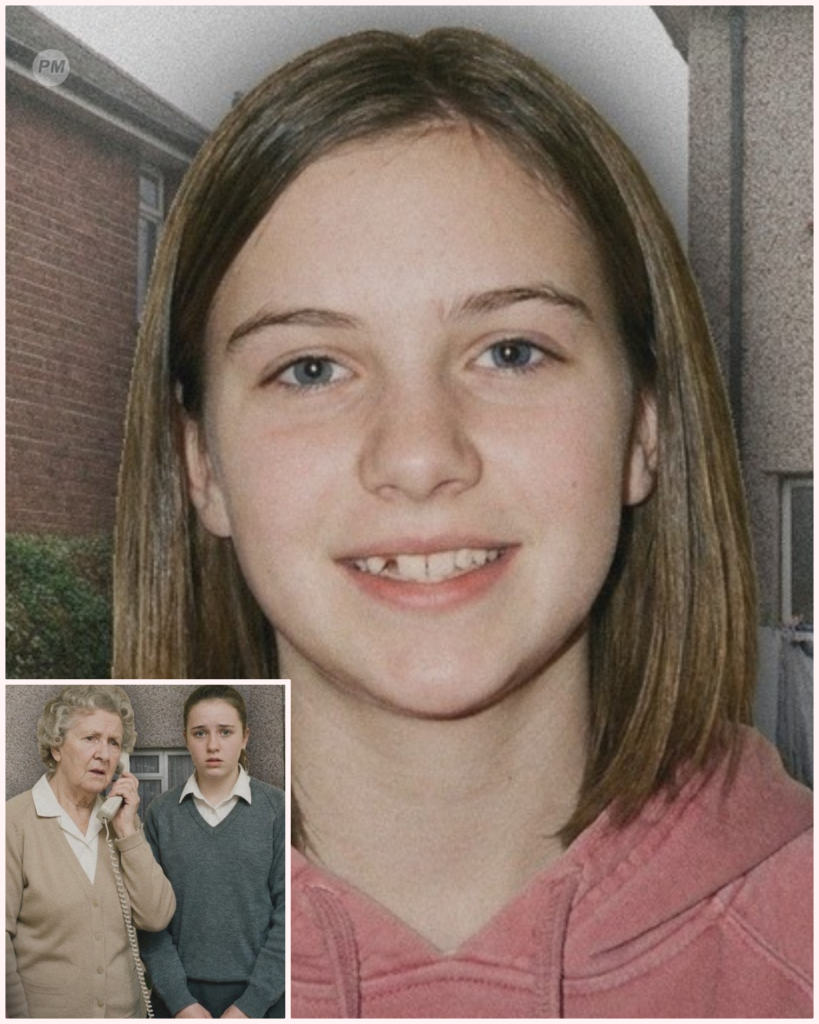
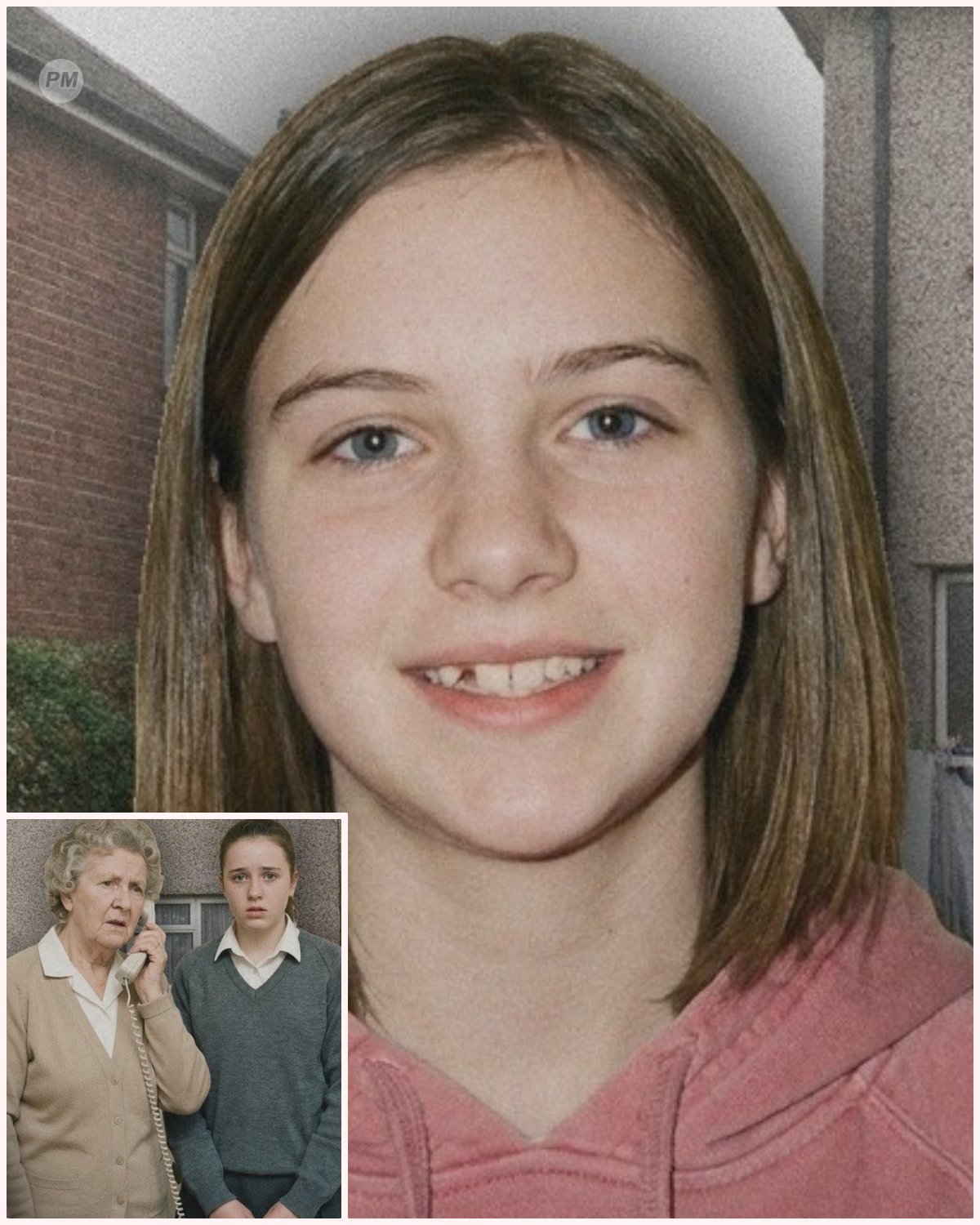
It showed a girl with a plight over one shoulder and freckles across her nose laughing at somebody off to the side in a long sleeve dress of dark velvet with a lace collar.
Underneath in black capitals, “Have you seen Kaik?” And below that, in smaller type, the description that every child in that street could recite without looking.
Emerald green velvet dress, cream lace collar. Last seen Friday 9th of December 2005 leaving the Hisham Road Youth Club.
Amina had walked past that poster twice a day for 11 years of school. Then she had walked past it going to college and to work.
A girl who is always 15 becomes part of the street. Like the postbox, you stop seeing her.
You never stop knowing her. She stood in the lane with her phone in her hand and her heart going.
She knew what she would be told, that it was a green dress, that there are thousands of green dresses, that it was Christmas and people wear velvet at Christmas.
She knew standing there that she could not see a label or a stitch, only a color, a collar and a speck of red.
So she did the only thing she could think of that was not nothing. She went back to her window and photographed it.
She zoomed as far as the phone would go and took one picture and another and another until she had 41 with the time stamped on everyone.
The drops frozen in midair under the pale sky. At 5 8 she rang 101.
It rang for 6 minutes. Then a woman’s voice kind and tired. The voice of someone 5 hours into a long shift.
Was anyone in danger? Amina said no. Was a crime taking place? Amina said she did not know.
The woman asked what exactly she wished to report and Amina heard herself say it out loud for the first time and it sounded insane.
I think there’s a missing girl’s dress hanging on a washing line in Clarence Terrace.
Kaye Dunn. It’s been 19 years today. There was a pause on the line and the sound of typing.
Right, said the woman. And is this dress, to your knowledge, the property of someone who is not entitled to have it?
I don’t know whose it is. That’s the point. I can log it for you, madam, as information.
If an officer thinks it’s worth looking at, someone may be in touch. It might be a few days.
Is there anything else I can help you with? Amina looked down at the yard.
A single drop gathered on the hem of the dress swelled and fell. No, she said.
Thank you. She put the phone on the windowsill. Across the lane, the dress turned a little on the line as if someone had breathed on it, and Amina Hussein, who had never in her life made a scene, decided that she was not going to let it go.
But to understand why a wet dress on a washing line mattered, you have to go back 19 years to a kitchen in Haitium and a woman of 70 threading a needle with the last of a reel of blue cotton.
Joyce Pickles had worked 31 years behind the counter of a fabric shop on Houston Road, and there was nothing in a roll of cloth that she could not read by touch.
In the first week of December 2005, she was 70 years old, a widow for 4 years, and she sat at her kitchen table in Hasham with a length of emerald velvet across her knees, her glasses on a chain, and the radio murmuring in the corner.
The velvet was for her granddaughter. Kaylee Dunn was 15, 5’3″ with freckles and a plat that she would not let anyone cut.
And she had been asking for a proper dress for the school Christmas dance since October.
Her mother, Julie, had found the velvet on a market stall and carried it home like a prize.
Nan Joyce had cut it, pinned it, and stitched it over four evenings, and she had given it a collar of cream lace that she had saved from her own wedding veil.
She did everything the old way. She put a name tape in the neck, the way she had put one in every school jumper Kaye had ever owned, a small woven strip, red letters on white, K done, sewn in with tiny stitches where no one would see.
When she found that the last pearl button had gone missing from the box, she went through her tin and found a red one with a tiny gold anchor on its face.
It had come off her late husband’s old cardigan. Walter had been a lifeboat man at Morham for 20 years.
She sewed it on at the neck without a word, and when the green thread ran out 3 in from the end of the hem, she finished the job in blue cotton because it was 10:00 at night and the shops were shut.
Nobody will see,” she said to the cat. “It’s under the fold.” There was one more thing, though she did not know it yet.
On the Thursday night, Kaye tried the dress on in front of the bathroom mirror, spilled tea on the left cuff, and dried it with her mother’s hair straighteners.
By the time Julie smelt burning, there was a brown mark the size of a 10 pence piece on the velvet.
Julie wept. Kaye wept. Nan Joyce looked at the cuff for a long time and said that it would make the dress hers and she gave them the rule which they had both heard a hundred times and which Julie would repeat to the police 19 years later.
Velvet is never put in a machine and never put in a dryer. You wash it by hand in cold water.
You hang it in the air and you let it drip. Friday, the 9th of December was wild and wet.
The forecasters had warned of a gale and a spring tide, and from the kitchen window in Hasham, you could hear the bay shouldering at the seaw wall.
Julie worked nights as a nursing auxiliary at the Royal Lancaster Infirmary, and on Fridays, Kaye always slept at her nan.
Her father, Paul, had gone to live in Spain two years before. It was the three of them, and it had always been enough.
At 6:00, Bethany Marsh arrived on the doorstep with a sports bag and her hair already straightened.
Beth was 15, too, Kayle’s best friend since they were seven, with a chipped front tooth and a laugh that took over a room.
She ate at the Dun’s table twice a week, and Julie had once said in front of her that she had two daughters and only gave birth to one.
The girls dressed in the back bedroom with the door shut and the music loud.
When they came down, Nan Joyce put her hand to her mouth. The velvet had caught the light and turned the color of deep water.
She took one photograph on the camera in the kitchen drawer and then she told Kaye to put her park over it because it was freezing.
Julie left for her shift at a quart to 9. Home by4 10 she said at the door and kissed her daughter on the top of her head.
It was the last time she saw her. The dance at the Haitium Road Youth Club ran from 7 until half 9.
There were 60 children, a borrowed disco, tinsel round the strip lights, and a table of sausage rolls.
The monitor on the door was a man named Pete Garside, a retired postman who had run the club for 20 years and who locked up at 10.
At 9:41, according to the account he gave the police afterwards, Kaye and Beth went out through the side door together laughing with their coats pulled around them.
What happened next was told to police by one person in one version within hours and it never changed.
Beth Marsh said that the two of them walked to the gate. They said good night at about 9:52.
Kaye turned left up Hasham Road to walk home the mile and a half to her nans.
She was wearing her dress under her parka. Pete Garside swore he had seen her go in the dress and she had waved to him.
Nobody had reason to doubt either of them. One was a 15-year-old girl, and the other was a man who knew every child in the club by name.
At 8 minutes to 10, a camera above the door of a fish bar on Marine Road recorded a slight figure in a baggy red top with the hood up, hurrying along the pavement toward the seafront, hands in pockets, head down against the wind.
A lad, the officer who logged it later said, “The walk of a boy and not a green dress in sight.”
The tape was marked and filed. At 20 11, Nan Joyce woke in her armchair with the television still on and the cat on her feet.
Kayle’s bed in the spare room was made and cold. She rang her daughter at the infirmary.
At 20 to 12, Julie rang the marsh house where a man in a vest answered furious at the hour.
Barry Marsh was a plumber, a big man with a temper that all of Hasham knew about, and he went up the stairs two at a time to fetch his daughter.
Beth came to the top of the landing in her pajamas, small and white as paper.
She said it in one breath. She went home. We said goodbye at the gate.
She was going to Nans. Julie put down the phone and rang the police. They did not think it was a girl who had run off.
Kaye was 15. The weather was foul and there was a spring tide a few minutes from the marine road.
So Lancaster Constabularary treated her from the first hour as a high-risk missing child. By dawn, there were 40 officers on the streets.
The Coast Guard and the lifeboat crew walked the shore for 4 hours before the gale, and the tide drove them back.
But by then the inquiry had a shape, and the shape was this, a girl in a green velvet dress walking inland, last seen at the gate of a youth club.
Posters, bus stations, Lancaster Railway Station, doortodoor in Hasham. By Sunday afternoon, the search had a direction.
It was away from the sea. At 5 10 that same Monday morning, Amina Hussein stood at the front counter of Moram Police Station with her phone held out in front of her like a ticket.
The man behind the glass was a civilian inquiry clerk with a lanyard and a cold.
He listened to her without interrupting, which she found almost worse than being cut off.
When she had finished, he took the phone, thumbed through the 41 photographs, spread two fingers on the screen, and handed it back.
“It’s a green dress, love,” he said. “It’s very nice. I’m not saying it isn’t.
It’s velvet. It has a lace collar. It’s the dress on the poster.” “There are thousands of green dresses at Christmas, and you couldn’t see a button from where you were standing.”
“Could you?” You said yourself. It was a little red dot. She opened her mouth and found that she had no answer to that.
He was not unkind. He told her that the call she had made at 5 8 was already on the system as an information log, that logs were reviewed, and that if she wanted to add anything, she could do so online.
He gave her a leaflet. If you’ve stayed with Amina this far, hit like and comment below what you would have said at that counter because she walked out into Houston Road feeling for the first time in her life like a person who was imagining things and imagining things is exactly what the world is built to make you feel.
She went home and sat by the kitchen window in her coat. The dress hung there quite still now, the dripping slowing to a single drop every minute or so, and she let herself think the thing she had been refusing to think since 8:00.
At 20 5 that morning, something had woken her. She had not thought about it since.
A flash across the bedroom ceiling, white and sudden, and gone. She had lifted her phone from the bedside table, seen 0520, and put her face back into the pillow.
A fox, she had thought. The sensor light in the yard opposite went off for foxes all the time.
But it had not gone off at all since she had moved in, because until October, there had been nobody in the yard to trigger it.
And now she looked along the terrace and noticed for the first time a small black doorbell on the front of number nine with a ring of blue light that was blinking, patient and unhurried in the gray afternoon.
Someone had been in that yard in the dark. Someone had pegged out that dress before the sun was up.
At 10 2 there was a knock at her door. The man on the step was in his 50s, gay-haired in a good overcoat, and he introduced himself as Inspector Neil Whitaker of Moram.
He had read her log, he wondered if he might come in. He sat on the edge of her sofa, with his hat on his knee, so reasonable and so courteous that it took her several minutes to realize she was being dealt with.
The house on Clarence Terrace, he said, belonged to a counselor, Craig Callaway, and his wife, who had bought it in the spring.
He had telephoned the counselor himself. Mr. Callaway was at the Royal Lancaster Infirmary at that moment, because his wife had gone into labor at 106 that morning, 34 weeks, and was on the labor ward.
“Mrs. Callaway said Inspector Whitaker is Beth Callaway. Bethany Marsh as was. I think you’ll know the name.
She founded the Find Kaye Group. She has stood on the steps of the Midland Hotel every 9th of December for 19 years, and tonight is the 19th.
He let it sit. If there is a woman in this town with a right to hang a green dress on a line, Miss Hussein, I suggest it’s her.
For all I know, it’s a replica she’s made for the vigil. Amina said that it hadn’t looked like a replica.
It had looked old. Then she has something that belonged to the girl, and she’ll be glad of the interest.
He smiled. But not the interest of a woman who has been photographing her home since 8:00.
Then came the part she remembered afterwards in order, like a list, a police information notice.
It was not a caution, he said, and it was not a charge, and it had no force in law.
It was a record that she had been told. If she photographed the property again or approached its occupants, the next conversation would be about harassment.
He would send the paper round in the morning, he hoped she would delete the pictures.
She said she would think about it. He said that was her right and put on his hat.
At 4, her landlord rang. A solicitor’s letter had arrived by email on behalf of Mr.
And Mrs. Callaway, and he wanted to know what exactly his tenant was doing at the window.
He was not angry, only the middleman. A counselor does not need long to find the right solicitor.
Amina put down the phone. In one day, three different people had politely told her she was mistaken.
Not one of them had told her why. And here is what 19 years had done to the people who loved the girl on that poster.
Julie Dunn had never changed her telephone number. She had kept Kayle’s bedroom exactly as it was down to the hair band on the radiator.
In 2014, a solicitor had explained to her a new law that would allow a court to declare her daughter dead.
Julie had thanked him and left and never mentioned it again. Joyce Pickles had not threaded a needle since the winter of 2005.
Her sewing basket stood on the dresser with the lid shut, and her radio played in the kitchen from morning to night, tuned to the same station, because that was the station that had been on when she woke up in her chair.
And every 9th of December at 7:00 in the evening, there was a vigil. It began in the first year with a dozen people on the steps of the Midland.
By the 10th, it had a name and a page online. And by the 15th, it filled the prominade with candles and a banner and a young woman at the front with a chip tooth and a clear shaking voice.
She had been Kaya’s best friend since they were seven. She read the poem every year, and every year she cried at the same line.
People said she was a saint. In 19 years, there had been one place she would not go.
The vigil was held at the Midland, then at the statue of Eric Moram, and once in a gale in the library.
But never the half mile along the front to the stone jetty where the seaw wall runs out into the bay.
It’s too much for me. Beth Callaway always said, “I can’t. You understand?” And everyone did.
There was one more person. Gary Tindle, 52 now, had been 33 in 2005 and had lived with his uncle in the dark house at number 11.
He had done odd jobs at the youth club. He had been questioned twice and never charged.
And in Moram, that was enough. A word was sprayed on his door. He moved away in 2010 to a flat above a bookmakers in Lancaster, and the house went on standing with the old man alone inside it until he died.
At 4, Amina’s mother rang to say that she had heard something strange, that the Callaways had put in a complaint about her daughter and what on earth was going on.
Amina told her. There was a very long silence. Julie will be at the house until half 6, said Nazarene quietly.
Then the vigil. She’s never missed one. Amina stood up from the window. The dress was still hanging there, gray now in the dusk.
She picked up her coat and her phone and the 41 photographs she had been told to delete.
She did not have a single proof, only a feeling, but she knew that somewhere in Hasham was an old woman who had not threaded a needle in 19 years, and who was about to be asked to look at a button.
The bus to Hisham took 25 minutes, and Amina spent every one of them rehearsing what to say to a woman whose daughter had been missing for 19 years.
She had not found a single sentence that did not sound cruel. Julie Dunn opened the door in her good coat.
She was 51, thin with gray roots, and a nurse’s tired, steady eyes, and behind her in the hall, a carrier bag of white candles stood ready for the vigil.
She knew Nasin Hussein’s daughter by sight. She did not ask her in until Amina had said very fast that she was sorry that she might be wrong and that she had come to ask her to look at some photographs.
Love, said Julie, not unkindly. I have been shown a lot of photographs she had.
There had been the psychic in 2007 who had seen water. There had been the letters, the calls, the girl in a Spanish supermarket who looked just like her, and the woman who sent her a green dress in the post in a padded envelope with no name.
Julie had learned to hold her breath until the moment passed. She let Amina in because she was her mother’s daughter, and because on this one night of the year, she could not bear to turn anyone away.
In the front room, in the armchair by the gas fire, sat a very old woman with a tartan blanket over her knees and a pair of glasses on a chain.
“Joyce Pickles was 89.” She looked up, and the radio in the kitchen played on low and tuneless.
“This is Nazarene’s girl, Mom,” said Julie. “She’s got some pictures.” Amina did not make a speech.
She handed over her phone, the first photograph already on the screen, the whole dress hanging from the line, green as a bottle.
Julie looked and her face did not change. She had seen a hundred. Then Amina said quietly, “Could you look at the neck?”
And put two fingers to the glass and pulled it wide. It was not a good picture.
It was a red dot blurred with a flicker of gold at its edge. But Nan Joyce took the phone from her daughter’s hand, lifted her glasses to her forehead, and held it so close to her face that her nose almost touched the screen.
She said nothing for a long time. There were four, she said at last, on Walter’s cardigan.
Four red buttons with an anchor. I had one for the dress, and I put the other three in the tin.
She turned her head slowly towards the dresser. Julie, the tin. Julie did not move the tin.
Julie, it was a biscuit tin with a dent in the lid. Nan Joyce opened it with fingers that shook and tipped what was inside into her lap.
A thimble, a reel of cotton, a measuring tape coiled like a snake, and three small red buttons, each with a tiny gold anchor on its face.
She picked one up and held it beside the screen. The red was the same red.
The anchor was the same anchor. “If it’s mine,” said Nan Joyce, and she was speaking now in the voice of a woman in a fabric shop, level and exact.
“Then it has a red button at the neck with an anchor. The hem is blue, not green, because I ran out of the green, and there is a burn on the left cuff, the size of a 10 pence piece.”
Straighteners. Look at the cuff, love. Look at the left cuff. Amina scrolled. There was a photograph.
The 31st taken when the wind had turned the sleeve out towards the lane. On the left wrist of the dress, just visible at the edge of the velvet, there was a small brown mark.
Julie sat down on the arm of the sofa. She did not cry. She made a noise Amina would hear for the rest of her life.
A small noise like air going out of something. I did that, she said with the straighteners.
I did that. Julie rang detective sergeant Rachel Aspenol at 10 to6. Aspenol was 43 with the cold case review team at Lancaster Constabulary and she had spent 18 months with Kaye Dunn’s file.
She answered on the second ring and listened and said nothing at all for almost a minute.
I want to believe you, she said at last. And I’m going to say something that you won’t like.
I can’t walk into a counselor’s backyard on the strength of a button in a photograph.
I’d need consent or a warrant, and no magistrate in the country will give me a warrant for that.
Mrs. Dunn, please don’t go near that house. Don’t post a word online. Let me make some calls.
That night at 7, the vigil went ahead on the steps of the Midland Hotel with 140 people and candles in jam jars and the poem read by a volunteer because Beth Callaway was on the labor ward.
Julie stood in the front row with her mother’s hand in hers. Nobody knew. A woman put a hand on her arm and said, “She’d be proud of you, Julie.”
And Julie looked at the sea in the dark and said, “I know.” The baby was born at 20 to 2 in the morning, Rosie Callaway, 6 weeks early by emergency cesarian, and straight to the neonatal unit with a tube in her nose.
Her mother lost a great deal of blood and was sedated and was in no state to be told anything.
At 8:00 on Tuesday, Detective Sergeant Aspenol’s phone rang in the car park of Morham Police Station.
It was Craig Callaway. He sounded as if he had not slept. He said that Inspector Whitaker had called, that he had heard about a dress, and that he wanted it gone from his house.
He had come home at 3 that morning for a shower and a change of clothes, he said, and found it on the line in the sensor light, hard with frost, and had taken it in.
It was hanging now on the radiator in the hall. He had no idea whose it was, but he thought he knew where it had come from.
There were boxes in the loft that had belonged to old Mr. Tindle, and Beth had been up there in October, going through them for the nursery.
She must have found it. She must have been looking for something of Kay’s. God help her, as she had been for 19 years.
Take it, said Craig Callaway. Take whatever you want. I’ve nothing to hide. At half 10, Aspenol stood in a hallway on Clarence Terrace in blue gloves with a scenes of crime officer at her shoulder.
The dress was still faintly damp, and it smelt of lavender. She lifted the collar with two fingers, turned it back, and read the small woven strip sewn into the neck in red letters on white.
K done. By Tuesday evening, the dress was in a laboratory 40 mi away under a lamp in the hands of a textile conservator named Dr.
Helen, who had examined cloth from shipwrecks and from battlefields, and had never once been surprised by it.
She spent three hours with the velvet, the seams, and the folds. Then she rang aspenol.
First, what you asked me to check. The hem is finished in blue cotton under the fold.
The scorches on the left cuff, and the label was sewn in by hand on the day the dress was made.
It’s the dress, Sergeant. Now, I need to tell you something, and I think you’d rather hear it from me than read it.
This dress has not been in a loft. It has been washed by hand in cold water a great many times, and put away folded along the same lines every time.
You can see them in the pile, like the creases in a letter you’ve read too often.
She paused. Someone has been looking after this dress sergeant for a very long time.
Someone who loved it. On Wednesday morning, Detective Sergeant Aspenol did the one thing she had been dreading and asked the mother of a missing girl where her daughter’s dress had been for 19 years.
She did it kindly in an interview room with a box of tissues and two cups of tea.
But she did it. Dr. Had said that someone had loved that dress. And in a cold case, the people who love the thing are the first people you look at.
I want you to tell me how you would wash it, said Aspenol. Julie answered without having to think in her mother’s words, the words she had said to the police in 2005, and to herself everyday since.
Velvet is never put in a machine and never put in a dryer. You wash it by hand in cold water.
You hang it in the air and you let it drip. That’s exactly how this dress has been washed, said Aspenol.
Julie went very still. She understood a second later than the sergeant what she had just said.
Then she said quite steadily that she had never seen the dress since the night of the 9th of December, 2005, that it had gone out of her house on her daughter’s back, and that if Aspenol wanted to check her house, her car, her mother’s bungalow, and her bank statements, she could start this afternoon.
Aspenol did as a formality, and found nothing. At the bungalow, Joyce Pickles sat with her stick across her knees and listened to a young constable ask her about handwashing.
“If I’d had my dress back,” said Nan Joyce, “do you think I’d have washed it once a year?”
“I’d have worn it out.” “By Wednesday night, the family was cleared, and nobody said so.
A suspicion has a way of lingering in a town long after it has been dropped.
On Thursday morning, the police went into the old Tindle house. Craig Callaway gave them the keys himself.
Gary Tindle had been brought in from his flat in Lancaster for the third time in his life, and Moram had settled on the verdict it had been holding since 2005.
Of course, it was him. It had been the nephew’s uncle’s house. It was the uncle’s loft.
The dress had come from the uncle’s loft. A van with ground radar rolled up Clarence Terrace and a team in white suits went into the backyard where the dress had hung and lifted the flags.
They worked for two days. They cleared 14 boxes from the loft. Old tax returns and pools coupons and the papers of a man who had never thrown anything away.
And Aspenol went through them herself, sheet by sheet. There was no tissue paper. There was no dress-shaped gap in the dust.
There was no scrap of green. On Friday afternoon, in a sleet that came in sideways off the bay, the radar operator took his headphones off and shook his head.
Nothing in the yard, nothing under the kitchen, nothing in the cellar but cold dust and a child’s tricycle.
Gary Tindle was released without charge at 4:00. By dark, someone had put a brick through the window of his flat.
Amina knew none of it except what the town knew. On Wednesday, a post appeared on a local group with a screenshot of her street accusing a young woman from Alexandra Lane of stalking a heavily pregnant counselor’s wife on the day she went into labor.
By Wednesday night, there were 300 comments. Attention seeker. Poor Beth after all she’s done.
Somebody found her mother’s shop and left a one-star review. Her manager at the chemists sent her home on Thursday, gently until it blew over.
The written copy of the police information notice had come through her letter box on Tuesday, and she had sat on the stairs and read it three times.
She did not photograph the house again. She had promised herself that, and she kept it.
But the first thing she had done on Tuesday was to count backwards from the sensor light.
520. And the second thing she had done was to think about the little black doorbell on number nine and the blue ring that never went out.
Number nine belonged to Mrs. Pat Bellamy, who was 78 and had been burgled in 2019.
Her camera pointed at the front of Clarence Terrace, not the back. And she had never turned it off since the night the police told her it was the best thing she could have.
Amina stood on her step on Thursday evening with her hands in her pockets and said nothing about Kaye Dunn at all.
She said only that she was trying to work out what time the ambulance had come to number 11.
Mrs. Bellamy made her a cup of tea and opened her laptop. The footage was clear.
From midnight to 28 minutes to 7, nobody came or went through the front of number 11.
No Gary Tindle, no stranger with a bag. The street was empty. And then it was blue.
At 0638 the front door opened. A man in a coat came out with an overnight bag and behind him a woman bent double with one hand on the doorframe and the other on her stomach.
Craig and Beth Callaway. Two paramedics. A ramp. The woman was helped into the ambulance and then on the step she stopped.
Amina watched it four times. At 0641, Beth Callaway turned her head and looked back up the path at the open front door, her face tight with pain as if she had left something behind.
Craig said something to her. She shook her head. He lifted her into the ambulance and the doors closed.
Whoever had hung that dress in the yard at 20 5 had been in the house the entire time.
It had not come in from outside. It had not been left by a stranger.
It had been put on that line by someone who was an hour and 20 minutes later climbing into an ambulance.
She sent the clip to Aspenol that night. Aspenel watched it at her kitchen table with a cold dinner at her elbow and ran it back to the step twice and said aloud to nobody, “What did you forget, love?”
But she also knew what it proved. That Craig or Beth Callaway had been in the house at 520.
That is all. It did not make anyone a criminal. A woman who goes into labor at 34 weeks forgets a great deal.
At midnight on Friday, Julie Dunn’s phone buzzed on her bedside table. A message from Beth.
Beth was still in the hospital, still weak in a bed on the post-natal ward, not a mile from where Julie worked.
Craig must have told her about the dig and about Gary and about the window.
I’m so sorry, Julie. That was all. Julie held the phone against her chest and thought, “Poor girl.
Poor girl. 19 years of searching and now this and her own house turned over by the police on top of everything.
She typed back, “Don’t be dafted. You’ve nothing to be sorry for. Get some rest.”
And then she could not sleep. She went across the landing into Kayle’s room and sat on the bed she had made every week for 19 years.
On the chest of drawers, there was a photograph in a silver frame. Two girls at a fair, arms round each other’s necks with the same grin and the same chipped tooth.
On the wall, a school photograph. And in a shoe box under the bed, where she had kept them since 2005, was a copy of the police file, the stills from the fishbar camera that she had stared at for a decade and then stopped being able to look at.
She took out the one on top, a hooded figure in a baggy red top on Marine Road at 2 minutes to 10, head down in the wind.
A lad, they had said, the walk of a boy. Julie held it under the lamp.
And sitting there at 1:00 in the morning in her daughter’s room, she thought of a red hoodie and the girl who used to wear it.
Julie rang Detective Sergeant Aspenol at 7 on Saturday morning and did not say hello.
The red top on the tape. The one they said was a lad. It was a hoodie, wasn’t it?
A big red one with the sleeves pulled down over the hands. “It’s what the log says,” said Aspenol carefully.
“It was Beth’s. She wore it every day that winter. Kaye was always borrowing it, and it came down to her knees.”
Julie was speaking fast, as if she were afraid the words would not be there if she slowed.
In the January, I asked Carol if I could have it to keep. I only wanted to hold it, and Carol said it was gone.
She didn’t say lost or the wash or anything, just gone. And she wouldn’t look at me.
I thought she was ashamed of the state of her own house. I’ve thought that for 19 years.
For a long time, Aspenol said nothing. By lunchtime, she had the original fishbar tape out of the archive and in front of a technician who spent 4 hours dragging pixels out of a camera that had been cheap in 2005.
At the left of the frame, 10 yards behind the hooded figure, there was a second shape, a girl in a long dark coat, walking more slowly, holding a sports bag against her chest with both arms, as one holds a baby.
On Sunday afternoon, Aspenol drove to a care home in Hisham to see Pete Garside, who was 89 and still remembered every child who had ever signed his register.
She read him his own statement. He listened with his eyes closed. “I never saw a frock,” he said at last.
“I saw a parka zipped to the chin and a girl waving. It was Bethany who said it.”
She said, “She’s freezing in that dress, Pete.” And I said, “Lovely. 19 years I’ve told myself I saw it.”
On Monday the 16th of December at 11:00 in the morning, Julie Dunn walked into the family room of the neonatal unit at the Royal Lancaster Infirmary, where she had worked nights for 22 years.
Aspenol had not been able to stop her. Julie had been on leave since the 9th.
Her name was on Beth’s visitors list. Beth had added it herself, and the obstitrician had forbidden any police interview before Tuesday.
She had only been able to make sure that Craig Callaway knew that a senior nurse was standing outside and that she herself was in the corridor with the door open a hands width.
Beth Callaway sat in a rocking chair in a dressing gown with a baby the size of a bag of sugar asleep on her chest.
She was 34. She looked 15. She smiled as Julie came in, the old sweet smile, and said, “Julie, you shouldn’t have come.
You’ve done so much.” And then she saw what Julie was holding out on the flat of her palm, a small red button with a gold anchor on its face.
Nobody spoke. The incubators ticked. Down the corridor, a machine chimed twice and stopped. “Where is she, Beth?”
Said Julie. Oh, God,” said Beth. It was barely a sound. “Julie,” she told it without being asked, in one long breath, without once looking away from the button, the way she had told a lie in a landing in her pajamas 19 years before.
The two of them had gone into the toilets at the youth club at 25 to 10, and Kaye had said she didn’t want to mess up Nan’s dress.
It was her first proper dress, and could she put on something old? Beth had a spare hoodie and a pair of jeans in the sports bag, red, huge.
Kaye had put them on, laughing, and folded the velvet into the bag and pulled her parka over the top.
And at the gate, boiling from the dancing, she had tied the parka around her waist.
There was a bottle of cider in the bag that Beth’s brother, Liam, had bought them.
They had wanted to sit on the stone jetty as they had a hundred times and talk about boys.
The wall was shut. Storm damage. There was a fence. She was not crying yet.
It was high tide coming. I said, “I bet you won’t walk along the top.”
I said it for a laugh. I dared her, Julie. And she did it. She stood up on the wall with her arms out and she was laughing.
And then a wave came over the steps and her foot went from under her.
Julie did not move. I got her hood. I had hold of her hood and it came out of my hand.
Beth’s voice cracked in half. I ran down the steps. I screamed her name. There was nothing there, just black.
I don’t know how long. Then I picked up the bag and I ran home.
Everyone had been watching television. Nobody had seen her come in. She lay in bed in her clothes and told herself that Kaye had climbed out, that she was cold and furious and walking to her nans.
She believed it for about 10 minutes. At 20 to 12, her father’s voice came up the stairs and she stood at the top in her pajamas and heard herself say the words.
She went home. We said goodbye at the gate. Why didn’t you ring 999? Said Julie.
It was the first thing she had said that was not a question about Kaye.
Because the phone was in the hall and dad was on the sofa and because if I rang I was ringing to say I’d killed her.
She shook her head. I’d already said she’d gone home. Julie when dad asked what she’d been wearing.
I said her dress. It was out before I knew. I said it on the landing and dad told you on the phone and I couldn’t take it back without telling you about the cider and the wall and the dare and the dress in my bag.
And my dad was Barry Marsh. He slammed a door in my brother’s face once over a speeding ticket and Liam never came back from Australia.
She laughed a terrible small sound. I was 15. I thought if I stayed quiet for a week, it would turn into something else.
And the dress, I couldn’t put it in a bin. Your mom’s stitches were in it.
Your mom’s veil, and I couldn’t give it back, because then I had to say where it had been since that night.
She had begun to cry now, silently, her tears falling on the baby’s blanket. Without the dress, it was only a lie.
With it, it was. She was somewhere. I washed it every 9th of December at midnight by hand in cold water the way your mom taught me.
It was the only way I could sit through the day. While it’s clean, she hasn’t gone.
Julie sat down very slowly on the edge of a plastic chair and the vigils.
If I stopped looking for her, it was never a lie. It was just what I did.
Her face crumpled. I never went back to the jetty. I walked to the Midland and I turned round.
She told the last part in a whisper, “The new house, the bathroom rail taken down for the nursery, the towel rail full of tiny vests.”
She had put the dress out at 20 5, meaning to bring it in at a quarter 6 and finish it on the hall radiator, as she did every year.
Craig had learned long ago never to ask about that date. At 10 6 as she reached for the back door the first pain had come and bent her double in the hall.
I forgot it 19 years and I forgot it. When the police came on Tuesday I was on a drip and Craig said it must have been in the loft and I let him.
I let him for 6 days. I’m so sorry, said Beth Callaway to the woman whose child she had lost.
I’m so sorry, Julie. Julie was silent for a very long time. She did not forgive her.
She did not shout. She laid the little red button on the arm of the rocking chair next to the baby’s hand, and she said the only thing she could.
She was laughing. “Yes,” said Beth. She was laughing. Aspenol came in then, and said the words of the caution gently, and Beth nodded through every one of them.
At 2:00 in the afternoon, with a solicitor beside her, and the door opened to the corridor, she told it all again on tape.
On Tuesday morning, the Coast Guard and a police search team, went out along the stone jetty with sonar and a boat.
The sea had had that stretch for 19 years. The sands off Morim move every season, and the bay gives back what it chooses.
They found a fence post, a boot, and a great deal of nothing. But the case was not over.
It had only become a different one, because the question that Julie Dunn put to Aspenol that night in her kitchen was the one that mattered most.
What happens to a woman who did this? The Crown Prosecution Service took until the February to decide.
When the decision came, it was one page long. There would be no charge. The prosecutors explained that the evidence would have to show to a criminal standard what a frightened 15-year-old had intended on a December night in 2005 and that there was no body, no witness to the fall and no one left alive to contradict her except herself.
They explained that Beth Callaway had told the truth within 7 days of the dress being found without being caught with a baby in an incubator and a button laid in front of her.
They had read the report of a forensic psychiatrist. They had considered the public interest and found it did not require a trial.
Aspenol drove to Hisham to tell Julie in person. Julie listened to the end and said, “Yes, I thought that was what it would say.
It did not mean that Beth got away with it. She had lost the group before the decision was made.
A week after the confession, the volunteers of Fine Kaye voted to dissolve and begin again under a new name without her, and the page she had run for 19 years went quiet.
She gave up her job. The local paper ran a front page and people she had known since school crossed the road.
Craig stayed. Rosie came home in the second week of January, 5 lbs and 1 ounce, and Beth sat in a clinic every Thursday and learned to say aloud what she had been telling herself for 19 years was not true.
Once a month, a letter went to Hisham. Julie never replied. She never threw one away either.
Then there was Gary Tindle. In the third week of December, Inspector Whitaker drove to Lancaster, climbed the stairs above the bookmakers, and stood in a doorway with his hat in his hand.
Nobody knows everything that was said. Gary told a reporter only one thing afterwards, standing in the doorway of his flat with a plaster over a cut where the brick had hit him.
“19 years,” he said. They looked at me for 19 years, and the whole time it was a kid.
He didn’t sound angry. He sounded like a man who had been carrying something all that time and had just been told he could put it down.
The police information notice against Amina Hussein was withdrawn on the 2nd of January. The solicitor’s letter was withdrawn 2 days later without comment.
The post on the local group came down and nobody apologized and her manager at the chemists called her into the back room shook her hand and gave her a week’s paid leave.
She did not feel victorious. She felt tired and mostly she felt like a woman who had spent a long time holding a door open.
On the 4th of June 2025, Julie Dunn stood in the high court and asked a judge to declare her daughter dead.
Aspenol had checked every unidentified find along the bay since December, and nothing had matched.
For 11 years she had refused to do it. Now, she had the camera and the tape and the sworn account of the one person who had been there.
The judge said that he was satisfied on the evidence that Kaye Marie Dunn had died on the 9th of December 2005 at the age of 15 and that a death certificate would be issued.
In the corridor afterwards, Julie sat down on a bench and did not move for 20 minutes.
Then she took the bus home to Hasham and made her mother’s tea. Nasarin Hussein took down the poster in the window of the shop on Regent Road that week.
She did it herself slowly, peeling the corners one by one off the glass. It had hung there for 19 years and 3 months.
She folded it, put it in an envelope, and took it to Julie, and in its place she put a small framed photograph with a card underneath.
Kaylee Dunn, born the 14th of March, 1990, remembered. The police released the dress in November.
It came back to Julie in a cardboard box lined with tissue, washed again by Dr.
Herself in cold water by hand. A year later, almost to the day, the people of Morim did something they had never done in 19 years of vigils.
They walked the half mile along the front in the dark to the stone jetty.
It was Tuesday, the 9th of December, 2025, and there were 400 of them. Julie walked at the front with her arm through her mother’s.
Nan Joyce was 90 years old now, in her good coat, in a wheelchair that Amina pushed.
In the pocket of that coat, she had a needle and a reel of green cotton and a small red button with a gold anchor on its face.
She had sewn it back on the neck of the dress herself the night before at her kitchen table with the radio playing.
It was the first stitch she had made since the winter of 2005. She had put it in, she said, a little crooked, and nobody had better say a word.
At the end of the jetty, the wind came straight off the bay. Julie stood by the rail with the dress over her arm.
She did not say a speech. She took a clos peg from her pocket, a plain wooden one, and she pegged the green velvet by the shoulders to the rail, so that it hung out over the water, and let the wind take it.
The cream lay stirred, the hem lifted. It moved like somebody who had finally come home and was shaking out her coat.
Nanjo said it very quietly, so that only the people nearest could hear. Hand wash, cold water, hang it up, and let it drip.
And Julie laughed and then she cried and then Amina took her hand. At the very back of the crowd, apart from everyone, a woman stood in a gray coat with her hood up.
She had walked the half mile. For the first time in her life, she had walked it.
Julie saw her. Neither of them moved and neither of them spoke. The sea came in against the steps and the vigil went on.
That is the story of Kaye Dunn and of a dress on a washing line that somebody forgot for two and a half hours in the cold.
If it stayed with you, subscribe, hit like, and tell me in the comments where you’re watching from tonight.
And if there is a coat or a button or a dress in your own family that holds somebody’s memory, keep it safe.
Thank you for staying with me to the very end. Good night.