PART 1: THE PRICE OF A DREAM
The sun had barely cleared the eastern hills when Jack Carter rode into Red Creek, and already the town seemed to be judging him.
It was the kind of frontier settlement that survived on stubbornness alone. Every storefront along the main street bore the scars of wind and drought, its paint blistered, its boards gone silver with age. Shopkeepers swept dust from their porches only to watch the wind return it. Children chased one another between wagons. Ranch hands gathered outside the general store, rolling cigarettes and trading gossip before the long day began.
Jack felt their eyes on him the moment his horse stepped onto the street.
He knew what they saw. Boots worn thin at the heel. A hat bleached pale by too many summers. A saddle that had been patched more times than he could count, and a horse whose ribs showed faintly beneath a dull coat. He looked like exactly what he was: a man who had spent his life working other people’s land and had never once owned a square foot of his own.
For eleven years, Jack had drifted from ranch to ranch across three territories. He had mended fences in the freezing rain of Wyoming and broken wild horses under the brutal Texas sun. He had driven cattle through river crossings that swallowed men whole. Every dollar he earned had a way of vanishing, but Jack had never stopped saving. Every coin he folded into the leather pouch beneath his shirt carried the same quiet prayer.
Someday. A place of my own. A place that’s home.
That pouch now held everything he had in the world. And this morning, he meant to spend it.
The land office smelled of old paper and lamp oil. Behind a scarred oak desk sat a stooped clerk named Elias Pruitt, his spectacles balanced on the very tip of his nose. When Jack explained what he had to spend, the old man studied him for a long moment, then unrolled a faded map across the desk.
“There’s only one property left that fits a purse like yours,” Pruitt said quietly.
Jack leaned over the map. The land was larger than he had dared imagine: rolling hills thick with wild grass, a sheltered valley, and a creek winding through its heart like a silver thread.
“That looks like good land,” Jack said.
Pruitt let out a long, tired breath. “It was.”
“What happened to it?”
The clerk leaned back, and his chair creaked beneath him. “The Wilson family owned it, years back. Good people. After they left, nobody stayed long. Four owners in twelve years. Some said the soil was cursed. Others said strange visitors came through every spring and frightened folks off.” He paused. “Folks learned to stay away.”
Jack looked at the asking price. It was impossibly low. “So nobody wants it.”
“That’s the polite way of putting it.” Pruitt hesitated, then lowered his voice. “There’s one man who wants it. Silas Crane. Owns the biggest cattle operation in the county. He’s been waiting for the price to fall low enough that he can take it for nothing. If you buy it, son, you’ll be standing in his way.”
Jack thought of eleven years of other men’s fences. Other men’s barns. Other men’s dreams.
“Then I suppose,” he said, “I’ll be standing.”
News traveled faster than a prairie fire in Red Creek. By the time Jack walked from the land office to the livery stable, a crowd had gathered by the hitching posts, and their laughter reached him before their words did.
“You ain’t really buying the Wilson place, are you?” called a rancher in a cattleman’s coat.
“You’d have better luck growing corn on bare rock,” someone else jeered.
“I give him a month,” a third voice offered. “Two dollars says he’s back begging for work before the first frost.”
The crowd roared.
Jack only smiled. He had spent his whole life listening to people explain why dreams couldn’t come true. Somewhere along the way, he had stopped arguing with them. He simply kept walking.
But one man wasn’t laughing.
He sat astride a tall black stallion at the edge of the crowd, his silver-banded hat tilted low and his gloved hands resting easily on the saddle horn. His clothes were too fine for Red Creek, and his eyes were too cold for anywhere. Two hard-faced riders flanked him like shadows.
“Mr. Carter,” he said, and the crowd went quiet. “Silas Crane. I understand you’ve just made a very expensive mistake.”
“I don’t recall asking anyone’s opinion.”
Crane smiled, though nothing in his face grew warmer. “Then allow me to offer it freely. That land is mine in every way but on paper. I’ve been patient. I’ll pay you what you spent this morning, plus fifty dollars for your trouble. You ride out today, and you ride out richer.”
It was more money than Jack had held at once in his entire life. For one heartbeat, he felt the old, familiar pull of the easy road.
Then he thought of the creek on that map.
“I’m obliged for the offer,” Jack said evenly. “But it’s not for sale.”
The silence stretched long and thin. Crane leaned forward slightly in his saddle.
“Everything is for sale, Mr. Carter. Some things just cost more than others.” He turned his stallion toward the road. “You’ll remember I asked nicely.”
That afternoon, the papers were signed. Everything Jack owned now belonged to a forgotten ranch nobody wanted.
The ride took nearly three hours. The trail wound across open prairie before climbing into gentle hills where tall grass rippled like the surface of a golden sea. When Jack finally reached the ranch gate, he reined in his horse and simply stared.
The place was old, but it was beautiful.
The cabin leaned slightly to one side, its porch weathered by countless seasons. A broken fence surrounded an empty corral where wildflowers now grew between the posts. Cottonwoods shaded the creek, and birds filled the still air with song.
“This place isn’t finished,” Jack murmured. “It’s just been waiting.”
Inside, dust lay over everything. A cracked stone fireplace stood against one wall, and a rough-hewn table sat in the center of the room, untouched for years. Sunlight slanted through the narrow windows, filling the cabin with a soft golden glow.
Jack removed his hat. For the first time in more years than he could remember, silence wrapped around him. It did not feel lonely. It felt like peace.
As evening settled over the valley, he built a small fire outside and ate a simple supper of bread, jerky, and beans, watching the colors of dusk spill across the hills.
Then something made the hair on his neck rise.
Far across the prairie, on a distant ridge, riders had appeared. Six of them, perhaps seven, sitting perfectly still. The dying sun turned them into black silhouettes against a sky the color of embers. Jack couldn’t make out their faces, but he knew, with the certainty of a man who had spent his life reading open country, that they were watching him.
His hand drifted toward the rifle propped against the woodpile.
For a long, breathless moment, nobody moved. Then, as one, the riders turned their horses and disappeared behind the hill, leaving only the whisper of the night wind.
Jack didn’t sleep much that night.
The next morning brought fresh hoofprints along the edge of the property, running straight toward the creek. Jack followed them carefully and found, beside a flat, smooth stone at a wide bend in the water, a woven basket. Inside lay freshly gathered herbs and a small bundle of wild sage.
No note. No sign of who had left it.
Jack studied the weaving. It was careful work, patient work, made by someone who took pride in her craft. Rather than carry it home, he placed it back exactly where he had found it.
“If it belongs to someone,” he said softly, “they ought to find it where they left it.”
When he turned, he froze.
Across the creek, beneath the cottonwoods, stood a young Apache woman. She was perfectly still, watching him from a respectful distance. Her expression held neither fear nor anger, only a calm and searching curiosity.
Jack tipped his hat. She gave the slightest nod. Her gaze moved to the basket, then back to him, and the faintest smile touched her lips. Then she was gone, slipping into the trees as silently as morning mist burning away.
When Jack rode into Red Creek that afternoon for supplies, the general store fell silent the moment he crossed the threshold.
An old rancher named Samuel Briggs leaned against the counter. “You spent the night out there?”
“I did.”
“And you came back.” Samuel’s eyes narrowed. “You see anybody?”
“Riders. On the ridge.”
Several faces exchanged uneasy glances. Samuel lowered his voice. “If Apaches are crossing your land, you leave them be. They rarely come near town anymore. But that ranch has always meant something to them. Nobody ever knew why.”
From the back of the store, a familiar voice answered.
“I know why.” Silas Crane stepped out from behind a shelf of canned goods, adjusting his gloves. “They mean to take it back. Every family that ever lived there got run off by those people. And now this fool thinks he can play neighbor with them.” He turned to the room, and his voice rose. “Mark my words. When they come in force, it won’t stop at his fence line. It’ll be your cattle next. Your homes. Your children.”
A murmur of fear rippled through the store. Jack watched it spread like spilled kerosene, and he understood exactly what Crane was doing.
He said nothing. He loaded his wagon with lumber, nails, flour, and coffee, and he drove home beneath a bruised and darkening sky.
On his porch, waiting for him, was the woven basket. This time it held fresh bread, dried berries, and a small piece of cedar carved into the shape of an eagle in flight.
The days that followed found a rhythm. Jack repaired fences, patched the barn roof, and cleared the overgrown trails. Slowly, the old ranch began to breathe again.
Then, one afternoon near the northern fence line, he heard a horse screaming.
Behind a stand of tall pines, a young chestnut mare thrashed in terror, her foreleg wedged between two massive boulders. Every desperate lunge drove her deeper into panic and brought her closer to snapping the bone.
Jack approached slowly. “Easy now,” he murmured. “Easy, girl.”
He draped his coat gently over her eyes, then found a stout branch to use as a lever. Sweat ran into his eyes as he worked the stones apart, inch by agonizing inch, speaking to her the whole time in a low, steady voice. At last, the trapped leg slid free.
The mare stumbled but held her feet. She tested the leg, looked at him for one long moment, then trotted into the trees.
When Jack turned to gather his tools, three Apache riders sat their horses at the edge of the forest.
The eldest dismounted. His face was carved deep by years and weather, and his eyes held a stillness that made Jack feel he was being weighed down to the ounce.
“You helped her,” the old man said, his English slow and deliberate.
“She needed help.”
“She belongs to our people.”
“I didn’t know that.”
“You helped without asking whose horse she was.” The old man studied him. “That is rare.”
“I’d have done the same for anyone.”
For the first time, the elder smiled. “My name is Nantan.”
“Jack Carter.” Jack extended his hand. After a brief hesitation, Nantan took it.
Nantan looked across the valley toward the cabin. “Many men have owned this land. They tried to drive us away.”
“I’ve got no reason to do that.”
“Our families have gathered by this creek every spring for generations,” Nantan said. “Long before fences marked these hills.”
Then the elder’s face grew grave. He swung back into his saddle and looked down at Jack with an expression that was impossible to read.
“In three days, our people will come. All of them.”
Jack’s heart began to pound. He thought of Crane’s warnings, of the frightened faces in the general store. “Should I be preparing for visitors?”
Nantan held his gaze for a long time. “Prepare as a good neighbor would. And Jack Carter, watch the road behind you. We are not the only ones who will come.”
Then the riders were gone.
For three days, Jack worked harder than he ever had. He repaired the gate, swept the porch, cleaned the spring, stacked firewood, and set buckets of fresh water by the corral. He did not know how many would come. He only knew he wanted them to feel welcome.
But each night, he heard hoofbeats on the town road that never came close enough to see. On the second night, he found his front gate chained shut and a single word burned into the post with a hot iron:
LEAVE.
He cut the chain and left the gate open.
On the third morning, the sky was pale and cold. Jack stepped onto the porch with his coffee, and the cup stopped halfway to his lips.
Along the entire length of the eastern ridge, riders were appearing. Not six, not twenty, but a long, unbroken line stretching from one end of the hills to the other, dark against the rising sun.
And behind him, rising from the direction of Red Creek, came another sound. The heavy, rolling thunder of many horses at a hard gallop. Men’s voices. The metallic click of rifles being readied.
Jack set down his cup and turned slowly toward the road.
Silas Crane was coming, and he had brought half the town with him.
Jack Carter stood alone on the porch of the ranch nobody wanted, caught between two armies, with the sun climbing and nowhere left to stand but right where he was.
PART 2: THE PROMISE IN THE DUST
The riders from town came over the last rise in a choking cloud of dust, perhaps thirty men in all. Some were Crane’s hired hands, hard-eyed men with rifles across their saddles. But many more were ordinary townsfolk: the blacksmith, the feed-store owner, two of the men who had laughed loudest outside the livery. They clutched old shotguns and hunting rifles with white-knuckled hands, and Jack saw in their faces not hatred but fear. Fear that had been carefully cultivated, watered, and fed.
At their head rode Silas Crane on his black stallion. Beside him, looking deeply uncomfortable, rode the county sheriff, a heavy-set man named Tom Ridley.
Crane reined in at the edge of the yard and raised a gloved hand. The column stopped.
“Mr. Carter,” Crane called, loud enough for every man behind him to hear. “We’ve come to protect this valley. Those savages on the ridge are massing for an attack, and you’ve left the gate wide open for them. Step aside.”
Jack walked down the porch steps and planted himself in the middle of the yard. He did not carry his rifle.
“Nobody’s attacking anybody,” he said. “Those are my guests.”
A ripple of disbelief ran through the townsmen. Someone muttered a curse.
“Your guests?” Crane laughed, and the sound carried. “You hear that? He’s thrown in with them. Sheriff, I’d say that makes this man a danger to every family in the county.”
Sheriff Ridley shifted in his saddle. “Silas, I came because you said there was trouble. I don’t see any trouble yet.”
“You will,” Crane said, “when they come down that hill.”
On the ridge, the line of Apache riders began to move. Slowly, without hurry, they descended into the valley. And as they drew closer, the townsmen’s faces began to change.
Because these were not warriors riding to battle.
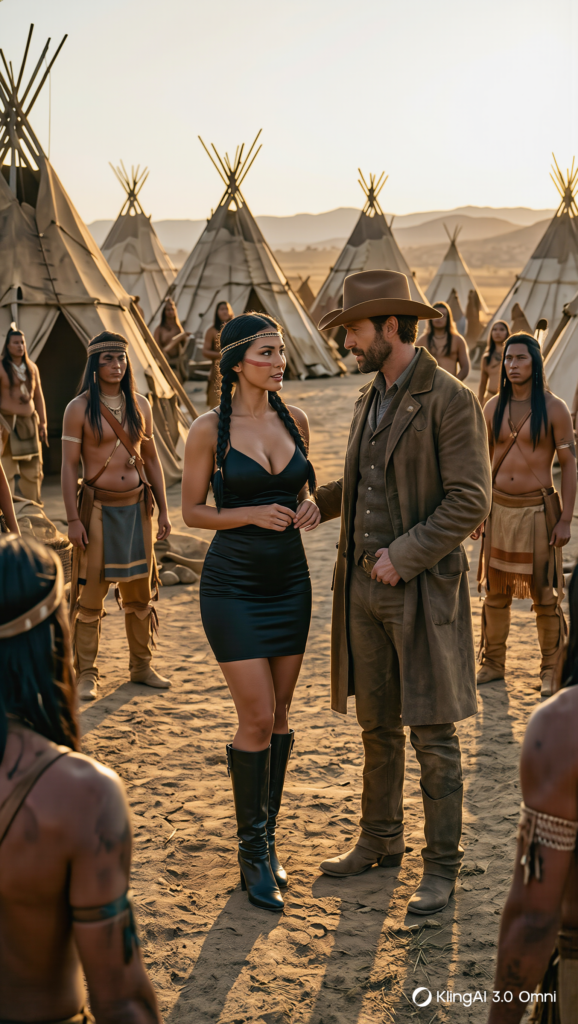
There were men, yes, but also women with cradleboards on their backs. Elders bent with age, riding with quiet dignity. Children sitting two to a horse, wide-eyed and curious. Pack ponies laden with blankets, cooking pots, and bundles of dried food. They came the way families come to a homecoming, not the way armies come to war.
At their head rode Nantan. Just behind him, on the chestnut mare Jack had freed from the rocks, rode the young woman from the creek.
The two groups halted perhaps fifty yards apart, with Jack Carter standing alone in the open ground between them.
For a long moment, the only sound in the valley was the wind moving through the grass.
Then one of Crane’s hired guns raised his rifle to his shoulder.
“Don’t,” Jack said.
He said it quietly, but something in his voice cut through the air like a blade. He turned his back on the Apache riders entirely and walked straight toward the townsmen until he was close enough to see the sweat on their brows.
“Look at them,” he said. “Go on. Look. You see war paint? You see a war party? I see grandmothers. I see children. I see families who have come to this creek every spring since before any of you were born. Since before your fathers were born.”
“Lies,” Crane snapped. “He’s been bought.”
“Bought with what?” Jack turned to face him. “A basket of herbs? A loaf of bread? A little wooden eagle?” He pulled the cedar carving from his coat pocket and held it up so that every man could see. “That’s what they’ve given me, Crane. That’s all they’ve ever given me. What have you given me? A chain on my gate. A word burned into my fence post.”
The sheriff’s head turned sharply. “What’s this about a fence post?”
“Come see for yourself, Sheriff. It’s still smoking at the edges.”
Crane’s jaw tightened. “This man is a liar and a squatter in league with—”
“I’m the lawful owner of this land,” Jack said, “and I’ve got the deed to prove it. Which is more than I can say for your claim on it.”
Samuel Briggs, the old rancher from the general store, slowly lowered his shotgun. He was staring past Jack at an elderly Apache woman who had dismounted and was helping a small boy down from his pony. She steadied the child with a gentle hand on his shoulder, just as Samuel’s own wife used to do with their grandchildren.
“Silas,” Samuel said slowly, “you told us they were coming to burn us out.”
“And they will—”
“With babies on their backs?” Samuel’s voice cracked with something between shame and anger. “I’ve lived in this county thirty-one years. I never once saw one of them raise a hand against a white family on this land. Not once. You told us they ran off the Wilsons. But I knew Martha Wilson. She left because her husband died of fever and she couldn’t work the place alone. She went east to her sister’s. That’s all.”
A murmur moved through the townsmen. One by one, gun barrels began to drift toward the ground.
Crane saw his control slipping away, and his face darkened. “You’re all fools. That creek is the only year-round water for twenty miles. Whoever holds this land holds the whole valley. Do you understand what that means? Cattle. Money. Power. And you’d hand it to a drifter and a band of—”
“So that’s it,” Jack said softly. “It was never about protecting anyone. It was about the water.”
The silence that followed was heavier than any gunfire.
Nantan dismounted and walked forward without hurry until he stood beside Jack. He looked at the armed men from town, not with anger, but with a deep and weary patience, the patience of a man who had seen this same scene play out many times in many places.
“There is something you should all see,” he said.
From his saddlebag, he drew a bundle wrapped in soft, oiled leather. He unfolded it carefully, layer after layer, until he revealed a sheet of old paper, yellowed and creased with age but still whole. The handwriting upon it had faded to brown, yet it remained perfectly legible.
“This was given to my grandfather,” Nantan said, “by the first family to settle this valley. Their name was Wilson. Not Martha Wilson’s husband, but his father, Josiah. He came here with nothing. His first winter, his wife fell sick and his cattle were dying. My grandfather’s people found them half-starved by this creek. They gave them food. They showed them which roots would heal and which would kill. They kept that family alive until spring.”
He handed the paper to Jack.
Jack read it aloud, his voice carrying across the silent valley:
“Let it be known to all who come after: I, Josiah Wilson, owe my life and the lives of my family to the Apache people who share this valley. In gratitude, I make this promise, binding upon myself and upon every owner of this land who follows me. The creek shall remain forever open to any traveler in need of water, rest, or safety, regardless of who they are or where they come from. The spring gathering of our Apache neighbors shall never be prevented. This land was saved by trust, and on trust it shall stand.”
Below the words were two marks: Josiah Wilson’s signature, and beside it, a carefully drawn eagle in flight.
Jack looked from the paper to the small cedar carving in his hand. The shape was identical.
His throat tightened. He looked up and found the young woman watching him from the chestnut mare, and for the first time, he understood. The gifts had never been bribes. They had been a question. Are you the kind of man who will keep the promise?
“That’s a pretty story,” Crane said coldly. “But a scrap of paper with a drawing on it isn’t law.”
“Actually, Silas,” said a thin voice from the back of the column, “it might be.”
Every head turned. Elias Pruitt, the old land clerk, was climbing down from a rickety buckboard. He had evidently followed the posse out of town. Clutching a leather ledger to his chest, he hobbled forward, his spectacles flashing in the morning sun.
“I’ve been clerk in this county for thirty-eight years,” Pruitt said, a little out of breath. “When young Carter bought this property, something nagged at me. I went digging through the old record books last night. Took me till nearly dawn.” He opened the ledger with trembling hands. “Josiah Wilson didn’t just write that promise on a scrap of paper. He had it recorded as a covenant on the original deed. Filed proper. Witnessed. It runs with the land.” He looked up at Crane over his spectacles. “Which means anyone who owns this ranch is bound to keep that creek open. And it means no one can ever fence it off, dam it, or sell the water rights. Not Carter. Not you. Not anybody.”
Crane’s face went white, then red.
“That’s why every owner left,” Pruitt added quietly. “Not curses. Not raiders. Every one of them bought it hoping to control the water, found out they couldn’t, and sold out cheap. And I’d wager a certain cattleman encouraged a few of those sales along.”
Sheriff Ridley turned slowly in his saddle to face Crane. “Silas. You told me there was an attack coming. You told me this man was conspiring against the town. You had men burning warnings into a lawful owner’s property.” His voice hardened. “I think you and I need to have a long talk back in Red Creek.”
“You can’t prove anything.”
“Maybe not today,” Ridley said. “But I’m going to try. And I’d suggest you not set foot on this man’s land again.”
Crane looked around for support. His hired men had already lowered their rifles and were edging their horses backward. The townsmen would not meet his eyes. Samuel Briggs spat in the dust.
With a snarl of fury, Crane wheeled his black stallion around and drove his spurs in hard. His hired hands followed him at a gallop, and within moments they were nothing but a cloud of dust fading down the town road.
The valley stood still.
Then, slowly, the blacksmith set his shotgun against a fence post. The feed-store owner took off his hat. One by one, the men of Red Creek looked at the Apache families gathered by the creek, and in their faces Jack saw the dawning of something painful and necessary: the shame of having been so easily made afraid.
Samuel Briggs walked forward until he stood before Nantan. The old rancher’s hands shook as he removed his hat.
“I’ve spent years believing stories that weren’t true,” he said hoarsely. “I told this young man to stay away from your people. I’m sorry. I wish I’d known better sooner.”
Nantan studied him for a long moment. Then he placed his hand briefly on Samuel’s shoulder.
“It is never too late to remember,” he said.
The young woman slid down from the chestnut mare and walked toward Jack. Up close, he could see the fine scar across the back of her hand, the kind that comes from years of working sharp tools in wood and reed. In her other hand, she held the woven basket.
“My name is Ayasha,” she said. Her English was quiet but clear. “Nantan is my grandfather. I made the eagle.”
“It’s the finest thing anyone has ever given me,” Jack said, and he meant it.
“We have watched the owners of this land for many years,” she said. “Every one of them tried to chase us away. Some with words. Some with guns. When you came, my grandfather said, ‘Leave him a gift. See what he does with it.’” A small smile touched her lips. “You put the basket back where you found it. No one had ever done that before. That was when we knew.”
Jack looked at the basket, then at her, then at the families spreading blankets beneath the cottonwoods, the children already running toward the creek, the elders pointing to places that held memories older than the town itself.
“I almost sold this place the first day,” he admitted. “Crane offered me more money than I’d ever seen.”
“But you did not.”
“No,” Jack said softly. “I didn’t.”
Ayasha placed the basket in his hands. Inside lay a fresh bundle of sage.
“Then welcome home, Jack Carter.”
PART 3: KEEPER OF THE PROMISE
The gathering lasted four days.
The townsmen who had come to fight stayed to eat. It began awkwardly, with Samuel Briggs accepting a bowl of stew from the elderly woman he had watched help the little boy from his pony. Then the blacksmith’s sons began skipping stones with the Apache children at the bend of the creek, and their laughter rang off the hills until the grown men could no longer pretend to be strangers. By the second evening, someone had ridden back to town for a fiddle. By the third, the blacksmith’s wife had arrived with three pies and a dozen questions, and she spent the entire afternoon learning from Ayasha’s mother how to weave a basket from creek reeds.
Jack moved through it all in a kind of quiet wonder. He kept the fires stoked and the water buckets full. He listened as the elders, with Nantan translating, told stories of the valley: the winter the creek froze solid and the people survived by melting snow, the summer a great fire swept the plains but stopped at the water’s edge, the spring a young Josiah Wilson knelt by this very creek, half-dead with grief and hunger, and was lifted to his feet by strangers who owed him nothing.
“He kept his word for forty years,” Nantan said one night, staring into the fire. “His son kept it after him. Then his son died, and the promise was forgotten. Fear filled the space where memory should have been. That is how it always happens. Not with a war. With forgetting.”
Jack turned the cedar eagle over in his fingers. “I’ll remember.”
“I know,” Nantan said simply. “That is why we came.”
On the fourth morning, the families packed their horses and prepared to ride for their summer grounds beyond the hills. One by one, they came to Jack before leaving. Some pressed his hand. Some said words in their own language that he did not understand but felt nonetheless. An old woman tied a small leather pouch of sage to his porch post. A little boy, perhaps six years old, solemnly presented him with a perfectly smooth creek stone and then ran away giggling.
Nantan was the last of the elders to mount. He looked down at Jack from his saddle, and for a moment the stern lines of his face softened into something almost like a father’s pride.
“We will come again in the spring,” he said.
“The gate will be open,” Jack replied. “It always will be.”
Ayasha was the very last to leave. She sat atop the chestnut mare and looked out over the valley: the repaired fences, the cleared trails, the cabin standing a little straighter now than it had a month ago.
“Spring is a long time,” she said.
Jack felt his face grow warm. “It is.”
“Perhaps,” she said, gathering her reins, “the mare will need her leg looked at before then. She is very fond of you.” And with the faintest smile, she turned and rode after her people.
Jack stood at the gate and watched until the last rider vanished over the ridge.
Silas Crane never returned to the valley. Within the year, Sheriff Ridley had gathered enough testimony from Crane’s own hired men about the chain, the branded fence post, and certain fires on certain neighboring ranches years before to bring charges in the territorial court. Crane sold his cattle holdings to pay his lawyers and left the county in disgrace. Few in Red Creek mourned his going.
Elias Pruitt framed a copy of Josiah Wilson’s covenant and hung it on the wall of the land office, where every person who came to buy property in the county would see it. “Let them remember,” the old clerk said, “that some things on this land were never for sale.”
As for Jack Carter, the town that had once laughed at him slowly learned to look at him differently. Ranchers began stopping by to water their horses at the creek and stayed to talk. Samuel Briggs came every Sunday, ostensibly to help mend fences, though mostly to sit on the porch and tell stories. The children of Red Creek grew up hearing about the cowboy who bought the ranch nobody wanted and turned out to be the only man in forty years worthy of it.
And the chestnut mare did, as it happened, seem to need her leg looked at. Quite often, in fact. Each time, she came ridden by a young woman with a basket on her arm and a fine scar across the back of her hand.
When spring returned, the riders appeared on the ridge at dawn, just as they had for generations. But this time, they did not stop and watch from a distance.
This time, they rode straight down into the valley, and waiting at the open gate to greet them, hat in hand, stood the man who had kept the promise.
Beside him, on his porch, a small cedar eagle sat in a place of honor, its wings spread wide, as if it were still flying.
The ranch nobody wanted was no longer forgotten. It had become what Josiah Wilson had always meant it to be: a place where fear gave way to trust, where old wounds gave way to new friendships, and where every traveler, whoever they were and wherever they came from, could find water, rest, and a welcome.
Because Jack Carter had learned what the people of Red Creek had spent forty years forgetting.
The strongest fences are not built from wood and wire.
They are built from the promises we choose to keep.