PART 1: THE WOMAN UNDER THE CANVAS
The first gray light of dawn crept over Dry Creek like a thief, slipping between the false-fronted buildings and settling on the dusty street in a pale, uncertain wash. The town still slept. Somewhere near the square, the baker had lit his ovens, and the smell of warm bread drifted through the cold air like a promise nobody had made.
John Harper pulled the last rope tight across his wagon and tested the knot with a hard tug. Flour. Wool blankets. Two crates of tools. A small box of medicine wrapped in oilcloth. Three days to the Kessler ranch, three days back. He had made this run more times than he could count, and he liked it that way. Predictable roads made for a quiet life, and a quiet life was the only kind John had ever trusted.
His old bay horse stamped impatiently in the harness.
“Easy, Rusty,” John murmured, scratching the animal’s neck as he climbed onto the seat. “Long road ahead of us.”
He was thirty-four years old and looked older. The frontier did that to a man: carved lines around his eyes, weathered his hands into leather, and taught him to say little and notice much. Folks in Dry Creek knew him as honest, fair, and private. They knew he’d lost his mother to fever when he was a boy, and his father, Thomas Harper, to a wagon accident on the Comanche Pass twenty years ago. They knew he didn’t drink much, didn’t gamble at all, and never went looking for trouble.
And trouble, as a rule, had never come looking for him.
That was true until the moment the wagon reached the edge of town.
It was a sound so faint he almost dismissed it. A shift of weight behind him. A breath, careful and held, the way a person breathes when they are trying very hard not to exist.
John stopped the wagon.
He turned on the seat. Nothing. Only crates and sacks under the heavy brown canvas, the same as he’d loaded them. But Rusty had swung his head around, ears pricked toward the wagon bed, nostrils flaring.
The horse had heard it too.
John set the brake, climbed down, and walked slowly to the back of the wagon. His hand hovered near the Colt on his hip, though some instinct told him he would not need it. He gripped a corner of the canvas and drew it back.
For a moment the whole world went still.
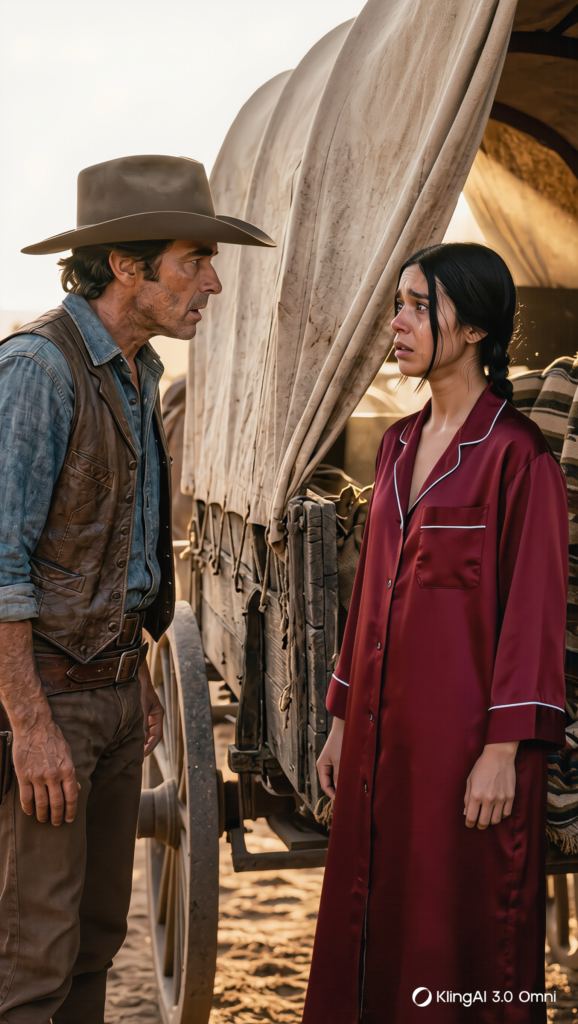
Wedged between the flour sacks and the folded blankets, knees drawn to her chest, lay a young woman. An Apache woman, no more than twenty-five, her long black hair half-escaped from a braid, her plain calico dress stained with dust and something darker at the hem. Her face was hollow with exhaustion. A thin scratch ran along one cheekbone.
But it was her eyes that froze him.
They held no anger. No cunning. Only fear: deep, bone-level fear, the kind John had seen once before, on the face of a boy caught in a flash flood, clinging to a branch as the water rose.
Slowly, she lifted both hands, palms open.
“I’m sorry,” she said, her English careful and soft. “Please. Don’t make me go.”
John took a step back. “Who are you?”
“My name is Ayana.”
“How’d you get in my wagon?”
“Before dawn. While it was still dark.” She swallowed. “I watched you load it. You didn’t lock anything. You checked on your horse twice. I thought… a man who checks on his horse twice might not be cruel.”
John rubbed the back of his neck, trying to make sense of it. “You could’ve asked for help.”
“I couldn’t.” Her voice dropped to almost nothing. “If anyone in that town had seen me, they would have taken me. And no one would have asked what happened after.”
He studied her for a long moment. She looked starved. She looked like she hadn’t slept in days. More than anything, she looked like someone who had run out of places to run.
Without a word, he reached into the small wooden box beneath the seat and handed her the heel of a loaf and his canteen.
She took them the way a person handles something that might be snatched back. “Thank you,” she whispered.
He opened his mouth to ask the hundred questions crowding his throat, and that was when he heard it.
Hoofbeats.
Not one horse. Several. Coming hard down the main street behind them, the rhythm sharp and deliberate in the morning hush.
The change in Ayana was instant and terrible. Whatever small relief had touched her face drained away. She looked past him toward the road, and then back at him, and her hands began to shake so badly that water spilled from the canteen onto the flour sacks.
“They’re looking for me,” she said.
“Who is?”
“There’s no time to explain.”
The riders were close now. John could hear their voices, rough and carrying. One of them shouted down the street, “You there! Hold that wagon!”
Ayana grabbed his sleeve. Her fingers were ice cold. She looked straight into his eyes, and her voice came out low and urgent and utterly naked.
“Please.”
He waited.
“Please. Pretend I’m your wife. Just until we’re out of this town.”
John stared at her.
It was the strangest thing anyone had ever asked of him. He knew nothing about this woman except her name. He didn’t know what she’d done or what she was running from. She might be a thief. She might be lying. Helping her might put a rope around his own neck.
But he had spent his life reading weather, reading horses, reading men across a trading table. And he knew, with a certainty that lived somewhere below thought, that what he was looking at was not guilt. Not deceit.
It was pure, desperate fear.
His mother’s old bonnet lay folded among his things, a faded blue thing he’d never had the heart to throw away. He pulled it out and pressed it into her hands.
“Put this on,” he said quietly. “Sit up front. Keep your head down. Don’t speak unless I do.”
She obeyed without a word. By the time the riders reached them, Ayana sat beside him on the wagon seat, the bonnet shading her face, her hands folded tight in her lap like any tired settler’s wife at sunrise.
Four men circled the wagon. Three were hired guns. John could tell by the way they sat their saddles, loose and bored, hands never far from their holsters. But the fourth was different. He was tall and lean, dressed in a black coat too fine for the trail, with a silver star pinned not to his chest but to his hatband, as though law were an ornament. His eyes were pale, almost colorless.
“Morning,” the man said. “Name’s Silas Crane. I work for Mr. Elias Whitmore.”
John knew the name. Everyone did. Whitmore owned the bank in Dry Creek, the land office, half the cattle range west of the river, and, it was whispered, a good many of the men who were supposed to keep him honest.
“John Harper,” John said. “Freight hauler.”
“Harper.” Crane rolled the name around his mouth like a stone. “We’re looking for an Apache woman. Young. Long hair. She stole something from Mr. Whitmore’s office two nights ago. You seen her?”
John felt his heart hammering against his ribs. Beside him, Ayana had gone so still she seemed carved from wood.
“My wife and I haven’t seen anybody on this road,” he said.
Crane’s colorless eyes slid to the woman in the bonnet. They stayed there.
“Your wife,” he repeated. “Didn’t know you’d married, Harper.”
“Didn’t know you kept track.”
One of the gunmen chuckled. Crane didn’t. He nudged his horse closer, close enough that John could smell the cigar smoke on his coat.
“Ma’am,” Crane said. “Look at me.”
The silence stretched until it felt like a wire about to snap. John’s hand drifted, slow as honey, toward his hip.
Then Ayana lifted her head, just enough. The bonnet’s shadow lay across her eyes. And she spoke, in a voice John had not heard from her, flat, weary, and unmistakably frontier-born.
“Mister, we’ve got three days of road and a bay horse with a bad hock. If you’re going to stare, stare quick.”
Crane looked at her for a long, long moment.
Then, slowly, he smiled. It was not a pleasant smile.
“Fair enough,” he said. He straightened in the saddle. “You see a woman like that traveling alone, Harper, you report it at the next town. Mr. Whitmore pays well for good citizens.”
“I’ll keep that in mind.”
The riders wheeled their horses and thundered back toward town, the dust of their passing hanging in the gold-gray air. Neither John nor Ayana moved until the sound had faded entirely.
Only then did John let out the breath he’d been holding.
“You can take the bonnet off,” he said.
She removed it with trembling hands. “Where did you learn to talk like that?” he asked.
“From a mission school. They tried very hard to make me sound like someone else.” She pressed the bonnet back into his hands, carefully, as though she understood it mattered. “I’m sorry. I never meant to put you in danger.”
John looked out at the long empty prairie stretching west. “I think,” he said, “you’d better start explaining.”
She told him in pieces as the wagon creaked across the grassland and hawks wheeled high in the cold blue sky.
Months ago, she said, she had found a wounded trader by the river, his wagon overturned in a storm, his leg broken. Her family had carried him to their camp and nursed him back to health. When he returned to Dry Creek, he repaid them by telling everyone he’d seen something valuable hidden near their land.
“Gold?” John asked.
“That’s what people chose to believe.” She shook her head. “Men came searching. Then Whitmore’s men came. They burned our lodges. They took my father to Dry Creek and said he would be released if he gave them what he was hiding.”
“Was there anything to give?”
She hesitated. And in that hesitation, John understood that the story she was telling him was true, but not complete.
By noon they stopped beneath a great cottonwood beside a narrow creek. Without being asked, Ayana gathered dry branches and filled the bucket. John warmed beans over a small fire, and they ate in a silence that should have felt awkward and somehow didn’t.
But all afternoon, she kept looking back.
And near three o’clock, John saw why. A plume of dust hung on the horizon behind them. Too steady for wind. Too patient for travelers.
“They’re keeping their distance,” he said. “Crane didn’t believe a word of it. He’s letting us lead him somewhere.”
He climbed down and studied the ground. Fresh hoofprints, four horses, had joined the road behind them that morning.
When he climbed back up, his face had changed.
“There’s a trail through the hills,” he said. “My father showed it to me when I was a boy. Slow and rough, but few men know it.”
Ayana looked at him in astonishment. “You’d change your road for someone you met this morning?”
“I still don’t know your whole story.”
“Then why help me?”
He considered the question honestly. “Because fear like yours can’t be faked.”
As the light softened into evening, John turned Rusty off the main road and into a narrow, winding trail between the hills. Behind them, the dust cloud rolled on along the flats, and for a little while, John believed they had vanished.
They made camp that night in a hollow among the pines, with no fire, wrapped in the blankets meant for the Kessler ranch. The stars burned cold and fierce overhead.
John couldn’t sleep. Near midnight, he heard Ayana shift. When he turned, she was sitting up, holding something in her lap: a leather-bound book, its cover cracked, tied with rawhide.
“That’s what you stole,” he said quietly.
“It was never his to own.” She ran her thumb along the spine. “My father gave it to me the night they took him. He told me to carry it to a man named Tobias Reed, at the old trading post on Ash Creek. He said if anything happened to him, this book was the only thing left that could make it right.”
“What’s in it?”
She was silent a long time. When she finally spoke, her voice shook.
“I was going to wait until I was sure I could trust you. But you deserve to know before you risk anything more.” She opened the book and turned it toward the starlight. “I read it, John. In the wagon, before dawn. I recognized your name the moment you told it to Crane.”
A cold feeling crawled up John’s spine.
“Your father’s name is in this book,” she whispered. “Thomas Harper. And so is the name of the man who killed him.”
John’s mouth went dry. “My father died in an accident. His wagon went off the Comanche Pass.”
“No.” Her eyes glistened in the dark. “It didn’t.”
Before he could answer, a sound cut through the night behind them.
The slow, deliberate click of a rifle hammer being drawn back.
And out of the blackness between the pines, a familiar voice, smooth as cigar smoke, drifted toward them.
“Evening, Mr. Harper. You’ll want to tell your wife to hand me that book. Slowly.”
PART 2: THE LEDGER OF PROMISES
Nobody moved.
The voice came from somewhere up the slope, among the black trunks. John couldn’t see Crane, but he could feel him, the way you feel a storm before the first drop falls. Beside him, Ayana had drawn the journal to her chest so tightly her knuckles shone pale in the starlight.
“I’m a patient man, Harper,” Crane called. “But my men aren’t. One of them’s got a bead on your horse. Another’s got one on you. I’d hate for this to get untidy.”
John’s mind raced. Rusty was hobbled twenty feet away. The wagon stood between them and the slope. His rifle was under the seat, his Colt on his hip, and he could count on one hand the times he’d fired at a man.
Then he remembered the hollow.
His father had camped here, years ago, with a boy of ten who asked too many questions. Why here, Pa? And Thomas Harper had pointed to the dry wash cutting behind the pines. Because a place with one way in is a trap, son. Always camp where there’s a back door.
“Ayana,” John breathed, barely moving his lips. “When I stand up, you roll behind the wagon and run for the wash. Don’t stop.”
“I won’t leave you.”
“You’ll leave me, or that book dies here with both of us.”
She stared at him. Then, almost imperceptibly, she nodded.
John rose slowly, hands lifted. “Alright, Crane. You win. Come get it.”
“Toss it out where I can see it.”
“She’s got it. Give her a second, she’s scared half to death.”
And in the instant Crane’s attention shifted to the shadow of the woman, John snatched the lantern from the wagon seat, struck it against the iron wheel rim, and hurled it into the dry pine needles at the foot of the slope.
The oil caught with a roar.
Flame leapt up in a bright, sudden wall between the camp and the trees. Horses screamed. A rifle cracked, and the bullet split the air beside John’s ear. He threw himself toward Rusty, slashed the hobbles with his knife, and hauled himself onto the bare back of the horse he had raised from a foal.
Ayana was already in the wash, running. John reached down, caught her arm, and swung her up behind him. Rusty plunged down the dry creek bed into the dark, gravel spraying beneath his hooves, while shouting and gunfire and firelight fell away behind them.
They rode until the stars began to fade.
They lost the wagon. They lost the flour, the blankets, the medicine, the tools, everything John had owned that was worth carrying. All they had left was one tired horse, one rifle, his mother’s faded bonnet stuffed in his coat, and a leather journal held against Ayana’s heart.
In the cold blue hour before sunrise, they stopped at a seep spring among the rocks to water Rusty. John sat on a boulder and stared at nothing.
Ayana sat beside him. For a long while, neither spoke.
“Tell me,” he said at last. “All of it.”
She opened the journal on her knees. The first pages were written in a strong, slanted hand, English mixed with Apache words John didn’t know, and sketched maps of rivers and hills.
“My father’s name was Nantan,” she said. “Twenty years ago, there was a winter so cruel the old ones still call it the Starving Moon. Settlers were dying on the plains. Families lost in the snow. My father and a white freighter found a wagon train frozen near the Ash Creek crossing. They worked together all that winter, guiding families to shelter, sharing food from our stores with settlements that had nothing.”
She looked up at him.
“The freighter was your father.”
John felt something crack open inside his chest. “He never told me.”
“Mine never told me either. Not until the night they took him.” She turned a page. “When spring came, they made promises. Your father, mine, and a few settlers. They wrote them here. Land along Ash Creek would be shared. Water rights divided fairly. Every family who survived that winter signed this ledger.”
John leaned closer. There they were: names and marks, dozens of them, inked across the yellowed pages. And among them, in a hand he would have known anywhere, the hand that had once written his name in the family Bible: Thomas J. Harper.
His throat closed.
“Then a young land agent arrived,” Ayana continued quietly. “Elias Whitmore. He forged new deeds and claimed the Ash Creek land for himself. Families who refused to sell were driven out. Your father started gathering proof. He wrote it all here.” She turned to the final entries, and the handwriting grew hurried, ragged. “He planned to carry this book to a territorial judge. He told my father he was leaving by the Comanche Pass.”
She didn’t have to finish. John read the last line himself, written in Nantan’s hand, a few weeks after the date his father had died:
Thomas did not reach the judge. Whitmore’s man Crane was seen on the Pass that morning. The wagon did not fall. Hide the book. Wait until someone will listen.
John closed his eyes.
Twenty years. Twenty years he had believed his father died through bad luck and a loose wheel. Twenty years he had nodded politely to Elias Whitmore on the street, had banked in his bank, had hauled freight on roads Whitmore’s money had paved.
When he opened his eyes, they were wet, and he did not try to hide it.
“Why now?” he asked hoarsely. “Why did they come for your father now, after all this time?”
“Because Whitmore is seeking appointment as territorial governor. A man like that can’t afford a book like this to exist.” She touched his hand, tentatively. “My father kept it hidden for twenty years, waiting for someone to listen. Now there’s no one left to wait.”
John looked down at her hand on his. Small. Calloused. Brave in a way he had never had to be.
“There’s me,” he said.
The old trading post on Ash Creek stood alone beside a dried streambed, its weathered sign creaking in the wind. REED’S GOODS & POST. The letters had faded nearly to ghosts.
“Nobody’s done business here in years,” John said.
“Someone still lives here,” Ayana answered.
The door opened before they reached the porch. An old man stood in the frame, silver-haired, leaning on a hickory cane, his face cracked like a dry riverbed. His eyes fell on Ayana, and something in them broke and mended in the same moment.
“I’ve been waiting for you, child,” he said. “Nantan told me you’d come if the worst happened.”
Then his gaze moved to John and stopped. He stared. He gripped the doorframe.
“Lord help me,” Tobias Reed whispered. “You have Tom’s face.”
Inside, the post was warm and cluttered: shelves of old books, maps pinned to the walls, a coffeepot hissing on the stove. Tobias poured three cups with shaking hands and sat heavily across the table.
“Your father was the best man I ever knew,” he said to John. “Him and Nantan both. When Tom died, Nantan and I knew it was murder. But we had no proof beyond this book, and no judge in this territory Whitmore didn’t own.” He spread his gnarled fingers on the table. “So we waited. And we grew old waiting.”
“There’s a judge now,” Ayana said. “Samuel Brooks, in Cedar Falls.”
Tobias nodded slowly. “Brooks is honest. Maybe the only honest one left. If anyone can stand against Whitmore…”
He never finished.
Through the open window came the sound they had all been dreading: hoofbeats, many of them, drumming across the flat.
John stepped onto the porch. A column of riders was coming from the east, eight at least, dust boiling behind them. At the front rode a tall, lean figure in a black coat.
“Crane,” John said. “He’s brought more men.”
Tobias was already moving. With surprising strength, he shoved aside a heavy wooden cupboard beside the hearth. Beneath it lay a trapdoor.
“My grandfather dug this tunnel during the raids of ‘51,” he said. “It runs under the creek bed to the cottonwoods. There’s a horse tethered there. Always keep one ready. Old habit.”
“Come with us,” Ayana pleaded.
Tobias smiled, gentle and tired. “Child, these knees couldn’t crawl twenty feet. Somebody has to keep Crane talking while you run. I’ve waited twenty years to do something for Tom Harper. Let me.”
John gripped the old man’s hand. “We’ll come back for you.”
“I know you will.” Tobias’s eyes were bright. “You’re his son.”
They dropped into the darkness. The trapdoor closed above them. And as they crawled through the cold, earthen tunnel, John heard boots thunder across the floorboards overhead, and Tobias Reed’s voice, steady and unafraid:
“Gentlemen. Coffee’s on. Afraid you’re about twenty years too late.”
They rode north for two days on Tobias’s sturdy mare and John’s faithful Rusty, sleeping in turns, eating little, avoiding every road. On the second evening, they reached the Pecos crossing, the last barrier before Cedar Falls.
The river was high with autumn rain, brown and fast.
They were halfway across when the first shot rang out.
Crane had not gone to Tobias’s post with all his men. He had sent riders ahead, guessing where any honest man would carry such a book. Now four of them burst from the willows on the far bank.
“Go back!” John shouted.
But behind them, on the bank they had just left, Crane himself appeared, black coat whipping in the wind.
They were caught in the middle of the river.
A bullet struck John high in the left shoulder. The world turned white, then red. He swayed in the saddle, and the current seized Rusty’s legs. Horse and rider went down into the churning brown water.
“John!”
He came up gasping, one arm useless, the river dragging him downstream. Through a blur of water and pain, he saw Ayana on the mare, the journal clutched in one hand, gunmen closing on her from both sides.
She looked at the journal. She looked at John, drowning.
And she made her choice.
She threw the journal, hard and high, onto a sandbar thick with willows, then kicked the mare straight into the current after him. She caught his collar with both hands and held on as the river swept them around the bend and away from the guns.
When they finally dragged themselves onto a muddy bank a half mile downstream, John lay shuddering in the reeds, blood soaking his shirt.
“The book,” he choked. “Ayana, the book…”
“I know.” Tears ran down her face, mixing with river water. “I know. Twenty years my father protected it. And I threw it away.”
“Why?”
She pressed her palm hard against his wound, and her voice broke apart.
“Because you were worth more.”
On the far side of the river, as dusk swallowed the valley, they watched Silas Crane wade his horse onto the sandbar, lean down from the saddle, and lift something small and dark from among the willows.
He held it up to the dying light.
Then he turned toward Cedar Falls and rode.
PART 3: WHAT THE RIVER COULDN’T TAKE
Ayana bound John’s shoulder with strips torn from her own dress and her mother’s knowledge of healing herbs. Rusty, impossibly, came limping out of the dusk, battered but alive, and nuzzled John’s face until he laughed through the pain.
“We’ve lost,” John said quietly as the stars came out. “Crane has it. By morning it’ll be ashes in Whitmore’s stove.”
Ayana was silent for a long time. Then she reached into the bodice of her torn dress and drew out a small oilskin packet, flattened and damp.
“My father taught me something,” she said. “Never carry the whole of anything precious in one place.” She unfolded the packet. Inside were six pages, carefully cut from the journal: the signatures of every family from the Starving Moon winter, Thomas Harper’s evidence of the forged deeds, and Nantan’s final entry naming Crane on the Comanche Pass.
“I cut them out in your wagon,” she whispered, “the morning I hid there. Before I knew whether I could trust you.”
John stared at her. Then he started laughing, laughing until his shoulder screamed, laughing with tears in his eyes.
“Crane rode off with an empty book,” he said.
“An empty book,” she agreed, smiling for the first time in days. “Full of old maps and trading accounts.”
Judge Samuel Brooks was a stooped, white-bearded man with spectacles perched on a sharp nose and a reputation for having never once taken a dollar he hadn’t earned. When a wounded freighter and an Apache woman in a torn dress walked into his office at dawn, he did not send them away. He listened.
He read the six pages three times. He compared the signatures against land records in his own archives. When he finally set them down, his hands were not quite steady.
“I knew Thomas Harper,” he said. “He wrote to me, twenty years ago. Said he was bringing proof of something terrible. He never arrived.” He looked at John over his spectacles. “I’ve wondered every day since.”
Within a week, word spread across the territory. Judge Brooks was calling a hearing on the Ash Creek deeds, and anyone who had survived the winter of the Starving Moon was invited to speak.
They came. Old men on crutches. Widows in faded shawls. Grandchildren of families long scattered. One by one, they stood before the judge and confirmed what the pages said: the shared promises, the fair trades, the families saved by a white freighter and an Apache guide, and the land later stolen by forged ink.
Elias Whitmore arrived with three lawyers and the confident air of a man who had bought every outcome he’d ever wanted. He smiled through the testimony. He smiled when he produced the journal Crane had recovered and showed the court its harmless pages.
His smile died when Judge Brooks laid the six missing pages beside it, and they fit the cut edges perfectly.
Then the final witness walked through the door, leaning on a hickory cane, one arm in a sling.
Tobias Reed.
Crane’s men had beaten him and left him for dead in the ruins of his trading post. But a Mescalero hunting party, Nantan’s kin, had found him the next morning. And the old man had kept something too: a twenty-year-old letter from Thomas Harper, describing the threats he’d received from Silas Crane.
Silas Crane was arrested that afternoon trying to ride south. Faced with the gallows, he did what such men always do. He talked. He named the man who had paid him to send Thomas Harper’s wagon off the Comanche Pass.
Elias Whitmore was taken from Cedar Falls in irons. The Ash Creek deeds were declared fraudulent. And Nantan, held for weeks in a storeroom behind Whitmore’s land office, walked free into the sunlight, thin and gray, and wept as his daughter ran into his arms.
John stood at a distance, watching. He felt Ayana’s father look at him over her shoulder. Nantan crossed the street slowly and studied his face for a long while.
“You have his eyes,” the old man said finally. “Thomas would be proud of his son.”
John found that he couldn’t speak at all.
The seasons turned slowly over the frontier.
Ash Creek ran again with the spring rains, and the land along its banks was divided as the old ledger had promised: Apache families and settlers sharing water, trading grain and horses, gathering around the same fires to tell the same stories from different sides. The old distrust didn’t vanish overnight. But respect grew, one harvest, one handshake, one conversation at a time.
John rebuilt Tobias Reed’s trading post with his own hands. The old man sat on the porch most afternoons, telling anyone who’d listen about Tom Harper and the winter of the Starving Moon.
And John kept finding reasons to drive his new wagon into the valley.
One warm autumn evening, a year to the day after he’d found her beneath the canvas, he pulled up at the edge of the village. Ayana was waiting, laughing, her hair braided with a ribbon the color of the sky.
“You’re late,” she said.
“Stopped for fresh flour. Somebody keeps asking for more bread.”
They unloaded together while children chased each other through the long grass and the elders watched with quiet contentment. Then, as the sun began to sink, they climbed the small hill overlooking Ash Creek, where both their fathers had once stood in the snow and made promises to strangers.
Ayana looked out over the valley.
“The morning I climbed into your wagon,” she said softly, “I believed I had nowhere left in the world to go.”
“And now?”
She turned to him. And John reached into his coat and drew out something faded and blue: his mother’s bonnet, the one that had turned a terrified stranger into his wife for the space of a lie.
“I’ve been carrying this a year,” he said, his voice rough. “I figure I’ve been pretending long enough. I’d like it to be true.”
Her eyes filled. She took the bonnet in both hands, the same careful way she’d held it that first morning, as though she understood exactly what it meant.
“Yes,” she whispered. “Yes, John Harper.”
Below them, lamps flickered on one by one in the homes along the creek, Apache and settler side by side, and the evening wind swept across the prairie carrying the scent of sage.
Sometimes the greatest journeys don’t begin with a map or a destination. Sometimes they begin with a faint sound beneath a canvas, a whispered plea, and a single decision to trust someone the rest of the world has decided to hunt.
John Harper had spent twenty years believing his father died by accident.
He learned instead that his father died keeping a promise.
And in the end, the son kept it for him.