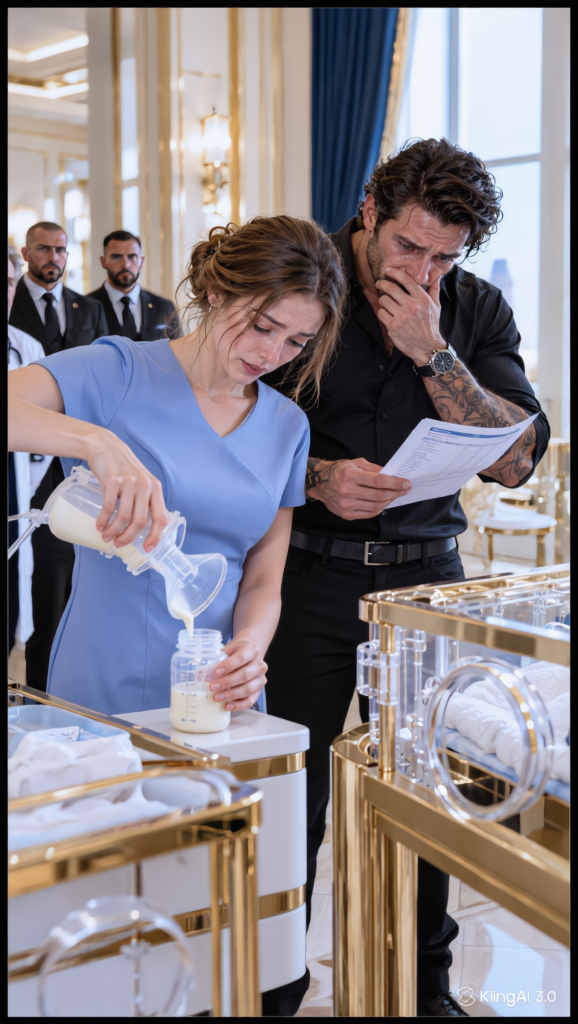
PART 1: THE WEIGHT OF NOTHING
The scale said 5.9 kilograms.
Elena Hart read the number twice, then a third time. The digital display glowed a pale, indifferent blue in the darkened nursery. Beneath her palms, Luca Moretti lay naked on the warm padding, his tiny chest rising and falling too fast. The skin over his ribs was so thin she could count every bone. His eyes, the same storm-dark grey as his father’s, tracked her face with a solemn, exhausted patience that no five-month-old should possess.
Three days ago, at the end of her last shift, he had weighed 6.2.
“You were doing so well, sweetheart,” she whispered, lifting him back into his blanket. He didn’t cry. That frightened her more than anything. Healthy babies screamed when they were cold. Healthy babies fought. Luca simply curled his fingers around her thumb and held on, as if he had already learned that the world could be taken from him at any moment.
Elena had been a pediatric nurse for nine years. Six of them were spent in the neonatal intensive care unit at St. Bartholomew’s, until the night a frightened junior doctor misread a chart and a premature girl named Rosie stopped breathing. Elena had been the one holding her. The hospital needed someone to blame, and the doctor’s father sat on the board. Her license survived the inquiry. Her career did not. Now she worked through a discreet private agency that asked very few questions, taking the night shifts nobody else wanted, in houses where the money was old or the money was dirty.
The Moretti estate was the second kind.
She had known it the moment the agency car turned through the iron gates on her first night, three weeks earlier. There were men at the gate who didn’t look like gardeners, men on the roof who didn’t look like roofers, and a silence in the vast stone house so heavy and absolute that it felt like a held breath. Nobody said the word mafia. Nobody had to. The city’s newspapers had been printing Dante Moretti’s name for a decade, always beside words like alleged and acquitted and witness withdrew testimony.
She had met him exactly once, on that first night.
He had been standing in this nursery at two in the morning, still in a charcoal suit, his tie gone, his sleeves rolled to the elbow. He was tall and broad through the shoulders, with a hard, beautiful face that looked carved rather than born. He hadn’t turned around when she entered. He was watching his son sleep.
“You’re the new one,” he had said. Not a question.
“Elena Hart. From the Whitmore Agency.”
“Four nurses before you, Miss Hart. Three pediatricians. A gastroenterologist who cost me more than most men earn in a year.” He finally turned. His eyes were cold and grey and utterly empty, the eyes of a man who had made his peace with doing terrible things. “My son is still dying. Do you know why?”
“Not yet,” she had said.
Something had flickered across his face then. Not warmth. Recognition, perhaps, that she hadn’t lied to him. “When you do,” he said, “you come to me. Not to my sister-in-law. Not to my men. To me.”
Then he had left, and she had not seen him since.
Elena wrapped Luca in a fresh blanket and settled into the rocking chair by the window. Rain whispered against the glass. Beyond it, the dark lawns of the estate rolled toward a black line of trees. She reached for the bottle warming in the electric cradle on the side table, the one she had prepared herself an hour earlier, and Luca latched immediately, sucking with a desperate, greedy hunger that made her throat ache.
He always ate for her. That was the first thing that had nagged at her.
The day staff’s logs, written in the neat, looping hand of the head nanny, Mrs. Pruitt, told a different story. Refused bottle. Took 40ml. Vomiting after feed. Loose stools x4. Lethargic. Day after day, the same grim litany. But on Elena’s nights, Luca drank everything she gave him and slept peacefully afterward. His diapers were normal. His color improved.
At first she had assumed it was coincidence. Babies had good nights and bad days. But Elena was a woman who kept records the way other people kept diaries, and after the first week, she had started writing down his weight at the start and end of every shift in a small black notebook she kept in the pocket of her scrubs.
The pattern was undeniable. He gained weight at night, with her. He lost it during the day, with them.
Not with Mrs. Pruitt alone. The day rotation included the nanny, a young housemaid named Teresa, and Luca’s aunt, Vivian Castellano, the younger sister of Dante’s late wife. Isabella Moretti had died on the delivery table five months ago, hemorrhaging while her husband stood helpless in a corridor full of armed men. Vivian had moved into the east wing two days after the funeral. Everyone in the house spoke of her the same way: devoted, tireless, heartbroken. She held Luca for hours. She sang to him in Italian. She was the one who prepared most of his daytime feeds herself, because she said it was what Isabella would have wanted.
Elena had met her twice. Vivian was in her early thirties, elegant, dark-haired, with the kind of grief-softened beauty that made people lower their voices around her. She had been nothing but kind. She had brought Elena coffee on her second night and pressed her hand and said, Thank God you’re here. Nobody else has helped him.
Elena hadn’t liked how much she wanted to believe that.
At 3:40 a.m., once Luca was asleep in his crib, Elena did something she had been planning for two days.
She went down to the formula pantry.
It was a small, climate-controlled room off the main kitchen, lined with shelves of imported Swiss formula in elegant silver tins, the kind sold in pharmacies for the price of a decent dinner. The night staff were told to use the tins on the left shelf. Elena had always done so. But on her last shift, coming down early, she had seen Vivian leaving this room with a tin in her hand, and the tin had come from a cabinet on the right, a cabinet Elena had never been told about.
Now she opened it.
Inside were six silver tins identical to the others. Same brand. Same label. Same Swiss cross embossed in the lid.
Elena took one from each shelf and set them side by side on the counter under the light.
It took her almost a minute to see it. The lot number printed on the base of the left-hand tin began with the letters CH. The one on the right began with CN. The font was very slightly heavier. The silver of the lid was a shade too bright.
She pried both lids open. She took a clean scoop and leveled a measure of each onto separate white saucers.
The powder from the left tin was a fine, creamy ivory. The powder from the right tin was paler. Grainier. When she rubbed a pinch between her fingers, it felt chalky, almost gritty, and when she brought it close to her nose, under the sweet, milky scent of formula, there was something else. Faint. Bitter. Vegetal, like crushed leaves.
Her pulse began to pound in her ears.
She thought of the logs. Loose stools x4. Vomiting after feed. She thought of Luca’s sunken fontanelle on Tuesday night, of his dry, cracked lips, of how his little body was losing more than it was taking in. Somebody was diluting his food and lacing it with something that emptied him out. Not quickly. Not obviously. Slowly, steadily, the way water wears away stone, so that a parade of the city’s finest doctors would see a failing infant, order more tests, and find nothing, because nobody tests the formula tin in a billionaire’s kitchen.
Somebody in this house was starving a baby to death.
Elena pressed a hand flat against the counter to steady herself. Every instinct she had told her to run straight up the stairs and pound on Dante Moretti’s door. When you know, you come to me. But she had stood in a hospital boardroom once and told the truth to powerful men, and she had watched the truth be rearranged into something that destroyed her. She needed proof. Something nobody could explain away.
She found a sterile specimen jar in her medical bag and filled it with powder from the right-hand tin. She sealed it, labeled it with the date and lot number in her small, careful handwriting, and slid it into the inner pocket of her bag. In the morning she would take it to a friend at a private laboratory downtown, a woman who owed her a favor from St. Bartholomew’s. She’d have results within forty-eight hours. Then she would go to Dante.
She returned the tins exactly as she had found them and climbed the back staircase to the nursery, her heart still thundering.
She would remember, later, that the nursery door was open a few inches when she came back. She had closed it. She was certain she had closed it.
Luca was asleep. The room was still. Elena told herself she was being paranoid, the way people do when they are frightened and alone at four in the morning. She sat back down in the rocking chair, pulled out her black notebook, and began writing down everything she had found: the lot numbers, the texture, the smell.
She didn’t hear the footsteps until they were in the doorway.
“Elena?”
Vivian Castellano stood in the soft glow of the hallway light. She wore a silk robe the color of wine, her dark hair loose around her shoulders. Her face was pale and her eyes were wide. In her hand she held Elena’s medical bag.
Elena’s blood turned to ice. She had left the bag on the chair by the door when she’d checked on Luca. She hadn’t taken it to the pantry. She’d only taken the jar.
The jar was in the bag.
“I couldn’t sleep,” Vivian said softly. Her voice trembled. “I came to check on him, the way I always do. And your bag fell when I brushed past it. And this rolled out.”
She held up a small brown glass vial.
Elena had never seen it before in her life.
“What is that?” Elena asked, rising from the chair.
“You tell me.” Vivian’s voice cracked, rising toward hysteria. Tears spilled over her lashes. “It says senna concentrate. That’s a laxative, isn’t it? A strong one. For adults. Why would a baby nurse need a strong laxative in her bag?”
“That isn’t mine. Mrs. Castellano, listen to me, I found…”
“You’re the only one who’s here alone with him at night!” Vivian sobbed. “The only one! For three weeks!”
“Check the formula…”
“Dante!” Vivian screamed. The sound shattered the silence of the house like a pane of glass. “Dante, please, oh God, she’s been hurting him!”
Somewhere in the depths of the house, a door slammed. Heavy footsteps thundered on the stairs. Luca woke and began to wail, a thin, weak cry that tore straight through Elena’s chest. She moved instinctively toward the crib.
“Don’t you touch him!” Vivian lunged between them.
Then Dante Moretti filled the doorway.
He was barefoot, in black trousers and an undershirt, as though he had come straight from bed, but there was nothing sleepy about him. His eyes swept the room in a single cold glance: his weeping sister-in-law, his screaming son, the night nurse frozen beside the crib, the vial in Vivian’s hand.
Two of his men appeared in the corridor behind him, guns drawn.
“She was poisoning him,” Vivian wept, thrusting the vial toward him. “Dante, it was in her bag. All this time, all these doctors, and it was her.”
Elena saw the moment the words landed. She saw the grief he had been holding for five months, the helpless, impotent rage of a man who could command an army and still could not save his child, crystallize into something with a target.
“Mr. Moretti,” she said, and her voice came out remarkably steady. “It isn’t true. I came to you. I was going to come to you. Somebody is…”
Dante reached behind his back, and his hand came up holding a pistol. He didn’t rush. He raised it with the terrible, unhurried calm of a man who had done this many times, until the black muzzle stared directly at the center of Elena’s chest.
Luca screamed. Vivian sobbed. The rain hammered against the windows.
“You have ten seconds, Miss Hart,” Dante Moretti said quietly, “to give me a reason not to pull this trigger.”
PART 2: TEN SECONDS
Elena had spent nine years in rooms where a few seconds decided whether someone lived or died. She had learned that panic was a luxury, and that the mind, if you forced it, could slow time down to a crawl.
So she did not beg. She did not cry. She looked past the gun into Dante Moretti’s eyes and said the one thing she knew he could not dismiss.
“Your son weighed 5.9 kilograms an hour ago. Three days ago, at the end of my last shift, he weighed 6.2. Every night I’m here, he gains. Every day I’m gone, he loses. I have the numbers for twenty-one days, in my own handwriting, in the notebook on that chair. If I were poisoning him, he’d be worse on my nights. He’s better.”
The muzzle didn’t move. But his eyes flicked, for the briefest instant, to the black notebook lying open on the rocking chair.
“Seven seconds,” he said.
“There are two kinds of formula in your pantry. The tins on the left shelf are real. The tins in the cabinet on the right are fakes. Wrong lot code, CN instead of CH. The powder is pale and chalky and it smells bitter. I took a sample tonight. It’s in a specimen jar in that bag.” She nodded at the medical bag hanging from Vivian’s hand. “Labeled, dated, sealed. Ask yourself why a woman who keeps a laxative in her bag would also collect evidence against herself.”
“She’s lying,” Vivian whispered. “Dante, she’s a clever liar, she’s…”
“Four seconds.”
“Weigh him,” Elena said. “Keep me locked in a room where I can’t touch anything. Have your own people feed him from the left shelf for forty-eight hours. Test the tins. Test the vial for fingerprints. If I’m lying, you’ll know in two days, and I’ll still be here for you to shoot.”
The nursery fell silent except for Luca’s thin, hiccuping cries.
Dante Moretti stood motionless for a long moment, the gun level, his jaw a hard, unreadable line. Elena watched a muscle tick in his cheek. She understood that she was watching a man at war with himself: the father who desperately wanted someone to blame and the strategist who had survived twenty years by never trusting the obvious answer.
Slowly, he lowered the pistol.
“Marco,” he said, without turning his head. One of the men in the corridor stepped forward. “Take Miss Hart to the blue room in the west wing. Nobody goes in. Nobody comes out. Take her bag. Don’t open it.”
“Dante,” Vivian breathed, aghast. “You can’t possibly believe…”
“I don’t believe anything yet, Vivian.” He finally looked at his sister-in-law, and something in his flat voice made her fall silent. “That’s the point.”
As Marco took Elena by the arm, she twisted back toward the crib. “He’s dehydrated,” she said urgently. “His fontanelle was sunken on Tuesday. He needs oral rehydration solution in small, frequent amounts, not just formula, and if he gets floppy or stops making wet diapers, he needs a hospital immediately, not another specialist. Please. Whatever you think of me, please.”
Dante held her gaze. He said nothing. Then Marco pulled her out into the dark corridor, and the nursery door closed behind her.
The blue room was a guest bedroom with a locked door, barred windows, and a man in the hallway who didn’t speak. Elena didn’t sleep. She sat on the edge of the bed with her arms wrapped around her knees and listened to the house. Every distant cry made her flinch. Every set of footsteps made her heart race.
She thought about Rosie, the tiny premature girl at St. Bartholomew’s. She thought about how the truth hadn’t mattered then. How men with power had simply decided what was true and made the world agree.
Dante Moretti had more power than any of them.
At 11 a.m., the door opened. It was Dante himself. He had showered and changed into a dark shirt, but there were deep shadows beneath his eyes. He closed the door behind him and leaned against it, studying her as if she were a chessboard.
“The vial has two sets of fingerprints,” he said without preamble. “One belongs to a pharmacist in the South Ward who swears he sold it to a woman in sunglasses who paid in cash. The other is smudged. Not yours.”
Elena let out a breath she hadn’t known she was holding.
“That proves nothing,” he went on coldly. “You could have worn gloves.”
“I could have,” she agreed. “And the formula?”
He was quiet for a moment. “I had a chemist look at it this morning. A man who usually tests other kinds of powder for me.” There was no shame in the admission, only flat fact. “The tins on the right are counterfeit. Cheap formula cut with starch and calcium carbonate to about half strength, mixed with a concentrated senna extract. Enough to give an infant chronic diarrhea. Enough to make him slowly lose more fluid and nutrition than he could take in. My chemist said a baby on that for a few more weeks wouldn’t survive. And no hospital would ever know, because his blood work would just look like a sick child who couldn’t keep food down.”
He said it all without inflection. But Elena saw his hands. They were clenched so tightly at his sides that his knuckles had gone bone-white.
“Who has access to that cabinet?” she asked quietly.
“Everyone in the household. That’s the problem.” Dante pushed off from the door and walked to the barred window, looking out at the grey, rain-soaked grounds. “Mrs. Pruitt has been with my family for eleven years. Teresa is twenty and terrified of her own shadow. And Vivian…” He stopped.
“Vivian prepares most of his daytime bottles,” Elena said. “She told me so herself. She said it’s what Isabella would have wanted.”
Dante turned from the window. For a moment, the cold, controlled mask slipped, and what lay beneath was raw and ugly with pain. “Vivian held my wife’s hand while she died. Vivian sleeps on a chair in the nursery when he has a fever. Vivian is the only family my son has left besides me.”
“I know,” Elena said gently. “That’s exactly why nobody would ever look at her.”
He stared at her. The silence stretched until it felt like the air before a storm.
“If you’re wrong,” Dante said finally, very softly, “you understand what I will do.”
“Yes.”
“And if you’re right?”
Elena met his eyes. “Then she knows I found the tins. She knew last night, which is why the vial appeared in my bag. Which means she’ll get rid of the evidence and she’ll find another way to hurt him. And she’ll do it while you’re grieving and looking at me.”
Something shifted in his face. It was the look of a predator who had suddenly caught a scent.
“Then we give her exactly what she wants,” he said.
By evening, the entire household believed that Elena Hart had been taken away.
Dante made sure of it. Marco loudly marched a woman in Elena’s coat and hood out to a black car in front of the staff entrance. Mrs. Pruitt wept with relief in the kitchen. Teresa crossed herself. Vivian stood at the window of the east wing and watched the car pull away through the gates, one hand pressed to her mouth.
Elena watched Vivian from a dark monitoring room on the third floor, where a wall of screens showed feeds from every camera in the house, including two new ones Dante’s men had hidden that afternoon: one inside the formula pantry and one above the nursery changing table.
Dante sat beside her in the dark, motionless, his eyes fixed on the screens. They had been there for six hours. He hadn’t eaten. He hadn’t spoken except to issue short, quiet commands into his phone.
“He’s on the real formula now?” Elena asked for the third time.
“Marco’s wife is feeding him. She raised four children. Nobody else touches his bottles.” Dante didn’t look away from the screens. “He took a full feed at four o’clock. He kept it down.”
Elena closed her eyes briefly. “Good.”
He turned his head then and looked at her properly, for what felt like the first time. “Why didn’t you leave?” he asked. “Last night, when I had a gun on you, you were looking at the crib. Not the door. Not the gun. The crib.”
Elena hesitated. “He was crying,” she said simply.
“That’s not an answer.”
She looked at the screen, at the dark, empty nursery. “Three years ago I held a baby girl while she died because someone made a mistake and someone else covered it up. I couldn’t save her. I’ve been working nights in strangers’ houses ever since, because it was the only place anyone would still let me do this job.” Her voice wavered for the first time. “I wasn’t going to let it happen again. Not to him. Not if I could stop it.”
Dante was silent for a long moment. When he finally spoke, his voice was rough. “I stood in a corridor while my wife bled to death,” he said. “I had eleven armed men and every doctor money could buy. I couldn’t do anything. I swore it would never happen to me again. And then I watched my son disappear a little more every day, and I couldn’t do anything again.” He looked back at the screens. “You understand what that does to a man like me, Miss Hart?”
“Elena,” she said quietly.
He glanced at her.
“After last night,” she said, “I think you can call me Elena.”
The ghost of something like a smile touched the corner of his hard mouth.
Then a door opened on the third screen, and the smile vanished.
At 11:52 p.m., Vivian Castellano entered the formula pantry.
She wore the wine-colored robe again. She moved quickly and quietly, glancing over her shoulder. She went straight to the right-hand cabinet and opened it.
It was empty. Dante’s men had removed the counterfeit tins that afternoon.
On the screen, Vivian froze. For several seconds she simply stared at the bare shelves. Then she reached into the pocket of her robe and drew out something small. A plastic sachet of pale powder.
Beside Elena, Dante went perfectly still.
Vivian walked to the left-hand shelf, took down one of the genuine tins, and opened it. She tore the corner of the sachet with her teeth.
Dante was already on his feet.
Elena ran after him. He took the back stairs three at a time, silent and fast as a wolf, his pistol in his hand. By the time Elena reached the ground floor, breathless, he was already standing in the pantry doorway.
Vivian whirled around. The open sachet slipped from her fingers and hit the floor, scattering pale dust across the tiles.
“Dante,” she whispered. “I was… I couldn’t sleep. I was checking the…”
“Don’t.” His voice was so quiet it was barely audible, but it stopped her as surely as a bullet. “Don’t insult me, Vivian. Not tonight.”
For a long moment, Vivian simply stared at him. Then her face changed. The soft, sorrowful sweetness drained away, leaving something hollow and terrible beneath. She saw Elena standing in the hallway behind him, and she laughed. It was a cracked, broken sound.
“Of course,” she said. “The nurse. I should have put the vial somewhere you’d have found it faster.”
“Why?” The single word seemed to cost him everything.
“Why?” Vivian’s eyes blazed with sudden, savage fury. “She died, Dante. My sister died on that table and you stood in the hallway with your guns and your men, and you couldn’t save her. And then you looked at him,” she spat the word, “as if he was worth it. As if he was a fair trade. She was thirty-one years old. She was everything I had. And every morning I had to hold the thing that killed her and smile.”
The silence in the pantry was absolute.
“He’s a baby,” Elena said, her voice shaking with anger. “He didn’t kill anyone.”
Vivian didn’t even look at her. She looked only at Dante. “Salvatore promised me,” she said, and her mouth twisted into something like a smile. “When the boy was gone, you’d break. Everyone knows you’d break. And Sal would take what’s left, and he’d take care of me, and you would finally understand what it feels like to lose everything.”
Salvatore Greco. Dante’s underboss. His oldest friend. Elena saw the name hit Dante like a physical blow.
Then, from somewhere upstairs, a woman screamed.
It was Marco’s wife. Her voice echoed down the stairwell, high and terrified. “Mr. Moretti! The baby! Something’s wrong with the baby!”
Elena didn’t remember running. One moment she was in the pantry doorway; the next she was in the nursery, and Marco’s wife was holding Luca, and Luca was jerking in her arms, his small body rigid, his eyes rolled back, his lips taking on a faint, dusky blue.
A seizure.
“Give him to me.” Elena took him and laid him on his side on the changing table, protecting his head, timing it against the clock on the wall. Her mind raced through the possibilities with cold, clinical speed: weeks of diarrhea, dehydration, electrolytes dangerously depleted. His sodium had probably been dropping for days. His little body had finally run out of reserves.
“What do I do?” Dante was beside her. His voice was raw. “Tell me what to do.”
“Get the car. Now. The closest pediatric emergency department, not the private clinic. He needs IV fluids and electrolytes, and he needs them in the next half hour.” She looked up at him. “Dante. Now.”
He was already gone, roaring orders down the stairwell.
The seizure stopped after ninety seconds, but Luca didn’t wake. He lay limp and grey, his breathing shallow. Elena wrapped him in a blanket and ran.
The armored SUV was waiting at the front steps with the engine running. Dante took the wheel himself. Elena climbed into the back with Luca against her chest, and the car tore down the long drive and through the iron gates into the black, rain-lashed night.
Halfway to the city, Luca stopped breathing.
PART 3: WHAT THE DOCTORS MISSED
Elena felt it before she saw it. The faint rise and fall against her chest simply stopped.
“Dante, pull over.”
He swerved onto the shoulder so violently the tires screamed. Elena laid Luca across her knees, tilted his head gently back, and sealed her mouth over his nose and tiny mouth. Two small, careful puffs of air. His chest rose. She pressed two fingers to the inside of his upper arm. There was a pulse. Weak, too slow, but there.
“Breathe, sweetheart,” she whispered. “Come on. Breathe for me.”
Another breath. Another. Dante had twisted around in the driver’s seat, his face white in the dim light, his eyes fixed on his son with a terror so naked it was almost unbearable to see.
On the fifth breath, Luca coughed. It was a tiny, choking sound. Then he drew in air on his own and let out a thin, furious wail.
Elena had never heard anything so beautiful.
“Drive,” she said, her voice breaking. “He’s breathing. Drive.”
Dante drove.
They reached St. Bartholomew’s in eleven minutes. Elena hadn’t set foot in it in three years. She carried Luca through the emergency doors and straight into the arms of a pediatric team, rattling off his history, his weight, the seizure, the apnea, the senna, the counterfeit formula, everything, in a clear, rapid voice that silenced the room.
The attending physician, a grey-haired woman named Dr. Okafor, looked up sharply. “Elena Hart? From the NICU?”
“Yes.”
Dr. Okafor didn’t waste another second. “Sodium and potassium, stat. Start a line. You heard her.”
Within minutes, Luca was hooked to IV fluids, his tiny arm splinted to a board. His blood work came back an hour later. His sodium and potassium were dangerously low, exactly as Elena had feared. Dr. Okafor came out to the family room where Dante stood rigid by the window and Elena sat with her hands clasped in her lap.
“Another hour,” the doctor said quietly, “and we’d be having a very different conversation. Whoever recognized this saved his life.”
She looked at Elena when she said it.
Dante didn’t say anything. He simply walked across the room, sat down beside Elena, and took her hand in both of his. His hands were shaking. She didn’t think anyone in the world had ever seen Dante Moretti’s hands shake.
Luca stayed in the hospital for nine days.
Elena barely left his side. On the second day, his color began to return. On the fourth, he drank a full bottle and kept it down. On the sixth, he smiled for the first time in weeks, a gummy, lopsided, astonishing smile, and Dante, who had not slept more than a few hours since that night, had to step out into the corridor and stand with his back to the wall for a long time.
On the ninth day, Luca weighed 6.6 kilograms.
Elena wrote it in her black notebook and underlined it twice.
She didn’t ask what had happened to Vivian, and Dante didn’t tell her. She heard pieces anyway, the way news traveled in that strange half-world. She heard that Vivian Castellano had been handed to the police along with a sealed box of evidence and a full confession on video, and that she would spend a very long time in a cell. She heard that Salvatore Greco had boarded a private plane to Palermo the night of Luca’s seizure and had never landed. She didn’t ask what that meant. She found she didn’t want to know.
On the last night, after Luca had fallen asleep in his hospital crib, Dante found her standing at the window of the darkened room, looking out at the city lights.
“Dr. Okafor told me what happened to you here,” he said quietly. “The inquiry. The doctor’s father on the board.”
Elena didn’t turn around. “It was a long time ago.”
“It was wrong.” He came to stand beside her. “The board has been informed that the inquiry’s findings were based on falsified records. They’ll be issuing a public correction next week. And a full apology.”
She turned, stunned. “How could you possibly…”
“I have my methods.” A faint, dangerous smile touched his mouth. “Nobody was hurt. Mostly they were persuaded.” The smile faded. “St. Bartholomew’s has also offered you your old position in the NICU. With a promotion.”
Elena’s breath caught. For three years, it was all she had wanted. Her name cleared. Her life returned.
“I don’t know what to say,” she whispered.
“Say you’ll think about the other offer first.” Dante looked down at his sleeping son, then back at her. The cold grey eyes she had once found so empty were anything but now. “Luca needs someone who sees what everyone else misses. So do I.” He paused. “I am not a good man, Elena. I won’t pretend to be. But I would burn this entire city to the ground before I let anything touch either of you again.”
Elena looked at him for a long moment: this terrible, beautiful, broken man who had once pointed a gun at her heart and now stood before her as if he were the one waiting to be shot.
“Ask me properly,” she said softly. “Not as your employee.”
Something cracked open in his face, something young and astonished and achingly human. He reached out and brushed a strand of hair from her cheek with a gentleness she would never have believed those hands possessed.
“Stay,” Dante Moretti said. “Not for him. For me. Stay with us.”
In the crib beside them, Luca stirred, sighed, and curled his small, strong fingers into his blanket, holding on the way he always had.
Elena slipped her hand into Dante’s.
“I’m not going anywhere,” she said.
Outside, the rain had finally stopped. And for the first time in five long months, the house of Dante Moretti had something it had lost: a child who was growing, and the quiet, stubborn beginning of a family.
THE END


