 Part 3 🌅
“You’re letting her keep your books?”
The driver’s words hung in the cold morning air.
Ruth felt her face go hot. Her fingers tightened on her pencil.
She waited for it. The hesitation. The awkward laugh. The moment Nate would decide she wasn’t worth the trouble.
Nate didn’t even look up from the bill.
“I’m letting her tell me what’s on my shelves,” he said calmly.
He crossed out the six and wrote a five.
“And she just told me you brought one crate too many. Belongs to Harlan, by the mark on it.”
The driver stared at him. Then at the crate. Then at Ruth.
He didn’t say another word. He just loaded Harlan’s crate back on his wagon and drove off. 😏
Ruth stood very still.
Nate hadn’t defended her name. He hadn’t argued with the gossip. He hadn’t made a speech.
He’d simply treated her work like work.
And somehow, that meant more than any speech ever could.
That evening, she added up the numbers. Between the smaller winter order and the freight mistake, Nate had kept nearly fifteen dollars in his pocket.
“Fifteen dollars,” he said, reading it twice. “In three days.”
“The system did it.”
“You made the system.”
He counted out her wages on the kitchen table. Exactly what they’d agreed. No extra coins. No favor tucked inside the payment.
Ruth counted them herself before she put them away.
“Tomorrow,” Nate said, “if you want it, I’ve got another proposition.”
The next morning, Ruth wrote her own terms on paper.
Three dollars a week through the winter buying season. She’d keep the inventory, check every freight delivery, prepare every order, and give him a written report every Saturday.
“And the room?” Nate asked.
“Separate. Sixty cents a week. Until I’ve saved enough to rent somewhere else.”
“Seventy-five,” Nate said.
Ruth raised an eyebrow. “The roof was already here. So was the bed. Sixty.”
Nate looked at her a long moment. Then he almost smiled.
“Done.”
They both signed. ✍️
The weeks that followed changed her days. Not into housekeeping. Into work.
Twice a week, she checked the stores. Before every trip to town, they went over the real numbers together. Nate started leaving freight bills on her end of the table without ever opening her ledger. She started asking him about worn leather and feed and repairs before writing a single final number.
Respect grew. Quietly. In small corrections neither of them resented.
Then one evening, Nate came out on the porch where Ruth was adding totals.
“Harlan wants to know if you’ll look at his freight books.”
Ruth set down her pencil. “Why me?”
“That freight driver told him you caught his missing crate before anyone signed.”
Ruth just sat there.
For months, stories about her had traveled all over town without her permission.
This was the first one that had carried something good. 🥹
Harlan arrived the next Monday with a box full of receipts. Ruth found he’d ordered fence staples twice from two different suppliers. She charged him her fee directly.
The week after, Mrs. Avery, who ran the big boarding house on the East Road, asked Ruth to look at her linen accounts.
By the end of the month, Ruth had three paying clients. Besides Nate.
She bought fresh pencils. She mended the binding on her notebook. And she started saving coins in a little cloth purse at the very bottom of her bag.
The town hadn’t suddenly become kind. Some people still crossed the street.
But Ruth had stopped needing everyone to believe the same thing at once.
Her work could be checked. Her results could be seen. And that was enough.
Then Mrs. Avery made her an offer.
“Steady work through the winter. Inventory, purchasing, linens. Four dollars a week. There’s a room upstairs.”
A month ago, that room would have decided everything.
Now Ruth asked careful questions. Who handled the cash? Who signed for freight? Would her duties be written down?
Only then did she say, “I’ll consider it.”
That night, she told Nate.
He was stacking split wood by the kitchen door. He didn’t stop.
“Four dollars. Good,” he said. “If the room comes with it, don’t take less pay because of it.”
Ruth stared at him.
He wasn’t trying to keep her depending on him.
He was reminding her to value herself enough to leave. 😢
The next morning, Ruth did something she’d been planning for weeks.
She set the ranch ledger in front of Nate.
“You’ll make Saturday’s entries today. Yourself.”
“Why?”
“Because if this system falls apart the minute I leave,” she said, “then I built it badly.”
He put the lamp oil in the wrong column. Ruth didn’t reach for the pencil. She just waited.
Nate frowned. Found the mistake. Fixed it himself.
By the end of the hour, the ledger balanced. Without her hand on it.
The ranch would be fine without her.
Which meant that whatever she felt about this place, it wasn’t just obligation anymore.
That evening, she found a folded page beside the ledger.
Nate had written her a reference.
It listed every date she’d worked. Every purchasing mistake she’d caught. Every dollar she’d saved. The perfect accuracy of every freight record.
Not one word about pity. Not one word about the accusation.
“You wrote this before I even decided,” Ruth said quietly.
“You might need it either way.”
“It makes leaving easier.”
Nate looked at her steadily.
“That’s what references are for.” 📜
The next morning, Ruth gave Mrs. Avery her answer.
“I’ll take the work. On one condition. I don’t want the room.”
Mrs. Avery frowned. “Why on earth not?”
“Because I want my job and my home kept separate. If four dollars included the room, then I’ll take four dollars without it.”
Mrs. Avery stared at her. Ruth had enough money saved now to walk away. They both knew it.
“Four dollars,” Mrs. Avery said.
Ruth rented a narrow little room above Green’s storeroom. Separate entrance. A good lock. She tested it herself. Then she paid a full week in advance.
Mr. Green handed her a small brass key.
This key hadn’t been given to her because she was stranded.
She’d paid for the right to hold it. 🗝️
On Saturday, they finished the last winter order together. Nate made every entry himself.
After supper, he counted her final wages onto the table.
“Paid in full,” he said.
“Paid in full,” Ruth said.
Then she went to her room. Packed her bag.
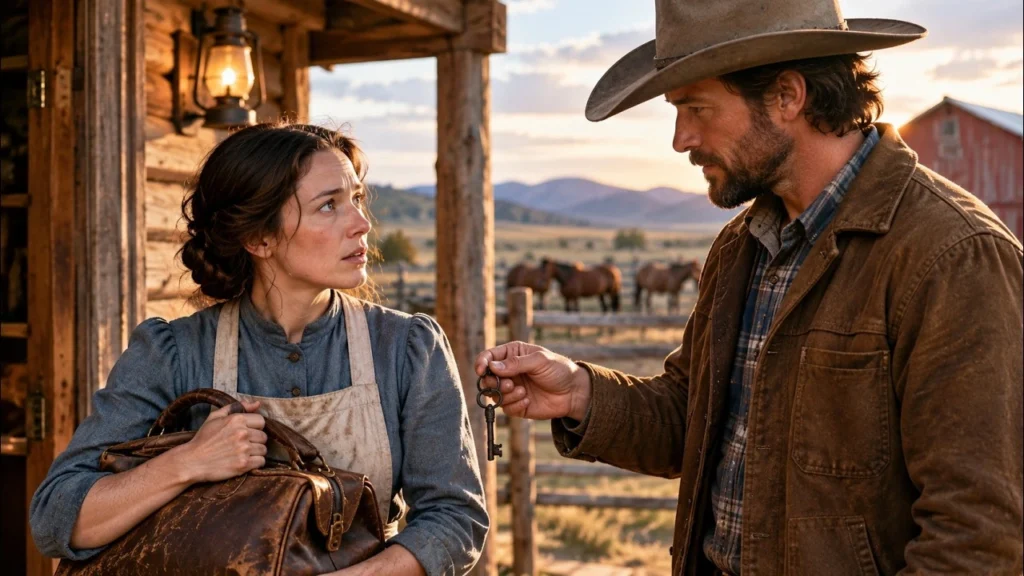
And last of all, she picked up the little iron key to the spare room.
She carried it into the kitchen. Nate was sitting at the table, mending a torn work glove.
Ruth set the key down beside his hand.
He stopped sewing.
“I leave after breakfast,” she said.
Nate looked at the key for a long time.
“Ruth,” he said.
It was the first time he’d ever used her first name.
“I could ask you to keep working here. But Avery pays more. And there’s more business in town.”
“Yes.”
“I could tell you to keep the room.”
His eyes went to the key.
“But then I’d never know if you stayed because you wanted the room.”
Ruth said nothing. Her heart was pounding.
Nate rested one hand on the table. Not reaching for her.
“So I’m not asking you to stay.”
“Then what are you asking?”
“Go to town,” Nate said quietly. “Take the work. Keep your own room. Your own key.”
He paused.
“And let me court you.”
The kitchen went perfectly still. ❤️
“Properly,” Nate said. “I come to you. Your work stays yours. And if you decide you don’t want me, nothing else changes. Not your job. Not your clients. Nothing.”
Ruth looked at the ledger on the shelf. At the wages in her pocket. At the key she’d just given back.
He’d waited until gratitude couldn’t be confused with love.
He’d helped make it possible for her to say no.
“Yes,” Ruth whispered.
Nate didn’t move. “Yes to what?”
And she understood why he asked. He wouldn’t take one ounce more from her answer than she chose to give.
“You may court me,” Ruth said.
Something in his face finally eased.
Ruth pushed the iron key across the table to him.
“I’m still moving tomorrow.”
Nate closed his hand around it and smiled.
“I know.”
On Monday, Ruth started at Mrs. Avery’s. Three days later, the same freight driver who’d once sneered at her set a bill on her desk and waited.
She counted five crates.
“Five listed,” he said.
“Five received,” Ruth answered.
He carried them inside. That was all. 😊
Nate came to town that Thursday evening. Dark Sunday coat. No ranch papers in his hands.
“Evening, Miss Whitaker.”
Ruth looked at the clock. “You’re early.”
“Horse didn’t understand courtship.”
For the first few minutes of their walk, neither of them knew what to do without an invoice between them. Then Nate told her the north fence had finally given up. Ruth told him Mrs. Avery owned thirty-one bedsheets and had believed she owned twenty-six.
“You’re still counting things,” he said.
“You’re still fixing things.”
“Fair.”
At the bottom of her stairs, he asked, “Next Thursday?”
“If your horse can manage it.”
He came the next week. And the week after. Always to town. Never expecting her to ride out to him.
One evening, he brought her a small wooden box with little dividers inside. For her pencils and receipts. He’d noticed them rolling off her narrow table.
“What do I owe you?” Ruth asked.
“Nothing,” Nate said. “This one isn’t ranch property.”
She kept it on her desk. 🥹
Just before Christmas, the office door opened.
Mrs. Bell walked in. The woman who’d once kept one hand on the door so she wouldn’t have to let Ruth in.
She stopped just inside, holding a folded bill.
“Miss Whitaker,” she said stiffly. “I was told you might look at this. I think I’ve been charged twice for lamp oil.”
Ruth held out her hand.
Mrs. Bell gave her the paper. There was no apology.
And Ruth discovered, to her surprise, that she didn’t need one to breathe.
She checked the dates. Found the double charge. Explained how to fix it.
“What do I owe you?” Mrs. Bell asked.
Ruth named her usual fee. Mrs. Bell paid it.
Ruth wrote it in her own account book. And went right back to work. 😏
On the last Sunday of the year, Nate asked her to ride out to the ranch.
Thin snow lay along the fence lines.
In the storeroom, the three boxes Ruth had labeled months ago still stood against the wall. Received. Checked. Entered.
But now there was a fourth.
Repair.
Ruth touched the label. “That wasn’t part of my system.”
“Improvement,” Nate said.
“I’ll consider approving it.”
Then Nate reached to the old hook beside the door. And took down the iron key to the spare room.
He held it a moment. Then he set it on the workbench between them.
He didn’t offer it back to her.
“When I first gave you that,” he said, “you needed a room.”
“I remember.”
“You don’t now.”
“No.”
“You have your own work. Your own money. And enough sense to tell me no.”
Ruth waited.
Nate looked at the key. Then at her.
“I want to marry you, Ruth. Not because this ranch needs your ledger. Not because you need my roof. I want you as my wife. If that’s the life you choose.”
The words were plain. Because they were true. And there was nowhere in them for obligation to hide.
Ruth thought of Mrs. Avery’s office. Her room above Green’s. The accounts waiting Monday. The money saved under her own name.
None of it had to disappear for this answer to be true.
“I’ll marry you,” she said.
Nate’s whole body seemed to breathe out.
“But I’m keeping my clients in town,” Ruth added.
“I expected you would.”
“And if you put coffee in three different places again, I’ll charge you to straighten it out.”
A full, wide smile spread across his face. “I’ve learned better.”
“That remains to be seen.”
Then Nate bent down and kissed her. Gently. Slowly. Leaving the choice hers until the very last inch.
Ruth didn’t move away. 💍
They married after the new year.
Ruth kept every one of her clients. Some mornings she rode into town beside Nate and came home at dusk. Other days he worked the cattle while she checked freight and balanced books.
Her work stayed hers. Always.
One winter evening, Ruth walked down the hall with an armful of clean towels.
The spare room door stood open now. Ready for any traveler who needed it. The bed was made. The quilt folded.
And the old iron key hung on its hook in the hallway.
She touched it once as she passed.
In the kitchen, Nate sat at the table with the ranch ledger open.
“Lamp oil,” he said, not looking up. “Two tins on hand. One ordered.”
Ruth leaned over his shoulder and checked the page.
“Correct.”
Outside, the winter wind moved over the Nebraska grass.
Behind her hung a key to a room she’d once been given when she had nowhere else to go.
And in front of her sat the man she’d been completely free to leave.
And had freely chosen to stay with. 🌅
✨ The truest kindness doesn’t make someone need you. It helps them stand on their own, and then hopes they’ll choose you anyway.
💬 What did you love more: how Nate trusted her, or how he let her go? Tell me in the comments.
(Note: This story is entirely fictional and created for entertainment purposes only. It does not represent any organization or individual, nor does it encourage inappropriate behavior. Content is created with the support of artificial intelligence.)


