PART 1: The Mountain Takes What It Wants
Cole Brannigan had been riding for three days when the red cliffs of Sentinel Butte finally rose out of the New Mexico haze.
Dust caked his boots. His hat had seen better years. And the only thing he carried with any certainty was the hope of honest work.
For six years, he’d drifted from ranch to ranch, never staying long enough to put down roots. He did his job, took his pay, and moved on before anyone could ask too many questions. People said he was unfriendly. Some said he had something to hide.
The truth was simpler, and heavier. He had lost too much already. And he’d learned that loneliness hurt a good deal less than disappointment.
As the sun slid toward the cliffs, he rode onto the Pierce ranch. It was the biggest spread he’d seen in years: grassland stretching clear to the butte, hundreds of cattle drifting slow beneath a copper sky.
Near the corral, three hands were losing a fight with a wild black stallion. The horse reared and bucked, ropes snapping taut, and sent one man sprawling into the dirt. A big, broad-shouldered foreman with a thick red mustache cursed and raised a quirt.
“Hold him, damn it! I’ll whip the fight out of him—”
“I wouldn’t,” Cole said quietly.
Every head turned. The foreman’s eyes narrowed. “And who the hell are you?”
Cole climbed down from his saddle without answering. He walked slowly to the corral rail. The stallion stood trembling in the center, eyes white, flanks heaving.
“Mind if I try?”
An older man stood near the gate: lean, silver-haired, with a hard, weathered face. Harlan Pierce, Cole guessed. The owner.
“You think you can do better than my foreman?” Pierce asked.
“I think he’s scared,” said Cole. “And scared don’t get whipped out of a horse. It just gets buried.”
He slipped through the rails. He didn’t approach the stallion directly. He simply stood, side-on, eyes down, talking low and soft, the same steady murmur over and over. Minutes passed. The ranch hands shifted impatiently. The foreman snorted.
Then the stallion took one step toward him. Then another.
Ten minutes later, Cole had his hand resting on the black’s neck, and the horse stood perfectly still.
Nobody spoke.
Harlan Pierce crossed his arms. “Name?”
“Cole Brannigan.”
“Looking for work?”
“Yes, sir.”
Pierce studied him for a long moment. “You start tomorrow.” Then, as Cole turned to go: “One more thing, Brannigan. Do your work. And stay away from my family.”
“Yes, sir.”
Behind Pierce, the red-mustached foreman watched Cole walk away with a look of pure, cold dislike.
His name, Cole would learn, was Dutch Kincaid. And Dutch Kincaid did not take kindly to being made a fool of in front of the men.
For the next three weeks, Cole worked harder than anyone on the ranch. He was up before dawn and finished long after dark. He mended fence, gentled horses, doctored sick calves, and spoke hardly at all. The other hands tried to pull him into card games and late-night whiskey. He always declined, preferring to sit alone by the fire after supper, listening to the coyotes up on the butte.
By the end of the first week, even the men who’d mocked him had started to respect him.
One of the people who noticed him was Harlan Pierce’s daughter.
Maggie Pierce was twenty-three and nothing at all like what people expected of a rich man’s daughter. She rode astride, wore her dark hair in a single thick braid, and spent more time on horseback in the hills than inside the big stone house where she’d grown up. Her mother had died of fever when Maggie was twelve. People said Maggie had her mother’s eyes: dark, steady, and quick to see through a lie.
She found Cole mending a fence by the creek one hot afternoon.
“You know,” she said, leaning on her saddle horn, “the men are starting to think you can’t talk at all.”
Cole glanced up. “I talk when I’ve got something worth saying.”
Maggie laughed. “Then I suppose I should be honored you answered.”
He smiled slightly and went back to work. She didn’t leave.
“What brought you here?”
“Work.”
“Nothing else?”
“Nothing else.”
She tilted her head. “That sounds lonely.”
His hands went still on the wire for just a moment. “Sometimes lonely’s easier.”
“Are you always this serious?”
“Most days.”
“That must be exhausting.”
And for the first time since he’d ridden onto the Pierce place, Cole Brannigan laughed out loud.
Maggie grinned. “There it is. I was starting to think you’d forgotten how.”
After that, they crossed paths often. Sometimes she brought him water. Sometimes they rode the same trails checking cattle. Their talk was simple: horses, weather, the hawks that nested on the butte. But Cole found himself looking forward to it in a way that frightened him a little.
Maggie noticed that, unlike every man who had ever courted her (and there had been many, drawn by her father’s money), Cole never tried to impress her. He never bragged. He never changed his manner around her. He treated her with plain kindness and respect, and nothing more.
Somehow, that mattered more than all the flowers and promises in the world.
Harlan Pierce noticed too.
One evening, he called Maggie into his study.
“I don’t want you getting close to that drifter.”
“Why?”
“Because men like him don’t stay.”
“You don’t know that, Papa.”
“I know enough.” He stared out the window at the bunkhouse. “Dutch tells me he’s seen men like Brannigan before. Running from something. And Dutch has been with us eight years.”
Maggie’s mouth tightened. “Dutch Kincaid has been trying to marry me since I was eighteen. He’d say anything about any man who looked at me twice.”
She left the room. Her father didn’t follow.
Out by the barn, Cole stood in the dusk, unaware of any of it. But across the yard, in the shadow of the bunkhouse door, Dutch Kincaid stood watching him with a cold, patient hatred.
Hidden beneath the red cliffs of Sentinel Butte lay a maze of ancient caves.
The old stories were older than the ranch. Older than the territory. The Apache families who still lived in the canyons to the west called the place sacred. Some passages were unstable, they warned. Others held meaning that outsiders would never understand. Most people respected the warnings and stayed away.
Maggie Pierce had always respected them too.
But Maggie had a secret almost no one knew. Her mother, Nahi, had not been a Spanish woman from Santa Fe, as her father told people in town. Nahi had been Apache. The granddaughter of an elder named Tazha, who still lived in the western canyons. And before she died, Nahi had told her daughter a story about a painted chamber, deep inside the butte, where the women of their family had once left their marks for a hundred years.
Maggie had wanted to see it her whole life.
On a bright morning in late September, she saddled her mare and rode toward the cliffs alone.
She didn’t notice that someone had loosened the cinch on her saddle the night before.
By noon, no one had seen her. At first, nobody worried. Maggie often disappeared into the hills for hours.
But as the afternoon wore on, a slow unease crept across the ranch.
Just before sunset, one of the hands spotted her mare coming in at a dead run.
The saddle was hanging under its belly. The cinch had slipped. And Maggie was nowhere.
Harlan Pierce went white to the lips. “Where is my daughter?”
Within minutes, riders were fanning out in every direction. Lanterns flared in the dusk. Men searched the creek, the hills, the trails. Cole rode with them without a word.
Hours passed. Nothing.
As full dark settled over the valley, a rider came down out of the western canyons: an old Apache man with long white hair, sitting a spotted pony. Cole had seen him once or twice trading at the ranch store. Harlan Pierce went stiff at the sight of him.
The old man dismounted and studied the mare. He ran his hand along her flank, looked at the slipped cinch, then knelt and studied the hoofprints in the dirt.
Then he looked up toward the black bulk of Sentinel Butte.
“She went to the mountain,” he said quietly. “To the caves.”
The men exchanged uneasy glances. Everyone knew about those caves. Tunnels had collapsed there a dozen times in living memory. Some passages ran for miles beneath the rock. Once inside, a man could lose all sense of direction in a matter of minutes. Two prospectors had gone in four summers ago. Nobody ever found them.
“You’re certain?” Pierce asked hoarsely.
The old man nodded. “If she went in before noon, she may still be alive.”
Pierce turned to his men. “I’ll pay whatever it takes. Who’ll go in after her?”
Silence.
Nobody moved. Every man there understood the danger. Some stared at their boots. Others looked away.
Dutch Kincaid cleared his throat. “Boss, it’s suicide in the dark. We wait till first light, get some rope, some more men—”
“I’ll go,” said Cole.
Pierce stared at him. “Those tunnels could bury you, Brannigan.”
Cole picked up a lantern. “So could standing out here doing nothing.”
Without waiting for permission, he swung up into the saddle and rode for the butte.
The old Apache man watched him go. Something unreadable moved in his deep-set eyes.
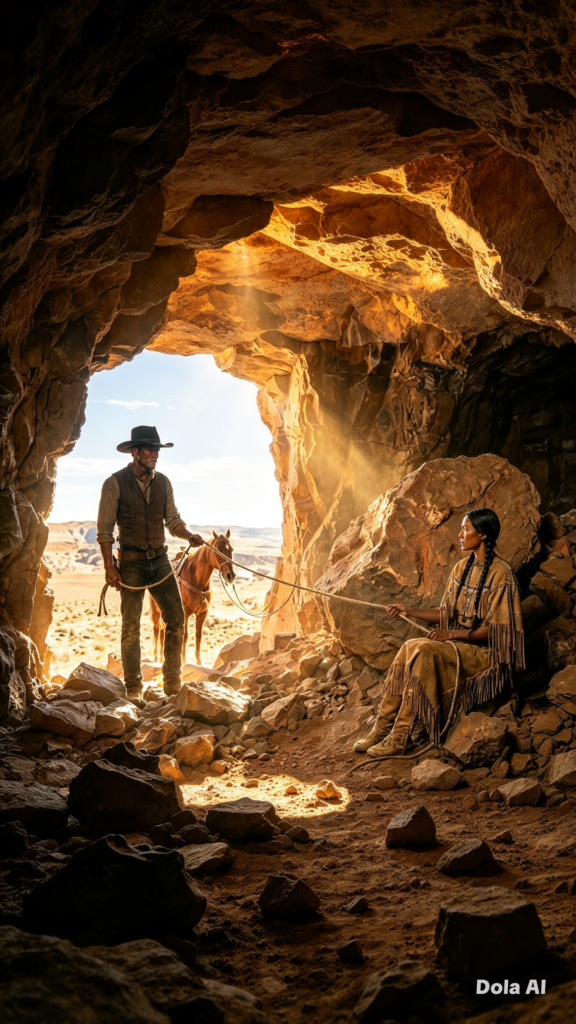
The cave mouth was a black wound cut into the red rock. Cold air breathed out of it, smelling of stone and old water.
Cole lit his lantern and stepped inside.
The silence was enormous. Water dripped somewhere in the dark. Shadows writhed across the walls as his lantern swung. Passages split and twisted in every direction.
He called her name. His own voice came echoing back.
He went deeper.
Minutes became hours. Twice, loose rock shifted under his boots and he nearly fell into black nothing. Once, his lantern guttered and he stood frozen in absolute darkness, his heart slamming against his ribs, until the flame steadied.
He went on.
And then, very faintly, from somewhere far ahead, he heard it.
“Help.”
He froze. “Maggie?”
“Cole?”
Relief hit him so hard his knees nearly buckled. He followed the sound through a narrow crack in the rock into a low chamber.
And stopped.
The walls were covered in paintings. Hundreds of them. Red and white and ochre figures: horses, suns, spirals, rows of tiny handprints, women’s handprints, layered over each other across a century.
And beneath them, huddled against the stone, sat Maggie. Her lantern had burned out hours ago. Her left leg was pinned beneath a slab of fallen rock. Tears streaked the dust on her face.
“Thank God,” she whispered. “Thank God.”
He knelt beside her. “Are you hurt?”
“My ankle. I don’t think it’s broken.” She was shaking. “You came. Nobody else came, did they? You came alone.”
“Couldn’t let your horse do all the worrying.”
In spite of everything, she laughed: a cracked, broken sound in the dark.
Together, they braced against the slab and pushed. It shifted. Shifted again. And slid free.
Slowly, with his arm around her waist, Maggie stood.
They had taken perhaps ten steps toward the crack in the rock when the mountain groaned.
It was a deep sound, felt more than heard, rolling up through the stone beneath their feet. Small stones pattered down from the ceiling. Dust sifted through the lantern light like snow.
Maggie’s fingers dug into his arm. “Cole—”
A second groan. Louder.
Then the passage they had come through collapsed with a roar like the end of the world.
Rock thundered down. Dust exploded through the chamber. Cole threw himself over Maggie as the lantern flew from his hand, skittered across the stone, and went out.
When the roaring finally stopped, there was only darkness.
Total, absolute darkness.
And silence.
And somewhere above them, the slow, grinding creak of a mountain that wasn’t finished falling.
PART 2: The Law of the Mountain
For a long moment, neither of them moved.
Then Maggie’s voice came, small and shaking, from somewhere beneath him. “Cole? Are you alive?”
“Reckon so.” He coughed, and dust filled his mouth. “You?”
“I think so.”
He groped across the stone in the dark until his fingers found the lantern. The glass was cracked, but the wick was intact. His hands were trembling so badly it took him four matches to light it.
The flickering light showed them the passage they had come through. It was gone. Buried under tons of red rock.
“The tunnel,” Maggie whispered. “It’s gone. We can’t get back.”
“Then we find another way.”
“What if there isn’t one?”
Cole looked at her and smiled, though it cost him something. “Then we keep looking until we find one.”
They moved deeper into the mountain. Maggie leaned on him, limping on her bad ankle. She never once complained, and when she stumbled, he caught her. When she started to lose hope, he talked to her: about horses, about the hawks on the butte, about nothing at all.
Hours passed. The air grew colder. The lantern grew dimmer. Three times they reached dead ends and had to turn back.
Finally, Maggie slid down against the wall and covered her face. “I can’t do this anymore.”
He knelt beside her. “Yes, you can.”
“What if we never get out?”
“We will.”
“You don’t know that.”
“No,” Cole admitted. “But worrying about what we can’t see won’t get us any closer.”
She looked at him in the guttering light. “Why are you doing this? Why risk your life for me?”
He was quiet so long she thought he wouldn’t answer.
“I had a little brother once,” he said at last. “Tommy. He was nine. We were crossing the Pecos in flood when we were boys, and the current took him. I was twenty feet away. I couldn’t reach him in time.” His voice was very quiet. “I’ve been riding away from that river for eighteen years, Maggie. Leaving you down here was never going to be something I could live with.”
She reached out in the dark and found his hand. She held it tight.
And that was when Cole felt it. A breath of air on his cheek. Faint, but cool and moving.
He was on his feet in an instant. “Do you feel that?”
Maggie lifted her face. Her eyes went wide. “Fresh air.”
He lifted the dying lantern and followed it: through a crawlway so narrow they had to inch forward on their bellies, around a bend, up a rubble slope. And there, at the top, a ragged hole in the rock, framing a scatter of stars and a white sliver of moon.
They crawled out onto the far side of Sentinel Butte and lay gasping on the cold red stone.
Maggie wept with relief. Cole lay beside her and looked up at the stars, and for the first time in eighteen years, the river in his head was silent.
Far below them in the valley, dozens of lanterns were moving.
Somebody spotted them. A shout went up.
“There! On the ridge!”
Harlan Pierce reached his daughter first. He threw himself from his saddle and pulled her into his arms.
“I’m sorry, Papa,” she sobbed into his shoulder. “I’m so sorry.”
“I thought I’d lost you.” His voice cracked. “God help me, I thought I’d lost you like I lost your mother.”
Only after a long time did he turn to Cole.
For a moment, the old rancher said nothing at all. Then he held out his hand. “Thank you.”
Cole shook it and said nothing.
But not everyone was weeping with relief.
Dutch Kincaid sat his horse at the edge of the lantern light, staring at Cole with an expression of raw, barely hidden fury.
And just beyond him, standing alone beside his spotted pony at the foot of the cliff, was the old Apache man. He had been watching the cave opening on the far side of the butte. As though he had known exactly where they would come out.
His face was very, very serious.
By morning, the whole valley knew that Cole Brannigan had walked into the mountain alone and brought Maggie Pierce out alive. People called him brave. Some called him a fool.
Cole wanted none of it. He only wanted things to go back to normal.
But shortly after sunrise, the old Apache man rode up to the Pierce ranch house. Three other elders rode beside him.
Harlan Pierce stepped out onto the porch, his face hard. “What do you want here, Tazha?”
The name meant nothing to Cole. But it meant something to Maggie. She came out onto the porch behind her father, limping on her bandaged ankle, and went very pale.
The old man dismounted. He removed his hat, slowly and respectfully.
“Harlan Pierce. You and I have not spoken in eleven years. Not since we buried my granddaughter.”
Cole looked from the old man to Pierce to Maggie, trying to understand.
“Your granddaughter?”
Maggie stepped forward. “My mother,” she said quietly. “Nahi. She was Apache. Tazha is my great-grandfather.” She glanced at her father. “Papa never let anyone in town know. He thought it would make things hard for me.”
Pierce’s jaw tightened, but he said nothing.
“Yesterday,” Tazha said, “my great-granddaughter went into the painted chamber beneath the mountain. The chamber of the women of our family. And this man went in after her, into a place no outsider has entered in a hundred years. And brought her back alive through the mountain’s other door.”
He looked at Cole, then at Maggie.
“Our people have an old law. Older than any of us. When two people go into the belly of the mountain, and face death together there, and come out through the mountain’s second door, the mountain has made them one. They walk one path. They are bound to each other.”
The silence on the porch was absolute.
“According to the law of my people,” Tazha said gently, “these two now belong to each other.”
Harlan Pierce’s face went red. “That’s impossible. My daughter isn’t some prize to be handed over to a drifter because of a story.”
“The law was never about owning anyone,” Tazha said calmly. “It was made to honor the bond between two people who faced death side by side. The mountain doesn’t give a woman to a man. It shows them what they already are to each other.”
Cole stepped forward. “Mr. Pierce, I didn’t go into that cave because I wanted anything in return.”
“And nobody decides my future but me,” Maggie said firmly.
Tazha bowed his head. “That is true. The law also says this: at the next full moon, the two must come before the council of elders. And there, each one, freely and alone, must choose to accept the bond. Or to release it.” He looked at them both. “The mountain shows the path. It does not force anyone to walk it.”
“When is the full moon?” asked Maggie.
“Nine days.”
Before anyone could speak, Dutch Kincaid stepped up onto the porch.
“Boss,” he said. His voice was smooth, almost sorrowful. “Before anybody goes making promises before any council, there’s something you need to see.” He reached into his coat and drew out a folded, yellowed piece of paper. “I’ve been holding onto this a while. Didn’t want to make trouble. But I can’t stay quiet anymore. Not now.”
He unfolded it and held it up.
It was a wanted poster. A sketch of a younger man, lean and hard-eyed. Beneath it, in thick black letters:
WANTED FOR MURDER. COLE BRANNIGAN. $500 REWARD. Pecos County, Texas.
Maggie’s breath caught.
Harlan Pierce turned slowly, very slowly, to face Cole.
“Is it true?” he asked.
Every eye on the porch fixed on Cole Brannigan.
And Cole, who had never told a lie in his life, said nothing at all.
PART 3: The Choice at the Full Moon
“Answer me, Brannigan,” Pierce said. His voice shook with fury. “Is that you?”
Cole looked at the poster for a long time.
“Yes,” he said quietly. “That’s me.”
Maggie made a small sound, like someone had struck her.
“Get off my land,” Pierce said. “You have one hour. If you’re still here, I’ll send for the sheriff in Las Cruces.”
Cole didn’t argue. He looked at Maggie once, a long look she would remember for the rest of her life, and turned and walked toward the bunkhouse.
Dutch Kincaid watched him go with a faint, satisfied smile.
Maggie found him in the barn, saddling his horse.
“Tell me,” she said.
“Maggie—”
“You crawled into a mountain for me. I sat with you in the dark for nine hours. You told me about your brother. You owe me the truth now, Cole Brannigan. All of it.”
He pulled the cinch tight and stood with his forehead resting against his horse’s shoulder. For a long time he didn’t speak.
“After Tommy drowned,” he said finally, “my pa started drinking. He blamed me. Said I should’ve reached him. He wasn’t wrong. Six years later, when I was nineteen, a man named Jed Sumner came to our place to collect on Pa’s gambling debts. Pa was drunk. They argued. Sumner pulled a gun.” Cole’s voice went very flat. “Pa shot him first. In the yard. In front of me.”
Maggie said nothing. She simply waited.
“The sheriff was coming. Pa was sobbing, saying he’d hang. And I thought about Tommy. About that river. About how I couldn’t save him.” He drew a ragged breath. “So I put Pa’s pistol in my own belt, and I rode away fast enough that everybody’d think it was me. And they did. Pa died two years later. Never told anybody the truth. And I’ve been running ever since.”
He finally looked at her.
“I can’t prove a word of it. There’s no witness left alive. Only me.”
Maggie stood very still.
Then she crossed the straw-strewn floor and put her hand flat against his chest, right over his heart.
“I believe you,” she said.
“Maggie—”
“I sat in the dark with you for nine hours, Cole. I know who you are.” Her eyes were wet but steady. “And I think I know who’s been loosening cinches on this ranch.”
He frowned. “What?”
“My cinch didn’t slip, Cole. Someone cut it nearly through. I saw it this morning in the tack room.” She held up a strip of leather. The cut was clean and straight, almost all the way across. “Somebody wanted me to fall in those hills. Somebody who thought, if I was hurt or lost, Papa would turn to the man he trusted most to run this place.” Her voice hardened. “Somebody who’s wanted to marry me and own this ranch since I was eighteen. And who’s been carrying an old wanted poster in his coat, waiting for the right moment.”
Old Tazha was waiting by the corral when they came out of the barn. As though, once again, he’d known exactly where they’d be.
“You are leaving?” he asked Cole.
“Mr. Pierce gave me an hour.”
“The law of the mountain gives you nine days.” The old man’s eyes glinted. “My great-granddaughter came out of that mountain bound to you. I am the oldest of the elders. The council has not yet spoken. No man, not even her father, may send you away before the full moon.”
Then he looked at the strip of cut leather in Maggie’s hand, and something cold came into his face.
“I know this cut,” he said. “I saw a man in the hills two nights ago, near the trail to the butte. A big man with a red mustache. He was waiting for the mare. Watching the trail.” Tazha nodded slowly. “I did not know then what he was waiting for.”
They brought it to Harlan Pierce that evening, in his study: Maggie, Cole, Tazha, and two hands who had seen Dutch Kincaid riding out alone toward the butte trail the night before Maggie vanished.
Dutch denied it, loudly and angrily.
Then Tazha’s grandson, a quiet young tracker named Itza, laid a bowie knife on Pierce’s desk. Dutch’s own knife, taken from his saddlebag an hour earlier. And beside it, the strip of Maggie’s cinch.
The fibers of the leather were still caught in the notch near the knife’s hilt.
The study went silent.
Dutch Kincaid looked at the knife. Then at Harlan Pierce. Then he lunged for the door.
He made it as far as the porch, where the sheriff from Las Cruces, sent for by Pierce that afternoon to arrest Cole, was just climbing down from his horse.
“Evening, Kincaid,” the sheriff said, his hand resting easily on his pistol. “Where you headed in such a hurry?”
When Dutch had been led away in irons, Harlan Pierce sat in his study for a long time without speaking.
Finally, he looked up at Cole.
“I misjudged you, son,” he said quietly. “Twice. I’m not a man who says that often.”
Cole said nothing.
“That poster,” Pierce went on. He picked it up off the desk. “It’s eleven years old. Pecos County.” He was quiet a moment. “I know the circuit judge in Pecos County. Name of Jesse Halliday. We rode together in the war. He’s an honest man.” He folded the poster carefully. “I’m going to write him tonight. And you’re going to tell him the truth, the same way you told it to my daughter. And then we’ll see what an honest judge makes of it.”
Judge Halliday’s reply came on the eighth day.
He had reopened the old file. He’d found the original statement of the coroner, never published, noting that the bullet that killed Jed Sumner had come from an old Colt Dragoon, a gun that had been found in Cole’s father’s possessions after his death. The sheriff who’d posted the reward had been voted out of office for drunkenness within the year. No witness had ever actually placed Cole at the scene. And a neighbor, now an old woman, had come forward when the judge’s men asked, to say she’d heard the shot from her porch, and had seen the boy riding hard away from the house after it, not before.
The charge against Cole Brannigan is dismissed, the letter said. Let him live his life in peace. He has carried another man’s sin long enough.
Cole read the letter three times, sitting on the corral rail at sunset.
Then he put his face in his hands.
Maggie sat down beside him and didn’t say anything at all. She simply leaned against his shoulder, and stayed there until the stars came out.
The full moon rose huge and white over Sentinel Butte.
In a canyon west of the ranch, beneath a great overhang of red stone, the council of elders sat in a half-circle around a small fire. Harlan Pierce stood at the edge of the firelight, hat in his hands, looking more uncertain than Cole had ever seen him.
Cole and Maggie stood before the elders. Tazha sat at the center.
“The mountain has shown its path,” he said. “Now each of you chooses. Freely. Alone. To accept the bond, or to release it. No one may speak for you. No one may choose for you.”
He looked at Cole.
“You first.”
Cole was quiet for a long time. When he spoke, his voice was low and steady.
“For eighteen years, I’ve been riding away from a river. I never stayed anywhere long enough to let anybody matter. Because I couldn’t stand losing anyone again.” He turned and looked at Maggie. “But I went into that mountain. And I found something I didn’t know I’d lost. If she wants me, I’ll stay. For as long as I’m alive. Mountain or no mountain. Law or no law.”
Tazha nodded slowly and turned to Maggie.
Maggie looked at her father first. Harlan Pierce met her eyes. Then, slowly, he nodded.
She turned to the elders.
“My mother told me about the painted chamber when I was a little girl,” Maggie said. “She told me the women of our family left their hands on those walls, so the mountain would remember them.” She took Cole’s hand. “I went into the dark looking for my mother. And instead, I found someone who walked into the dark looking for me.” Her voice shook. “If there had been no law, I would still choose him. I choose him now. Freely. With my whole heart.”
Tazha smiled. For the first time since Cole had met him, the old man’s whole face softened.
“Then the mountain was right,” he said.
They were married that autumn beneath the red cliffs of Sentinel Butte. Ranch hands, townsfolk, and Tazha’s people from the western canyons stood together in the golden light: the first time anyone could remember the two peoples gathering in one place without suspicion.
Harlan Pierce gave his daughter away. When he placed her hand in Cole’s, his eyes were wet.
“Take care of her, son,” he said hoarsely.
“I’ll spend my life at it, sir.”
Old Tazha spoke the blessing. When it was done, he laid one weathered hand on Maggie’s head, and the other on Cole’s.
“The old laws were never about forcing two hearts together,” he told the gathered crowd. “They were made to remind us to treasure the ones who would walk into the dark for us. Not because they must. Because they choose to.”
That winter, Maggie and Cole rode out to Sentinel Butte together, with Tazha leading the way on his spotted pony, to the mountain’s second door.
Deep inside, by lantern light, in the painted chamber where the women of her family had left their marks for a hundred years, Maggie pressed her palm into a shallow bowl of red ochre and laid her hand flat against the stone.
Then she turned and held out the bowl to her husband.
Cole hesitated. “It’s for the women of your family.”
“You walked into this mountain for me,” Maggie said softly. “You’re my family now.”
He pressed his hand into the ochre. And beside her small red handprint, high on the ancient wall, he set his own.
They stood together in the lantern light, looking at the two marks side by side.
Cole Brannigan had ridden into Sentinel Butte looking for nothing but honest work. He’d spent eighteen years running from a river.
And in the end, it was a mountain that finally brought him home.