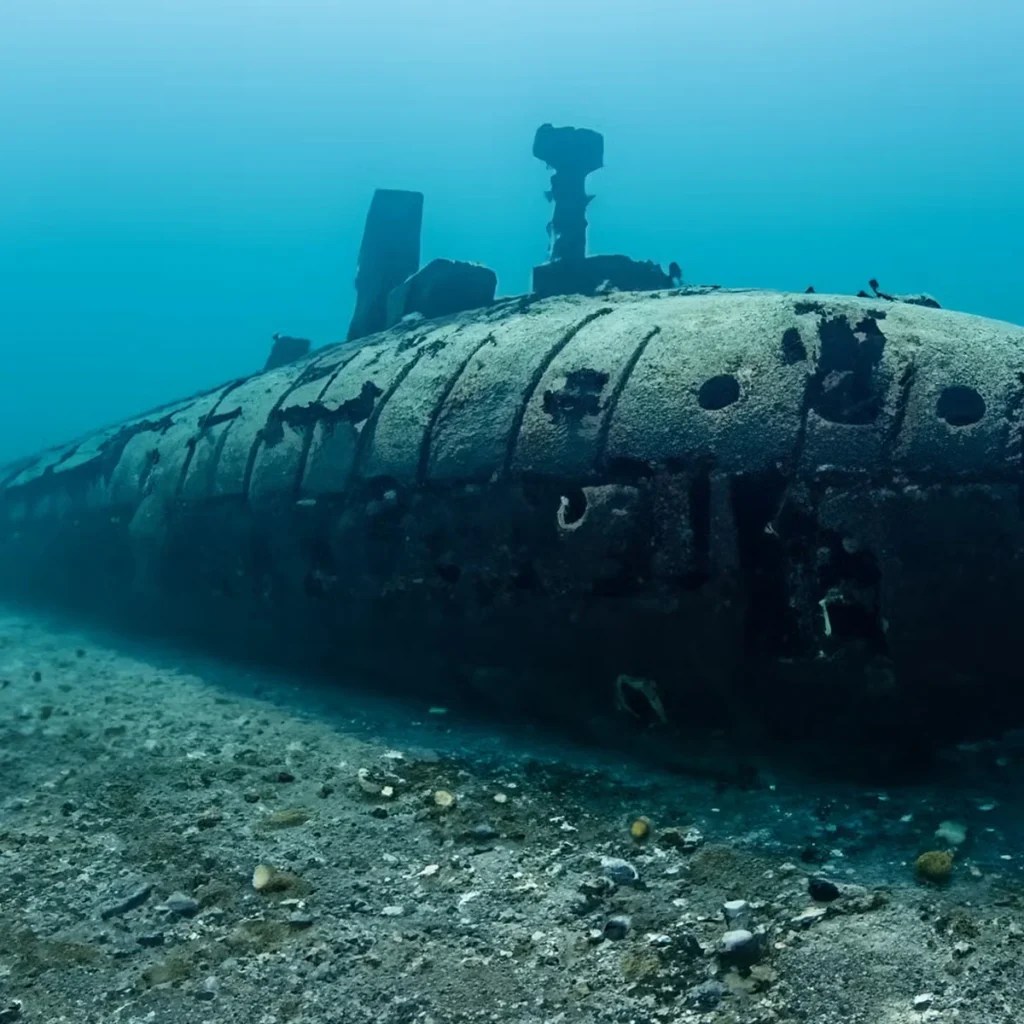
Scientists Finally Know Why the Hunley Crew Never Tried to Escape
The H.L. Hunley earned a place in naval history, and then became a steel coffin holding one of the Civil War’s strangest mysteries.
On February 17, 1864, the hand-powered Confederate submarine attacked the USS Housatonic outside Charleston Harbor, becoming the first submarine ever to sink an enemy warship in combat. But the Hunley never came home.
When researchers finally raised it more than a century later, they found its eight crewmen largely where they had served. There was no frantic rush toward the hatches and no obvious attempt to save the boat. Why would trained men stay at their stations while their submarine sank?
For generations, every obvious explanation seemed to fall apart. Now, new research into underwater blasts offers a chilling answer.
A Mission Built Around Risk
The Hunley was barely 40 feet long and only about four feet across at its widest point. Lieutenant George Dixon commanded from the forward conning tower, while seven men sat shoulder to shoulder, turning a long hand crank connected to the propeller. Inside, there was hardly room to stand, turn around, or squeeze past another crewman.
Danger followed the submarine long before its famous mission. It sank twice during training, killing members of two earlier crews, including the man it was named after, Horace L. Hunley. Each time, the vessel was recovered and readied to sail again. Built from iron boiler material and operated without an engine, the Hunley depended on muscle, careful balance, and calm teamwork. Dixon’s crew knew they were climbing into a machine with almost no margin for error.
Their target was the USS Housatonic, a steam-powered sloop that was part of the Union blockade outside Charleston. The Hunley had no self-propelled torpedo. Instead, a copper canister packed with 135 pounds of black powder was mounted on a 16-foot spar sticking out from its bow. The plan required Dixon to drive the spar into the Housatonic’s hull and set off the charge at extremely close range.
The explosion ripped the Union ship open. The Housatonic sank quickly, and five sailors were killed. The Hunley had done something no combat submarine had ever done before. But its own crew vanished on the way back.
The Boat That Never Returned
On shore, men were waiting for a blue light, the prearranged signal that the mission had succeeded. Several historical accounts describe a light appearing on the water after the explosion. If those accounts are accurate, the Hunley may have survived the attack long enough for Dixon to signal success.
No one ever saw it return.
The submarine came to rest on the seabed about 1,000 feet from the Housatonic, on the seaward side of the wreck rather than along the expected route back to shore. Its location puzzled searchers for generations and fueled theories about currents, navigation errors, and collisions.
The wreck was finally found in 1995 and raised in 2000. Archaeologists then began the slow work of removing sediment from an interior that had stayed sealed for 136 years. They expected to find signs of chaos, perhaps crewmen crowded around the exits, or evidence of a desperate struggle against rising water.
Instead, the remains were found largely at their assigned stations. There were no obvious fractures from a violent collision. The rear hatch was still locked. The forward hatch was unlatched. The ballast weights had not been released, and the pumps were not set to drain water from the crew compartment. Dropping the heavy keel weights could have helped the submarine rise in an emergency. That they were untouched made the crew’s stillness even harder to explain.
Whatever happened seemed to have prevented any organized response at all.
Theories That Fell Short
Drowning seemed like the simplest explanation. The Hunley could have sprung a leak, lost control, or taken on water through a damaged viewport. But a serious flood should have given at least some of the men time to work the pumps, release the ballast, or move toward a hatch.
Suffocation also seemed possible. Eight men were working hard inside a cramped iron tube with no ventilation. But rising carbon dioxide causes severe headaches, shortness of breath, confusion, and growing panic before unconsciousness. Those symptoms should have led to visible attempts to surface or escape.
Another theory blamed the USS Canandaigua, a Union ship that rushed in to rescue survivors from the Housatonic. It may have passed close to the Hunley and could have struck it. Investigators also considered gunfire, mechanical failure, entanglement, and damage from the Hunley’s own torpedo.
Each idea explained part of the story, but none explained the silence inside the hull. The crew did not behave like men facing a slowly developing emergency. Their positions, the pump settings, the untouched ballast, and the locked rear hatch all suggested that either they never realized they were in danger, or they were rendered helpless before they could react.
A Shock Through Iron
Biomedical engineer Rachel Lance turned her attention to the weapon itself, hanging just 16 feet from the Hunley’s bow. Underwater explosions behave very differently from blasts in open air, because water transmits pressure very efficiently. The spar put some distance between the crew and the charge, but perhaps not enough to protect them from the shock wave.
Lance and her team built a one-sixth-scale model of the submarine, nicknamed the CSS Tiny. They set off scaled-down black powder charges underwater, measured the pressure outside the model, and studied how the blast traveled through its metal hull. Using historical data on explosives, they connected their small-scale tests to the full-size attack in 1864.
Their proposed explanation didn’t require the Hunley’s hull to break at all. The pressure wave outside could have made the wrought-iron hull flex, creating a second pressure wave inside the crew compartment. Unlike shrapnel or a collision, this kind of damage would leave almost no trace after more than a century underwater.
That sudden pulse would have passed straight through the men without throwing them around or breaking their bones. Organs filled with air, especially the lungs, are particularly vulnerable to a sharp spike in pressure. It can tear delicate lung tissue and rupture blood vessels while leaving few marks on the skeleton.
The team calculated that each crewman had less than a 16 percent chance of surviving the blast. The men may have been killed or incapacitated almost instantly, before anyone could reach a pump, the ballast controls, or a hatch.
Why No One Escaped
The blast theory explains the most disturbing evidence all at once. The Hunley’s weapon worked exactly as intended against the Housatonic, but the same explosion may have sent a deadly pulse back through the submarine. The crew may have made history and lost their lives in almost the same instant.
It also explains why the excavation revealed no dramatic final struggle. Blast injuries of this kind damage soft tissue, which had long since disappeared by the time the submarine was recovered. The bones could remain intact, the equipment untouched, and the hull seemingly sound, even though the men inside could not have survived.
The theory is still debated. Some researchers question whether the flexing of the hull would have been strong enough to kill the crew. The unlatched forward hatch also leaves open the possibility that Dixon did something after the explosion. And the reported blue light suggests that at least someone may have survived briefly, though where the light came from, and exactly when, remains uncertain.
Even so, sudden blast injury fits the crew’s lack of action far better than a slow leak or a dwindling air supply. The Hunley may have drifted for a while before sinking, with eight men sitting silently at their stations.
They never tried to escape because the first successful submarine attack in history had already left them unable to do anything at all.