PART 1: A Joke Thrown to the Crowd
In the spring of 1876, Arizona Territory lay where two worlds met and seldom touched without friction.
The desert stretched beneath a sky so blue it looked painted, broken by red mesa walls, low mesquite, and thin silver rivers. Those rivers decided where a person could live and where the land would kill them within a week. Cattle drives cut long dust lines across that country. Apache families moved through it the way their grandparents had, following water and season along trails older than any settler’s fence.
Fear kept the two worlds apart more often than not. But at a few trading posts scattered along the rivers there was something close to common ground. There a rancher and a warrior’s daughter could stand in the same dust and trade without either of them reaching for a weapon first.
It was not peace. But it was a beginning, and beginnings mattered more than most people knew.
Levi Hayes was twenty-nine. He had spent eleven years working cattle across that territory, and he had a reputation that traveled farther than he did. It wasn’t for gunplay or cards. It was for something quieter, and rarer in that country: a gift with horses that other men couldn’t explain and didn’t entirely trust.
His father had worked horses before him. Before a fever took the old man when Levi was seventeen, he had taught his son one lesson above all others.
Force builds obedience, son. It never builds trust. And only one of those will still be standing once the fear runs out.
Levi had seen what that meant when he was nine. In a barn that seemed enormous to a boy, he watched his father stand for two hours beside a mare so ruined by her last owner that she flung herself into the fence rail whenever a rope touched her. His father never raised his voice. He stood and waited until the mare decided, in her own time, that his hands meant something other than pain.
That afternoon Levi decided what kind of man he wanted to be. He didn’t want to be the loudest man in a room, or the fastest with a gun. He wanted to be the kind of man other creatures trusted before they trusted anything else about him.
He had never imagined that the whole territory would one day test that inheritance in front of a crowd of strangers.
He rode into Copper Creek trading post that morning to resupply after a long drive. The post sat where a shallow river bent around a stand of cottonwoods. A man could find flour, ammunition, gossip, and sometimes trouble there, all within a hundred yards of each other.
He heard the crowd before he saw it. Half of Copper Creek was pressed around one wooden corral, and the air was thick with voices. Levi tied his gelding Ranger to a crowded rail and worked his way through the edge of the crowd.
He stopped breathing for a moment.
The stallion was dust-gray with a black mane, tall and deep in the chest, built like something from an old rancher’s tall tale. Muscle rolled under his coat with every furious step. His ears were pinned flat and his eyes were ringed white. Snapped ropes lay scattered over the corral floor like shed snakeskins.
The post owner was happy to explain. The horse had run wild in the northern high country for years, unclaimed and uncatchable, until riders finally roped him two days ago. Since sunup a dozen men had tried to ride him. Every one of them had been thrown within seconds or dragged half the length of the corral.
Some said no man alive could break him. Others said the whole untamed spirit of the territory had gone into one horse too proud to be owned.
Levi watched the stallion’s eyes and thought: That isn’t pride. That’s terror.
At the front of the crowd stood Whit Dawson, broad and red-faced, enjoying every fall. He ran the biggest herd for fifty miles and had very little patience for softness in a horse or in a man. He had lost two good riders to the stallion that morning and seemed to take a sour pleasure in watching everyone else fail beside him. Everyone also knew that Dawson was the loudest voice in Copper Creek against any friendliness toward the Apache families who traded there. He wore that suspicion as openly as his hat.
A few yards down the rail stood a young Apache woman, and she was the only person at the fence who did not look afraid.
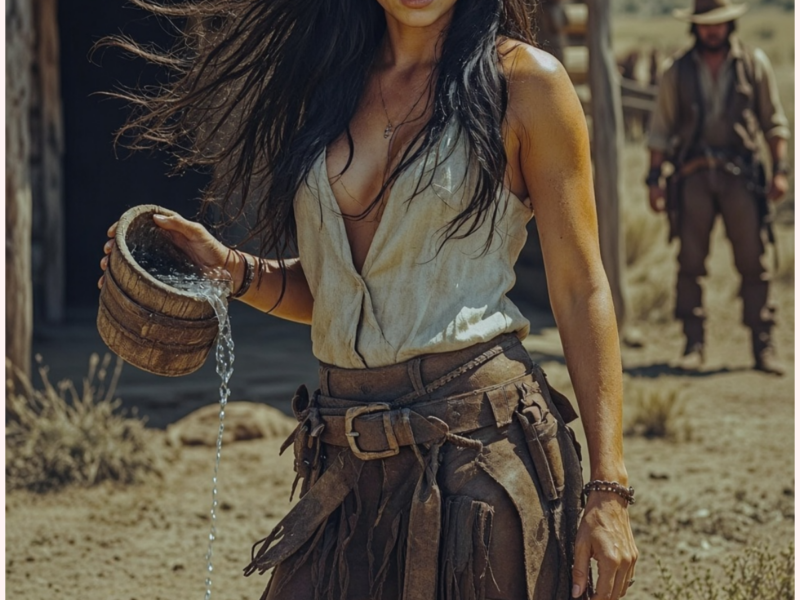
She stood with her arms folded, watching the chaos with amused calm. Her doeskin dress was worked with beadwork in deep blue and red, and small turquoise ornaments held her dark hair back from her temples and caught the morning light. When the third cowboy hit the dirt, she laughed. It wasn’t a cruel laugh. It was the bright, unsurprised laugh of someone who had watched pride meet its match too many times to feel sorry for it.
Her name was Tehya. She was the daughter of a respected family in her band, and she had been raised to speak her mind and to back it up with skill. She could track, trade, and read a person’s character faster than most people liked. She had turned away hopeful suitors from both sides of Copper Creek. She wasn’t cold. She had simply never met a man whose confidence held under real pressure the way it held when nobody was watching.
A rancher shouted another reward for anyone brave enough to try next. Two young cowboys swaggered forward, then backed off fast when the stallion reared and screamed at the sound of their boots on the rail.
Tehya laughed again. Then her gaze drifted past them and landed on Levi.
He had said nothing and boasted nothing. He was standing at the edge of the crowd studying the horse the way a man studies a problem he means to solve.
Something in that stillness drew her. She crossed the space between them with an easy stride, close enough that half the crowd could hear her, and she made sure they did.
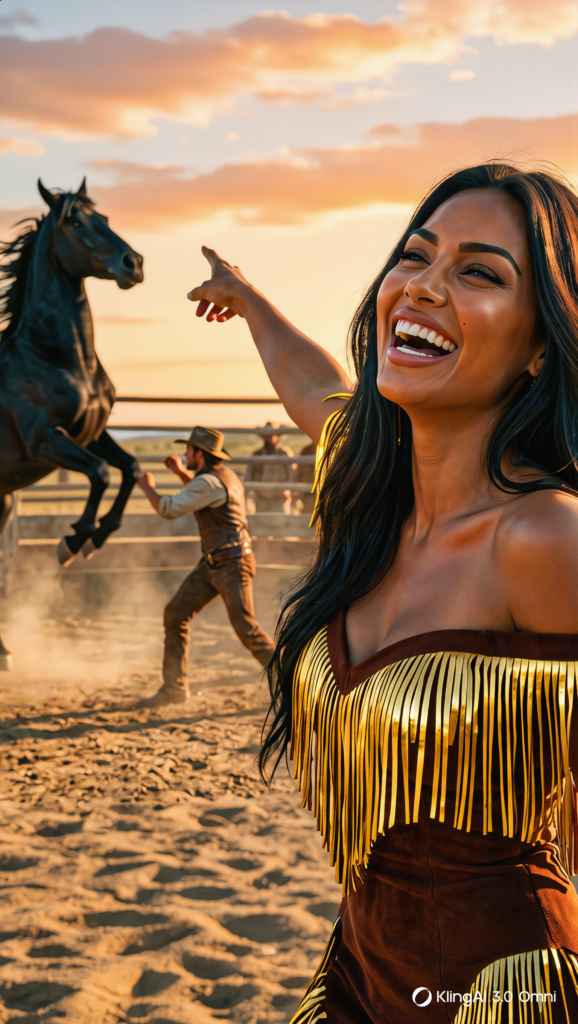
“Cowboy,” she said, “if you can tame that wild horse, I’ll be your wife.”
For one full breath, Copper Creek went silent.
Then the laughter broke over them like a wave. Cowboys pulled off their hats to wipe their eyes. An old rancher slapped his knee. Even the men who had just been thrown laughed, grateful for something to take the sting out of their own failure.
“Take the bet, Hayes!” somebody hollered. “Before you come to your senses!”
Whit Dawson laughed loudest of all. “Go on, cowboy. Get yourself killed for a joke.”
Everyone took it for a bit of morning entertainment, one more jest at a stranger’s expense. Tehya believed that most of all.
Levi looked at her for a long moment. Then he tipped his hat with unhurried courtesy and smiled. It wasn’t the embarrassed smile the crowd expected. It was small, and genuinely amused.
“A promise is a promise, ma’am,” he said. “But first let’s see whether that horse wants a friend before he decides to take a rider.”
The laughter faded into puzzled murmuring.
Levi set his hat on a fence post. He hung his coiled rope on the rail, where it could do no good and no harm. Then he climbed over the gate carrying nothing but patience.
The stallion charged the instant Levi’s boots touched the dirt.
He came across the corral like a landslide. He pulled up a few feet short and reared high on his hind legs, screaming. Dust exploded into the air, and half the crowd stumbled back from the rail.
Levi didn’t flinch. He didn’t raise his hands or brace himself to fight. He stood with his feet planted and his arms loose at his sides and let the animal look at him.
A horse that charges is not always angry. More often it is afraid, and fear that looks like rage is still fear, however much dust it raises. This stallion had spent every day of his life free on open country. In two days he had been roped, dragged behind strangers, penned inside four walls, and shouted at by people who wanted only to make him obey.
Levi knew only one cure for that, and it was time.
The stallion came down hard and began to circle at a stiff, suspicious trot without once taking his eyes off the man in the center. Levi let him circle. He turned slowly in place so he always faced the horse. He never stepped toward him and never cornered him, and gave the animal no reason to believe that this human, unlike all the others, meant him harm.
Minutes went by, then what felt like an hour.
At last Levi began to speak, too low for the fence to make out the words. The tone carried, though. It was calm and unhurried, almost fond, the way a man talks to an old friend rather than to a half-wild animal that had broken four ropes since dawn.
“He’s lost his mind,” someone muttered. “Standing out there like a fence post.”
“Five minutes with a real rope and a good spur,” Dawson said loudly, “and that horse’d learn who’s master.”
Midway through the standoff the stallion bolted sideways. He thundered so close past Levi that his shoulder nearly clipped the cowboy and spun him half around. Dawson’s laughter cracked across the corral.
“Somebody fetch a real horseman to finish the job!”
Levi didn’t answer him. He reset his feet, let his shoulders drop, and waited for the horse to come back around, just as patient as he had been a moment before. Ignoring the fence cost him nothing, and it earned him something from the horse that shouting back at Dawson never could have.
Slowly the circling became pacing. The stallion stopped farther away, then closer, then closer again. At last he halted a few careful yards from Levi. His ears were no longer pinned, and his breathing was heavy but no longer explosive.
Levi lifted one empty hand, palm open, and held it there without stepping forward and without asking for anything.
The stallion lowered his head and studied that hand for a long moment.
At the rail Tehya realized she had unfolded her arms.
She had expected this cowboy to fail loudly like the others. Or worse, she had expected him to succeed the way cruel men sometimes did, by stubbornness and the whip. What she was watching was neither. He wasn’t trying to conquer the horse. He was trying to earn it.
The sun climbed. Most of the crowd drifted back to their wagons and stalls, bored with a show that was all waiting and no wreck. By midday only a handful remained at the fence. Tehya was one of them, her chin resting on her folded arms, watching a stranger with more attention than she had meant to give anyone that day.
Levi knelt slowly by a water bucket someone had left near the fence. He nudged it toward the stallion and stepped back.
The horse eyed the bucket with deep suspicion. Several silent minutes passed. Then thirst won out over caution. The stallion stepped forward, lowered his head, and drank, while Levi stood perfectly still a few yards away.
It was an easy moment to miss. But it changed something that every rope that morning had failed to touch. This one wants nothing from me but my company.
Levi took a piece of dried apple from his coat pocket. He always carried some for Ranger, more from habit than need. He held it out on his flat palm and waited.
The stallion lifted his head, took one step, then another, stretched out his long neck, sniffed, and then took the apple from Levi’s hand as gently as a child.
A soft sound went through the few people left at the fence. Old ranchers who had broken horses with rope and spur all their lives admitted quietly that they had never seen anything like it.
Tehya felt something rise in her chest that she had not expected to feel when she walked into Copper Creek that morning. It wasn’t amusement anymore. It was admiration, and something beneath it she didn’t have a name for yet. She was learning that courage didn’t always look loud. Sometimes it looked like this: a man choosing patience when anger would have been so much easier and faster, and so much less likely to work.
As the afternoon light turned gold across the desert hills, Levi rested his hand fully along the stallion’s neck for the first time. The horse flinched once and then settled. Levi stroked the black mane slowly and kept talking, and the great gray animal stood and listened.
Children clapped from the fence. Grown men who had laughed at the wager that morning took off their hats without quite deciding to.
The post owner brought a plain leather saddle to the rail. Levi didn’t swing it straight onto the horse’s back. He let the stallion smell every strap and buckle first, giving him time to understand the strange thing before it ever touched his skin. The horse shifted nervously, but he didn’t bolt. Levi settled the saddle into place and drew the cinch tight.
Word had spread. The crowd had come back and packed the rails three deep. Everyone understood that this was the moment when every rider before him had failed: the weight of a saddle, and then the weight of a man.
Levi put one boot in the stirrup and paused, giving the horse one last unhurried moment.
Then he swung into the saddle.
For one long heartbeat, nobody in Copper Creek breathed.
The stallion stood rigid under him and trembling. Then he took one step, and another. He didn’t buck. Levi kept the reins loose and refused to pull against a mouth that had only just begun to trust a human hand.
That was when Levi saw the movement by the gate.
One of Dawson’s riders had slipped along the outside of the fence, a lean man with a coiled bullwhip and a grin. Dawson stood a few steps behind him with his arms folded, watching.
Levi understood a half-second too late.
“Don’t—”
The whip cracked like a rifle shot an inch from the stallion’s flank.
Every bit of trust built over the long afternoon broke at once. The stallion screamed and exploded forward, headed blind and at full speed for the far fence.
On that fence, perched on the top rail where he had climbed for a better view, sat a small Apache boy no older than eight.
The crowd shrieked. Tehya was already running.
The boy saw half a ton of terrified horse coming straight at him. He froze where he sat, and the space between them was closing faster than anyone could reach him.
PART 2: The Weight of Trust
There was no time to think. Levi didn’t try to.
Every rider before him had fought this horse, and every one of them had lost. So he did the one thing no frightened rider ever does. He didn’t haul on the reins. He dropped his weight deep into the saddle and leaned his whole body to the left. He laid one hand flat against the stallion’s straining neck and spoke into the wind in the same low, steady voice he had used all afternoon.
Easy. Easy. I’m still here.
For one terrible stride the stallion kept on toward the boy.
Then he felt the familiar hand and heard the familiar voice, and something in him remembered the water bucket and the dried apple and the long hours when this man had asked him for nothing.
The stallion swerved.
He passed so close to the fence that his shoulder grazed the rail beneath the boy’s dangling feet. The child tumbled backward off the far side into Tehya’s arms just as she reached him. The stallion thundered along the corral wall, and Levi stayed in the saddle, leaning and murmuring. By the third lap the horse’s run had slowed to a lope, then a trot, then a shuddering, sweat-soaked walk.
Levi halted him in the center of the corral. Then, in a voice the whole crowd could hear, he said:
“Somebody open the gate.”
The post owner fumbled the latch. Levi walked the stallion out through the gate. Once they had open ground ahead, he let him run.
The great gray horse stretched out across the grassland under a darkening amber sky. Gold dust rose behind his hooves, and Levi sat light and easy on his back, as though he had ridden this horse a hundred times instead of for one extraordinary afternoon.
Copper Creek erupted. Children screamed with delight. Old ranchers threw their hats in the air. Merchants left their stalls to watch the unbreakable stallion run proud and free under a cowboy who had never once struck him.
When Levi brought him back, the horse stopped beside the fence and lowered his head peacefully.
Levi swung down and walked straight to the bullwhip rider, who had stopped grinning.
“You nearly killed a child,” Levi said quietly. His voice did not rise at all, and that was somehow worse than shouting. “You do that to an animal I’m working, or any animal near any child, and you and I will have a different kind of conversation.”
The man looked to Dawson. Dawson’s face was dark red.
“It was a joke, Hayes.”
“So was the wager,” Levi said. “Only one of them nearly put a boy in the ground.”
He turned his back on them both, which in that country said more than any words could have.
Tehya stood at the fence with the small boy clinging to her waist. His name was Yona, and he was the son of her cousin.
Her teasing was gone. In its place was something warmer and far more honest.
“I never believed anyone could do that,” she said. “My wager was only mischief, meant to prick one more proud cowboy. I didn’t expect you to win.” She paused. “And I certainly didn’t expect to mean it if you did.”
Levi chuckled. “I knew it was a joke, ma’am. I hold no grudge over it. If anything, I owe you my thanks. Without your wager I’d have ridden right past the finest horse I’ll ever touch.”
“You saved Yona.”
“The horse saved Yona. He chose to turn.” Levi looked back at the stallion, standing calm at the rail. “I only gave him a reason to.”
They talked while the crowd thinned and the light turned orange over the western hills, and neither of them seemed in any hurry to stop. Before he left, Tehya surprised herself by inviting him to her family’s camp the following week.
Levi accepted without hesitation. Then he spent the whole ride home in the dark half sure he had misheard her, and half afraid to hope he hadn’t.
He named the stallion Storm, for the way he had torn through that corral like weather nobody could predict.
At the camp Levi first met Tehya’s grandmother, whom everyone called Grandmother Chodi. Her sharp eyes missed very little, and her opinion carried far beyond her own fire.
She watched him for the better part of an hour without saying a word. She noted how he sat, how he listened more than he talked, and how he thanked a boy who brought him water as seriously as he would have thanked a grown man.
Finally she spoke, and Tehya translated. “She asks whether you truly stood in that corral all day without once losing your temper.”
“I came close more than once,” Levi admitted. “I just chose not to let it show.”
Grandmother Chodi gave a short laugh of surprise and said something to her granddaughter.
Tehya’s mouth curved. “She says this one at least knows the difference between courage and noise.”
It wasn’t approval, not yet. But Tehya heard the change in her grandmother’s voice and knew exactly what it meant.
After that Levi kept coming back. At first he had excuses about checking Storm’s progress. Then he stopped bothering with excuses.
He taught the camp’s children to work horses the way his father had taught him, without a whip and without fear. Yona had been thrown from a stubborn pony twice before Levi ever came and had decided that horses simply didn’t like him. For three afternoons Levi only sat beside that pony with the boy. He taught Yona to read the animal’s ears, its tail, and its breathing before ever asking him to go near it. On the fourth afternoon Yona led the pony around the camp on a loose rope with a grin that stretched across his whole face. After that he followed Levi everywhere like a shadow follows the sun, full of questions.
In return Tehya taught Levi pieces of her language. She showed him which plants along the riverbank could close a wound or break a fever. She took him walking through country he had ridden past a hundred times without ever really seeing it the way her people saw it.
Beside the evening fires he told her about his father, about long drives through land so empty a man could go a week without hearing another voice, and about the loneliness that had settled into him after his father died. He told her it had been easing, a little more each week he rode to her fire instead of sitting alone at his own.
She told him about her people’s history, the songs her grandmother had taught her, and the seasonal journeys her family still made by the same water and stars their ancestors had followed for longer than anyone could count.
Neither of them could have said when friendship became something more. It came the way morning comes after a long night, so gradually that by the time you notice the light, it has been there a while.
Not everyone was pleased.
Some ranchers muttered that a cowboy had no business courting an Apache woman. Some of Tehya’s own people wondered whether a settler’s promises would hold any better than his rope.
And Whit Dawson had not forgotten Copper Creek. He had been laughed at in front of the whole territory, and his man had been called out for nearly killing a child. A man like Dawson could carry that kind of grudge for years.
Late that summer, two dozen head of Dawson’s cattle disappeared.
By sundown the story had spread through every saloon in the valley: Apache riders ran them off. By midnight a dozen of Dawson’s men were drinking and loading rifles. By dawn they were riding toward Tehya’s camp.
Yona brought the warning. He rode his pony bareback through the gray light, the same pony he had once been afraid of, and burst into Levi’s yard shouting. Levi was on Storm within a minute.
He reached the camp only moments ahead of Dawson’s riders.
The camp’s men were already standing with weapons in hand. The women had gathered the children behind the shelters. Grandmother Chodi stood at the center of it all, small and straight and unafraid. Tehya stood beside her with a rifle she clearly knew how to use.
Dawson reined in at the edge of the camp with his riders fanned out behind him.
“Twenty-four head,” he called. “We know where they went.”
Levi turned Storm slowly and rode out until he sat alone between the two lines. He didn’t draw his gun.
“You don’t know anything, Whit,” he said. “You’re guessing. And you’re about to start a war on a guess.”
“Get out of the way, Hayes. This is no concern of yours.”
“It’s every concern of mine.” Levi kept his voice level. “That storm three nights ago came down off the northern mesa. Your herd drifted ahead of it. Cattle in a hard wind run downhill and away from the weather. That puts them in the box canyon below Red Wash, not in anybody’s camp.”
“And you know that how?”
“Because I’ve tracked cattle in this country for eleven years, and so have you, when you’re sober.” A few of Dawson’s own riders shifted in their saddles. “Ride to Red Wash with me. Right now. If your cattle aren’t there, I’ll stand aside myself. But if they are, you’ll turn around and go home, and you’ll never say a word like that again about these people.”
The silence stretched until it nearly broke.
Tehya was watching Levi, and he could feel it. He knew that if this went wrong, the next shot would never be forgotten on either side, by the people of her camp or the ranches of the valley.
“Fine,” Dawson spat. “Red Wash.”
They found all twenty-four head grazing peacefully in the box canyon, exactly where Levi had said they would be. They had been scattered by the storm and nothing more.
Dawson didn’t apologize. Men like Dawson rarely do. But he turned his horse and led his riders home without a word, and he never repeated the accusation.
That evening, when Levi rode back into camp, Grandmother Chodi was waiting for him at the fire. She said one sentence and then went into her shelter.
Tehya’s eyes were bright when she translated it.
“She says a man who rides between two rifles with an empty hand has the same kind of courage as a man who stands in a corral with an empty hand.” Tehya paused. “She says she has made up her mind about you.”
Levi looked across the fire at Tehya.
“And you?” he asked quietly. “Have you made up yours?”
She held his gaze for a long moment.
“I made up my mind the moment that horse drank from your hand,” she said. “I’ve only been waiting for you to catch up.”
PART 3: The Flood
The real test came that autumn.
A storm rolled out of the northern mountains and turned a dry wash near Dawson’s spread into a brown, churning flood almost overnight. More than thirty of Dawson’s cattle had sheltered from the wind in the low ground. By the time anyone noticed, they were stranded on a shrinking spit of mud with the water climbing by the minute.
Dawson’s riders were exhausted from moving the herd all day and couldn’t reach the far bank through the current. Dawson stood on the near shore shouting orders no one could safely follow.
Word reached Tehya’s camp within the hour, and she didn’t hesitate. She and three of the camp’s best riders came down to the wash at a hard gallop, just as Levi came pounding in on Storm from the other direction.
They needed only a few shouted words. They worked in pairs, Apache riders and one cowboy, crossing back and forth through water that would have unnerved any horse that didn’t trust its rider completely. They cut cattle free of the mud one and two at a time and drove them up onto solid ground.
Storm crossed that current more times than any other horse there. The water rose past his knees and then his chest, and he stayed sure-footed and never once lost his nerve. He was exactly the animal that long, patient afternoon at Copper Creek had promised he would become.
Once Tehya’s mare stumbled in the deepest channel and went down. Before Levi could even shout, Storm had turned beneath him and put his great gray body upstream of her, breaking the current long enough for the mare to find her feet.
Tehya looked across the water at Levi, soaked and gasping.
“Your horse,” she shouted, half laughing and half sobbing, “has better manners than any man in this territory!”
“He learned them somewhere,” Levi called back.
When the last steer stood safe on high ground, the light was gone. Every rider there, settler and Apache alike, was soaked through and shaking with cold and relief.
Dawson counted his cattle in the dark. When he finished, he walked straight to Tehya, took off his hat in front of his own riders and hers, and thanked her plainly.
“I’d have lost half my herd tonight,” he said roughly, “if your people hadn’t come. You rode faster and braver than my own men could.” He swallowed. “I’ve said things about your people. I was wrong about them, and I was wrong at that camp. I’m sorry.”
It wasn’t a grand speech, and it didn’t erase years of suspicion overnight. But it was honest, and with men like Dawson honesty went further than anything showier could have.
From that night on, Dawson never spoke another careless word against the families who traded at Copper Creek. In the seasons that followed, he was more than once the first to offer help when their camp needed it.
Levi asked her on an evening in early winter, beside the same river that ran past Copper Creek. There was no crowd watching this time and no wager attached, only the plain truth of what he wanted.
He had rehearsed the words the whole ride over. Every one of them left him the moment she turned to look at him in the low evening light.
So he simply told her the truth.
“I can’t remember what my evenings felt like before you filled them,” he said. “And I don’t much care to find out again.”
Tehya had once laughed in front of a whole trading post at the idea of marrying a stranger over a horse she was sure he could never tame. This time she said yes without a moment’s teasing.
Later, laughing again but more softly, she told him that some part of her had known the answer since the moment a wild stallion drank from his open hand.
They married the following spring on the open ground beside Copper Creek trading post, under a sky so wide and blue it seemed to cover the whole territory.
Ranchers who had once watched Apache visitors with narrow eyes stood shoulder to shoulder with warriors and elders who had once wondered whether any settler’s word could be trusted. Children from both peoples ran laughing between wagon wheels and cookfires, untroubled by boundaries their parents had once thought could never be crossed.
Grandmother Chodi spoke the first blessing. Her sharp eyes were softer than Levi had ever seen them. Her words carried across the hushed crowd in a language he had spent a whole year learning, and he understood every one of them.
Yona stood nearby holding Storm’s lead rope with the fierce pride of a boy who had earned that honor through a season of patient practice. He was no longer a child who believed horses didn’t like him.
Whit Dawson stood among the ranchers with his hat in his hands, nodding along with no trace of the old suspicion.
When the vows were spoken, the crowd broke into cheers much like the ones that had greeted a wild stallion’s first gallop a year before. Levi lifted Tehya onto Storm’s back and swung up behind her. Together they rode once around the gathered crowd, just as he had once ridden that same horse out across the open prairie on the day they met.
This time there was no wager to settle and no crowd waiting to see him fail.
There was only the wide Arizona sky above them, and two peoples standing together beneath it who had learned, one patient day at a time, that trust built slowly outlasts fear built quickly.
People told their story for years afterward around Copper Creek and far beyond it, passing it from ranch to ranch and family to family the way the best frontier stories travel. It grew a little in the telling, but its heart never changed.
Those who had watched Levi climb into that corral carrying nothing but quiet confidence liked to say that he had never really been taming the stallion. He had been showing everyone at that fence what patience looks like when it’s given the time it needs. That included the proud woman who had laughed at him and was about to become his wife.
The legend Copper Creek remembered wasn’t really about a cowboy who broke an unbreakable horse.
It was about a man and a woman who broke something much harder to move than any horse. They wore away the fear between two worlds, one honest and patient day at a time, until those two worlds found common ground beneath the same wide sky.
And it began, as the old-timers loved to remind anyone who would listen, with a joke a laughing girl called across a crowded corral.
“Tame that horse, cowboy, and I’ll be your wife.”
He did, and she kept her word.