PART ONE: A Bargain Struck at the Well
The well at the Whitaker place had been dry for nineteen days, and Jonah Whitaker had counted every one of them.
He was hauling water from Cañada Verde again, two barrels lashed to the wagon bed and four miles each way, when he saw the woman standing at his gate. It was late afternoon in the Arizona Territory, the year 1883, and the light came in long and copper across the mesquite. At first he took her for a mirage, the kind the desert throws at men who have gone too many days hoping for rain.
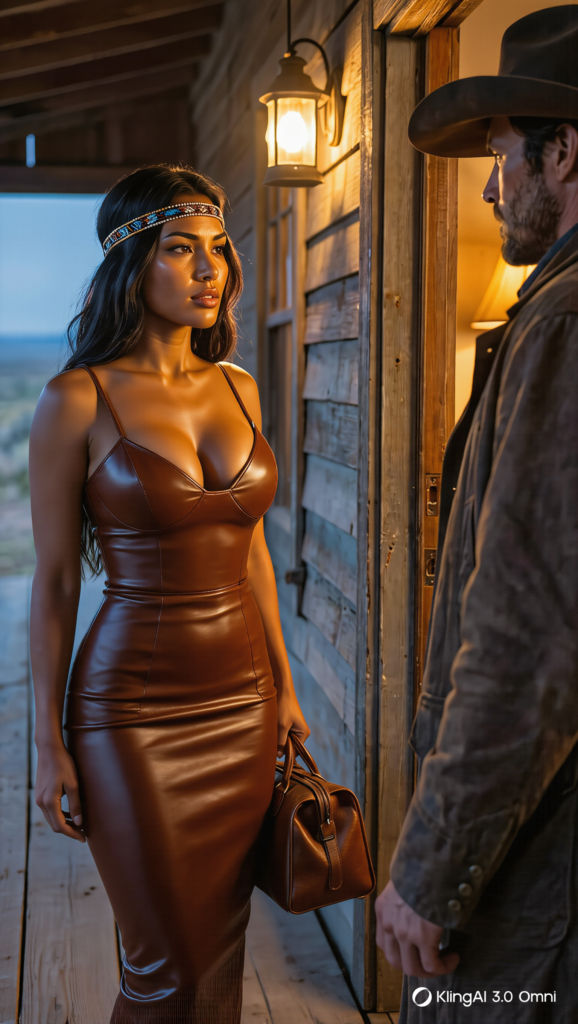
She was not a mirage. She was a young woman, perhaps twenty-four, in a dark blue riding skirt pale with dust and a man’s canvas coat buttoned to the throat despite the heat. Her black hair was braided tight and pinned. She held no bag, no bundle, nothing but a small carved wooden box under one arm. She stood perfectly still, the way people stand when they have walked a long way to say something difficult and are afraid that moving will shake loose their nerve.
Jonah reined in the team. He didn’t get down.
“If you’re looking for work, there isn’t any,” he said. “If you’re looking for water, I’ll spare you a cup. That’s about the size of what I’ve got.”
“I’m not looking for either one, Mr. Whitaker.” Her English was precise, lightly accented with the Spanish of the old families along the Santa Cruz. “My name is Inés Ortega y Salas. I’ve come about Garrick Hale.”
Jonah went very still on the wagon seat.
Garrick Hale was the land agent for the Southern Pacific in Tubac. He was soft-spoken and smiling, and he owned the paper on half the ranches between the river and the Mexican line. He held the paper on this one too. Nine days from now, Jonah’s note came due at Hale’s bank. Nine days from now, without rain, without a sold herd, without a miracle, Hale would own the Whitaker place. With it he would own the only other water in this end of the valley besides the old Ortega spring two miles south.
“What about him?” Jonah said.
“He wants your land.” She lifted her chin. “And he wants mine. And I think, if you’ll listen to me for a quarter of an hour, there’s a way we can keep him from having either one.”
A boy watched them from the porch while they talked.
Eli Whitaker was seven. He had his mother’s fair hair and his father’s grey eyes, and he hadn’t spoken a word since the night his mother died of a fever, fourteen months before. He didn’t cry or laugh, and he didn’t answer his name. He followed his father like a small shadow, and some nights Jonah heard him walking the hallway in the dark, back and forth, the way Jonah himself had walked it the night Catherine died.
Now Eli stood at the porch rail with a tin cup in both hands and stared at the stranger as though she were a picture in a book.
Inés saw him. She paused in the middle of her explanation and lifted one hand to him, a small, open wave. Eli did not wave back. He did not look away either.
“That’s my son,” Jonah said shortly. “He doesn’t speak.”
“I know,” Inés said. “The priest at San José told me. He prays for him.”
Jonah’s jaw tightened. “The priest has more time for prayers than I do. Say what you came to say.”
So she said it, standing in his yard in the long copper light, with the carved box held against her chest.
Her family had held the Ortega grant since 1791. It was a Spanish land grant, confirmed under Mexico and supposedly protected by the treaty that made this country American. Her grandmother Doña Lucía had held it alone for twenty years, and she had died in March. Inés was the last of the family. And Garrick Hale had appeared at her door three weeks after the funeral with a lawyer from Prescott and a territorial statute.
“Under the new law,” she said, “a grant must be proven before the surveyor general by a resident heir. A household. Hale’s lawyer says that an unmarried woman living alone is not a household under the statute. It’s a guardianship case. And the court will appoint a guardian for the property.” Her mouth twisted. “Guess whom they have in mind.”
“Hale.”
“Hale.” She opened the carved box. Inside, wrapped in oiled silk, lay a folded document of heavy rag paper, brown at the edges, its seals cracked but whole. “This is the original grant, signed by the governor of Sonora. Hale doesn’t know I have it. My grandmother hid it the year the Americans came, because she didn’t trust them. The copy in the Tucson records office has been altered. Someone changed the boundary. The spring is no longer inside my land on that copy.” She lifted her eyes. “It’s inside yours. Inside the land Hale will own in nine days.”
Jonah stared at the document. Then at her.
“So he takes my place for the note,” he said slowly. “He takes yours through a guardianship. And the forged boundary means nobody can ever argue the spring belonged to the Ortegas. He gets every drop of water in the south valley.”
“And then he sells it to the railroad at whatever price he names.”
“What do you want from me?”
She closed the box. Her hands, he noticed, had begun to tremble, though her voice didn’t.
“I have six hundred dollars,” she said. “My grandmother’s savings. It isn’t enough to save my land in court, but it is enough to pay your note in full. I’ll give it to you on one condition.” She took a breath. “Marry me. On paper. A household. Then I’m no longer an unmarried woman alone, and Hale’s guardianship fails. Your note is paid, so you don’t lose your land. I’ll file the grant as your wife, with you standing as witness, before the surveyor general in Tucson on the twentieth. After that, if you want, we go our separate ways. I’ll ask nothing else of you.”
The desert was very quiet. A cactus wren scolded from the ocotillo fence.
Jonah laughed. It came out rough and short, without any humor in it at all.
“Lady,” he said, “you walk onto my land a total stranger, with a box full of Spanish paper, and ask me to marry you by Sunday?”
“Yes.”
“I buried my wife fourteen months ago.”
“I know.” Her voice softened, just barely. “I’m not asking you to forget her. I’m not asking you for anything that belongs to her. I’m asking for your name on a paper and mine beside it. That’s all.”
He looked at her for a long time. Then he looked past her, at the cracked earth of his dead well and at the hills where his starving cattle stood in the scraps of shade. He looked at Eli on the porch, a seven-year-old boy who had already lost one thing too many.
“Why me?” he said. “There are other men in the valley.”
“Because you’re the only other person Hale needs to ruin.” She held his gaze. “And because Father Benedicto says you’re the most stubborn man in Santa Cruz County, and I need someone who won’t sell me out the first time Hale offers him a better price.”
Jonah was quiet.
On the porch, Eli set his tin cup down on the rail. He walked down the steps, across the yard, past his father’s wagon, and stopped in front of Inés Ortega. He looked up at her for a long moment with his grave grey eyes.
Then he reached out and took hold of the edge of her canvas coat, the way a child takes hold of a grown-up’s hand in a crowd.
Jonah felt something crack open in his chest that had been sealed for fourteen months.
“Sunday,” he said hoarsely. “We’ll ride to San José on Sunday.”
They were married on Sunday afternoon in the adobe chapel of San José de Tumacácori, a mission whose roof had half fallen in long ago. Father Benedicto was a bent old Franciscan with ink-stained fingers. He performed the ceremony in Spanish and English both, and he looked at the two of them over his spectacles as though he knew exactly what kind of marriage this was and intended to pray for a better one.
There were three witnesses: Eli in a clean shirt; Rosario Méndez, who had been Doña Lucía’s housekeeper for thirty years and wept through the whole thing; and Tom Begay, Jonah’s one remaining hand, a quiet Navajo stockman who stood with his hat against his chest and said nothing at all.
When the priest told Jonah he could kiss his bride, Jonah hesitated. Inés lifted her face to him with a small, steady look that said it’s only paper, and he bent and kissed her cheek, quickly and lightly.
She smelled of sage and woodsmoke, and her skin was warmer than he had expected.
He signed the register. She signed below him in a clean, slanting hand: Inés Ortega y Salas de Whitaker. Father Benedicto sanded the ink, closed the book, and laid his old hand on both their heads.
“God sees what you’ve done here,” he said in Spanish. “And God is patient with fools who mean well.”
They rode back to the Whitaker place at dusk in the wagon with Eli asleep in the bed behind them, his head on Inés’s folded coat. The six hundred dollars sat in a leather pouch inside Jonah’s shirt. The original grant was locked in its carved box under the wagon seat.
Neither of them talked much. Halfway home, as the first stars came out over the Santa Ritas, Inés said quietly, “Thank you.”
“Don’t thank me yet,” Jonah said. “Hale doesn’t take losing well.”
“You think he’ll know already?”
“A wedding at San José with a Whitaker and an Ortega?” He snorted. “Rosario’s cousin works in Hale’s kitchen. He knew before we left the church.”
She was quiet a while. “Then he knows the guardianship has failed.”
“He knows something’s changed. He won’t know about the grant.” Jonah glanced at the box under the seat. “Not unless somebody tells him.”
He showed her to the spare room when they got home. It had been the sewing room once, Catherine’s, and he hadn’t opened the door in fourteen months. He stood in the doorway holding a lamp while she looked at the dusty treadle machine, the basket of half-finished quilting, and a child’s nightshirt with one sleeve still unsewn.
“I’ll clear it out tomorrow,” he said roughly.
“No.” Inés touched the nightshirt gently. “Leave it. I’ll finish the sleeve, if you don’t mind. He’ll want it come winter.”
Jonah didn’t answer. He set the lamp on the table and left her there. In the hallway, he stood with his back against the wall a long time before he went to his own bed.
The fire started a little after two in the morning.
Jonah woke to the smell of it, kerosene first and then the dry, fierce crackle of old pine. He was out of bed and into the hall with his rifle before he was properly awake. Orange light was already flickering at the far end of the house, where the kitchen met the barn. Smoke boiled along the ceiling.
“Inés!” He pounded on her door. “Fire!”
The door flew open. She was already dressed, boots on, the carved box clutched against her chest. She had not been asleep either.
“Eli,” she said.
They ran for his room together. The smoke was thicker in the north wing, low and choking. Jonah kicked the door open and swept the lamp across the narrow bed.
The bed was empty.
The window stood wide open, its curtain streaming out into the night. There were no little boots by the door. Eli was gone.
From the yard outside came the drumming of hooves, three horses at least, riding hard toward the south road. Above the roar of the fire, a man’s voice called out, laughing:
“Tell your Mexican bride Mr. Hale sends his wedding congratulations!”
Jonah stood frozen in his son’s doorway, the burning house collapsing around him. For the first time in fourteen months, the silence of his son’s empty room was the loudest thing he had ever heard.
PART TWO: The Boy Who Couldn’t Call Out
Inés moved first.
She grabbed Jonah’s arm and dragged him back from the doorway as a beam from the kitchen ceiling came down in a shower of sparks. “Out!” she shouted. “Out, Jonah, now, or there’ll be no one left to find him!”
They came through the front door into the yard with their lungs burning. Tom Begay was already at the pump, working the useless handle of a dry well with the desperation of a man who knew it was useless. The kitchen and the barn were fully alight. The horses screamed in the corral. Smoke rolled up black against the stars.
“Tom!” Jonah shouted. “Eli?”
Tom shook his head. “Didn’t see him. Saw the riders. Three of ’em, heading south.” He spat soot. “One of them had a bundle across his saddle.”
Jonah’s knees nearly went.
Inés caught his arm. “Look at me.” Her face was black with smoke. Her eyes were fierce and absolutely steady. “Eli’s window opens to the north. Not the south. The riders went south.”
He stared at her.
“If they’d taken him, they’d have pulled him through the door, not the window,” she said rapidly. “Children who are frightened run, Jonah. They climb out. They hide. He couldn’t call out to you. He can’t. So he did what a silent child does, and he hid.” She turned and pointed into the darkness beyond the burning house. “North. Where does a seven-year-old boy hide on this ranch?”
Jonah’s mind went blank. Then it went to a summer afternoon nearly two years gone. He remembered Catherine laughing and Eli running ahead of her down into the arroyo behind the house, to the cave beneath the old cottonwood roots where the flash floods had hollowed out the bank. His mother had called it Eli’s castle.
“The arroyo,” he breathed.
They ran.
The arroyo was black as pitch, its sandy bed lit only by the orange glow of the burning house behind them. Jonah slid down the bank with Inés right behind him, both of them calling Eli’s name. They knew he couldn’t answer, but they called anyway, because a silent child still needs to hear that someone is looking.
The cave beneath the cottonwood roots was empty.
Jonah stood in front of it with his chest heaving. Smoke drifted down the arroyo. Somewhere far off a coyote yipped.
“He’s not here,” he said. His voice cracked. “Inés, he’s not here—”
“Wait.” She was crouched in the sand at the cave mouth, running her fingers over the ground in the dim light. “Small boot prints. Fresh. He was here.” She followed them a few feet along the arroyo bed, then stopped. “And there.” Next to the small prints, deep and heavy, were a man’s boot prints. “Someone found him.”
Jonah went cold all through.
Then, from somewhere down the arroyo, came a sound. It was not a voice. It was a rhythmic, metallic tink… tink… tink, like a spoon on a tin cup.
Inés lifted her head. “Jonah. What is that?”
He knew it instantly. It was the tin cup Eli carried everywhere and set down on the porch rail when he wanted something. A seven-year-old boy who couldn’t speak had found the only voice he had left.
They ran toward the sound.
A hundred yards down the arroyo, where it bent beneath a granite ledge, they found him. Eli was sitting on the sand in his nightshirt, his knees drawn up and his tin cup in both hands, tapping it against a rock in a steady, desperate rhythm. Beside him lay a man.
The man was facedown in the sand, groaning, with blood on his temple. A rope was coiled loose beside him, and a revolver lay half-buried in the sand a few feet away.
Eli looked up at his father. He pointed at the man, then at a sharp, fist-sized granite rock beside his own small foot. Then he went back to tapping the cup, faster, as if he couldn’t stop.
Jonah dropped to his knees in the sand and swept his son into his arms. Eli went rigid for a moment and then clung to him with both arms around his neck, still clutching the tin cup, his whole small body shaking.
Inés picked up the revolver. She turned the groaning man over with her boot. He was one of Hale’s teamsters, a hard-faced man named Vic Carney whom she had seen loading wagons behind the land office in Tubac.
“He came to take the boy,” she said quietly. “And the boy hit him with a rock.”
Jonah looked at his son over Eli’s shoulder. Seven years old, silent for fourteen months, and he had defended himself with a stone in the dark and then called for help the only way he could.
“Catherine,” Jonah whispered into his son’s hair. “Catherine, look what he did.”
Inés had to turn away.
They tied Carney with his own rope and threw him over Tom Begay’s horse. By the time the sun came up, the ranch house was a smoking ruin. Only the stone chimney and the adobe north wing still stood, and the north wing held Eli’s room and Catherine’s sewing room, where Inés had slept.
The carved box was safe. So was the six hundred dollars.
The barn was gone, and so were two horses and the winter feed. Jonah stood in the ashes of the kitchen where Catherine had cooked for eight years and didn’t say anything for a long time.
Inés came and stood beside him. She did not touch him.
“Hale meant to take Eli,” she said. “To bargain. He knew you would sign anything to get your son back. The land, the water, a statement that our marriage was a fraud. Anything.”
“I would have,” Jonah said hoarsely.
“I know.” She looked at the smoking ruin. “So would I.”
He turned and looked at her. Her face was still black with soot. She had burned her hand dragging him out of the hallway, and she hadn’t mentioned it once.
“You’ve known my son four days,” he said.
“Five,” said Inés. “And I sat up last night finishing his nightshirt sleeve.” Her mouth trembled, just slightly. “It burned.”
Jonah reached out without thinking and took her burned hand in his. He turned it over gently. The blister ran across her palm, angry and red.
“Rosario has salve,” she said. “It’s nothing.”
“It’s not nothing.” He held her hand a moment longer than he needed to. “Nothing you’ve done since you walked through my gate has been nothing.”
They took Carney to the territorial marshal in Tucson, forty miles north. They took the original grant too, and the six hundred dollars, and Eli, who would not let go of Inés’s coat the entire ride.
Marshal Dan Pruett was a lean, tired man who had been in the Territory long enough to know exactly what Garrick Hale was, and long enough to know how hard it would be to prove. He listened to the whole story in his cramped office behind the courthouse. He looked at the singed edges of the grant, at Carney sullen in irons, and at the silent boy clutching a tin cup.
“Carney’ll swear he was out for a moonlight ride,” Pruett said wearily. “He’ll swear he found the boy lost and was bringing him home. Hale will swear he never heard of him. And an arson with no witnesses but a boy who doesn’t talk…” He spread his hands. “I’ll hold Carney. But I can’t touch Hale on this.”
“Then touch him on the forgery,” Inés said.
Pruett looked at her.
She unwrapped the grant on his desk. “The copy in the surveyor general’s office downstairs has been altered. The southern boundary has been moved. Compare it to this. The original, signed by the governor of Sonora in 1791. Somebody in that office changed the record, and somebody paid them to do it.”
Pruett studied the brown, crackling paper for a long moment. Then he got up, went downstairs, and came back twenty minutes later with a clerk, a ledger, and a very pale face.
“The boundary was changed,” he said quietly. “Fourteen months ago. The entry’s in a different ink. The clerk who made it was a man named Lyle Ferris.” He paused. “He quit a month after. Moved to Tubac. Went to work for the Southern Pacific land office.”
“For Hale,” said Jonah.
“For Hale.” Pruett sat down heavily. “Ferris is the key. If he’ll swear Hale paid him, I can bring charges. If he won’t, Hale walks.”
“Then we find Ferris,” said Inés.
“Hale will have found him first,” said the marshal.
They didn’t find Lyle Ferris. Lyle Ferris found them.
He came to Rosario Méndez’s adobe in Tubac three nights later, where Jonah, Inés, and Eli were staying while they decided what came next. He was a thin, frightened man in a clerk’s coat, and he knocked at the back door at midnight so softly that only Inés heard him.
“You’re the Ortega woman,” he whispered when she opened it. “The one with the real grant.”
“Yes.”
“Hale knows you have it now. Carney’s wife told him. He’s going to come for it.” His hands were shaking. “He came for me tonight. Wanted me to leave the Territory. Gave me two hundred dollars and told me if I was ever seen in Arizona again…” He swallowed. “I’ve got a daughter, ma’am. Nine years old. I changed that boundary because Hale said he’d see me in prison for debt otherwise. But I can’t…” His voice broke. “Your husband’s boy. I heard what Carney tried to do. I can’t be part of that.”
Inés drew him inside. Jonah came in from the front room, rifle in hand. He took one look at the shaking clerk and set it down.
“You’ll swear to it?” Jonah said. “Before Pruett and a judge?”
“If you’ll keep my daughter safe while I do.”
“She’ll stay here with Rosario,” Inés said. “With us.”
Ferris looked at her a long moment. Then he nodded.
They rode for Tucson at dawn: Jonah, Inés, Tom Begay, and Lyle Ferris on a borrowed mule, with the grant in its carved box in Inés’s saddlebag. Eli stayed behind with Rosario and Ferris’s daughter. When they left, he stood at the gate with his tin cup and watched them go without making a sound. The silence of it nearly broke Inés’s heart.
At the halfway well at Sahuarita, Garrick Hale was waiting.
He sat a fine bay horse in the middle of the road with eight riders spread behind him. He was a pleasant-faced man of fifty, round-cheeked and smiling, in a pearl-gray suit and a panama hat, and he looked like someone’s kindly uncle. He tipped his hat to Inés.
“Mrs. Whitaker,” he said. “Felicitations on your marriage. I’m sorry I couldn’t attend.”
“You sent a fire instead,” said Inés.
“Fires happen in dry country.” His smile never moved. “As do accidents on long rides.” He looked at Ferris, who had gone white as bone. “Lyle. I’m disappointed.”
“Let us pass, Hale,” Jonah said.
“Of course.” Hale gestured graciously at the road. “All of you can pass. Just leave the box. And Lyle.” He tilted his head. “Lyle and I need to have a conversation about loyalty.”
Jonah’s hand moved toward his rifle. Eight rifles came up behind Hale with a single, ugly sound.
“I wouldn’t,” Hale said mildly. “You’ve already lost a house, Whitaker. Do you want your son to lose his father too? He’s lost so much already, poor mute little thing.”
Something went cold and absolute in Jonah’s face.
Inés saw it. She knew, with total certainty, that in the next ten seconds Jonah Whitaker would draw on nine men to answer an insult to his son, and he would die doing it.
She urged her horse forward between Jonah and Hale.
“Take it,” she said. She pulled the carved box from her saddlebag and held it out. “Take the grant. Let them pass. Let Ferris go home to his daughter. It’s only paper.”
“Inés—” Jonah began.
“It’s only paper, Jonah.” She didn’t look back at him. “You told me nothing I’d done was nothing. Well, this is something. I’m choosing it.”
Hale studied her with real curiosity for the first time. Then he rode forward and took the box from her hands. He opened it. The old brown document lay inside on its oiled silk, its cracked seals of the governor of Sonora gleaming faintly in the morning sun.
He smiled.
“Your grandmother was a careful woman,” he said. “So am I.”
He took a match from his waistcoat, struck it on his saddle horn, and set the Ortega grant on fire.
Inés made a sound, a single small cry, and then nothing. She watched two hundred years of her family’s land curl black in Garrick Hale’s gloved hand and blow away across the Santa Cruz valley in grey flakes.
“There,” said Hale gently. “Now there’s only one record, and it’s mine.” He wheeled his horse. “Lyle, you’re coming with us. The rest of you go home. Whatever home you have left.”
Two of his men took Ferris’s mule by the bridle. The clerk looked back at Inés once, desperate and despairing, as they led him away south.
Then Hale and his riders were gone in a cloud of yellow dust, and Inés sat her horse in the middle of the empty road with ashes on her skirt. She did not cry.
Jonah rode up beside her. He couldn’t find a single word to say.
She turned and looked at him. And then, impossibly, slowly, the corner of her mouth lifted.
“Jonah,” she said quietly. “Did you really think my grandmother hid only one copy?”
PART THREE: What Doña Lucía Knew
The document Garrick Hale burned was a copy, a very good one, made in 1848 by Doña Lucía herself with a scribe from Hermosillo, seals and all. It was her decoy. The old woman had trusted no American, and no Mexican either.
The original lay sewn into the lining of Inés’s canvas coat, the coat a silent seven-year-old boy had taken hold of on the first day as if he knew it held something precious.
“I’m sorry I didn’t tell you,” Inés said on the ride to Tucson. “I didn’t tell anyone. My grandmother made me swear.”
“You let me think you’d lost everything.” Jonah’s voice was rough.
“I let Hale think it.” She looked at him. “You were the one who had to believe it, or he’d have seen it in your face. You’re a terrible liar, Jonah Whitaker.”
He looked at her. Then he laughed, a real laugh, startled out of him. It was the first one Inés had heard from him, and she thought she might go a long way to hear another.
Marshal Pruett took one look at the original grant and sent riders after Hale before Inés had finished explaining.
They caught him at the Calabasas crossing that evening. Lyle Ferris was still alive, roped to his own mule. Hale was arrogant and unhurried, completely certain he had burned the only evidence that could hang him. He had not burned the original, and he hadn’t counted on what Ferris would say in a Tucson courtroom once he knew his daughter was safe and his employer was in irons.
The hearing came three weeks later, before Judge Hiram Wells of the territorial court, a stern old man who had read law in Philadelphia and despised land fraud the way some men despise horse thieves. Ferris testified for a full day. He told the court how Hale had paid him, how he had altered the boundary in the record, and what Hale had promised to do to him if he ever spoke. Carney turned on his employer the next morning to save his own neck. He confessed to the fire and the attempt on the boy, and he named the man who had sent him.
Garrick Hale was sentenced to twelve years in the territorial prison at Yuma. The Southern Pacific dismissed him the same week. The altered boundary was struck from the record, and the Ortega grant was confirmed by the surveyor general, on the original document, in the name of Inés Ortega y Salas de Whitaker.
And the six hundred dollars paid off the note on the Whitaker ranch in full, at a bank no longer controlled by the man who had tried to burn it down.
It rained in late August, the first real rain in eleven months. It came out of the south in a great soft wall, filling the arroyos and drumming on the tin roof of the two-room adobe Jonah and Tom Begay had raised beside the old stone chimney. Eli stood out in the yard in it with his face turned up and his arms spread wide. Inés stood in the doorway and watched him, and Jonah stood beside her.
“The well will come back,” he said. “Couple of weeks.”
“And the spring at Ortega runs regardless.” She smiled. “Grandmother always said it was the only thing in the valley more stubborn than she was.”
He was quiet for a moment. Then: “The marshal says the grant’s confirmed. And the note’s paid. Hale’s gone.” He kept his eyes on the rain. “There’s nothing holding you to this anymore, Inés. If you wanted to go back to your own land. Our bargain’s done.”
She was quiet so long that he finally turned to look at her.
She was looking at Eli, out in the rain.
“I promised you I’d ask nothing else of you,” she said quietly. “I’ve been trying to keep that promise for a month. It’s the hardest promise I’ve ever made.”
“Inés…”
“I’d like to ask something now. If you’ll let me.”
He swallowed. “Ask.”
She turned to face him. The rain roared on the roof. Her hair had come loose from its braid in the damp, and her eyes were very dark and very steady, the same as when she had stood at his gate holding a box of old paper and the whole of her nerve.
“I’d like to stay,” she said. “Not on paper. Not for a hearing. Not for Hale or the land or anything I can write in a ledger. I’d like to stay because I don’t want to be anywhere you and that boy aren’t.” Her voice shook at last. “That’s all. That’s the whole of it.”
Jonah Whitaker had buried a wife, lost a house, and nearly lost a son. He had held his grief so tightly for fourteen months that he had forgotten there was anything else to hold. He looked at the woman in his doorway and understood that the thing cracking open in his chest was not grief at all.
He reached up and brushed a wet strand of hair from her face. Then he kissed her, not on the cheek, and not quickly.
When he finally lifted his head, she was laughing and crying at once.
“That,” she said unsteadily, “is not on paper.”
“No,” said Jonah. “It isn’t.”
Out in the yard, a small voice spoke.
It was rusty and hoarse and almost lost in the rain, but both of them heard it. Both of them would hear it for the rest of their lives.
“Pa.”
Jonah went absolutely still.
Eli stood in the mud with the rain running down his face. He was looking at the two of them in the doorway, and his grey eyes were very bright. He took a breath, the way a child does before jumping into deep water. Then he said, in that small, cracked voice that had been silent for fifteen months:
“Is Inés staying?”
Jonah couldn’t answer. He couldn’t make a single sound.
So Inés answered for both of them. She walked out into the rain and knelt in the mud in front of the boy, and took his small cold face between her hands.
“Yes, mijo,” she said. “I’m staying.”
Eli flung his arms around her neck. Jonah came down off the step and knelt and wrapped his arms around them both. The three of them knelt together in the August mud, soaked to the skin, while the rain came down over the Santa Cruz valley, filling the dry arroyos and soaking the cracked earth of two ranches that would never again be separate.
They were married a second time in October, in the chapel at San José de Tumacácori. This time there was no bargain in it.
Father Benedicto performed it in Spanish and English both. When he reached the part about the kiss, he looked over his spectacles at Jonah with enormous satisfaction and said, “This time, my son, please don’t aim for the cheek.”
The whole chapel laughed. Eli laughed loudest, a clear, ringing sound that made Rosario Méndez burst into tears all over again.
Inés signed the register a second time beneath her husband’s name, in her clean, slanting hand. Then, because she was Doña Lucía’s granddaughter and trusted no record she hadn’t seen with her own eyes, she asked the priest for a fresh sheet of paper. She copied the entry out in full, signed it, had Jonah sign it, and had Father Benedicto witness it.
“For safekeeping,” she said, folding it into quarters.
Jonah raised an eyebrow. “And where does this one go?”
Inés smiled, opened her coat, and patted the lining.
“Where all the important papers in this family go,” she said.
— THE END —