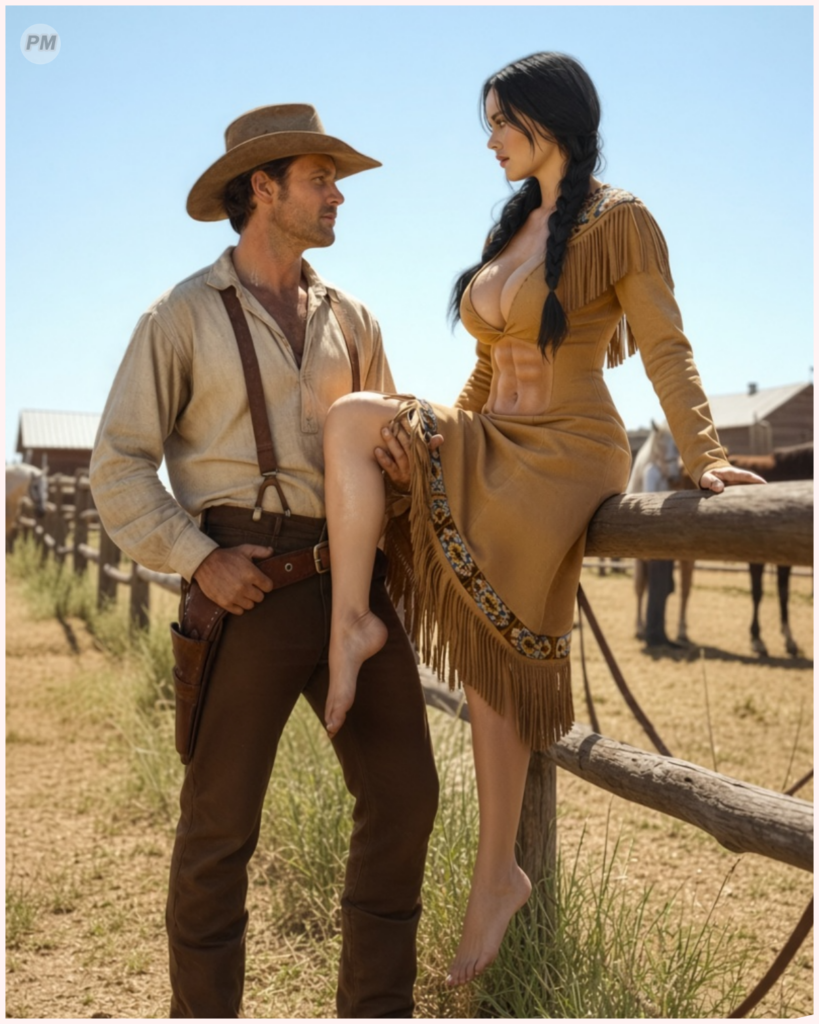
Elias Ward reached the edge of the border town just after midday. Heat pressed down on the dry ground and dust drifted behind him with every tired step of the old mare beneath him.
She had carried him through hard years, long drives, lean seasons, a fire that took everything he owned, but now her legs trembled even on level dirt.
He kept one hand on her neck, steadying her as she walked the last few yards toward the livery stable.
He had come here for one reason, to buy a new horse and continue north, where a rancher he once worked for had offered him a winter job.
Wasn’t much, but it was work and he needed something predictable to hold onto. After years of drifting, he wanted a place where he could stand still for more than a month.
That was his mission, find a horse, reach the ranch, and rebuild some kind of structure in his life.
He dismounted slowly, letting the mare lean against him for balance. Her breath shook. Elias looked at her and felt guilt rise in his chest.
He had pushed her too far, hoping she’d last until town. She didn’t owe him this much work.
She deserved to lie down, rest, and not rise again. He swallowed hard and called the stable hand.
They spoke briefly, confirming what Elias already knew. She wouldn’t survive another journey. He nodded once, more to himself than to anyone else, then stepped away from the stable.
His hands tightened at his sides. The loss hit him faster than he expected. The mare had been his last living link to the years before the fire, the years when he still had family, a home, and purpose.
Now, that final connection was falling apart right in front of him. He needed air, so he walked toward the trading post where the street opened up.
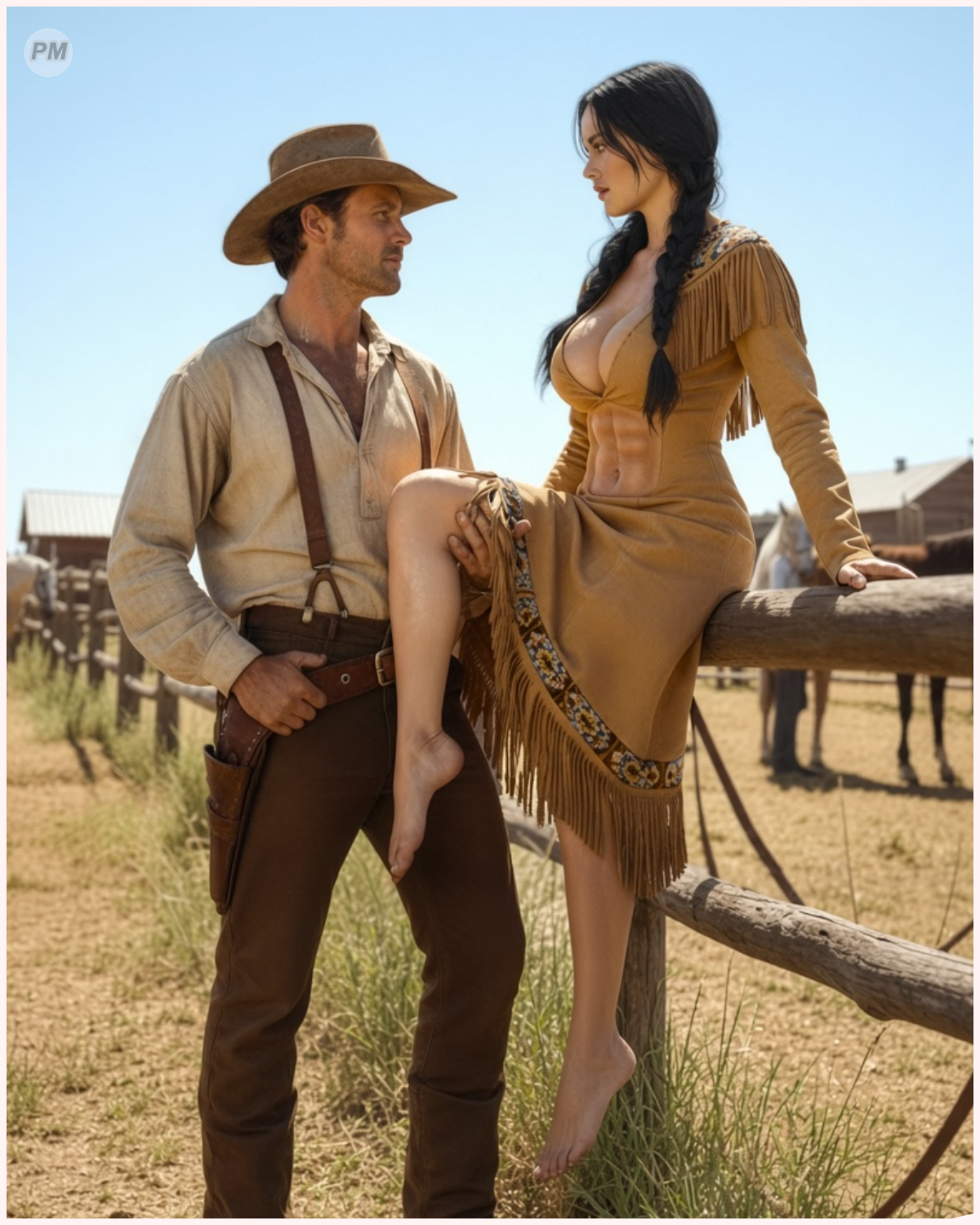
That was when he saw her. A woman stood alone near the wall of the post, holding a bundle of supplies against her body with an awkward angle.
Her left arm hung stiff and close to her ribs. The way she shifted her weight told him she was in pain.
Her clothing, beadwork, and braided dark hair identified her clearly as Apache. The townspeople kept their distance, glancing at her only long enough to confirm they didn’t want to be near her.
She kept her eyes low as if reducing her presence would keep her safe. Every time someone passed, her breath tightened.
It wasn’t fear alone, it was the habit of someone who had been treated roughly more than once.
Elias stopped walking. He didn’t mean to stare, but something about her posture held him.
She reminded him of himself on the worst days after the fire, when talking to anyone felt dangerous, when every sound made him brace for something to go wrong.
He looked away, tried to refocus on the horse he planned to buy, but the thought didn’t hold.
His chest tightened again, this time with a different kind of discomfort. He didn’t like the idea of walking past her and pretending he didn’t notice she needed help.
Yet, he also didn’t want to intrude, especially on someone who clearly had reason to distrust strangers.
He forced himself to move forward. Step by step, he closed the distance between them.
She shifted slightly, preparing for rejection or trouble. That reaction alone made him slow his pace, keeping his movements controlled and non-threatening.
“Ma’am,” he said quietly, stopping a few feet away. He kept his voice steady, neutral.
“You look like you’re handling too much with that arm.” Her eyes lifted only halfway.
She didn’t answer. Her jaw set and her shoulders tightened. She was expecting him to judge her or speak roughly.
The silence stretched. Elias remained still. He didn’t glance around, didn’t push his presence. He simply waited.
“I don’t need help,” she finally said, though her voice shook slightly. “I’m not asking you for anything,” he replied.
“Just offering to carry the weight.” The bundle in her arms slipped a fraction. She caught it and winced.
That small reaction gave Elias the answer she wasn’t willing to say out loud. She turned her face away, debating.
Pride, fear, and exhaustion pushed against one another in her expression. Her injured arm trembled from holding the supplies too long.
She looked toward the road leading out of town, long, exposed, and rough terrain for someone in her condition.
After several seconds, she exhaled. “The cabin is far,” she said quietly. “And I walk slow today.”
“I walk slow today, too,” he answered. She didn’t smile, but something in her shoulders eased.
She shifted the supplies toward him. He took them carefully, making sure she saw that he would not crowd her space.
He waited for her to start walking first. As they left the town, Elias kept his steps measured and silent.
The air cooled slightly as afternoon shadows grew. In the distance, a bank of dark clouds formed over the plains.
The storm would reach them before nightfall. Ayoka, he learned her name later, but even now he watched her with the curiosity of someone trying to understand another person’s wounds.
Kept her eyes on the ground ahead of her. The way she moved told him she was used to walking alone, used to expecting trouble, used to bracing for the next hardship.
Elias’s thoughts shifted between the mare he had lost, the future that suddenly felt uncertain again, and this woman whose quiet distress echoed pieces of his own life.
He didn’t know what he was doing or why he couldn’t simply walk away and focus on his original mission.
Buying a horse and leaving should have been simple, but something about her struggle made him feel responsible in a way he hadn’t felt in a long time.
He adjusted the supplies in his arms and cleared his throat lightly so she knew where he stood behind her.
“Storm’s coming,” he said. “I know,” she answered. “We should hurry.” Her cabin waited somewhere ahead and Elias sensed already that reaching it would not be the end of his choice, but the beginning of one.
The wind shifted sharply as they moved farther from town, carrying the first cold warning of the storm.
Ayoka increased her pace, keeping her injured arm close to her body. Elias stayed a few steps behind, close enough to offer help if she stumbled, but far enough to give her room.
The clouds thickened quickly, turning the open plains darker than they should have been at that hour.
The trail narrowed as it passed through low brush. Elias studied their surroundings with quiet attention.
He wanted to understand how far her cabin might be, why she lived this far from town, and whether she had anyone else nearby.
The supplies she carried earlier, simple necessities, nothing extra, suggested she managed everything alone. The stiffness in her arm worried him.
He’d seen sprains, fractures, and deep bruises. Hers seemed worse than she admitted. When the first drops of rain fell, she glanced back with a tight breath.
“Not far,” she said, though her voice carried strain. Lightning flared in the distance. Elias adjusted his grip on the supplies.
“We’ll make it.” She didn’t answer, but she pushed forward with determination that impressed him.
For someone carrying visible pain, she held herself with firm control. Still, her pace slowed as the rain thickened.
The ground softened beneath their boots. She slipped once, caught her balance, and kept walking without looking at him.
Elias understood that acknowledging it would only make her feel exposed. Minutes later, the outline of a small cabin appeared against the darkening sky.
A single-room structure built from weathered logs, the roof patched in several places. A faint strand of smoke lifted from the chimney.
Ayoka quickened her steps, her breathing shallow with effort. Inside, the air was warmer but carried the scent of damp wood.
Elias placed the supplies on a small table and immediately noticed details that raised quiet questions.
The single chair pulled close to the hearth, a small basket of dried herbs, a set of tools repaired and re-repaired until the handles were nearly worn through.
There were no extra boots by the door, no additional bedroll, no signs of shared life.
Ayoka shut the door firmly against the wind and leaned her good hand against the wall for balance.
Her injured arm trembled more visibly now. Elias stepped to the side to avoid blocking her path.
“Sit,” he said in a low voice. She hesitated, unsure whether accepting help again would create a debt she could not repay.
After a moment of silence, she moved to the chair and lowered herself carefully onto it.
Elias crouched beside the table and opened the bundle of supplies, sorting through the items she had bought.
Among them were fresh bandages, a small jar of salve, and a water container. She had come to town for medical needs, not comfort.
“How long has it been hurting like this?” He asked. “Two days,” she answered. “A fall.
No doctor comes this far.” “Town doctor didn’t look at it?” Her jaw clenched. “They don’t treat me unless forced.”
The statement was plain, not dramatic, but Elias felt a tightness in his chest. It confirmed what he suspected during the walk.
She bore every hardship alone because she had no choice. He opened the salve and approached her slowly.
“Let me set it better.” She watched him with guarded eyes but didn’t pull back.
He worked with steady hands, pressing gently along the bone to check for breaks. Her breath caught when he touched one spot.
He recognized the reaction immediately. “Not broken, badly strained.” She exhaled, both relieved and exhausted, while he wrapped the fresh bandage, he sensed more beneath her silence.
Fear that accepting help might make her vulnerable and a constant readiness to defend herself if kindness turned into expectation.
He kept his movements precise, giving her no reason to tense further. Outside, rain hammered against the roof.
The wind pushed at the cabin walls. Ayoka’s gaze shifted toward the sound. “You shouldn’t stay long.”
She said. “Storm or not, I’ll stay until it’s safe to travel.” He answered. “That’s all.”
He wasn’t sure if the words comforted her or not, but she didn’t argue again.
She shifted in the chair trying to hide a wince. Elias noticed anyway. “You need rest.”
He said. “I’ll rest when the fire is steady.” He knelt beside the hearth, stacking the wood properly and coaxing the flames higher.
The warmth spread slowly through the cabin. As he worked, he took note of the patches on the roof.
Temporary repairs she had managed herself. They wouldn’t hold under a heavy storm. If he stayed through the night, there was a chance the roof would begin leaking again.
He made a mental note to check it once the rain eased. Ayoka watched him from the chair, her expression unreadable but calmer than before.
She seemed to study him with a mixture of caution and reluctant trust. “Why were you in town?”
She asked. “Needed a horse.” He answered. “Mine’s not making another day.” She nodded once understanding without prying further.
He didn’t yet explain the rest. The winter job, the hope for steady work, the reason he wanted to keep moving.
It didn’t matter at that moment. What mattered was that they were here. The storm was strengthening and the night would be long.
Another gust struck the cabin. Ayoka flinched slightly, likely remembering the roof problems. Elias stood, wiped the rain from his coat, and checked the door latch.
It held firm. When he turned back, she was leaning her head against the chair, her eyes heavy with exhaustion.
“You’re safe for the night.” He said quietly. Her eyes opened just enough to meet his.
There was no fear in them now, just the fatigue of someone who had carried too much alone.
He pulled a second stool near the hearth and sat down, giving her space but staying close enough to help if her arm worsened.
The firelight reflected across the worn wooden walls, revealing the full shape of her life.
Steady labor, loneliness, and a constant effort of survival. It also revealed his own uncertainty.
He had planned to leave town with a new horse and a clear direction. Now he was here in a stranger’s cabin feeling a responsibility he did not fully understand.
Ayoka shifted in her seat, her voice softer than before. “Thank you.” Elias nodded once.
“Rest.” The storm intensified outside, but inside the cabin, the air settled in a steady warmth.
The long night ahead would change both of them more than they expected. Rain eased shortly before dawn, leaving only steady dripping from the eaves and the low rumble of distant thunder.
Elias rose from the stool, stretching the stiffness from his back. Ayoka slept lightly in the chair, her injured arm supported with a folded blanket he had placed beneath it during the night.
Her breathing was even now and the tension in her shoulders had eased. The cabin felt calmer than the night before, but the smell of damp wood signaled another problem.
A thin line of moisture crept along one corner of the roof. Elias stepped closer and pressed his hand lightly against the log wall.
The cold dampness confirmed the leaks were returning. The storm had weakened the older patches.
He knew these little problems could become dangerous if left unhandled. Ayoka stirred at the sound of his steps.
Her eyes opened halfway. “Is it morning?” “Almost.” He said. “Roof needs work.” She tried to sit up straighter, but the moment she shifted her arm, pain shot through her face.
She hid the reaction quickly, but Elias had seen enough. She wasn’t ready for heavy tasks.
The injury ran deeper than she claimed. “I’ll handle it.” He said. “That roof is old.”
She replied quietly. “I’ll fix it myself.” “You won’t today.” She looked down unsure whether to argue.
Independence had kept her alive, but exhaustion made the decision for her. She gave a small nod and let her head rest again.
Elias stepped outside pulling the door closed behind him. Morning light revealed the damage more clearly.
Loose shingles, sagging beams, and a large patch that had been repaired multiple times. He examined the work with the practical eye of someone who had rebuilt more than one shelter in rough country.
The structure wasn’t failing, but it was worn thin. Ayoka had done everything she could on her own.
It wasn’t enough for weather like this. He gathered fallen branches and leftover boards stacked near the cabin wall.
Nothing fancy, but enough to reinforce the weak points. While working, he noticed markings in the dirt.
Fresh hoof prints and old wagon tracks. The cabin wasn’t completely isolated. People passed through this area sometimes.
It meant she lived close to danger, not just loneliness. By the time the sun broke through the thinning clouds, Elias had secured the roof with added beams and replaced the worst shingles.
He wiped rainwater and sweat from his brow, feeling the familiar burn of labor across his shoulders.
The work steadied him. It gave him purpose he hadn’t expected to find here. Inside the cabin, Ayoka had woken fully and was tending the fire with one hand.
She moved cautiously trying not to show discomfort. Elias stepped in and closed the door to keep out the lingering wind.
“You climbed the roof.” She said, not quite a question. “It needed it.” He replied.
Her gaze settled on him longer than before, as if evaluating whether he expected thanks or something more.
When she realized he didn’t, her posture softened. “I have tea.” She offered. “For pain.”
He nodded and sat on the stool while she prepared it. Her movements were careful but practiced.
The tea’s scent, dried leaves, and a hint of sage filled the small room. She poured a cup and set it on the table between them.
He watched her wrap her arm tighter with the bandage he’d applied. “How long have you been here alone?”
He asked. “Many months.” She said. “After my husband died, I stayed. I know this land better than any other place.”
“Anyone nearby who checks on you?” “No.” She paused. “Better that way.” Elias studied her expression.
She spoke with steady confidence, but there was a fatigue behind her eyes that told a fuller story.
Living alone this far out wasn’t just a choice. It was a shield against trouble she could not constantly fight.
Still, fear wasn’t what ruled her. She carried a quiet resilience built from surviving one hardship after another.
A gust of wind rattled the window frame drawing her attention. “The storm broke one of the last roof patches.”
She said. “I thought it would hold.” “It will now.” Elias replied. She looked at him again, this time with something closer to trust.
“Why do this? You don’t know me.” “Someone helped me once when I needed it.”
He said. “I remember what that felt like.” It was the truth. After the fire that took his family, a ranch foreman he barely knew had given him enough work to survive the winter.
Elias had never forgotten the weight lifted in that moment. Seeing Ayoka struggle alone stirred the same memory.
Ayoka absorbed his answer slowly, then shifted the conversation. “What will you do now that your horse is gone?”
“I’ll figure out.” He said. “I was headed north for work. Might still go. Haven’t decided.”
She nodded but didn’t hide the tension in her jaw. She didn’t want him staying out of obligation.
At the same time, the small flicker in her eyes suggested she wasn’t ready to face more days alone with a weakened arm and a roof that only held because of his repairs.
Another silence filled the cabin, not uncomfortable but cautious. They were two strangers trying to understand the boundaries of their situation.
Elias stood. “I’ll bring in more wood before the next rain.” “You don’t have to.”
“Still doing it.” She didn’t answer, but her eyes followed him as he stepped outside again.
Something in her expression had shifted. An acceptance that his presence didn’t threaten her. And maybe for the first time in a long while, she wasn’t fighting the day alone.
As he gathered wood, he considered how easily he could leave once the weather cleared.
The path north was still waiting. So was the work. But the image of Ayoka struggling to lift a bundle with one good arm stayed sharp in his mind.
Leaving her like this would sit poorly with him. Inside the cabin, Ayoka watched him from the doorway, her hand resting lightly against the frame for balance.
She didn’t call out to him or question his intentions. She simply observed as if trying to understand a man who stepped into her life without demanding anything in return.
Elias stacked the wood near the door and straightened. Their eyes met. Neither spoke, but the decision forming between them was already taking shape even if neither recognized it fully yet.
Clouds thinned by midday, leaving behind a pale, washed-out sky and the heavy stillness that often followed a long storm.
Elias finished stacking the last of the dry wood near the cabin wall. His shoulders ached, but it was the kind of tiredness that came from useful work, not drifting without direction.
As he wiped his hands on his trousers, he noticed a Yoka step outside. Her injured arm supported against her chest with a fresh wrap.
She scanned the repaired roof, the stacked wood, and the cleared path he had made from the door to the well.
Her expression was quiet, but the tension that had marked her face the day before had softened.
She walked slowly toward him. “You did much,” she said, “more than I expected.” He nodded without making anything of it.
“Needed doing.” Ayoka looked out across the plain where water pooled in low spots and the grass bent from the weight of last night’s rainfall.
“This land is hard,” she said, “harder when alone.” Elias waited. He sensed she wasn’t just making conversation.
She took a slow breath, grounding herself before she continued. “My husband was killed near the river south of here,” she said.
“The men who did it were never found. There was no help after. I stayed because leaving meant losing everything you built and because I knew how to survive in this place.”
Her voice didn’t tremble, but the memory pressed against her words with weight she didn’t hide.
Elias studied her posture, noting how she kept her spine straight even while speaking about loss.
She wasn’t asking for pity. She was offering truth. He dropped his gaze to the dirt for a moment, then lifted it again.
“I lost my family in a fire,” he said, “a long time back. I tried rebuilding, but nothing felt steady after that.
I’ve been working my way across the frontier since.” Ayoka’s eyes shifted toward him, searching for something in his tone.
“Is that why you plan to go north?” “They have steady work. A rancher I knew offered it.”
He paused. “I figure I’d take it and stay there through winter. Try making sense of it next year from there.”
She absorbed this quietly. “You wanted peace.” “Something close to it,” he answered. The wind carried the scent of wet soil, filling the silence between them.
Neither looked away. It felt like the first time their shared experiences stood openly in the space instead of hidden behind caution.
The connection wasn’t sudden or dramatic. It was steady and practical, built on losses they both understood.
Ayoka stepped toward the wood pile. “I should carry some of this inside.” “Don’t,” Elias said, moving automatically to block her path.
“Your arm won’t take weight yet.” “I must do my part.” “You are. You’re here.
Let me handle the lifting.” Ayoka hesitated, not used to being told to rest. After a brief pause, she nodded once.
The small gesture held more trust than any verbal agreement. Inside the cabin, she settled into the chair while Elias brought in the wood.
The repairs he made earlier now held solid. The air was warmer and the draft that used to slip through the roof had weakened.
Elias dropped the last pieces near the hearth and dusted his hands. Ayoka watched him carefully.
“What will you do when the road dries?” She asked. Elias expected the question, but answering it wasn’t simple anymore.
When he arrived here, the plan had been straightforward: buy a horse, head to work, keep moving until the rest of life made sense.
But seeing how isolated she lived, seeing her push through pain while everyone else ignored her, pushed another thought forward.
“I’ll decide when it’s time,” he said. Her eyes lowered for a moment as if bracing for an unspoken outcome.
She looked back at him, not accusing, not pleading, simply preparing herself for the possibility of another departure in her life.
Elias sat on the stool opposite her. “You said no one comes here. Not neighbors, not your people.
No one.” “They have their reasons,” she replied. “I have mine.” He nodded. “Reasons don’t change that you shouldn’t be alone with that arm or with men from town riding this direction.”
Her gaze sharpened. “You saw something?” “Tracks near the cabin. More than one set. Not from this morning.”
She straightened a little, understanding the risk. The cabin’s isolation, which once gave her safety from town, also meant trouble could reach her before anyone knew.
She looked uneasy, but she hid most of it. Elias leaned forward slightly. “You’re strong.
That’s clear, but strength doesn’t mean you shouldn’t have someone here.” Ayoka studied him for a long, long moment.
The fire flickered between them, throwing uneven light across her features. “If you stay,” she said quietly, “it must be your choice, not because you feel responsible.”
“I know.” He meant it. Responsibility wasn’t what held him here. Something else was forming, something steady and quiet, built from the way she fought through pain, the way she tried to protect her independence, and the way she carried her past without letting it consume her.
She exhaled, relieved not by his answer, but by the honesty in it. She adjusted the bandage on her arm, her movements slow but improving.
“I will teach you how I gather water,” she said. “There is a spring east of here.
The ground is tricky after storms.” Elias stood. “Show me when you’re ready.” Ayoka rose from the chair with caution.
She stepped outside with him, stopping at the edge of the small yard. She pointed toward a low ridge where the earth dipped in unpredictable ways.
“You read tracks well,” she said, “but the soil changes. You must watch how it sinks under you.”
Elias listened closely, asking questions she had expected him to overlook. She answered with careful detail, sharing knowledge she once kept guarded.
What began as a practical lesson shifted into something deeper, the first real sign that they were beginning to trust one another not out of necessity, but out of choice.
As the sun lifted higher, their shadows stretched side by side across the wet ground.
And though neither of them said it aloud, the thought forming in both their minds was the same.
What they were building here might change the direction of their lives more than either planned.
The ground dried slowly over the next 2 days, leaving behind firm paths where muddy trenches had once swallowed footprints.
Elias and Ayoka walked the land each morning, moving with a rhythm that formed naturally.
She showed him the spring, the places where the soil had sudden drops, and the narrow ridges that looked solid but shifted under weight.
Elias learned quickly, asking questions that helped him understand how she navigated the open terrain alone.
Her arm healed at a steady pace. The swelling had gone down, and she could lift her hand higher without flinching.
Still, she protected it instinctively, refusing to test its limits. Elias respected that caution. He’d seen too many injuries worsened by stubbornness.
Inside the cabin, their routines took shape without discussion. Elias gathered wood and checked traps she had set earlier in the season.
Ayoka focused on herbs, sewing, and preparing small meals with what they had. She moved more confidently now, her steps lighter, and the guarded silence between began shifting into something warmer.
One afternoon, Elias repaired a weak section of the cabin door, hammering a new brace in a place.
Ayoka walked in from the spring with a clay pot of water. She paused at the doorway, watching him work.
The sound of steady tapping filled the small clearing. “You understand tools,” she said. “I had to,” Elias replied.
“A ranch only holds together if everything is fixed before breaks.” She set the water pot on the table and leaned her good shoulder against the doorframe.
“You spoke of working on a ranch before. Was it a place you meant to stay?”
“For a time,” he said, “but things changed after the fire. Moving became easier than staying.”
Ayoka absorbed the explanation without judgment. “Fire takes more than houses,” she said quietly. “It does.”
He didn’t add details. He didn’t need to. She recognized the tone, the way grief settled into a person’s movements long after the initial loss burned out.
She shifted the topic gently. “You read trouble well. The tracks you saw near the cabin, do you think they will return?”
“Could be hunters,” Elias said. “Could be someone just passing through. Hard to know without seeing them.”
Ayoka nodded, but her shoulder stiffened. Living alone meant threats stayed unspoken, pushing into her thoughts even on quiet days.
Elias caught the strain in her eyes. “I’ll keep an eye out,” he said. “If anyone comes close, we’ll know.”
She didn’t ask him how long he planned to do that. She didn’t ask whether he was staying or preparing to leave.
Those questions sat between them, waiting for something more certain than a storm or circumstance to bring them forward.
Late that evening, as dusk settled over the plains, they ate a simple meal by the hearth.
The fire burned steadily, the warmth settling her anxiety. Ayoka stirred a pot of stew with her good hand, tasting the broth before handing a bowl to Elias.
He accepted it with a nod. “You cook better than any trail cook I’ve known.”
Her lips curved slightly, not a full smile, but a softened expression he hadn’t seen before.
“Trail cooks burn everything. Easy to be better.” Her quiet humor surprised him, and he let a breath of amusement escape.
The tension in the room lifted. As they ate, Ayoka’s gaze drifted to the repairs he made earlier in the day.
“You have done much work for a man who is only passing through.” Elias took a slow breath, feeling the weight of her words settle somewhere deeper.
“Doing what’s needed comes naturally,” he said, “especially when it helps someone who shouldn’t have to do everything alone.
She lowered her eyes, touched by the sincerity, but unsure how to hold it. I’ll learn not to expect anyone, she said.
The last time I trusted a stranger, it cost me more than I could give again.
You don’t owe me anything, Elias said. I’m here because it feels right to help, not to take something.
Her eyes lifted, searching his face for any hint of hidden motive. She found none.
For the first time, uncertainty gave way to something steadier. Confidence that his presence didn’t threaten her boundaries.
Thunder rolled faintly in the distance, not from a coming storm, but from clouds breaking apart as night settled.
Ayoka set her bowl down gently. There’s a ridge north of here, she said. My husband used it to watch for riders.
If tracks return, that is where you will see them first. Elias nodded. Show me tomorrow.
She hesitated, then added, I will go with you. The land speaks differently after rain.
You should hear it from someone who knows. He appreciated the offer. It was not just guidance, it was trust.
All right, he said, we’ll go together. As the fire dimmed, Ayoka prepared her bedroll and Elias settled on the stool beside the hearth.
The cabin felt less empty now. The distance between them was no longer defined by caution, but by the slow, steady understanding built through shared days and quiet cooperation.
Outside, the plains stretched into darkness, wide and uncertain. Inside, two people who had spent too long navigating life alone found themselves moving, carefully, naturally, toward something neither had planned for, but neither wished to push away.
They left at first light, moving toward the northern ridge with a steady pace. The storm’s remnants still clung to the low ground, creating pockets of softer earth that Ayoka navigated with practiced awareness.
Elias followed her steps closely, watching the land as she pointed out subtle signs, shifts in soil color, bent grass, the way a rock’s shadow revealed whether something had passed recently.
Her arm was improving, though she still kept it close. She spoke more freely now, explaining which tracks belonged to deer, which to coyotes, and which belonged to riders she wished she had never seen again.
Elias listened carefully, filing each detail away. Understanding this land meant understanding her life, and understanding her life felt necessary in ways he didn’t fully articulate.
When they reached the ridge, Ayoka climbed the final slope slowly. Elias steadied her by the elbow when loose dirt slipped under her boots.
She accepted the support without tension. At the top, the land opened in a wide stretch below them.
Fields broken by narrow brush lines, a dried creek bed winding toward the foothills, and a narrow trail that connected the cabin to the distant road.
Ayoka scanned the terrain with a controlled breath. Tracks were there, she said, pointing to a shallow bend of earth where soil darkened in irregular patterns.
Not from hunters. Wagons don’t come this way. Elias crouched beside the marks. They were faint, but clear.
Multiple riders had passed, and not long before he first arrived. The direction suggested they circled near the cabin before moving on.
He traced the depth of the prints. Heavy horses, not just scouts. Ayoka’s jaw tightened.
Some men from town think the land here should be theirs. They come to look, even if they do nothing.
He looked up sharply. How often? Enough that I stopped counting, she said. They haven’t harmed me.
They only watch. Sometimes closer than I like. Explain more the isolation, the constant caution, the way she carried herself the first time he saw her.
She had learned not to rely on anyone because relying on the wrong person could bring danger faster than help.
Elias felt a slow heat rise in his chest. Not anger in the explosive sense, but a steady, focused irritation at the thought of men circling her home while she lived alone and injured.
You shouldn’t be dealing with that alone, he said. Ayoka didn’t argue. Silence stretched between them, filled by the distant sound of wind traveling across the grass.
Elias stood and scanned horizon one more time. No riders today. No dust rising in the distance.
Still, he knew their tracks meant they’d return eventually. If they come back, we’ll see them before they see us, he said.
Ayoka didn’t correct his choice of words we Instead, she gave a small nod and began the descent, trusting him to follow.
On the walk back, the air carried a dry warmth that signaled the return of stable weather.
Ayoka pointed out a patch of wild roots she planned to harvest when her arm strengthened.
Elias noted the location, offering to help when the time came. She didn’t refuse. By midday, they reached the cabin again.
Elias added a new beam to the porch frame, reinforcing the structure against future storms.
Ayoka ground herbs into a small bowl, preparing a stronger salve to reduce her remaining swelling.
Their movements blended into a shared routine with no conflict or hesitation. Later, while Ayoka rested near the hearth, Elias stepped outside to check the perimeter one more time.
The land looked quiet, no movement, no riders. Yet he knew distance didn’t change the fact that danger had once been close.
As he approached the cabin again, he heard hooves, multiple, approaching from the east. He stopped and listened.
The riders were not rushing or shouting, but they were coming directly toward them. Dust lifted behind them in a thin, rising line.
Ayoka stepped to the doorway with a sharp breath, recognizing the pattern of the approach.
Those men come to question, she said, not to help. Elias stepped beside her, calm but alert.
Stay inside. She didn’t argue. Her injured arm made stepping forward impossible. She retreated a few steps, though her eyes stayed locked on the approaching figures.
Three riders slowed near the cabin, their expressions stiff with suspicion. The leader, a broad man with a weathered coat and tight mouth, leaned slightly forward in the saddle.
You there, he called to Elias. You staying with her? Elias didn’t flinch. Helping, he said.
That your business or hers? Mine. The man smirked in a way that carried disrespect more than humor.
She’s known to stir trouble with folks in town. We keep an eye on this place.
Ayoka’s voice came sharply from inside. I stir nothing. You bring the trouble here. One of the men laughed under his breath.
Elias stepped forward just enough to make his stance clear. She’s hurt. You’ll move on.
The leader tilted his head, measuring him. You plan on staying long? He asked. As long as needed.
The riders exchanged looks. Elias saw the calculations behind their eyes, the sizing up of a man who didn’t back away.
After a tense moment, the leader gave a shallow nod. We’ll ride through another time, he said, voice low.
Make sure nothing’s changed. They turned their horses and moved off, leaving a thin trail of dust behind.
Elias watched until they disappeared from sight. Only then did Ayoka step outside again, her breathing uneven.
They won’t stop, she said, not soon. He faced her with a steady expression. Then I won’t leave you alone with them.
Her eyes widened slightly, not with fear, but with a recognition that something between them had shifted.
His decision wasn’t born of obligation anymore. It came from a deeper place, shaped by days spent learning her world and seeing her strength tested again and again.
She lowered her gaze, steadying her breath. I don’t know what to call this, she said quietly, but I’m not afraid with you here.
Elias felt the same truth settle in him. We’ll figure the rest out, he said, one day at a time.
A calm silence fell between them. Not just relief, but the beginning of a bond shaped by choice, not survival.
The threat outside was real, yet the space between them inside the cabin felt more certain than at any moment since he arrived.
And neither of them tried to deny it. The riders did not return that day, yet the tension they left behind lingered in the air long after dust from their horses settled.
Ayoka prepared a small meal inside while Elias checked the perimeter again, pacing the land with slow, deliberate steps.
Every mark in the soil, every shift in the grass, every faint indentation mattered. He wanted to be certain no one had doubled back or lingered out of sight.
When he finally stepped inside, Ayoka placed a bowl of stew on the table. Her movements were steadier now, her arm supported by a new wrap she had made with the herbs and salve.
She watched him with a careful expression, one touched with concern, but not fear. You walked far, she said.
Needed to know the ground was clear. It is for now. They ate in silence for a moment, the sound of wind pressing lightly against the cabin walls.
Elias felt her watching him more than before, not with suspicion. Those days were passing, but with an unspoken question she didn’t know how to voice.
She wasn’t just wondering whether he meant to stay. She wanted to understand why he stayed.
After the meal, she began clearing the bowls with her good hand. Elias stood to help, but she shook her head gently.
“I can do this,” she said. “My arm is stronger.” He stepped back, respecting the boundary.
Her independence mattered deeply to her, and now that her injury was healing, she wanted to reclaim what she had lost in those painful days.
He watched her move carefully around the hearth. The faint stiffness in her posture is still present, but improving.
When she finished, she sat down near the fire. Darkness settled over the plains outside, quiet and deep, broken only by the occasional call of distant owls.
Elias took the stool beside her, leaning forward slightly. “They’ll come again,” she said, her voice low but steady.
“I know,” he answered. “They come because they think this land should be theirs,” she continued.
“My husband worked it, built the cabin, planted what we could. When he died, they believed I would leave.
They think I take more space than I should.” Elias studied her features, calm, controlled, but weighted with years of pushing back against pressure she faced alone.
“You belong here,” he said. “They don’t decide that.” She looked into the fire, absorbing the words slowly.
“I stayed after his death because leaving meant losing everything, and because I was not ready to begin somewhere else.
The land held memories, even the hard ones.” Elias nodded. He understood. The places he had left behind after the fire still haunted him.
Staying anywhere had felt impossible. But here, in a cabin that did not hide its scars, he felt less like a ghost drifting through borrowed spaces.
Ayoka continued, “When you came, I thought you would do what most men do, help once and walk away.
Your staying changed the air here. It changed how I wake and how I rest.”
Elias looked at her, not fully expecting the honesty. She kept her gaze on the hearth, not because she was afraid of his reaction, but because speaking openly came with its own weight.
She drew a slow breath. “Are you staying because you want to, or because you feel you should?”
He considered the question. The truth rose without hesitation. “I want to,” he said. “I didn’t plan it, but every day here makes more sense than moving on.”
This time she looked directly at him. There was no shyness, only careful hope. “Then we face what comes together.”
He held her gaze. “Yes.” The simplicity of the answer settled something between them that had been shifting quietly since the moment he carried her supplies.
Their bond was no longer a reaction to danger or circumstance. It was a choice.
The next morning brought clear skies and a calm wind, rare signs of stable weather after so many storms.
Ayoka stepped outside with Elias. Her arm cradled, but more flexible than the day before.
They walked toward the edge of the field, where a section of fence had weakened over time.
Elias began lifting the broken rails. “Let me show you how we used to brace this,” she said, pointing with her good hand.
“My husband built it without extra nails. It uses the angle of the posts.” He followed her instructions, fitting the rails the way she described.
As they worked, she spoke of small parts of her past, how she and her husband lived their first seasons here, where they found water, how long it took to learn which plants survived the climate.
Her voice held no heaviness now. She was sharing history, not grief. Elias noticed that she watched him differently, measuring not whether he would leave, but how he fit into the work, into the land, into the quiet rhythm of her days.
When they finished the repairs, she stepped back to inspect the fence. “Good,” she said.
“It will hold.” She turned to him with a rare, faint smile. “You work like a man who plans to return to the same spot tomorrow.”
“I do.” Her breath caught, not in fear, but in a subtle, grounding sense of recognition.
It was the first time either of them admitted, even indirectly, that his presence was becoming part of her life rather than a temporary interruption.
As they walked back toward the cabin, the land felt less empty, the silence less heavy.
Elias carried the tools. Ayoka walked beside him with a relaxed pace. Neither felt alone in the stretch of open plains.
They didn’t speak of the riders that day. They didn’t speak of fear or of what might come next.
Instead, they focused on the rhythm they were building, knowing that the decisions waiting ahead were not born from pressure or danger, but from a growing wish to build something together rather than apart.
Whatever came next would come from that choice. The morning passed with a steady, quiet warmth as Elias and Ayoka settled into the familiar rhythm they had created.
She tended to the herbs hanging near the window, while he checked the traps along the creek bed.
Her arm had regained much of its strength, and she moved with more confidence than at any time since he arrived.
The sense of fragility that once marked her steps had faded into something steadier. But the balance they had built carried a weight neither of them spoke aloud, the question of what came next.
Elias sensed it each time he caught her watching him from the corner of her eye, as if measuring whether the days they spent together could truly last.
He felt it when he looked at the clear horizon and realized he no longer felt pulled toward the ranch up north.
Stability waited there, but it didn’t feel like the kind of life he wanted anymore.
When he returned to the cabin near midday, Ayoka was preparing a pot to boil water.
She turned when he entered, studying his expression. “You walked far today,” she said. “Wanted to see how the land settled after yesterday’s repairs,” he replied.
She nodded, but her eyes lingered on him a moment longer. Something unspoken hovered in her gaze, concern, curiosity, maybe both.
As they ate a simple meal, silence stretched between them. It wasn’t tense, but it carried a shift neither had addressed.
After finishing her soup, Ayoka set the bowl aside and looked toward the window. “Your horse in town,” she said quietly.
“You still need to buy one.” Elias felt the impact of her words more deeply than he expected.
She wasn’t pushing him away, but acknowledging the life he had before he arrived. “I know,” he said.
She folded her hands in her lap. “If you go, it would be the way you planned before, a clear path, work waiting for you.”
“And if I stay?” He asked. Ayoka’s eyes lowered briefly. “Staying has its own weight.
This land is not easy. The men who watch it will return. Choosing this place means choosing those problems, too.”
He appreciated her honesty. She wasn’t offering a simple answer or asking him to decide on feelings alone.
She was giving him the truth, her truth, without softening the realities he would face beside her.
Elias leaned back slightly. “And what would it mean for you if I stayed?” Her breath caught, but she returned his gaze with steady clarity.
“It would mean I’m not alone anymore,” she said. “It would mean someone here chooses this life with me, not because of duty or pity, but because it feels right.”
He absorbed the weight of her words slowly. She wasn’t a woman who spoke lightly about trust.
The fact that she admitted this much meant her guard had lowered more than she ever intended.
After a long moment, Elias stood and walked to the door, letting the air hit his face.
The plains stretched wide and quiet. The direction north was open. No storms blocked the way.
No obligations held him here. And yet, the thought of leaving felt wrong in every way that mattered.
Behind him, Ayoka rose to her feet. “If you decide to go,” she said, her voice even, “I won’t stop you.”
She stepped closer, stopping just behind him. “But I will feel the loss.” Elias closed his eyes briefly.
Her presence at his back, her steady voice, the quiet strength she carried, it anchored something inside him.
But the decision couldn’t be made halfway. He needed to act with clarity, not hesitation.
“I should ride to town,” he said. Ayoka’s breath tightened. She didn’t ask why. “When?”
“Now.” She nodded once, accepting his choice without argument. She gathered her shawl and walked him to the edge of the yard.
The air between them felt both heavy and honest. She met his eyes with a collected expression that didn’t hide the uncertainty beneath her calm.
“Be safe,” she said. Elias started down the trail, each step feeling heavier than it should.
The land around him stretched wide and familiar now. He passed the ridge where she had shown him the tracks.
He walked the path he had repaired for her. He followed the line of fence they had built together.
Every piece of the land reminded him of the days shared beside her. And still, he kept walking because the only way to choose was to step away and ask himself whether returning felt like obligation or desire.
It took him hours to reach town. He bought a strong bay gelding and signed the papers quickly, avoiding long conversations with the stable hands.
When he mounted the new horse, something in him tightened. The view toward the open northern trail felt hollow.
He turned his horse in the direction of the cabin. The sun dipped low as he approached the familiar clearing.
Ayoka stood outside, her arms drawn close, watching the horizon with a tense, unreadable expression.
When she saw him riding back, not toward the north, but toward her, she didn’t move at first.
Her breath left her in a quiet, visible release. Elias dismounted and stepped toward her.
“I bought the horse,” he said, voice steady, “but I didn’t want to ride past your cabin.”
Ayoka looked at him for a long moment, the weight of the day settling in her eyes.
She didn’t speak, but the way her shoulders relaxed told him everything. He stepped closer, leaving no uncertainty in the space between them.
“If you want me here,” he said, “I stay.” Her nod was small but firm, shaped by certainty rather than fear.
“I want you here,” she answered. The quiet that followed wasn’t heavy anymore. It felt like the moment they had both been moving toward without realizing it, simple, steady, and real.
Together, they walked back into the cabin, leaving the door open long enough for the last light of the evening to follow them inside.
Night settled over the plains with a calmness neither of them had felt in days.
Ayoka lit a lantern and placed it near the hearth while Elias sat his saddle down in the corner of the cabin.
The new horse grazed outside, tied loosely where he could move comfortably. The room felt warmer now, not because of the fire, but because the uncertainty between them had finally shifted into clarity.
Ayoka prepared tea with deliberate movements, her arms steadier than before. Elias noticed how she no longer guarded it as fiercely, no longer tightened her jaw at every small motion.
She poured two cups and handed one to him. Her fingers brushed his briefly, an unplanned gesture, but neither pulled away.
“You came back sooner than I thought,” she said quietly. “I didn’t see a reason to stay gone,” he replied.
She took a seat near the hearth. “You chose quickly.” “I chose honestly.” The silence that followed felt full, not empty.
Outside, the horse stamped lightly against the dirt. Inside, the air settled into an easy rhythm.
Ayoka watched the flames for a moment, then turned to Elias with a question that had waited too long.
“What happens now?” Elias took his time answering. The decision he made earlier wasn’t a temporary one.
It required grounding, not vague promises. “I’ll build a stable for the new horse,” he said.
“Fix the back fence, too. It’s weaker than the rest.” Ayoka lowered her gaze, listening closely.
“I’ll stay through winter,” he continued, “help you with the land. Make sure no one rides up here thinking this place is unguarded.”
She looked up slowly. “Through winter?” She repeated, as if testing the weight of the words.
“And longer,” Elias added, “if you want that.” Ayoka didn’t respond right away. Instead, she stood and walked to the window, pulling the curtain aside.
The moonlight spilled across the field, illuminating the repaired fence line and the land she had protected alone for so long.
She rested her hand against the wood frame. “When my husband died,” she said, her voice level but soft, “I believed this place would end with me.
Not because I wanted it to, but because I didn’t see another way forward.” She turned to face him.
“You changed that without forcing anything. I didn’t expect someone to stand with me again.”
Elias rose from his stool and moved closer, keeping his steps slow and deliberate. “We stand together,” he said.
“That’s the only way this works.” Ayoka studied him with an expression that balanced trust and the last remnants of caution left in her.
“Then we build this life with both voices,” she said, “not only yours, not only mine.”
He nodded. “Agreed.” The shift between them was subtle but decisive. They were no longer two people surviving side by side.
They were choosing a shared direction. The next morning began with a clear sky and a crisp wind.
Elias took his tools and began measuring the ground behind the cabin for the new stable.
Ayoka joined him, marking where the posts should go and advising on the layout her husband once planned but never finished.
Working together came naturally, their efforts moving without confusion or conflict. During the afternoon, Elias rode the new horse across the field to test its strength.
Ayoka watched from the cabin steps, her expression steady but warm. When he returned, she met him halfway with a small pouch of herbs.
“For the horse,” she said, “to calm its after travel.” He accepted it with a short nod.
“Thank you.” As the sun lowered, they inspected the land where riders had once circled.
No fresh tracks disturbed the soil. The tension that had shadowed the cabin for weeks eased a little more.
Ayoka turned to Elias. “They may come again,” she said. “I know,” he replied, “and I’ll be here.”
This time, she didn’t hide her reaction. Relief crossed her face openly, followed by the quiet acceptance no longer had to guard her vulnerability from him.
Later, they sat outside the cabin, legs stretched toward the warm dust. The sky burned with late evening colors, shifting calmly into night.
Ayoka spoke first. “You said you wanted peace,” she said. “Does this feel like it?”
Elias considered the question. He looked at the cabin, the land, the woman beside him.
“It feels like the start of it.” She nodded once, satisfied. No grand expressions, no unnecessary emotion, just a shared acknowledgement of the path they were beginning.
As night deepened, they walked inside together. The connection between them had shifted again, not with a sudden spark, but with the firm, steady sense that neither would face the coming days alone.
The foundation of their life, once uncertain, was taking shape piece by piece, as real and grounded as the land beneath their feet.
Morning light filtered through the cabin window, soft and steady. Elias stepped outside with a coil of rope over his shoulder, the air cool enough to carry the scent of damp soil from the night’s light drizzle.
Ayoka followed a moment later, wrapping a shawl around her shoulders. Her arm was nearly healed now, the stiffness reduced to a faint reminder of the weeks behind them.
The land felt different today, calm, settled, no lingering signs of riders or threats. It was the first morning in a long while where neither of them scanned the horizon out of habit.
Instead, they walked toward the new stable frame Elias had spent days building. He ran his hand along the wood, checking the joints.
“Needs one more brace on the eastern side,” he said. Ayoka stepped beside him, placing her palm on the smooth timber.
“It’s strong,” she said, “stronger than anything built here before.” “Should be,” Elias replied. “This one’s meant to last.”
Her eyes shifted toward him. She understood the weight behind those words, not just about the structure, but about what they were creating together.
They spent the morning completing the final supports. Ayoka handed him nails and cut small lengths of rope, moving with the quiet precision she carried into everything.
Elias drove each piece into place, working with the focus of a man who had accepted responsibility not out of obligation, but out of genuine purpose.
By midday, the stable stood fully assembled. The new horse grazed nearby, its ears flicking as it watched them.
Ayoka stepped inside the structure first, testing the footing and brushing her fingers along the beams.
“My husband once dreamed of a place like this,” she said. “We planned it together, but life shifted before we could begin.”
Elias joined her. “Dreams can start again,” he said. “Different shape, same purpose.” Ayoka nodded.
“And now, not alone.” They walked back to the cabin for a small meal. The fire crackled softly while they sat across from one another.
Ayoka’s movements held no hesitation now, no guarded edges, no uncertainty about the space between them.
Elias felt the same steadiness in himself. The drifting years behind him no longer pulled at his thoughts.
After they finished eating, Ayoka set down her bowl and folded her hands. “You said you wanted to build something here,” she said.
“Do you still feel that way?” “I do,” Elias answered without pause. “And not just until winter.”
“No, longer.” Ayoka held his gaze. “Then we must decide what this life looks like.
It should be built with intent.” Elias leaned forward slightly. “Say what you’re thinking.” She took a slow breath.
“If we stay on this land together, we share its burdens and its choices. We prepare for the riders who may return.
We plant a garden when spring comes. We split the work evenly. We decide our path as one.”
Elias listened, feeling a quiet certainty grow inside him. “That’s what I want.” Her expression softened, not with dramatic emotion, but with a grounded relief.
“Then we stand as partners,” she said, “not out of fear or need, but because we choose it.”
He nodded. “Partners.” The words settled the last unanswered question between them. That afternoon, Elias checked fence lines while Ayoka pointed out places where the soil held strong for planting.
She explained how the rabbits moved through the brush, how water shifted during spring thaw, how the wind carried warnings long before trouble arrived.
It wasn’t just information. It was her welcoming him fully into the life she had protected alone for years.
As the sun dipped low, they returned to the cabin and set two chairs outside.
For the first time, they sat together not out of necessity, but out of comfort.
The sky but out of comfort. The sky blazed with amber light. A breeze lifted strands of Ayoka’s hair.
Elias rested his hands loosely on his knees, feeling the calm settled deeply in his chest.
Ayoka spoke softly, “When you first walked beside me on the road, I did not know what your presence meant.
I thought you were passing through.” “I thought the same,” Elias admitted. “But sometimes the place where you stop becomes the place you choose.”
She considered his words with a quiet nod. “This is our home now,” she said.
He looked at her, steady, strong, no longer a woman standing alone against the world.
“Yes,” he said, “it is.” Night came slowly, stars emerging one by one above the open plains.
The cabin behind them glowed with warm lantern light. The new stable stood firm in the moonlit clearing.
The land felt settled, grounded, and truly theirs. No questions lingered. No paths unchosen. Elias Ward had arrived searching for a horse in a direction.
Ayoka had lived holding on to what little she had left. Together, they built something stronger than either expected.
A shared life, a safe home, and a future shaped by choice rather than loss.
And on that quiet night, under the wide frontier sky, their story reached its true ending.
Not with uncertainty, but with a clear and steady beginning for both of them.