PART 1: The Horse Who Came Home
The stall was empty.
Wes Hollander stood in the gray light of dawn with a bucket of oats in one hand, staring at the open door, the broken halter rope, the churned straw where his horse should have been.
For seven years, the black stallion called Ransom had been at his side. Through blue northers on the Llano Estacado, cattle drives up the Goodnight Trail, flooded river crossings, and long, lonely nights under the stars. Ransom was fast, fearless, and smart enough to smell trouble before it came over the hill. Wes trusted that horse more than he’d trusted most men he’d ever known.
Now there was nothing in the stall but a broken rope and silence.
The ranch hands at the Crooked Creek outfit, outside the little Arizona town of Galeyville, had plenty of theories. Apache riders had been seen moving through the valley the night before, they said. Tracks in the dust led east, toward the Chiricahua Mountains.
“Stole him, sure as sunrise,” said the foreman, a narrow-faced man named Pike. “Don’t go after him, Hollander. Ain’t worth your scalp.”
Old Boyd Tatum, who owned the outfit, caught Wes’s arm as he cinched up a borrowed sorrel.
“You ride into Apache country alone, son, you might not come out again. One horse ain’t worth your life.”
Wes checked the Winchester in its scabbard and swung into the saddle.
“He’s more than a horse, Boyd.”
The old rancher shook his head. “Sometimes a man goes looking for one thing and finds a whole different kind of trouble waiting for him.”
Wes rode out anyway.
He followed the tracks all day: across dry washes, over rocky saddles, up into the high country where the cottonwoods gave way to scrub oak and juniper. The deeper he went, the quieter the world became. No birds crossed the sky. No rabbits broke from the brush. Only the wind moved, whispering through the canyon walls.
It was strange, he thought, studying the hoofprints in the soft sand of a creek bed. Ransom’s prints were clear among the others. But there were no drag marks. No sign the stallion had fought or balked. Ransom had a temper on him. He’d bitten two horse thieves in Texas so badly they’d needed stitches. Yet here, he’d walked along as calm as a Sunday buggy horse.
Near sundown, Wes climbed a ridge, crouched in the rocks, and looked down.
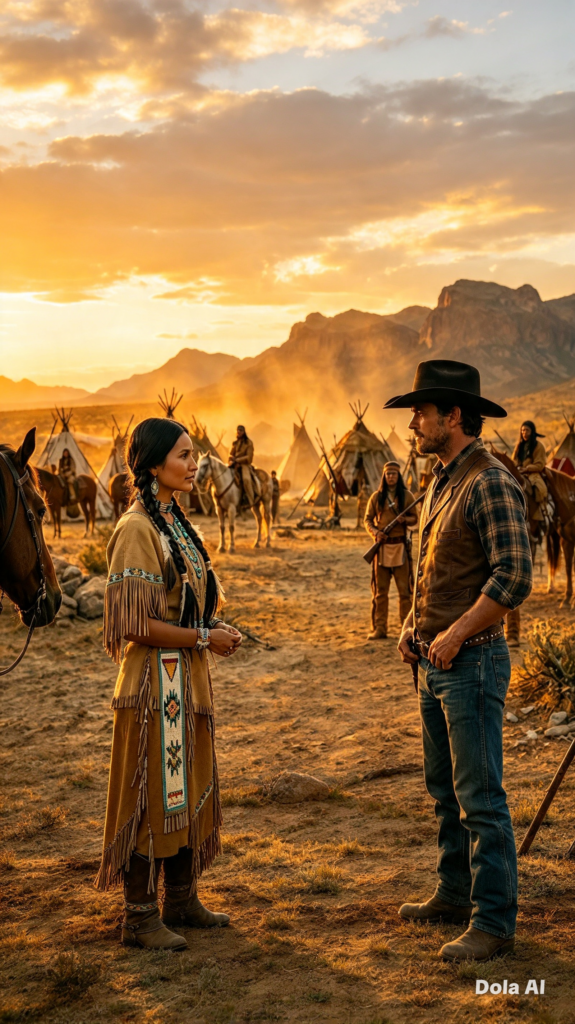
Below him lay an Apache camp, tucked deep in a hidden valley between the mountains. Brush lodges along a clear stream. Smoke rising from a dozen cookfires. Children running between the lodges. Women grinding mesquite beans. Warriors standing watch at the edges with bows in their hands.
And beside the biggest lodge, near the water, stood Ransom.
Relief hit Wes so hard he nearly laughed out loud.
Then he stopped. Something was wrong.
The stallion wasn’t tied. He was standing loose, perfectly calm, beside an old man in dark buckskin decorated with faded beadwork. And the old man had his hand resting on Ransom’s neck.
Ransom, who would bite any stranger who came within arm’s reach, was leaning into that old man’s hand as if he’d known it all his life.
Wes frowned.
He waited in the rocks until full dark, until the fires burned down to embers and the camp went quiet. Then he moved.
He slipped down the slope through the shadows, step by careful step, his hand never far from the revolver on his hip. He circled the lodges downwind. He held his breath as he passed a sleeping dog.
Ransom saw him first. The stallion lifted his head and gave a low, soft nicker.
“Easy, boy,” Wes whispered, reaching for the stallion’s mane. “Easy now. We’re going home.”
“You came a very long way for that horse,” said a calm voice behind him.
Wes spun and drew.
Three Apache warriors stood not ten feet away, bows drawn, arrows aimed at his heart. Between them stood the old man in buckskin. He showed no fear at all. Only a quiet curiosity.
“That horse is mine,” Wes said hoarsely.
The old man nodded slowly. “Yes. He is.”
Wes blinked. He’d expected anything but agreement.
“But before you take him,” the old man said, “there is something you must hear.”
“I didn’t come here for stories, old man.”
The chief stepped closer and laid his hand on Ransom’s neck again. The stallion lowered his head against the old man’s chest.
“Many years ago,” the old man said softly, “this horse belonged to my son.”
Wes didn’t sleep that night.
They’d taken his guns and let him bed down by the chief’s fire, two warriors watching him through the dark. Every rustle of the brush brought his hand to his empty holster.
At dawn, a young Apache woman brought him a gourd of water and a strip of dried venison without a word. She was perhaps twenty, slim and sharp-eyed, with a long braid down her back. She looked at him the way a hawk looks at a rabbit.
The old chief came down to the stream at sunrise.
“Walk with me,” he said.
Wes hesitated, then followed him along the water. The old man moved slowly, but there was a kind of authority in the way he carried himself, and his dark eyes moved over every rock and tree as though each one held a memory.
“I am Eskadi,” the chief said at last.
“You already know my name, I reckon.”
“Wes Hollander.” Eskadi nodded. “The scouts heard the white men shout it at your ranch.”
He looked toward Ransom, grazing loose by the camp.
“That horse remembers this place.”
“I bought him off a trader in Las Cruces seven years ago,” Wes said flatly. “Paid good money too.”
“My son raised him from the day he was born. He named him Swift Shadow. The trader who sold him to you took him from my son’s body.”
Wes stopped walking.
“You expect me to believe that?”
Eskadi turned to face him. “I believe you did not know the truth.”
The old chief reached into a leather pouch at his belt and drew out a thin, braided strip of leather. “When the horse came home two nights ago, my granddaughter found this woven deep into his mane, at the root. Where no one would think to look.”
He handed it to Wes.
At first it looked like nothing. A plain braid. Then Wes noticed that one end had been carefully unstitched. Inside, folded tight as a cigarette paper, was a small square of faded cloth.
He unfolded it slowly.
It was covered in strange symbols, drawn in charcoal and red ochre. Mountain peaks. A river. A canyon shaped like a broken arrowhead. And rough marks that looked like a trail.
“What is this?”
“A map.”
“To what?”
Eskadi looked toward the distant cliffs.
“Eight years ago, soldiers came into these mountains. Not the army. Hired men, in army coats, paid by powerful men in Tucson and Santa Fe who wanted the silver in these hills. Three villages were burned. Families disappeared. Then the newspapers said Apache raiders had massacred settlers, and the government sent real soldiers to drive our people onto the reservation, and the silver men took the land.” The old man’s voice was very quiet. “My son, Dasoda, found proof. Letters. A ledger. Names. Who paid. Who gave the orders. He hid them. Then he was killed. His horse was taken. And we never found what he hid.”
Wes stared down at the cloth in his hands. “You think this leads to it.”
“My son trusted that horse more than any man alive.” Eskadi’s eyes were bright. “For seven years, Swift Shadow has carried my son’s last secret in his mane. And three nights ago, he broke his rope and came home.”
“Came home,” Wes said slowly. “You’re saying nobody stole him.”
“No one in this camp went near your ranch.” Eskadi studied him. “The horse came by himself. He knew the way.”
Wes felt something cold run down his spine. No drag marks. No struggle. Ransom had walked into these mountains of his own free will.
He held the cloth for a long moment. Then he held it out to the old chief.
“Here. This is yours. Your son’s. It’s got nothing to do with me.”
But Eskadi didn’t take it.
“I will make you an offer, Wes Hollander,” the old man said quietly. “Take your horse. He is yours. You paid for him. He chose you, and he has been happy with you. I will not take him back.”
Wes stared at him.
“But in return,” Eskadi went on, “you will finish what my son began. You will follow this map. You will find what he hid. And you will carry it to the white men’s judges. Because if my people carry it, no one will listen. If a white man carries it, they must.”
The words hung in the cool morning air.
“That’s your offer?” Wes said hoarsely. “My own horse back, in exchange for getting myself killed?”
“It is the only offer I have,” said Eskadi.
Before Wes could answer, shouting rang out from the edge of camp.
A young scout came running down the slope, his chest heaving. He gasped out a stream of words in Apache, pointing south.
Eskadi’s face went dark.
“How many?” he asked.
“Ten. Maybe more behind.”
Wes ran to the edge of the ridge and looked south. Far out across the desert floor, a long plume of dust was rising. Riders. Fast ones. Coming straight up his own trail.
His stomach turned over.
“Did you tell anyone where you were going?” Eskadi asked.
Wes started to shake his head. Then he remembered.
The bunkhouse. Pike, the foreman, standing in the shadows by the barn door while Boyd argued with him. Pike, who’d been so very quick to say Apaches. Pike, who’d come to Crooked Creek three years ago from somewhere around Las Cruces.
Somebody had loosened that halter rope. Not to steal Ransom.
To follow him.
Wes turned back to the old chief, his face gray.
“They’re not coming for the horse,” he whispered. “They’ve been waiting seven years for him to lead them here. They’re coming for that map.”
Down on the desert floor, the dust cloud split into two long arms, curling to surround the mouth of the canyon.
And at its head, on a tall white horse, rode a man in a long blue army coat with a marshal’s star pinned on his chest.
PART 2: The Valley of Graves
They reached the canyon before midday.
Wes stood beside Eskadi at the camp’s southern edge while warriors took cover along the rocks above, bows strung. Women hurried the children behind the lodges toward the river. The morning’s quiet sounds had vanished completely.
The riders reined up just out of bow range. Twelve of them, hard-faced men with rifles across their saddles.
Wes knew the leader the moment he saw him.
Cyrus Vane.
Tall, gaunt, with a face like a hatchet blade and pale eyes that never seemed to blink. He wore a deputy U.S. marshal’s star, but everybody in the Territory knew who he really worked for: whatever rich man needed a problem to disappear quietly. Wes had seen Vane once before, in a mining camp in New Mexico. A man there had testified against a silver company. He was found in a dry wash a week later.
Vane’s pale eyes found Wes instantly.
“So the stories are true,” he called out pleasantly. “Wes Hollander. Rode into Apache country all by his lonesome.”
Wes kept his hand near his holster. Eskadi’s granddaughter, Nalin, had returned his guns at dawn without a word. “What do you want, Vane?”
“The horse.” Vane smiled thinly. “And what he’s been carrying in that mane for seven years.”
A murmur ran along the rocks.
“You come into our land with guns,” Eskadi said. “Leave.”
Vane didn’t even glance at the old chief. “That map belongs to important people, Hollander. Very important. Hand it over, and nobody here gets hurt.”
Wes looked at Eskadi. And suddenly, he understood all of it.
These men hadn’t come for justice. They hadn’t come for a stolen horse. They had come to bury the truth for good, and every witness along with it.
Vane slowly drew his rifle from its scabbard.
“One chance, cowboy. Ride out. Leave these people to us. You were never here.”
Silence fell over the canyon.
Wes looked back at the camp. The women by the river. A little boy, no older than five, clutching his mother’s skirt, staring wide-eyed at the men with rifles. Old men with their bows drawn and trembling.
Yesterday, Wes Hollander had thought these people were horse thieves.
Today, armed white men wearing the law’s star were preparing to slaughter them for a scrap of cloth.
“You may still go,” Eskadi said quietly beside him. “No one would blame you.”
Wes looked down at the revolver on his hip. Then he looked up at Cyrus Vane.
“No,” he said. “I believe I’ll stay.”
Vane’s face went cold. “Suit yourself.”
The first shot shattered the morning.
A bullet whined off the rock beside Wes’s head. Then the canyon exploded. Rifles cracked from the riders’ line. Arrows hissed down from the cliffs in black streams. Horses screamed. Dust boiled up so thick Wes could barely see.
He dove behind a boulder beside two young warriors and fired back at the line of riders. One man jerked in his saddle and fell.
Vane’s men charged.
Three of them broke straight toward the center of camp. Wes rose and fired twice. One rider tumbled from his saddle. An arrow took the second in the shoulder and he spun away.
Then Wes saw two more riders peel off the edge of the fight and gallop hard toward the river. Toward the women and children.
He ran.
He reached the riverbank just as the lead rider raised his rifle at a small boy frozen beside the water, the same little boy he’d seen clutching his mother’s skirt.
Wes fired. The rider pitched backward off his horse into the shallows.
The second rider wheeled around and leveled his rifle at Wes’s chest from twenty feet away.
He never pulled the trigger. Nalin came off a boulder like a mountain lion, knocked him clean out of the saddle, and had her knife at his throat before he hit the ground.
She looked up at Wes, breathing hard, a cut bleeding on her cheek.
“You fight well,” she said, “for a horse thief.”
“I’m not the thief,” Wes panted. “Remember?”
For the first time, she almost smiled.
The fight lasted nearly an hour.
At last, with four of his men down and the rest pinned in the rocks, Cyrus Vane pulled back to the canyon mouth. He sat his white horse in the dust and stared across the battlefield at Wes.
“This isn’t finished, Hollander,” he called. “The men I work for will burn every lodge in these mountains before they let that paper see daylight.”
Then he and the survivors turned and rode out of sight down the canyon.
Slowly, silence came back.
That evening, the camp was quiet in a way Wes had never heard a place be quiet.
Smoke drifted over the lodges. Wounded warriors lay beside the fires while women moved among them with water and cloth. Down by the river, the old men sang softly over the body of a young warrior named Itza, who had died holding the camp’s southern edge.
Wes sat alone beside Ransom with dried blood on his sleeve.
For the first time in his life, he didn’t know where he belonged.
Everything he’d ever been told about Apaches, in every saloon and bunkhouse in the Territory, said they were savages. Killers. Thieves.
Yet the only men he’d seen attacking women and children today had worn a United States marshal’s star.
Eskadi came and lowered himself slowly onto a stone beside him. The old man’s shoulder was bound in a bloody cloth where a bullet had grazed him.
“You fought for people you hardly know,” the chief said.
Wes stared into the fire. “Maybe I should’ve known them sooner.”
Eskadi was quiet a long time. Then he unfolded the map on his knee.
“The map is not complete,” he said. “These marks lead to the northern canyons. But my son hid the last place carefully. He knew dangerous men would search for it.”
“Then how do we find it?”
Eskadi laid one finger on a small mark burned into the corner of the cloth. A circle, with a single line crossing it. “My son left a sign only our family would know.”
A scout came running out of the dark. “The white men have made camp,” he said breathlessly. “On the western ridge. They’re waiting for more riders. Twenty, maybe more, coming from Tucson.”
Eskadi nodded slowly. “Then Vane will come back at dawn. With twice the guns.”
Wes already knew he was right. Men like Cyrus Vane never quit after losing once. Not when they had rich men behind them, and witnesses to bury.
The old chief rose painfully to his feet.
“We ride tonight,” he said.
Under a cold white moon, Wes, Eskadi, Nalin, and three warriors rode north into the mountains.
The air grew colder with every mile. Sheer black cliffs rose around them like walls. Ransom moved surefooted through the dark, never once stumbling, as though he’d walked these trails a thousand times.
Maybe he had, Wes thought.
Near midnight, Eskadi raised his hand.
“There,” he whispered.
Behind a jumble of fallen boulders, nearly invisible from the trail, a narrow crack ran into the mountain. A canyon shaped like a broken arrowhead.
They led the horses through, single file. The passage twisted, narrowed, twisted again. And then, without warning, the walls fell away, and they stepped out into a small, hidden valley ringed by stone cliffs.
Wes stopped dead.
The valley was full of graves.
Rows and rows of them, stretching away into the moonlight. Wooden markers, weathered gray. Piles of stone. Dozens of them.
Some were very small.
Wes felt his stomach clench painfully.
Eskadi walked slowly among them. “Families,” he said quietly. “Whole villages. The men in army coats killed them here. Then they told the newspapers my people had massacred white settlers, and the government sent real soldiers to finish what they started.”
He stopped beside a weathered marker at the edge of the valley and knelt.
Wes looked down. Carved into the gray wood, half worn away by eight years of weather, was a small circle with a single line crossing it.
The same mark burned into the corner of the map.
“My son,” Eskadi whispered. “He buried his own people here. And then he hid the truth with them.”
Wes took off his hat. Something cold and hard settled deep in his chest. This was the secret in Ransom’s mane. Not silver. Not gold.
Murder.
Nalin knelt beside her grandfather and began to dig with her hands at the base of the marker.
And a rifle cracked from the cliffs above.
Stone exploded inches from Wes’s head.
He threw himself flat. Bullets rained down into the valley of graves. All around the rim of the cliffs, men were rising out of the darkness. Twenty of them. Thirty. Rifles leveled.
And at the very edge of the cliff, silhouetted against the moon, stood Cyrus Vane.
“Did you really think,” Vane called down, “that I wouldn’t track a black horse by moonlight?”
Old Eskadi rose slowly to his feet among the graves of his people. He didn’t run. He didn’t take cover. He simply stood there, unarmed, facing the cliff.
“Eskadi, get down!” Wes shouted.
Vane raised his rifle and fired.
The old chief spun and fell across his son’s grave.
PART 3: Into the Light
“Grandfather!”
Nalin threw herself over Eskadi as bullets churned the earth around them. Wes scrambled across the graves on his belly, grabbed the old man under the arms, and dragged him behind a rock pile at the foot of the cliff.
Eskadi’s face was gray. Blood soaked through his buckskin, high on the left side of his chest.
“Hold on,” Wes said hoarsely, pressing his bandana hard against the wound. “You hear me, old man? You hold on.”
Eskadi’s eyes found his. Even now, they were calm.
“The truth,” the chief whispered. “Find the truth.”
Above them, Vane’s voice rang out across the valley. “Give me the map, Hollander, and I’ll let the girl live. That’s a better offer than the old man got.”
Wes looked at Nalin, crouched beside her grandfather with tears cutting through the dust on her face.
Then he looked at the weathered grave marker with the circle and the line.
And he made a decision.
“Nalin,” he said quietly. “Can you get your people up those cliffs? The back way?”
She looked at him with fierce, wet eyes. “There’s a goat trail. On the east side. Vane’s men don’t know it.”
“Then go. Take them up. Get above Vane.” He pulled the map from his shirt and pressed it into her hand. “And if I don’t make it back, you carry this to a judge in Santa Fe yourself. You make them listen.”
“What are you going to do?”
Wes looked up at the cliff.
“I’m going to give him what he wants.”
He stood up from behind the rocks, slowly, with his hands raised high.
“All right, Vane!” he shouted. “You win. I’ll bring it to you.”
Rifles tracked him as he walked out into the open, across the moonlit graves, toward the narrow path that zigzagged up the cliff face. He climbed slowly. Every step, he expected a bullet in his back.
None came.
At the top, Vane was waiting with six men. The marshal’s pale eyes gleamed.
“Smart man. Hand it over.”
“It’s down there.” Wes nodded down at the valley. “Buried. In the old man’s son’s grave. I can show you exactly where.”
Vane’s eyes narrowed. He looked down over the edge into the valley of graves.
That was the moment Nalin and her warriors came up over the eastern rim behind Vane’s men.
Arrows hissed out of the dark. Two of Vane’s riflemen went down. The others spun, shouting, firing blindly into the shadows.
Wes lunged.
He hit Vane low and hard, driving him back from the cliff’s edge, and they went down together into the rocks. Vane’s rifle went flying. The marshal clawed for the pistol on his hip.
Wes slammed his wrist against a boulder, once, twice, and the pistol clattered away over the stone.
Then Vane’s knee drove into his ribs, and the world went white with pain. Vane rolled on top of him, his long hands closing around Wes’s throat.
“Eight years,” Vane hissed, squeezing. “Eight years I’ve been waiting for that horse to go home.”
Wes’s vision began to darken at the edges. Somewhere far away, he heard gunfire. Shouting.
And then he heard a sound he knew better than his own heartbeat.
A stallion’s scream.
Ransom came up the cliff path like a black thunderbolt. He’d broken his tether down in the valley. He reared over the two men, iron-shod hooves flashing in the moonlight.
Vane threw himself sideways to escape them, and his hands left Wes’s throat.
Wes rolled, grabbed the fallen pistol, and leveled it at Vane’s chest.
“Don’t move.”
Vane froze on his knees in the dust.
Behind him, the gunfire was dying away. Vane’s men were throwing down their rifles, surrounded by Nalin’s warriors on the clifftop.
Wes rose slowly to his feet, gasping, his throat raw, the pistol never wavering.
“It’s over, Vane,” he rasped. “You’re going to stand in front of a judge.”
Cyrus Vane looked up at him. And then, for the first time, he laughed.
“A judge?” he said. “Hollander, the men I work for own the judges.”
“Not all of them,” said Wes. “Not after tonight.”
They found Eskadi alive.
He lay among the graves with Nalin’s shawl pressed against his wound, his breathing shallow but steady. The bullet had gone clean through, high on his chest, missing his heart by the width of two fingers.
“Stubborn old man,” Nalin whispered, kneeling beside him, tears running down her face.
“You get it from me,” Eskadi murmured.
At dawn, they dug at the foot of Dasoda’s grave.
Two feet down, wrapped in oiled deerskin and sealed with pine pitch, they found a small tin box.
Inside lay everything.
A leather ledger, eight years old, recording every payment made to the men in army coats. Letters on the stationery of the Santa Rita Silver Company, signed by the company’s president and countersigned by a territorial judge named Thaddeus Crowe. A list of names: twenty-two hired gunmen, with their pay.
And at the very top of that list, the name of the man who had commanded them.
C. Vane.
Wes looked at the name for a long time.
Then he turned to Cyrus Vane, sitting bound among the graves, and held up the page.
Vane’s face went the color of ashes.
It took Wes Hollander eleven days to ride to Santa Fe.
He took the tin box, Cyrus Vane in irons, and four of Vane’s men who, once they saw the ledger, began falling over each other to testify in exchange for their lives. Nalin rode beside him the whole way.
In Santa Fe, he walked into the office of the United States Attorney for the Territory of New Mexico and laid the tin box on the desk.
It was the beginning of the biggest scandal the Southwest had ever seen.
Within six months, the Santa Rita Silver Company was in receivership. Judge Thaddeus Crowe resigned in disgrace and was later indicted. Cyrus Vane stood trial in federal court for the murders in the valley of graves. And when the jury heard Nalin testify, through an interpreter, about what had been done to her people, the courtroom was silent as a church.
The newspapers that had once called it an Apache massacre printed the truth on their front pages.
It didn’t bring back the dead. Nothing could.
But for the first time in eight years, the people buried in that hidden valley had their names.
When Wes finally rode back into the Chiricahua Mountains in the spring, Ransom carried him up the long trail into Eskadi’s camp without needing to be guided once.
The old chief was waiting by the stream, thinner than before, a bandage still across his chest. But standing.
He watched Wes dismount. Then he looked at Ransom for a long time.
“You kept your part of the bargain,” Eskadi said.
“So did you,” said Wes. “He’s still mine.”
Eskadi smiled slowly. “He was never mine to give, Wes Hollander. He was always my son’s. And my son chose to send him to you.”
Wes frowned. “Your son was dead seven years before I ever saw this horse.”
“Was he?” The old man’s eyes glinted. “A trader took that horse from my son’s body. A trader who sold him to the one cowboy in the whole Territory who would follow him into these mountains, and stand with my people when the guns came, and carry the truth to the white men’s judges.” He shrugged. “You call it luck. We call it something else.”
Wes didn’t know what to say to that.
So he said nothing. He just stood there in the warm spring sun beside the old chief, watching Ransom wander down to the stream and drink, as though he’d come home.
Wes Hollander never did go back to work for the Crooked Creek outfit.
Pike, the foreman, disappeared the week the ledger was published. Rumor said he’d been on Vane’s payroll for three years, watching and waiting for a black stallion to go home.
Instead, Wes bought a small piece of land in the foothills of the Chiricahuas, half a day’s ride from Eskadi’s camp. He raised horses there, and traded with Eskadi’s people, and learned their language one stumbling word at a time.
Nalin taught him most of it.
She came down to his place often that first summer, first to trade, then to help him gentle the young stock, and then, eventually, for no particular reason at all that either of them was willing to say out loud.
Every autumn, on the anniversary of that night, Wes and Nalin and old Eskadi rode up together into the northern canyons, to the hidden valley behind the boulders. They cleared the brush away from the graves. They set new stones on the cairns.
And at the foot of a weathered marker carved with a small circle and a single crossing line, Wes Hollander always took off his hat, and stood for a long while in silence.
He had ridden into those mountains to take something back.
Instead, he had been chosen to carry something out.
And somewhere in the stillness of that valley, he liked to think a young man named Dasoda knew that his horse had finally finished the job.