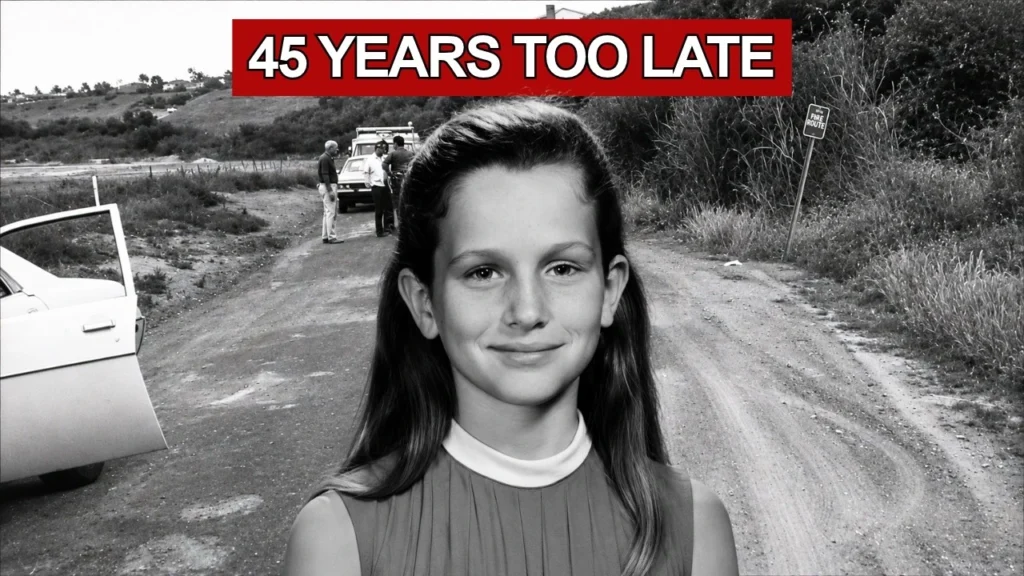
Linda's classmates were children when she was take…
Linda’s classmates were children when she was taken and they never stopped thinking about her.
Is there someone from your own childhood you’ve never forgotten? If you’d like to share that memory in the comments, I’d be honored to read it.
And if you’re still with me, please stay because what the people who remembered Linda did next changed this case.
In April 2018, the arrest of a suspect in the Golden State Killer investigation drew attention to a new way of using DNA to solve old crimes.
Genetic genealogy could connect an unidentified DNA profile to relatives whose family histories might eventually lead to a suspect.
For Linda’s old classmates, it raised a question.
If investigators could identify someone connected to crimes from decades earlier, why couldn’t they do the same for Linda? David Wetemeyer and other former classmates organized a Facebook group called Justice for Linda Ann O’Keefe.
Some visited the Newport Beach Police Department hoping to persuade detectives to keep looking.
They learned that the investigation had never been formally forgotten.
Sergeant Kurt Depweg had already been exploring new forensic techniques.
His department had commissioned work from Parabon Nano Labs to produce an approximate image of the unidentified man using genetic information.
A reconstruction could suggest physical characteristics, but it wasn’t a photograph and nobody yet knew his name.
Depweg also wanted the public to know the girl whose case the department was trying to solve.
Former department spokesperson Jennifer Manzella helped create a social media campaign that would retell Linda’s final day in a series of posts.
It began on July 6th, 2018, the 45th anniversary of her disappearance.
The posts, written in an imagined first-person voice and grounded in investigative records and family memories, returned to Linda’s home on Orchid Avenue, her sisters, her piano, the dress her mother made, and the phone call from school.
As the day unfolded online, readers followed the route toward the sighting beside the van.
Linda’s old classmates knew the ending before the people discovering the story for the first time.
The campaign reached an enormous audience.
It did not produce the eyewitness tip that directly solved the murder, but it renewed public attention and helped bring the case to the attention of genetic genealogist C.
C.
Moore.
When investigators asked for her help, there was finally a way to pursue the genetic clues beyond the limits of the criminal database.
C.
C.
Moore and the investigators began with the unidentified DNA profile that had been preserved from Linda’s case.
They searched a genealogy database called GEDmatch for genetic relatives of the unknown man.
Matches offered clues to shared family lines, and Moore used public records to trace those families.
Some branches led nowhere.
The search moved forward, but not nearly fast enough to produce an immediate answer.
Then the investigation took an unexpected turn.
In late 2018, another genealogy service, FamilyTreeDNA, opened access for certain violent crime investigations.
The Newport Beach detectives submitted the unidentified profile there as well.
In January 2019, Sergeant Detwiler received a call from the company.
He expected news about a close relative, someone who could give genealogists another branch of a family tree to follow.
Instead, he was told the company might have found the man himself.
The match pointed to James Alan Neal.
The earlier searches through relatives had revealed possible family connections, but this new result was different.
In a later interview, Detwiler said Neal had voluntarily submitted his own genetic information to FamilyTreeDNA while researching his family history.
Investigators had been hoping for a relative.
Instead, they had a match pointing to Neal himself.
After more than 45 years, the unknown DNA finally had a name attached to it.
Detectives still had to confirm the lead independently and establish that the man could have been in the area where Linda disappeared.
The search now moved to Colorado.
In 2019, James Alan Neal was 72 years old and living in Monument, Colorado, near Colorado Springs.
He was a father and grandfather.
He had once been known as James Albert Layton Jr.
And investigators learned that he had lived in Southern California around the time of Linda’s murder.
His background raised additional concerns.
Records showed earlier arrests, including a 1966 incident involving an underage girl.
Investigators also discovered allegations of abuse involving other children.
Those allegations would require their own evidence and legal proceedings.
They were not convictions for Linda’s murder, but they prompted detectives to examine Neal’s history more closely.
There was another reason to be cautious.
A promising genealogy result could not replace a direct forensic comparison.
The detectives needed DNA collected from Neal that they could independently test against the material saved in 1973.
A team led by Detective Mike Fletcher traveled to Colorado to conduct surveillance.
They watched Neal’s movements and looked for something he might discard.
He smoked cigarettes, but instead of dropping the butts on the ground, he usually extinguished them and kept them in his pocket.
The investigators repeatedly watched potential evidence disappear with him.
Then Neal visited a grocery store.
This time, he dropped a cigarette in the parking lot.
Detectives recovered it and sent it to the Orange County Crime Laboratory.
The DNA matched the evidence preserved from Linda’s body.
The science had narrowed the search from an unknown figure beside a van to a specific man living in Colorado.
But when investigators questioned Neal, they still wanted to know whether he would say anything about Linda and the afternoon she disappeared.
During a recorded interrogation, detectives confronted him with parts of his past and questioned him about alleged misconduct involving girls.
According to the later account broadcast by 48 Hours, Neal acknowledged certain earlier acts while offering excuses, but when shown Linda’s photograph, he denied knowing her.
He maintained that he had never picked her up and had nothing to do with her death.
Then detectives told him his DNA matched the evidence from Linda’s body.
Neal said he could not explain it.
He did not confess.
Even when left alone with her photograph, he continued to deny responsibility, addressing the picture with an expression of sympathy while insisting he hadn’t done it.
The denials did not erase the forensic evidence, but they also left investigators without an account of where Linda had been taken or what happened during the missing hours.
Neal was informed that he was being arrested for her murder.
On the morning of February 19th, 2019, detectives took James Allen Neal into custody in the Colorado Springs area.
More than 45 years after Linda’s disappearance, the case had finally produced an arrest.
Before the announcement reached the public, there was someone the detectives needed to call.
On February 19th, Sergeant Court Depweg telephoned Cindy Borgeson.
She had spent almost her entire adult life knowing that her younger sister’s killer had never been identified.
Detectives had kept the surviving family informed over the years, but Cindy had never been confident she would live to hear that someone had been arrested.
Depweg asked whether she was sitting down.
Then he told her police had arrested a man that morning in connection with Linda’s murder.
Cindy later said the moment felt strangely like the day her sister’s body was found.
Everything seemed to slow down.
This time the first feeling was excitement after 45 years, investigators finally had a man in custody, but almost immediately she thought of the people who could not share the news.
Barbara and Richard were gone.
Barbara had carried regret over the last school office phone call, and Richard had lived with anger that someone had taken their little girl.
Neither parent would ever hear the name investigators had finally found.
There was an almost painful symmetry to the two calls in Cindy’s memory.
In 1973, she had been near her mother when Linda called from school asking for a ride.
In 2019, Cindy was the one receiving a telephone call that would change how she understood her sister’s story.
The first call had seemed ordinary until it was too late.
The second was one she had hardly dared expect.
The following day, authorities publicly announced Neil’s arrest.
Linda’s former classmates learned that the case they had carried from childhood now had a suspect.
Some welcomed the development with relief.
Others were angry that a man accused of Linda’s murder had been able to grow old while she had not.
Neil was returned to California.
He pleaded not guilty.
Prosecutors also brought charges connected to the alleged sexual assaults of two other girls in Riverside County years after Linda’s death.
They intended to present the evidence against him in court where the allegations could be tested and a jury could decide whether he was guilty.
For a time, that trial seemed like the final chapter the family and investigators had waited so long to reach.
The prosecution was preparing a case built around the DNA evidence and Neil’s documented connection to Southern California.
Other charges and allegations were part of the legal proceedings.
Prosecutors believed the evidence would stand up at trial, but no jury had yet heard it and Neil continued to deny responsibility for Linda’s murder.
On May 25th, 2020, Neil was transferred from custody to a hospital because of an illness.
He remained there.
On July 22nd, he died at the age of 73 before his trial could take place.
There was no verdict, no conviction, no sentence for Linda’s murder.
Investigators had identified and arrested a suspect, but a court would never decide his guilt.
For some of Linda’s classmates, that was a painful and unfinished ending.
They had hoped to see the evidence heard publicly and the accused man answer for it before a jury.
Cindy’s response was different.
She had spoken about forgiveness even before the legal case ended, explaining that her Christian faith helped her avoid carrying hatred through the rest of her life.
She said she had prayed for Neal and for his family, recognizing that his relatives were facing a shocking ordeal of their own.
Forgiveness, for Cindy, did not mean that the crime was excusable or that the evidence no longer mattered.
She also acknowledged that a trial would have been difficult.
The family still didn’t know exactly what Linda endured during the hours between her disappearance and her death.
A courtroom would have forced those questions into the open with evidence and descriptions that might have been deeply painful to hear.
Cindy suggested that she found some comfort in being spared that experience, even though others longed for a verdict.
The arrest had answered a question that followed the family for decades, yet it couldn’t answer every question, and it couldn’t undo the way a single summer afternoon had changed their lives.
What Cindy had left were the memories of a little sister she had known for only 11 years.
When people discuss the Linda Ann O’Keefe investigation, they often begin with the extraordinary evidence, the swabs kept in a vial, the social media campaign, and the genetic work that led detectives to Colorado.
Cindy’s memories take her somewhere quieter.
To the family’s portrait, taken when Richard and Barbara were still raising three daughters together.
Everyone is facing the camera.
The girls are smiling.
In that picture, there is no unanswered phone call, no van, no investigation, just a family gathered for a photograph.
Cindy has been candid about her relationship with Linda.
At 18, she wanted to be with friends her own age.
Having to keep an eye on her younger sisters sometimes felt like a chore.
Linda, 7 years younger, liked Nancy Drew, the piano, and older jazz and blues music.
Cindy liked different records and had different plans for her days.
They weren’t close friends then.
Cindy assumed that would come later once the gap in their ages mattered less.
She expected they would have time as adults to talk about their childhood, compare memories, and get to know one another in a new way.
Now she is the one who remembers Linda crouching beside a creek in the redwoods waiting patiently for little creatures to approach.
She remembers the books, the music, the dresses Barbara made, and the way Linda enjoyed being at her father’s side.
Those memories belong to a childhood the sisters shared.
The conversations they might have had about it as grown women never happened.
Linda was 11 years old.
Cindy was 18.
They were still a long way from the age when sisters sometimes become friends, and they never got there.
Before you go, I’d like to know what stayed with you.
Was it the classmates who remembered Linda after so many years, the evidence Jim White saved, or Cindy’s belief that she and her little sister would have time to become closer? Share your thoughts in the comments.
And if you’d like others to know Linda’s story, please like the video, share it, and subscribe to Crime of Opportunity.
On that Friday afternoon in 1973, Linda Ann O’Keefe was 11 years old, and she only wanted a ride home.