California 1973 Cold Case Solved — She Went to Sum…
California 1973 Cold Case Solved — She Went to Summer School and Never Came Home

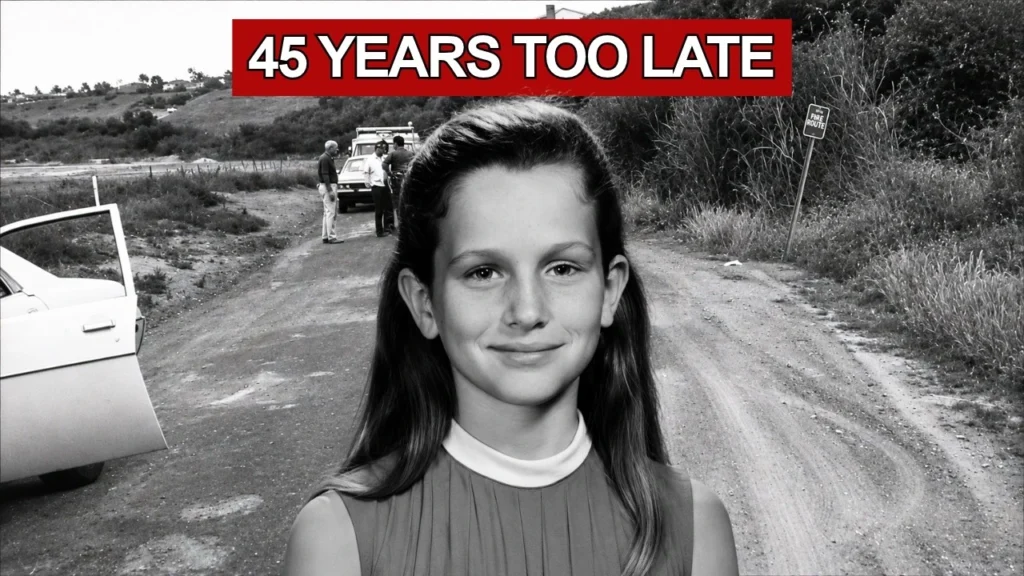
On the afternoon of July 6th, 1973, an 11-year-old girl stood in the office of her summer school in Newport Beach, California, and called home.
Linda Ann O’Keefe wanted a ride.
She had gone to school that morning without her bicycle.
Her mother answered, and Linda asked whether someone could come and get her.
Her mother was in the middle of a work day.
She told Linda to walk home.
A classmate who saw Linda in the office remembered that she was crying.
The two girls left in different directions, and Linda started down the quiet streets of Corona del Mar, a neighborhood where children had always come and gone on their own.
Less than an hour later, two people driving along Marguerite Avenue noticed Linda standing beside a turquoise van.
She was talking to a man they didn’t recognize, and the door of the van was open.
That sighting lasted only a moment.
Investigators would spend the next 45 years trying to learn who the man was and what happened after the witnesses drove away.
Linda was supposed to be walking home along streets her family knew well.
Before we follow that journey, please give this video a like if you’d like more people to hear what happened here.
It helps this story find viewers who may never have heard Linda’s name.
In the early 1970s, Corona del Mar was a quiet coastal community within Newport Beach, a place of ocean breezes, neighborhood schools, and families who had settled there for the easy pace of life near the Pacific.
Children rode their bicycles to friends’ houses and walked to school, and parents didn’t worry much about it.
Everyone knew the streets, and most people knew the families who lived on them.
Linda lived on Orchid Avenue with her parents and her two sisters.
She was the middle child.
Her father, Richard, was a machinist who liked working on projects with his hands, and Linda liked being at his side while he did.
Her mother, Barbara, was an artist and a gifted seamstress who made much of the family’s clothing.
Her older sister, Cindy, remembers Linda as a gentle, quiet girl, a little shy and often happiest alone with a book.
Cindy has called her an old soul, observant and soft-spoken.
The two of them read Nancy Drew mysteries.
Linda played the piano and she listened to music that seemed far too old for a girl her age, including Billie Holiday and old blues records.
She was a girl scout, she liked crafts and she loved animals.
Cindy’s happiest memories of Linda come from the family’s camping trips to the redwoods.
While other children squealed over the creatures along the creek, Linda would crouch at the edge of the water and wait and newts and small snakes seemed to come right up to her.
Cindy has called her a kind of frog whisperer.
Animals trusted her and Cindy was always a little astonished by it.
The O’Keefes weren’t wealthy, but their home was full of things made by hand.
Barbara’s sewing and artwork, Richard’s projects and Linda’s own books, crafts and piano practice.
Barbara sewed for all three girls and one of her creations for Linda was a white summer dress decorated with blue flowers and darker blue trim.
On Friday, July 6th, Linda chose to wear it to school.
Linda was attending summer classes at Lincoln Intermediate School in Corona del Mar.
She usually rode her bicycle, but on that Friday her piano teacher had given her a ride.
She carried a homemade school bag with school and art supplies inside and wore the white dress with blue flowers that Barbara had sewn.
At home, it looked like any other working day.
Nobody had reason to expect Linda would not return that afternoon.
When class ended, Linda went to the school office and called home.
Cindy was sitting near her mother and overheard Barbara’s side of the conversation.
Linda was asking to be picked up.
Barbara was occupied with her work and told her to walk.
It was a routine decision in a neighborhood where children regularly made their way home on their own.
Another girl, Lysa Christopher, saw Linda in the office.
She remembered her classmate crying and looking upset.
After they left the building, Lisa and Linda went in different directions.
Lisa could not have known that this was the last time she would see her alive.
A little after 1:00, 19-year-old Janine Peerl, known as Jandy, was driving with her mother near Marguerite Avenue and Inlet Drive.
The Peerls lived only a few houses away from the O’Keefes, and Jandy recognized Linda standing at the roadside.
Beside her was a turquoise-colored van, its door open.
Linda appeared to be talking to a man.
Jandy didn’t immediately think the girl was in danger.
What struck her was how unusual it was to see Linda alone with an unfamiliar adult.
The O’Keefe children were often seen with their parents or siblings.
Jandy later tried to help police describe the vehicle and the man, but there was no reliable license plate number that could lead detectives to him.
It became the last confirmed sighting of Linda alive.
No witness could tell investigators how the conversation ended, whether she entered the van, or where she went next.
Those missing moments would remain central to the investigation for decades.
When Linda didn’t arrive home, her family initially thought she might have stopped somewhere along the way.
It was summertime, and the streets were familiar.
But as the afternoon wore on, Barbara began calling around.
By early evening, the police had been notified that Linda was missing.
Officers searched on foot and in patrol cars.
The efforts spread through the neighborhood, the area around Fashion Island, and the Back Bay.
Neighbors joined in.
A helicopter and vehicles capable of reaching rougher terrain were used.
When Jandy returned home and saw the activity, she learned Linda was the missing child.
She went to the police with the account of the turquoise van.
For the first time, investigators had a reason to fear that Linda might have encountered someone who had taken her away.
At around 11:30 that night, a woman near the Back Bay Bluffs reportedly heard a female voice crying out as though someone were being hurt.
She did not call police then.
Detectives learned of it later.
It was a deeply troubling detail, although they could not establish precisely what was happening or whether a call would have changed the outcome.
The following morning, Saturday, July 7th, a local architect named Ron Yeo went cycling with his young son along a Back Bay nature trail.
The area was peaceful, surrounded by water, reeds, and places where children might watch frogs near the edge of the marsh.
At around 10:00, Ron noticed a patch of vegetation that looked promising for a small nature stop.
He looked into the reeds and saw a child’s body.
It was Linda.
She still wore the white dress with blue flowers that her mother had made.
Her homemade bag was nearby.
Investigators determined that she had been sexually assaulted and strangled.
The medical examination placed her death during the early hours of Saturday morning, many hours after the sighting at the van.
There was still no reliable account of where she had been during that time.
Richard O’Keefe was asked to identify his daughter.
The man who loved working on projects with Linda, who had enjoyed having her close by while he worked, now faced a task no parent should have to face.
When Cindy arrived home later that day, she found police around the house.
She remembered seeing her father on the porch weeping uncontrollably.
Inside, Barbara was crying, too.
Until that moment, Cindy had not truly imagined that her sister might be dead.
Seeing her parents made the news real before she could even begin to understand it.
One day earlier, Linda’s biggest immediate problem had been finding a way home after class.
Now detectives were reconstructing the hours of her disappearance, and her family was facing a loss that could not be undone.
In the days after Linda was found, the neighborhood changed.
Children who had ridden bicycles freely were now kept close.
Parents who had once thought little of an unfamiliar car began looking at every vehicle with suspicion.
Then a young man named Peter Wooten came forward and claimed responsibility.
He had recently graduated from high school and was known to some in the community, including Cindy.
Police brought him in and questioned him about details of the crime.
His account did not withstand scrutiny.
Nothing connected him to Linda, the van, or the physical evidence.
Investigators concluded the confession was an attempt to gain attention, and he was released after 2 days.
The timing added another cruelty.
Wooten was released on the same day Linda was buried.
Her funeral was crowded with relatives, school friends, and members of her Girl Scout troop.
Cindy remembered that it was there, surrounded by people who had come to say goodbye, that the reality of her sister’s death became impossible to deny.
An apparent answer had arrived and vanished while the family was trying to bury an 11-year-old girl.
Investigators turned back to the eyewitnesses.
They produced a composite sketch of a tanned white man with curly hair and circulated it.
They examined tire impressions and looked for a van matching the description.
But no license plate had been recorded, no vehicle was definitively connected to the crime, and the leads failed to produce a suspect.
For years, that turquoise van remained one of the clearest details anyone could give police.
It was also a reminder of everything they still did not know.
The case had one piece of evidence that would become crucial many years later.
During the original examination, a forensic criminalist named Jim White collected biological material from Linda’s body.
He preserved two swabs in a small capped vial.
The samples were stored while the investigation continued.
In 1973, investigators couldn’t create the sort of DNA profile that modern detectives use to identify a person.
White saved the material because he understood its potential value, not because he knew exactly what future science would make possible.
The vial remained in evidence storage as the years went by.
In the late 1990s, technicians were finally able to develop a genetic profile from it.
The profile was entered into the national criminal DNA system, CODIS, in 2001, but there was no match.
The DNA pointed to an unknown man, and investigators still had no name to attach to it.
For the O’Keefe family, those years were not measured by changes in laboratory technology.
They were measured by all the ordinary parts of family life that now happened without Linda.
Cindy has described how the O’Keefe family slowly withdrew after Linda’s murder.
The trips to the Redwoods, the beach outings, the family visits to museums, things they had once done together largely stopped.
Barbara became increasingly isolated.
Richard went to work and came home.
The house on Orchid Avenue was still their house, but the rhythm of living there had changed.
Barbara returned again and again to the last telephone call.
She had been working and had asked her daughter to walk.
Cindy, who overheard that conversation, carried her own regret about not volunteering to pick Linda up.
These were decisions made without any knowledge of danger.
Neither mother nor sister had caused the crime.
Yet Cindy remembered how persistently the family’s grief attached itself to those ordinary moments.
Richard’s response was different.
Cindy recalled how angry he remained that someone had taken his daughter.
The man who used to welcome Linda beside him while he worked now had no answers about what had happened to her.
Both Richard and Barbara died without learning who investigators would eventually identify as the suspect.
Linda’s classmates carried their own memories into adulthood.
They graduated, took jobs, raised families.
They still remembered the girl who loved books and animals, who had been there one summer and then simply wasn’t.
Inside the Newport Beach Police Department, Linda’s photograph remained among the unsolved cases, a reminder for investigators who had never met her.
Decades later, some of those former classmates would discover they weren’t the only ones who had refused to let the story disappear.
I want to pause here and ask you something.


